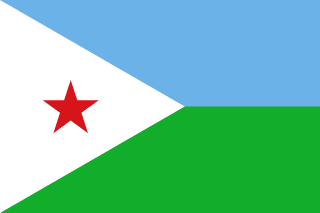
Djibouti
Republic of Djibouti
Population: UN WPP 2024, revision 1, projection for 1 July 2026. Sources and methodology.
Geography and territory
Djibouti is one of Africa’s smallest nations, covering just 23,200 km² and home to a population of about 1.2 million, at the strategic tip of the Horn of Africa, beside the Bab el-Mandeb strait that links the Red Sea to the Gulf of Aden and the wider Indian Ocean. The country borders Eritrea to the north, Ethiopia to the west and south, and Somalia to the southeast, with its eastern coast opening onto the Gulf of Aden. This position astride one of the world’s busiest shipping lanes has shaped the country’s history and economy more than perhaps any other single factor.
The Djiboutian landscape is predominantly desert and volcanic, a result of its location at the triple junction where the African, Arabian, and Somali tectonic plates meet, one of the most geologically active zones on the planet. Lake Assal, lying 155 meters below sea level, is the lowest point on the African continent and one of the lowest anywhere on Earth, with water up to ten times saltier than the ocean. By contrast, Moussa Ali, on the border with Eritrea and Ethiopia, rises to 2,028 meters. Coastal plains give way inland to desert plateaus scattered with volcanic formations, tectonic rifts, and salt lakes.
Djibouti’s climate ranks among the most extreme on Earth, with summer temperatures regularly topping 45 degrees Celsius and occasionally reaching 50 degrees in the interior plains. Rainfall is exceptionally scarce, making Djibouti one of the driest countries in the world. Despite these harsh conditions, its marine environment is remarkably rich: the waters of the Gulf of Tadjoura shelter coral reefs, whale sharks, manta rays, and dolphins, while the Day Forest, a relict patch of tropical woodland in the northern mountains, preserves the last vestige of the country’s primeval vegetation.
History
The territory of modern Djibouti has been inhabited since prehistory by nomadic pastoral peoples. The Afar and the Issa, the country’s two principal ethnic groups, have occupied the region for centuries — the Afar in the north and west, and the Issa, of Somali origin, in the south and east. Both maintained trade ties with Arabia and inland Africa, and the Djiboutian coast served for generations as a departure point for African pilgrims crossing the Red Sea toward Mecca.
European interest in the region intensified in the mid-nineteenth century as France sought a strategic base on the route to its colonies in Indochina. France acquired the coastal territory around Obock in 1862 and founded the city of Djibouti in 1888, which became the capital of a colony known first as French Somaliland and later as the French Territory of the Afars and the Issas. The railway linking Djibouti to Addis Ababa, completed in 1917, permanently tied the territory’s economic fortunes to Ethiopia’s.
Djibouti gained independence on June 27, 1977, among the last French colonies in Africa to do so, with Hassan Gouled Aptidon as its first president. Tensions between the Afar and Issa communities erupted into civil war between 1991 and 1994, resolved through a peace agreement that established power-sharing between the two groups. Since 1999, President Ismail Omar Guelleh has governed the country, maintaining political stability and cementing Djibouti’s role as a global logistics and military hub, hosting foreign military bases from France, the United States, China, Japan, and Italy.
Culture and society
Djiboutian society is shaped by its two principal communities: the Afar, a Cushitic people related to the Afar of Ethiopia and Eritrea, and the Issa, of Somali descent. Both share a centuries-old nomadic pastoral tradition and practice Sunni Islam, the country’s state religion. French and Arabic serve as official languages, used in government and education, while Afar and Somali remain the mother tongues spoken by most of the population in family and community life.
Djiboutian culture is deeply rooted in the nomadic traditions of the desert. Oral poetry is a revered art form in both communities, used to record history, resolve disputes, and mark important occasions. Music and dance accompany every major celebration; Djiboutian weddings unfold over several days with traditional dances, songs, and communal feasting. The oud, a stringed instrument of Arab origin, and hand drums accompany melodies that blend African and Arab influences into a distinctive musical identity.
Despite its small size, Djibouti City is home to roughly two-thirds of the national population, creating a sharp contrast between urban life and the nomadic existence of the interior. The capital is a melting pot where Djiboutians mix with Ethiopians, Somalis, Arabs, and a sizable expatriate community tied to the foreign military bases. Islamic holidays, especially Eid al-Fitr and Eid al-Adha, are the year’s most important social occasions, and offering tea or coffee to any visitor remains a deeply held obligation of hospitality.
Economy
Djibouti’s economy rests almost entirely on its geostrategic position as a logistics and port-services hub, with a GDP of approximately $4.6 billion and a Human Development Index of 0.513, classified as low. The Port of Djibouti serves as the maritime gateway for landlocked Ethiopia, a nation of more than 120 million people, channeling the great majority of Ethiopian foreign trade. Port and transit services generate the bulk of national revenue, and the government has invested heavily in expanding and modernizing port infrastructure, including specialized terminals and a free trade zone.
Foreign military bases provide another essential source of income. France, the United States, China, Japan, and Italy all maintain permanent military installations in Djibouti, paying substantial annual rents to the government. The American installation, Camp Lemonnier, is the largest permanent U.S. military base in Africa, while China’s base, opened in 2017, was its first overseas military facility, underscoring the strategic weight of the nearby Bab el-Mandeb strait.
Djibouti’s economic challenges remain considerable. Agriculture is almost nonexistent given the extreme climate, forcing heavy reliance on food imports, and unemployment, especially among young people, remains a persistent concern. Economic dependence on Ethiopia and on military rents creates structural vulnerabilities, though the government has pursued an ambitious diversification strategy encompassing tourism, fisheries, renewable energy, and financial services, with ambitions of becoming a regional hub often likened to Singapore.
Food and cuisine
Djiboutian cuisine blends Somali, Afar, Ethiopian, Yemeni, and French culinary traditions, a reflection of the many influences that have converged on this small territory. Lahoh, a spongy, slightly sour flatbread similar to Ethiopian injera and made from fermented wheat or sorghum flour, forms the staple of the Djiboutian diet, eaten at breakfast with butter and honey and alongside meat and legume stews at main meals.
Goat and camel meat are the most widely consumed, typically simmered in fragrant stews seasoned with cumin, coriander, cinnamon, and cardamom. Skoudehkaris, a spiced rice dish prepared with lamb or goat, is considered the national dish and served on the most festive occasions. Djiboutian sambusas, triangular pastries filled with spiced minced meat or lentils, are a ubiquitous snack, especially popular during Ramadan, while fresh fish from the Gulf of Aden, grilled or simmered in coconut curry, rounds out the diet in the capital and coastal areas.
Tea and coffee are the essential social beverages, consumed in ceremonies that structure daily life. Djiboutian tea is brewed strong and heavily sweetened, often flavored with cardamom or cinnamon, while the coffee ceremony, shared with Ethiopian tradition, is an elaborate ritual involving roasting the beans, brewing them in a clay jebena, and serving three successive rounds. Fresh or fermented camel milk remains a vital source of nourishment for nomadic communities in the interior, prized as a source of strength and health.
Tourism and landmarks
Djibouti offers adventurous travelers an otherworldly landscape and an exceptionally rich marine environment. Lake Assal, set in a volcanic depression 155 meters below sea level, is the lowest point in Africa and the third lowest on Earth. Its waters, among the saltiest on the planet outside Antarctica, glow an intense blue amid white salt formations, creating a lunar landscape of striking beauty. Afar communities still extract salt from the lake and transport it by camel caravan, exactly as they have for centuries.
The waters of the Gulf of Tadjoura are a haven for diving and snorkeling. The coral reefs off the Iles Moucha and Iles Maskali support extraordinary marine biodiversity, and between November and February, whale sharks, the largest fish in the world, visit Djiboutian waters, offering visitors the rare chance to swim alongside these gentle giants. Ghoubbet Bay, a submerged volcanic crater connected to the Gulf of Tadjoura, features deep blue water framed by black volcanic rock in a scene of almost surreal drama.
The country’s interior holds unique geological wonders. The plain surrounding Lake Abbe, on the border with Ethiopia, is studded with limestone chimneys that rise from the ground like ghostly columns, formed by geothermal activity, a landscape so otherworldly it has served as a film location. The Day Forest, the country’s last stand of primeval woodland, sits more than 1,500 meters up in the northern mountains and offers a dramatic contrast to the surrounding aridity, while the Ali Sabieh depression, where the African and Arabian plates are visibly pulling apart, allows visitors to walk quite literally between two continents.
Fun facts about Djibouti
- Lake Assal is the lowest point on the African continent and holds some of the saltiest water on Earth outside Antarctica.
- Djibouti hosts military bases from six different countries, giving it arguably the highest concentration of foreign military installations anywhere in the world.
- Temperatures in Djibouti can exceed 50 degrees Celsius, making it one of the hottest countries on the planet.
- The nearby Bab el-Mandeb strait is one of the busiest shipping routes on Earth, carrying close to 30 percent of global maritime trade.
- The limestone chimneys of the Lake Abbe plain have been used as a filming location thanks to their otherworldly, almost extraterrestrial appearance.
- Djibouti is one of the few places on Earth where the active separation of two tectonic plates is visible to the naked eye.
Djibouti in numbers
Latest World Bank and UNDP observations, each with its own year. “World median” is the middle value among the countries that report the same indicator; “#” ranks from the highest value.
Population since 1960
Djibouti had 86,024 people in 1960 and 1.2 million in 2025 — 13.8 times as many.
People
73.0% of people live in towns and cities (world median 63.4%). 28.8% are under 15 and 5.0% are 65 or older — a middle-aged population. Women have 2.62 children on average, above the replacement level of about 2.1.
Economy
The economy grew by 6.5% in real terms in 2025. Consumer prices fell by 0.3% in 2025. Services make up the largest share of output (75.7% of GDP); agriculture contributes 2.3%.
Development and environment
UNDP rates human development in Djibouti as low, with an index of 0.513 in 2023 (rank 175 of 193). 65.3% of people use the internet and 69.2% have access to electricity. Forest covers 0.3% of the land (world median 32.8%).
Sources: World Bank, World Development Indicators (CC BY 4.0), most recent observation from 2015 onward; UNDP Human Development Report 2025. Retrieved 2026-10-10. Sector shares need not add up to 100% because taxes and subsidies on products are excluded. Missing values are left blank rather than estimated. Sources and methodology.
Climate of Djibouti
Averaged across Djibouti, the warmest month is July (33.2 °C) and the coolest is January (24.0 °C), a seasonal swing of 9.2 °C. The annual mean is 28.4 °C.
About 227 mm of precipitation falls in a typical year. August is the wettest month (46 mm) and June the driest (5 mm). What little rain there is falls mostly from July to September (45% of the total).
Less than 250 mm a year is typical of desert climates.
Show monthly values as a table
| Month | Mean °C | Low °C | High °C | Precipitation, mm |
|---|---|---|---|---|
| January | 24.0 | 19.0 | 29.1 | 10 |
| February | 25.1 | 20.3 | 30.0 | 8 |
| March | 26.5 | 21.8 | 31.4 | 23 |
| April | 28.4 | 23.6 | 33.3 | 26 |
| May | 30.0 | 25.1 | 35.1 | 20 |
| June | 32.1 | 26.9 | 37.4 | 5 |
| July | 33.2 | 27.8 | 38.7 | 33 |
| August | 32.5 | 27.2 | 37.9 | 46 |
| September | 30.9 | 26.0 | 35.8 | 23 |
| October | 28.0 | 22.7 | 33.2 | 11 |
| November | 25.9 | 20.5 | 31.3 | 11 |
| December | 24.4 | 19.1 | 29.7 | 10 |
Figures are 1991–2020 averages across the whole land area of Djibouti, from the World Bank Climate Change Knowledge Portal, CRU TS 4.08 (CC BY 4.0). They are not readings from one weather station: the capital, the coast and high ground can be much warmer, cooler, wetter or drier.
Travel essentials for Djibouti
The practical details visitors ask about first. Traffic in Djibouti drives on the right, like most of the world. Mains electricity is 220 V at 50 Hz, so devices made only for 110–120 V (common in North America) need a converter unless they are dual-voltage — most phone and laptop chargers are.
- Emergency number
- 17Fire 18
- Driving side
- Right
- Plug types
- Type C, Type EC: two round pins (Europlug); E: two round pins, earth pin in the socket
- Voltage
- 220 V50 Hz
- Dialling code
- +253From abroad: your exit code, then 253 and the number
- Currency
- Djiboutian Franc (DJF)
- Time zone
- EAT (UTC+3)Current local time in Djibouti
Compiled from IEC plug and voltage standards, national emergency-service listings and the UN road-traffic conventions. Emergency numbers and local coverage can change — confirm them locally on arrival. Djibouti's internet domain is .dj.
Where Djibouti ranks in the world
Each position counts only the countries with data in that ranking guide. First place is the highest value — for price levels, the most expensive. Select a card to see the full table.
- Population158th of 1961.2 millionUN projection, July 2026
- Land area146th of 19523,180 km²World Bank, 2023
- Population density135th of 19450 per km²World Bank, 2023
- GDP (nominal)158th of 187$4.2BWorld Bank, 2024, current US$
- GDP per capita130th of 187$3,553World Bank, 2024, current US$
- Life expectancy163rd of 19466.2 yearsWorld Bank, 2024
- Price level62nd of 16555 (US = 100)ICP 2021, household consumption
Bordering countries of Djibouti


Compare Djibouti with another country
Frequently asked questions about Djibouti
What is the capital of Djibouti?
The capital of Djibouti is Djibouti.
What is the population of Djibouti?
The UN World Population Prospects projection for Djibouti is 1,199,459 people (1.2 million) on 1 July 2026. National statistical offices may publish different estimates.
What language is spoken in Djibouti?
The official language of Djibouti is French, Arabic.
What currency is used in Djibouti?
The currency of Djibouti is the Djiboutian Franc (DJF).
How big is Djibouti?
Djibouti covers an area of 23,200 km².
What type of government does Djibouti have?
Djibouti is a presidential republic.
Which countries border Djibouti?
Djibouti shares land borders with Eritrea, Ethiopia, Somalia.
What is the highest point in Djibouti?
The highest point in Djibouti is Moussa Ali (2,028 m).


