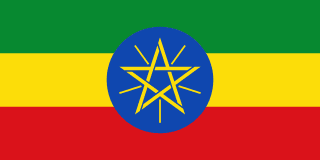
Ethiopia
Federal Democratic Republic of Ethiopia
Population: UN WPP 2024, revision 1, projection for 1 July 2026. Sources and methodology.
Geography and territory
Ethiopia is a vast landlocked country in the Horn of Africa covering 1,104,300 square kilometers, making it one of the largest nations on the continent. Its geography is extraordinarily varied, dominated by the Ethiopian Highlands, a massive continuous highland region that has earned the country the nickname “roof of Africa.” The highest point, Ras Dashen, rises to 4,550 meters in the Simien Mountains, and much of the population lives at altitudes that keep temperatures moderate despite the country’s tropical latitude.
The Great Rift Valley cuts through Ethiopia from northeast to southwest, splitting the highlands into two major blocks and forming a geological depression dotted with lakes, hot springs, and volcanic formations of great scientific interest to geologists and biologists alike. The Danakil Depression, in the northeast, is one of the hottest and most inhospitable places on Earth, with temperatures topping 60 degrees Celsius and surreal, colorful landscapes shaped by mineral deposits.
Ethiopia also possesses substantial water resources. Lake Tana, in the northwest, is the source of the Blue Nile, which supplies roughly 85 percent of the Nile’s total flow. The country’s lowlands include extensive savanna in the east and west, dense tropical forest in the southwest, and desert terrain in the east. This geographic diversity supports an equally wide range of ecosystems, home to numerous species of plants and animals found nowhere else on Earth, from the highland forests of the south to the arid scrublands bordering Somalia and Kenya.
History
Ethiopia holds one of the oldest and most compelling histories in the world. In the Afar region, researchers discovered the fossil remains of “Lucy,” a more than three-million-year-old Australopithecus afarensis skeleton that reshaped scientific understanding of human evolution. The Kingdom of Aksum, which flourished between the 1st and 7th centuries AD, was one of antiquity’s great civilizations, an early adopter of Christianity as a state religion in the 4th century and builder of the monumental obelisks that still stand in the city of Aksum today.
Ethiopia holds the singular distinction of being the only African country never colonized by a European power, retaining its sovereignty even through the Italian occupation of 1936 to 1941, which was never internationally recognized as legitimate colonization. Emperor Haile Selassie, the dominant figure of 20th-century Ethiopian history, modernized the country and made it a founding member of both the United Nations and the Organization of African Unity, whose headquarters were established in Addis Ababa.
A 1974 revolution overthrew Selassie and installed a Marxist military government known as the Derg, led by Mengistu Haile Mariam, plunging the country into years of conflict, devastating famine, and repression that drew international humanitarian attention. After the Derg’s collapse in 1991, Ethiopia adopted a federal system organized around its ethnic diversity. In 2018, Prime Minister Abiy Ahmed launched sweeping political reforms and signed a peace agreement with Eritrea, earning him the 2019 Nobel Peace Prize, though the years that followed also saw renewed internal conflict in parts of the country.
Culture and society
Ethiopia is a genuine cultural mosaic, home to more than 80 distinct ethnic groups, each with its own language and traditions. The largest groups include the Oromo, Amhara, Tigray, and Somali peoples, who live together under a federal system organized along ethnic regional lines. Amharic, written in the ancient Ge’ez script, serves as the official language of the federal government, though more than 200 languages are spoken across the country as a whole.
Religion plays a central role in daily Ethiopian life. The Ethiopian Orthodox Church, one of the oldest Christian churches in the world, counts millions of adherents who observe a form of Christianity rich in ritual, fasting, and festivals such as Timkat, marking Epiphany, and Meskel, commemorating the finding of the True Cross. Islam is the country’s second-largest religion, and the two faiths have historically coexisted in a notable state of equilibrium.
Ethiopia uses its own calendar, derived from the ancient Coptic calendar, with 13 months and a count that runs seven to eight years behind the Gregorian calendar, giving rise to the well-known tourism slogan “Ethiopia, land of thirteen months of sunshine.” Ethiopian music, built on distinctive pentatonic scales and hypnotic rhythms, has earned international recognition, especially through the ethio-jazz movement pioneered by musician Mulatu Astatke.
Economy
The Ethiopian economy has grown rapidly over the past two decades, positioning the country among Africa’s fastest-growing economies. Agriculture remains the foundation, employing more than 70 percent of the workforce and generating a substantial share of GDP. Ethiopia is Africa’s largest coffee producer and the fifth-largest in the world, and it is also a major producer of cereals, pulses, cut flowers, and spices.
The government has pursued an ambitious industrialization strategy centered on industrial parks designed to attract foreign investment, particularly in textiles, footwear, and food processing. The Grand Ethiopian Renaissance Dam, under construction on the Blue Nile, is set to become Africa’s largest hydroelectric facility and stands as a symbol of national development, though it has also generated diplomatic friction with Egypt and Sudan over the sharing of Nile waters.
The services sector has expanded on the back of telecommunications, banking, and tourism. Ethiopian Airlines, the national carrier, is Africa’s largest and most profitable airline, linking the country to destinations across the globe through its hub at Addis Ababa’s Bole International Airport. Even so, Ethiopia faces significant challenges, including widespread poverty, food insecurity, internal ethnic conflict, and the ongoing need to diversify its economic base to sustain long-term growth.
Food and cuisine
Ethiopian cuisine is among the most distinctive in Africa, built around injera, a spongy fermented flatbread made from teff, a nutrient-dense native grain that grows almost exclusively in the Ethiopian highlands. Injera functions simultaneously as base, plate, and utensil: it is spread across a tray and topped with an array of stews and sauces that diners scoop up by tearing off pieces of the bread with their right hand.
Among the most popular dishes are doro wat, a spicy chicken stew with hard-boiled eggs and berbere spice, widely considered the national dish; kitfo, minced raw beef marinated in spiced butter and chile; and shiro, a chickpea or lentil puree favored during the many fasting days observed by the Ethiopian Orthodox Church. Berbere, a spice blend made from dried chiles, ginger, coriander, fenugreek, and other spices, is the essential seasoning underlying Ethiopian cooking.
The Ethiopian coffee ceremony is a socially important ritual that can last for hours. Green beans are roasted in front of guests, ground by hand with a mortar and pestle, and brewed in a traditional clay pot called a jebena. Coffee is then served in three successive rounds known as abol, tona, and baraka, each carrying its own symbolic meaning. For Ethiopians, coffee is far more than a beverage; it is an act of communion, hospitality, and social connection.
Tourism and landmarks
Ethiopia offers exceptional tourism riches, ranging from ancient archaeological sites to breathtaking natural landscapes. The rock-hewn churches of Lalibela, carved directly out of solid rock in the 12th century on the orders of King Lalibela, rank among the architectural wonders of the world and remain a major pilgrimage site for Orthodox Christians. The complex of eleven monolithic churches, linked by tunnels and passageways, is a UNESCO World Heritage Site.
The Simien Mountains, also a World Heritage Site, offer spectacular scenery of jagged peaks, deep gorges, and high plateaus that shelter endemic species such as the Ethiopian wolf, the walia ibex, and the gelada, a distinctive primate that lives in large troops along the cliffs. At the opposite extreme, the Danakil Depression fascinates visitors with its alien, fluorescent-colored landscapes, lava lakes, and crystallized salt formations.
The city of Aksum preserves the remains of the ancient Aksumite empire, including monumental obelisks, palace ruins, and the Church of Our Lady Mary of Zion, which tradition holds houses the Ark of the Covenant. The castles of Gondar, often called the “Camelot of Africa,” the island monasteries of Lake Tana, and the Omo Valley, where tribal communities maintain ancestral ways of life, round out an extraordinarily rich tourism offering that spans thousands of years of continuous history.
Fun facts about Ethiopia
- Ethiopia is considered the cradle of humanity, thanks in part to the discovery of the fossil “Lucy,” more than three million years old.
- It is the only African country never colonized by a European power.
- The Ethiopian calendar has 13 months, twelve of 30 days plus a final month of five or six days, and runs seven to eight years behind the Gregorian calendar.
- Ethiopia is the birthplace of coffee, with legend crediting its discovery to a goatherd named Kaldi, who noticed his goats becoming energetic after eating coffee berries.
- Teff, the grain used to make injera, is so tiny that about 150 grains equal the size of a single grain of wheat.
- Addis Ababa, the capital and headquarters of the African Union, sits at 2,355 meters above sea level, making it one of the highest capital cities in the world.
Ethiopia in numbers
Latest World Bank and UNDP observations, each with its own year. “World median” is the middle value among the countries that report the same indicator; “#” ranks from the highest value.
Population since 1960
Ethiopia had 21.4 million people in 1960 and 135.5 million in 2025 — 6.3 times as many.
People
24.1% of people live in towns and cities (world median 63.4%). 38.8% are under 15 and 3.3% are 65 or older — a young population. Women have 3.91 children on average, above the replacement level of about 2.1.
Economy
The economy grew by 9.8% in real terms in 2025. Consumer prices rose by 13.2% in 2025. Services make up the largest share of output (36.6% of GDP); agriculture contributes 32.8%, a large share that points to a farming-based economy.
Development and environment
UNDP rates human development in Ethiopia as low, with an index of 0.497 in 2023 (rank 180 of 193). 21.9% of people use the internet and 56.6% have access to electricity. Forest covers 23.8% of the land (world median 32.8%).
Sources: World Bank, World Development Indicators (CC BY 4.0), most recent observation from 2015 onward; UNDP Human Development Report 2025. Retrieved 2026-10-10. Sector shares need not add up to 100% because taxes and subsidies on products are excluded. Missing values are left blank rather than estimated. Sources and methodology.
Climate of Ethiopia
Averaged across Ethiopia, the mean temperature stays between 21.7 °C (December) and 25.0 °C (April) — a swing of only 3.3 °C, so seasons are marked by rainfall rather than by heat.
About 857 mm of precipitation falls in a typical year. August is the wettest month (143 mm) and January the driest (13 mm). The wettest stretch is July to September, with 43% of the year's total.
Show monthly values as a table
| Month | Mean °C | Low °C | High °C | Precipitation, mm |
|---|---|---|---|---|
| January | 22.1 | 14.3 | 30.0 | 13 |
| February | 23.5 | 15.6 | 31.4 | 15 |
| March | 24.5 | 17.3 | 31.8 | 43 |
| April | 25.0 | 18.3 | 31.7 | 91 |
| May | 24.7 | 18.6 | 30.8 | 107 |
| June | 24.2 | 18.4 | 29.9 | 79 |
| July | 23.3 | 18.1 | 28.6 | 131 |
| August | 23.1 | 17.8 | 28.4 | 143 |
| September | 23.4 | 17.5 | 29.4 | 98 |
| October | 23.0 | 16.5 | 29.5 | 87 |
| November | 22.2 | 15.1 | 29.4 | 36 |
| December | 21.7 | 14.1 | 29.4 | 14 |
Figures are 1991–2020 averages across the whole land area of Ethiopia, from the World Bank Climate Change Knowledge Portal, CRU TS 4.08 (CC BY 4.0). They are not readings from one weather station: the capital, the coast and high ground can be much warmer, cooler, wetter or drier.
Travel essentials for Ethiopia
The practical details visitors ask about first. Traffic in Ethiopia drives on the right, like most of the world. Mains electricity is 220 V at 50 Hz, so devices made only for 110–120 V (common in North America) need a converter unless they are dual-voltage — most phone and laptop chargers are.
- Emergency number
- 911Police 991 · Ambulance 907 · Fire 939
- Driving side
- Right
- Plug types
- Type C, Type F, Type LC: two round pins (Europlug); F: two round pins with side earth clips (Schuko); L: three round pins in a row (Italian)
- Voltage
- 220 V50 Hz
- Dialling code
- +251From abroad: your exit code, then 251 and the number
- Currency
- Ethiopian Birr (ETB)
- Time zone
- EAT (UTC+3)Current local time in Ethiopia
Compiled from IEC plug and voltage standards, national emergency-service listings and the UN road-traffic conventions. Emergency numbers and local coverage can change — confirm them locally on arrival. Ethiopia's internet domain is .et.
Where Ethiopia ranks in the world
Each position counts only the countries with data in that ranking guide. First place is the highest value — for price levels, the most expensive. Select a card to see the full table.
- Population10th of 196138.9 millionUN projection, July 2026
- Land area25th of 1951,128,499 km²World Bank, 2023
- Population density78th of 194114 per km²World Bank, 2023
- GDP (nominal)59th of 187$149.7BWorld Bank, 2024, current US$
- GDP per capita166th of 187$1,134World Bank, 2024, current US$
- Life expectancy147th of 19467.6 yearsWorld Bank, 2024
- Price level159th of 16528 (US = 100)ICP 2021, household consumption
Bordering countries of Ethiopia


Compare Ethiopia with another country
Frequently asked questions about Ethiopia
What is the capital of Ethiopia?
The capital of Ethiopia is Addis Ababa.
What is the population of Ethiopia?
The UN World Population Prospects projection for Ethiopia is 138,902,185 people (138.9 million) on 1 July 2026. National statistical offices may publish different estimates.
What language is spoken in Ethiopia?
The official language of Ethiopia is Amharic.
What currency is used in Ethiopia?
The currency of Ethiopia is the Ethiopian Birr (ETB).
How big is Ethiopia?
Ethiopia covers an area of 1,104,300 km².
What type of government does Ethiopia have?
Ethiopia is a federal parliamentary republic.
Which countries border Ethiopia?
Ethiopia shares land borders with Eritrea, Djibouti, Somalia, Kenya, South Sudan, Sudan.
What is the highest point in Ethiopia?
The highest point in Ethiopia is Ras Dashen (4,550 m).


