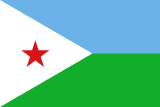
Flag of Djibouti
Republic of Djibouti
Flag details
- Country
- Djibouti
- Official name
- Republic of Djibouti
- Capital
- Djibouti
- ISO code
- DJ / DJI
- Region
- East Africa
Flag colors
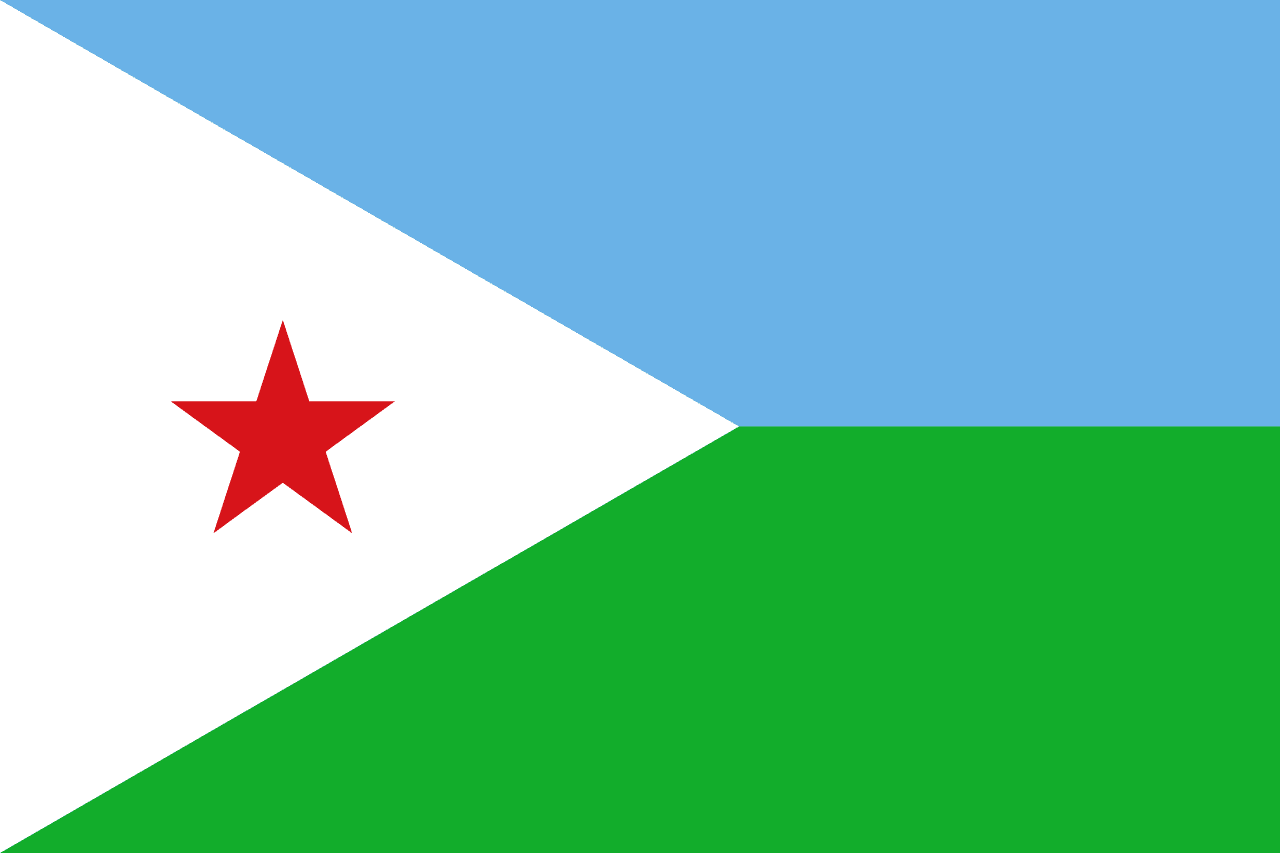
- #6ab2e735%
- #12ad2b35%
- #ffffff27%
Share of the flag's surface, measured from the image.
Download the flag
Meaning and history of the flag of Djibouti
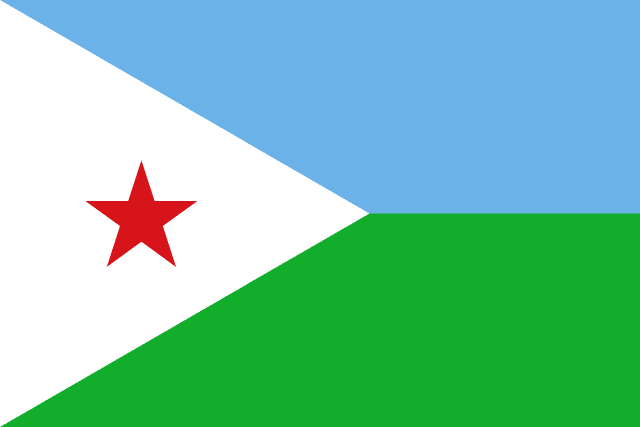
Djibouti's flag was adopted on June 27, 1977, the day the country gained independence from France. It consists of two equal horizontal bands, sky blue on top and green below, with a white isosceles triangle at the hoist containing a five-pointed red star at its center.
The sky blue represents the sky and the sea as well as the Issa (Somali) people, one of the country's two main ethnic groups. Green stands for the land and for the Afar people, the other predominant ethnic group. The white of the triangle represents peace, and the red star symbolizes the unity of the territory's peoples and the blood shed in the fight for independence; it is also read as a symbol of the regions inhabited by the Somali people.
Djibouti's flag draws direct inspiration from the flag of the Somali Coast Liberation Front (LPAI), the independence movement that led the country to sovereignty. Its design is relatively simple compared with other African flags, yet every element carries a precise meaning tied to the country's two-part ethnic makeup. The combination of sky blue and green is unusual among African flags, giving it a distinctive visual identity. Djibouti holds major strategic importance in the Horn of Africa, and its flag flies alongside numerous foreign military bases stationed on its territory.
You can view the flag of Djibouti in high resolution above and download it in several sizes for personal, educational or reference use. To explore more, visit the full Djibouti profile, its map, or the current local time in Djibouti.