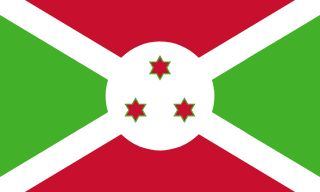
Burundi
Republic of Burundi
Population: UN WPP 2024, revision 1, projection for 1 July 2026. Sources and methodology.
Geography and territory
Burundi is one of the smallest countries in Africa, covering just 27,834 square kilometers, yet its compact territory holds a remarkably varied landscape of mountains, hills, and fertile valleys that have earned it the nickname “the heart of Africa.” The country lies in the African Great Lakes region and borders Lake Tanganyika to the west, an immense body of water that plunges to depths of 1,470 meters, making it the second-deepest lake on Earth.
Burundi’s terrain is shaped by a series of mountain ridges running roughly north to south, with elevations ranging from about 773 meters along the shores of Lake Tanganyika to 2,670 meters at the summit of Mount Heha, the country’s highest point. The Congo-Nile Divide, which crosses the western part of the country, marks the watershed between the Congo and Nile river basins. East of this ridge, rolling plateaus and river valleys form the country’s main agricultural heartland.
The climate is a temperate, high-altitude equatorial type, with elevation moderating what would otherwise be tropical heat and abundant rainfall sustaining lush vegetation. Mountain slopes covered in tropical forest and tea and coffee plantations stand in contrast to the Imbo plain along Lake Tanganyika, where temperatures run higher and the vegetation takes on a more distinctly tropical character. Despite its small size, Burundi supports significant biodiversity, including endemic birds and primates in its highland forests.
History
Burundi’s history centers on an ancient monarchy dating back at least to the seventeenth century. The kingdom, ruled by mwami (kings) of the Ganwa dynasty, developed a stratified society in which Hutu, Tutsi, and Twa communities coexisted under a web of relationships that went well beyond simple ethnic division. The mwami was regarded as a sacred figure who embodied the unity of the kingdom and mediated among its different communities.
European colonization began under German administration in the late nineteenth century, when Burundi, together with Rwanda, was absorbed into German East Africa. After the First World War, the territory passed to Belgium under a League of Nations mandate. Belgian colonial rule hardened ethnic identities through policies of racial classification and systematically favored Tutsis in administration and education, planting the seeds of future conflict.
Independence, proclaimed on 1 July 1962, was followed by decades of interethnic violence that left deep scars on Burundian society. Tensions between Hutu and Tutsi communities erupted into episodes of mass violence in 1972 and 1993, and a civil war raged from 1993 to 2005, displacing large numbers of people and devastating the rural economy. The Arusha Accords of 2000 laid the groundwork for a power-sharing system between the two communities, and a new constitution and elections followed in the years after, though political stability remains fragile as the country continues its slow process of reconciliation and reconstruction under a presidential system of government.
Culture and society
Burundian culture is deeply rooted in oral tradition and music, which shapes nearly every aspect of social life. The royal drums of Burundi, known as karyenda, are the country’s most recognized cultural symbol. Carved from tree trunks and covered in cowhide, these sacred drums are played in ensembles of up to twenty percussionists who perform striking routines combining rhythm, dance, and acrobatics. The tradition of Burundian drumming was inscribed on UNESCO’s Representative List of the Intangible Cultural Heritage of Humanity in 2014.
Oral poetry and song are highly valued art forms in Burundian society. Ubwenge, the art of eloquence and rhetoric, is a skill traditionally prized and cultivated from childhood. Inyambo, poems composed in praise of cattle, reflect the historic importance of livestock in Burundian culture, where cows are not merely a source of material wealth but a symbol of social status and a means of building community ties.
Burundian craftsmanship includes basketry, particularly the agaseke baskets decorated with geometric patterns that are traditionally given as gifts at weddings and other ceremonies, and pottery, especially the work of Twa artisans, whose techniques are passed down through generations. Contemporary Burundian society faces the ongoing challenge of building a national identity that transcends the ethnic divisions of the past, drawing on shared values of community, hospitality, and respect for elders.
Economy
Burundi’s economy, with a gross domestic product of roughly $3.37 billion, is among the smallest and most fragile in Africa. Agriculture is the backbone of the economy, employing more than 90 percent of the population and generating the bulk of export earnings. Coffee and tea are the leading cash crops, and Burundian coffee in particular is prized internationally for its quality and its floral, citrus notes, although production continues to suffer from poor infrastructure and chronic underinvestment.
Subsistence farming, centered on bananas, cassava, sweet potatoes, corn, and beans, forms the food base for most of the rural population. Pressure on farmland is one of the country’s most pressing problems: with a population density among the highest in Africa, Burundi struggles with a chronic shortage of cultivable land, fueling social tension and environmental degradation.
Burundi’s prospects for economic development hinge on diversifying production, improving transport infrastructure, and sustainably developing its mineral resources, which include nickel, gold, rare earth elements, and largely unexplored coltan deposits. The country’s strategic position in the Great Lakes region and its relatively recent accession to the East African Community offer opportunities for regional trade integration, though political and logistical obstacles remain formidable. Landlocked and reliant on distant seaports reached through neighboring Tanzania or Kenya, Burundi also faces persistently high transport costs that weigh on nearly every sector of its economy, from coffee exports to the price of imported fuel and manufactured goods.
Food and cuisine
Burundian cuisine turns subsistence ingredients into genuine culinary tradition, combining basic staples with creativity to produce nourishing, comforting food. Ubugari, a thick paste made from cassava or corn flour cooked in water, is the essential staple, eaten at nearly every meal alongside sauces of beans, vegetables, or meat when available. Beans, prepared in countless ways, are the country’s primary source of plant protein.
Isombe, a stew made from pounded cassava leaves cooked with peanut paste and palm oil, is one of the most representative dishes of Burundian cooking. Mukeke, fresh fish from Lake Tanganyika grilled or simmered in tomato sauce, is a prized delicacy especially popular in communities along the lakeshore. Goat skewers, slow-roasted over charcoal and served with fried plantain or potatoes, are the star dish of celebrations and popular restaurants alike.
Bananas occupy a central place in both diet and culture, eaten green as a vegetable, ripe as a fruit, and fermented into homemade beer. Urwarwa, banana beer, and impeke, sorghum beer, are the traditional drinks that accompany social gatherings and ceremonies. Tea, grown on the country’s hillsides, carries its own social ritual, while Burundian coffee, enjoying a growing international reputation, is increasingly appreciated in specialty coffee circles abroad.
Tourism and landmarks
Lake Tanganyika is Burundi’s premier natural attraction and one of Africa’s great ecological treasures. Its clear waters hold more than 350 species of fish, many found nowhere else, and its golden beaches offer pockets of quiet beauty. The Rusizi Nature Reserve, at the mouth of the Rusizi River where it empties into the lake, is an ecologically important wetland where visitors can spot hippopotamuses, crocodiles, and waterbirds amid mangroves and papyrus stands.
The Source of the Southern Nile, near Rutovu in the south of the country, holds great historical and symbolic significance. A stone pyramid marks the spot where the southernmost spring feeding the Nile, Africa’s longest river, rises from the ground. Identified by the German explorer Burkhart Waldecker in 1934, the site offers a contemplative setting amid green hills and highland forest. Kibira National Park, in the northwest, protects one of the last remaining stretches of montane tropical forest in the region, home to chimpanzees, colobus monkeys, and hundreds of bird species.
Bujumbura, the former capital and the country’s largest city, stretches along the shore of Lake Tanganyika and offers a relaxed urban atmosphere with beaches, restaurants, and lively nightlife. The Musée Vivant, a zoological and botanical park in the city, allows visitors to observe local wildlife, including crocodiles and hippopotamuses. Gitega, the current capital, is home to the National Museum, which preserves artifacts related to the Burundian monarchy and the country’s cultural traditions. The tea-covered hills surrounding the city offer rolling, verdant scenery that has earned Burundi the occasional nickname “the Switzerland of Africa.”
Fun facts about Burundi
- Burundi’s royal drums, recognized by UNESCO as Intangible Cultural Heritage, were historically considered sacred and were used to announce war, peace, royal births, and harvests.
- Burundi is home to the southernmost source of the Nile, the longest river in Africa, marked by a stone pyramid near the town of Rutovu.
- With a population density among the highest on the continent, Burundi is one of the most densely populated countries in Africa, despite also being one of the least urbanized.
- Lake Tanganyika, which forms Burundi’s western border, holds roughly 16 percent of the world’s available fresh surface water and is the second-deepest lake on the planet.
- The Kirundi word urukundo, meaning “love,” is widely considered the most beautiful expression in the language and is frequently used as a given name.
Burundi in numbers
Latest World Bank and UNDP observations, each with its own year. “World median” is the middle value among the countries that report the same indicator; “#” ranks from the highest value.
Population since 1960
Burundi had 2.8 million people in 1960 and 14.4 million in 2025 — 5.2 times as many.
People
25.7% of people live in towns and cities (world median 63.4%). 44.0% are under 15 and 2.5% are 65 or older — a very young population. Women have 4.79 children on average, above the replacement level of about 2.1.
Economy
The economy grew by 4.2% in real terms in 2025. Consumer prices rose by 34.1% in 2025 — very high inflation. Services make up the largest share of output (42.1% of GDP); agriculture contributes 34.3%, a large share that points to a farming-based economy.
Development and environment
UNDP rates human development in Burundi as low, with an index of 0.439 in 2023 (rank 187 of 193). 8.6% of people use the internet and 20.1% have access to electricity. Forest covers 10.9% of the land (world median 32.8%).
Sources: World Bank, World Development Indicators (CC BY 4.0), most recent observation from 2015 onward; UNDP Human Development Report 2025. Retrieved 2026-10-10. Sector shares need not add up to 100% because taxes and subsidies on products are excluded. Missing values are left blank rather than estimated. Sources and methodology.
Climate of Burundi
Averaged across Burundi, the mean temperature stays between 19.5 °C (July) and 21.4 °C (September) — a swing of only 1.9 °C, so seasons are marked by rainfall rather than by heat.
About 1,229 mm of precipitation falls in a typical year. January is the wettest month (169 mm) and July the driest (5 mm). The wettest stretch is November to January, with 40% of the year's total.
Show monthly values as a table
| Month | Mean °C | Low °C | High °C | Precipitation, mm |
|---|---|---|---|---|
| January | 20.4 | 14.8 | 26.0 | 169 |
| February | 20.7 | 14.9 | 26.5 | 126 |
| March | 20.6 | 14.9 | 26.3 | 164 |
| April | 20.5 | 15.1 | 26.0 | 155 |
| May | 20.3 | 14.8 | 25.9 | 96 |
| June | 19.8 | 13.3 | 26.3 | 14 |
| July | 19.5 | 12.3 | 26.8 | 5 |
| August | 20.9 | 13.7 | 28.2 | 15 |
| September | 21.4 | 14.5 | 28.3 | 61 |
| October | 21.3 | 15.0 | 27.8 | 106 |
| November | 20.5 | 14.7 | 26.4 | 163 |
| December | 20.3 | 14.8 | 25.8 | 155 |
Figures are 1991–2020 averages across the whole land area of Burundi, from the World Bank Climate Change Knowledge Portal, CRU TS 4.08 (CC BY 4.0). They are not readings from one weather station: the capital, the coast and high ground can be much warmer, cooler, wetter or drier.
Travel essentials for Burundi
The practical details visitors ask about first. Traffic in Burundi drives on the right, like most of the world. Mains electricity is 220 V at 50 Hz, so devices made only for 110–120 V (common in North America) need a converter unless they are dual-voltage — most phone and laptop chargers are.
- Emergency number
- 117
- Driving side
- Right
- Plug types
- Type C, Type EC: two round pins (Europlug); E: two round pins, earth pin in the socket
- Voltage
- 220 V50 Hz
- Dialling code
- +257From abroad: your exit code, then 257 and the number
- Currency
- Burundian Franc (BIF)
- Time zone
- CAT (UTC+2)Current local time in Burundi
Compiled from IEC plug and voltage standards, national emergency-service listings and the UN road-traffic conventions. Emergency numbers and local coverage can change — confirm them locally on arrival. Burundi's internet domain is .bi.
Where Burundi ranks in the world
Each position counts only the countries with data in that ranking guide. First place is the highest value — for price levels, the most expensive. Select a card to see the full table.
- Population78th of 19614.7 millionUN projection, July 2026
- Land area143rd of 19525,680 km²World Bank, 2023
- Population density14th of 194533 per km²World Bank, 2023
- GDP (nominal)162nd of 187$3.0BWorld Bank, 2024, current US$
- GDP per capita187th of 187$216World Bank, 2024, current US$
- Life expectancy175th of 19463.8 yearsWorld Bank, 2024
- Price level137th of 16533 (US = 100)ICP 2021, household consumption
Bordering countries of Burundi


Compare Burundi with another country
Frequently asked questions about Burundi
What is the capital of Burundi?
The capital of Burundi is Gitega.
What is the population of Burundi?
The UN World Population Prospects projection for Burundi is 14,729,157 people (14.7 million) on 1 July 2026. National statistical offices may publish different estimates.
What language is spoken in Burundi?
The official language of Burundi is Kirundi, French and English.
What currency is used in Burundi?
The currency of Burundi is the Burundian Franc (BIF).
How big is Burundi?
Burundi covers an area of 27,834 km².
What type of government does Burundi have?
Burundi is a presidential republic.
Which countries border Burundi?
Burundi shares land borders with Rwanda, Tanzania, Democratic Republic of the Congo.
What is the highest point in Burundi?
The highest point in Burundi is Mount Heha (2,670 m).


