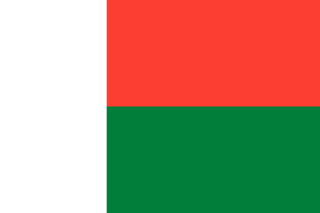
Madagascar
Republic of Madagascar
Population: UN WPP 2024, revision 1, projection for 1 July 2026. Sources and methodology.
Geography and territory
Madagascar is the fourth-largest island on Earth, covering 587,041 square kilometers and separated from the southeastern coast of Africa by the Mozambique Channel, a stretch of open water roughly 400 kilometers wide. That separation, which occurred some 88 million years ago, turned the island into a natural laboratory of evolution, and its biodiversity is so exceptional that scientists often describe Madagascar as a miniature continent in its own right.
A mountainous spine, the Central Highlands, runs the length of the island from north to south, with elevations regularly topping 1,500 meters. The highest point, Maromokotro, rises to 2,876 meters within the Tsaratanana Massif in the north. The eastern coast drops sharply toward the Indian Ocean and is cloaked in humid rainforest, while the western side slopes more gently toward the Mozambique Channel through dry deciduous forests and open savanna.
Climate varies enormously from one region to the next: humid and tropical along the east coast, where cyclones bring heavy seasonal rain; temperate across the central highlands; and semi-arid in the south and southwest, home to a strange and thorny scrubland found nowhere else on the planet. This range of climates and terrain supports staggering biodiversity — an estimated 90 percent of Madagascar’s plant and animal species exist nowhere else in the world. Lemurs, primates unique to the island, have become the best-known symbol of that singular natural heritage, with no land borders shared with any other country, since Madagascar is entirely surrounded by ocean.
History
Madagascar’s history diverges sharply from that of mainland Africa because its roots are fundamentally Austronesian. The island’s first settlers arrived roughly 2,000 years ago from Southeast Asia, most likely from Borneo, crossing thousands of kilometers of open ocean in one of the most remarkable maritime migrations in human history. They brought with them the Malagasy language, terraced rice cultivation, outrigger canoe technology, and cultural traditions that continue to link Madagascar more closely to Asia than to continental Africa.
From around the seventh century onward, Arab, Indian, and Bantu African traders established coastal settlements that plugged Madagascar into the wider commercial networks of the Indian Ocean. Inland, rival Malagasy kingdoms competed for dominance, and it was the Kingdom of Imerina, centered in the highlands, that eventually unified much of the island under the Merina dynasty during the nineteenth century. Queen Ranavalona I and King Radama I stand out as central figures of that era of national consolidation.
France colonized Madagascar in 1896 after crushing Merina resistance, and it governed the island for more than six decades, extracting its natural resources and imposing forced labor on much of the population. Independence finally arrived on June 26, 1960, followed by a period of socialist rule under Didier Ratsiraka and later a series of democratic transitions punctuated by political crises. Madagascar continues to grapple with poverty, deforestation, and governance challenges, though its exceptional natural and cultural wealth still offers considerable potential for future development.
Culture and society
Malagasy culture is a genuinely one-of-a-kind fusion of Austronesian, African, Arab, and Indian influences, blended into something that resembles no other culture on Earth. The Malagasy language, part of the Austronesian family and related to languages spoken in Borneo, Indonesia, and the Philippines, is spoken island-wide with regional variation and forms the chief thread of identity binding together 18 recognized ethnic groups, among which the highland Merina and the coastal Sakalava are especially prominent.
Perhaps the most distinctive cultural practice is famadihana, the “turning of the bones.” At intervals, families exhume the remains of their ancestors, rewrap them in fresh silk shrouds, and carry them in a joyful procession with music and dancing before returning them to the tomb. Far from being somber, famadihana is a celebration of the enduring bond between the living and the dead, who are regarded as active members of the community and protectors of family well-being.
Fady, a system of taboos governing daily life, sets out specific prohibitions that vary by community, family, and even individual, and breaking them is believed to invite misfortune. These taboos can touch on foods, days of the week, colors, places, or behaviors, reflecting a Malagasy worldview in which the visible and spiritual realms are deeply intertwined. Traditional music, played on instruments such as the valiha, a bamboo tube zither, the kabosy guitar, and the sodina bamboo flute, produces delicate sounds that evoke both Southeast Asia and Africa at once.
Economy
Madagascar’s economy rests primarily on agriculture, which employs more than 70 percent of the workforce and accounts for a substantial share of national output. Rice is both the dominant crop and the staple of the Malagasy diet, yet domestic production falls short of what a fast-growing population needs, forcing the country to import significant quantities each year. Vanilla is the star export: Madagascar produces roughly 80 percent of the world’s supply, a labor-intensive crop grown mainly along the northeastern coast that generates vital but highly volatile income.
Other important export crops include cloves, pepper, coffee, lychees, and cacao. Artisanal and industrial fishing contribute both to food security and to exports, particularly shrimp and tuna. Mining has grown in significance, with ilmenite, cobalt, nickel, and sapphires drawing substantial foreign investment, though extraction projects have also stirred environmental and social controversy.
Despite this exceptional natural wealth, Madagascar remains one of the poorest countries in the world, with much of the population living below the poverty line. Recurrent political crises, inadequate infrastructure, corruption, and vulnerability to cyclones and drought have all held back economic development, keeping the country’s GDP at around $19.62 billion and its Human Development Index at 0.487, classified as low. Ecotourism stands out as a promising avenue for growth, one that could link biodiversity conservation directly to income for local communities.
Food and cuisine
Malagasy cuisine revolves around rice, which functions less as a mere staple than as a cultural cornerstone whose presence at the table is considered indispensable. Vary, as cooked rice is called in Malagasy, is eaten three times a day and forms the base onto which laoka, the various accompaniments, are ladled to add flavor and variety. Rice is so central to the culture that the Malagasy verb for “to eat,” mihinam-bary, literally translates as “to eat rice.”
Romazava is generally regarded as the national dish, a stew of zebu beef, wild greens known as bredes, tomato, ginger, and onion, served over rice for a comforting, aromatic meal. Ravitoto, pounded cassava leaves cooked with pork or zebu beef and coconut milk, is another essential specialty. Dishes such as henakisoa sy voanio (pork with coconut) and akoho sy voanio (chicken with coconut) reveal the clear imprint of Southeast Asian cooking traditions on the Malagasy table.
Zebu, the humped cattle seen throughout the island’s landscapes, supplies the most prized and widely eaten meat in the country, whether grilled, stewed, or dried into a jerky-like biltong. Achards, spicy pickles made from mango, lemon, or papaya, add brightness and contrast to meals as a condiment. Ranon’apango, water infused with toasted rice, is the everyday drink that accompanies most meals, while rhum arrangé, rum steeped with local fruits and spices such as vanilla, cinnamon, and lychee, is the drink of choice for festive occasions.
Tourism and landmarks
Madagascar is an unmatched destination for nature lovers thanks to its singular biodiversity and remarkably varied scenery. The Avenue of the Baobabs, near Morondava, is the island’s most iconic image: a row of towering Grandidier’s baobabs lining a dirt road, a strikingly surreal sight especially at sunset, when the light turns the ancient, centuries-old trunks golden.
Madagascar’s national parks offer exceptional wildlife encounters. Andasibe-Mantadia, close to the capital, lets visitors hear the haunting call of the indri, the largest living lemur, echoing through the forest canopy. Ranomafana protects humid forests of dazzling biodiversity, including the golden bamboo lemur, discovered only in 1987. Isalo offers a landscape of sandstone canyons, natural pools, and palm groves reminiscent of the American West. The Tsingy de Bemaraha Strict Nature Reserve, a World Heritage Site, safeguards a surreal “stone forest” of razor-sharp limestone spires forming a vertical maze found nowhere else on the planet.
Madagascar’s coastline rounds out its tourist appeal, with destinations such as Nosy Be, a tropical island with white-sand beaches, spectacular reefs for diving, and the chance to spot humpback whales between July and September. Sainte-Marie Island, a former haven for pirates, blends history and nature in an intimate setting. Antananarivo, the highland capital, charms visitors with its colonial-era architecture, bustling markets, and the Rova, the royal palace crowning the city’s highest hill.
Fun facts about Madagascar
- Around 90 percent of Madagascar’s plant and animal life is endemic, meaning it exists nowhere else in the world.
- Madagascar produces roughly 80 percent of the world’s vanilla, making it the most expensive spice after saffron.
- The island is home to six of the world’s nine baobab species, and some individual trees are more than a thousand years old.
- More than 100 species of lemur live in the wild exclusively on Madagascar.
- The Malagasy language is related to the languages of Borneo rather than to any African language, evidence of an extraordinary sea migration roughly 2,000 years ago.
- Famadihana, the ceremony of exhuming and honoring the dead, reflects the Malagasy belief that ancestors continue to shape the lives of the living.
Madagascar in numbers
Latest World Bank and UNDP observations, each with its own year. “World median” is the middle value among the countries that report the same indicator; “#” ranks from the highest value.
Population since 1960
Madagascar had 5.1 million people in 1960 and 32.7 million in 2025 — 6.4 times as many.
People
32.9% of people live in towns and cities (world median 63.4%). 38.9% are under 15 and 3.5% are 65 or older — a young population. Women have 3.91 children on average, above the replacement level of about 2.1.
Economy
The economy grew by 3.0% in real terms in 2025. Consumer prices rose by 8.1% in 2025. Services make up the largest share of output (48.8% of GDP); agriculture contributes 21.7%, a large share that points to a farming-based economy.
Development and environment
UNDP rates human development in Madagascar as low, with an index of 0.487 in 2023 (rank 183 of 193). 18.7% of people use the internet and 42.5% have access to electricity. Forest covers 17.3% of the land (world median 32.8%).
Sources: World Bank, World Development Indicators (CC BY 4.0), most recent observation from 2015 onward; UNDP Human Development Report 2025. Retrieved 2026-10-10. Sector shares need not add up to 100% because taxes and subsidies on products are excluded. Missing values are left blank rather than estimated. Sources and methodology.
Climate of Madagascar
Averaged across Madagascar, the warmest month is January (24.9 °C) and the coolest is July (19.3 °C), a seasonal swing of 5.6 °C. The annual mean is 22.7 °C.
About 1,473 mm of precipitation falls in a typical year. January is the wettest month (312 mm) and September the driest (32 mm). The three wettest consecutive months, December to February, bring 54% of the year's total — a pronounced rainy season.
Show monthly values as a table
| Month | Mean °C | Low °C | High °C | Precipitation, mm |
|---|---|---|---|---|
| January | 24.9 | 20.7 | 29.0 | 312 |
| February | 24.9 | 20.8 | 29.0 | 273 |
| March | 24.7 | 20.5 | 29.0 | 204 |
| April | 23.7 | 19.2 | 28.2 | 89 |
| May | 21.9 | 17.0 | 26.9 | 52 |
| June | 20.1 | 15.0 | 25.2 | 47 |
| July | 19.3 | 14.3 | 24.5 | 51 |
| August | 19.9 | 14.7 | 25.2 | 42 |
| September | 21.2 | 15.8 | 26.6 | 32 |
| October | 22.7 | 17.7 | 27.8 | 52 |
| November | 23.9 | 19.2 | 28.6 | 102 |
| December | 24.7 | 20.4 | 29.0 | 217 |
Figures are 1991–2020 averages across the whole land area of Madagascar, from the World Bank Climate Change Knowledge Portal, CRU TS 4.08 (CC BY 4.0). They are not readings from one weather station: the capital, the coast and high ground can be much warmer, cooler, wetter or drier.
Travel essentials for Madagascar
The practical details visitors ask about first. Traffic in Madagascar drives on the right, like most of the world. Mains electricity is 127 V at 50 Hz, so appliances built only for 220–240 V need a voltage converter.
- Emergency number
- 117Fire 118
- Driving side
- Right
- Plug types
- Type C, Type D, Type E, Type J, Type KC: two round pins (Europlug); D: three large round pins in a triangle; E: two round pins, earth pin in the socket; J: three round pins (Swiss); K: three round pins (Danish)
- Voltage
- 127 V50 Hz
- Dialling code
- +261From abroad: your exit code, then 261 and the number
- Currency
- Malagasy Ariary (MGA)
- Time zone
- EAT (UTC+3)Current local time in Madagascar
Compiled from IEC plug and voltage standards, national emergency-service listings and the UN road-traffic conventions. Emergency numbers and local coverage can change — confirm them locally on arrival. Madagascar's internet domain is .mg.
Where Madagascar ranks in the world
Each position counts only the countries with data in that ranking guide. First place is the highest value — for price levels, the most expensive. Select a card to see the full table.
- Population49th of 19633.5 millionUN projection, July 2026
- Land area44th of 195581,800 km²World Bank, 2023
- Population density131st of 19454 per km²World Bank, 2023
- GDP (nominal)132nd of 187$17.6BWorld Bank, 2024, current US$
- GDP per capita183rd of 187$550World Bank, 2024, current US$
- Life expectancy173rd of 19463.8 yearsWorld Bank, 2024
- Price level149th of 16530 (US = 100)ICP 2021, household consumption
Compare Madagascar with another country
Frequently asked questions about Madagascar
What is the capital of Madagascar?
The capital of Madagascar is Antananarivo.
What is the population of Madagascar?
The UN World Population Prospects projection for Madagascar is 33,522,052 people (33.5 million) on 1 July 2026. National statistical offices may publish different estimates.
What language is spoken in Madagascar?
The official language of Madagascar is Malagasy and French.
What currency is used in Madagascar?
The currency of Madagascar is the Malagasy Ariary (MGA).
How big is Madagascar?
Madagascar covers an area of 587,041 km².
What type of government does Madagascar have?
Madagascar is a semi-presidential republic.
What is the highest point in Madagascar?
The highest point in Madagascar is Maromokotro (2,876 m).


