Countries of Oceania
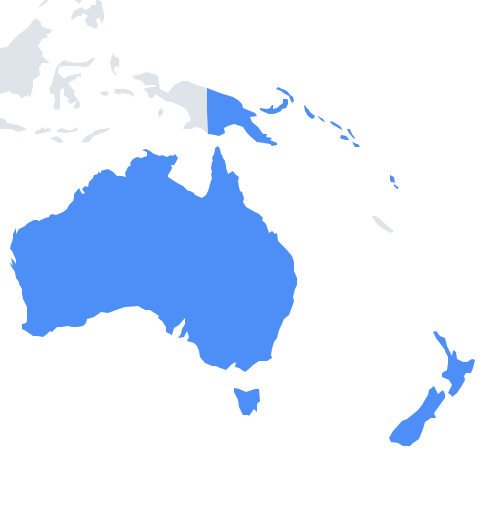
Oceania is home to 14 countries and around 46.3 million people, spanning 8,487,527 km². The most populous is Australia. Explore every nation below.
About Oceania
Oceania is the smallest continent by land area and population, scattered across the vast Pacific Ocean. It combines the continental landmass of Australia with the islands of New Zealand, Papua New Guinea and thousands of smaller islands grouped into Melanesia, Micronesia and Polynesia — including some of the world’s smallest and most remote nations, such as Tuvalu and Nauru.
Despite its size, Oceania’s diversity is striking: Papua New Guinea alone is home to over 800 languages, more than any other country. Ancient indigenous cultures — Aboriginal Australians, Māori, and the seafaring peoples of the Pacific — coexist with modern economies, coral atolls with snow-capped peaks, and the Great Barrier Reef, the largest living structure on Earth.
Oceania in figures
- The largest country by area is Australia (7,692,024 km²) and the smallest is Nauru (21 km²).
- Australia, Papua New Guinea and New Zealand are the most populous, together home to 94% of the people in Oceania; Tuvalu has the fewest inhabitants (9,362).
- The most densely populated country is Nauru, with about 576 people per km²; the most sparsely populated is Australia (3.5 per km²).
- By GDP per person in 2024, Australia is the richest (US$64,610) and the Solomon Islands the poorest (US$1,934) — a gap of 33 to 1.
- Australia has the highest Human Development Index (0.958) and Papua New Guinea the lowest (0.576).
- No country is landlocked and 13 are island nations.
Regions of Oceania
Countries.World groups the 14 countries of Oceania into 4 regions, listed here by number of countries; within each region, countries are ordered by population.
Micronesia 5
Melanesia 4
Australasia 2
Compare the countries of Oceania
All 14 countries ranked by population. Sort any column to compare area, density, income, human development or urbanisation.
14 countries. Scroll the table for all entries. Base rank follows the page’s main measure; sorting another column keeps that rank.
| Base rank | |||||||||
|---|---|---|---|---|---|---|---|---|---|
| 1 |  Australia Australia | Canberra | Australasia | 27,227,096 | 7,692,024 | 4 | $64,610 | 0.958 | 87.7 |
| 2 |  Papua New Guinea Papua New Guinea | Port Moresby | Melanesia | 10,947,848 | 462,840 | 24 | $2,912 | 0.576 | 15.8 |
| 3 |  New Zealand New Zealand | Wellington | Australasia | 5,287,479 | 268,021 | 20 | $49,432 | 0.938 | 84.0 |
| 4 |  Fiji Fiji | Suva | Melanesia | 937,282 | 18,274 | 51 | $6,426 | 0.731 | 59.5 |
| 5 |  Solomon Islands Solomon Islands | Honiara | Melanesia | 858,288 | 28,400 | 30 | $1,934 | 0.584 | 31.3 |
| 6 |  Vanuatu Vanuatu | Port Vila | Melanesia | 342,564 | 12,189 | 28 | $3,960 | 0.621 | 22.3 |
| 7 |  Samoa Samoa | Apia | Polynesia | 220,528 | 2,831 | 78 | $5,393 | 0.708 | 17.5 |
| 8 |  Kiribati Kiribati | Tarawa | Micronesia | 138,445 | 811 | 171 | $2,551 | 0.644 | 63.4 |
| 9 |  Micronesia Micronesia | Palikir | Micronesia | 114,183 | 702 | 163 | $4,252 | 0.615 | 22.5 |
| 10 |  Tonga Tonga | Nuku'alofa | Polynesia | 103,291 | 748 | 138 | $6,215 | 0.769 | 21.2 |
| 11 |  Marshall Islands Marshall Islands | Majuro | Micronesia | 35,075 | 181 | 194 | $7,590 | 0.733 | 79.1 |
| 12 |  Palau Palau | Ngerulmud | Micronesia | 17,614 | 459 | 38 | $18,169 | 0.786 | 79.3 |
| 13 |  Nauru Nauru | Yaren | Micronesia | 12,101 | 21 | 576 | $14,048 | 0.703 | 100.0 |
| 14 |  Tuvalu Tuvalu | Funafuti | Polynesia | 9,362 | 26 | 360 | $5,884 | 0.689 | 65.4 |
No countries match these filters. Try another name or reset the filters.
Area is total area as listed on each profile. “—” means no observation is published. Sources and methodology.