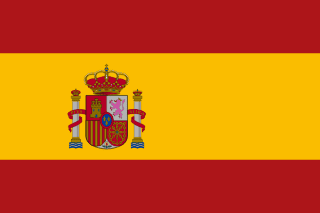
Spain
Kingdom of Spain
Population: UN WPP 2024, revision 1, projection for 1 July 2026. Sources and methodology.
Geography and territory
Spain occupies most of the Iberian Peninsula, at the southwestern edge of Europe. With an area of 505,970 square kilometers, it is the fourth-largest country on the European continent, behind only Russia, Ukraine, and France. Its territory also includes the Balearic Islands in the Mediterranean, the Canary Islands in the Atlantic off the coast of Africa, and the autonomous cities of Ceuta and Melilla in North Africa.
Spain has an extensive high plateau and several major mountain ranges. The Meseta Central dominates the interior of the peninsula, ringed by mountain systems including the Cantabrian Range to the north, the Iberian System to the east, the Sierra Morena to the south, and the Central System, which splits the plateau in two. The Pyrenees form the natural border with France and include peaks exceeding 3,000 meters.
The country has nearly 8,000 kilometers of coastline along the Mediterranean Sea, the Atlantic Ocean, and the Bay of Biscay. This geographic diversity produces a wide range of climates, from the humid, temperate oceanic climate of the north to the Mediterranean climate of the east and south, the semi-desert conditions around Almería, and the subtropical climate of the Canary Islands.
Spain’s major rivers, the Tagus, Ebro, Duero, and Guadalquivir, carve fertile valleys through an otherwise arid interior and have shaped settlement patterns since antiquity. The UN medium-variant projection puts Spain’s population at 47,850,793 on 1 July 2026; national estimates may differ. Its population is concentrated along the coasts and in the two great metropolitan areas of Madrid and Barcelona, while much of the interior plateau remains sparsely populated, a phenomenon Spaniards call “emptied Spain.” This mix of dense coastal cities and vast rural expanses gives the country an unusually varied population geography for its size.
History
Spain’s history is one of the richest and most layered in Europe. The Iberian Peninsula was home to Iberians, Celts, Phoenicians, Greeks, and Carthaginians before the Roman conquest in the third century BCE. Hispania became one of the most important provinces of the Roman Empire, producing emperors including Trajan and Hadrian, along with the philosopher Seneca.
After the fall of Rome, the Visigoths established a kingdom that lasted until the Muslim invasion of 711. For nearly eight centuries, Al-Andalus flourished as one of the most advanced cultural and scientific centers of the medieval world, leaving an extraordinary architectural legacy still visible in the Alhambra of Granada, the Mosque-Cathedral of Córdoba, and the Giralda of Seville.
The Reconquista culminated in 1492 with the fall of Granada to the Catholic Monarchs, Isabella and Ferdinand. That same year, Christopher Columbus reached the Americas, ushering in the era of the Spanish Empire, which stretched across much of the Americas, the Philippines, parts of Africa, and Europe. Spain became the foremost world power during the sixteenth and seventeenth centuries, a period known as the Golden Age.
The twentieth century was marked by the Civil War (1936-1939) and the Franco dictatorship, which lasted until 1975. The democratic transition that followed is regarded as a model of peaceful political transformation. The current constitution, adopted in 1978, established a parliamentary monarchy and a State of Autonomies made up of 17 autonomous communities and 2 autonomous cities.
King Juan Carlos I, who had been groomed by Franco as his successor, surprised the world by steering the country toward democracy rather than continuing authoritarian rule, and his decisive stand against an attempted military coup in 1981 helped cement the new constitutional order. Spain joined the European Economic Community in 1986 and has since been a driving force behind European integration, hosting the euro currency and welcoming millions of workers and residents from across the continent and beyond.
Culture and society
Spain has one of the most influential cultural legacies in the world. In literature, the country produced universal figures such as Miguel de Cervantes, author of “Don Quixote,” considered the first modern novel. Federico García Lorca, Antonio Machado, and Nobel laureate Camilo José Cela are part of an exceptional literary tradition.
In the visual arts, Spain has given the world masters such as Velázquez, Goya, Picasso, Dalí, and Miró, whose works hang in premier museums including the Prado, the Reina Sofía, and the Guggenheim Bilbao. Spanish architecture spans from the Roman monuments of Mérida to the modernist creations of Antoni Gaudí in Barcelona, by way of the unique Mudéjar style that blends Christian and Islamic techniques.
Flamenco, recognized by UNESCO as Intangible Cultural Heritage, is perhaps Spain’s most recognizable artistic expression. Born in Andalusia, it combines singing, dance, and guitar in a profoundly emotional performance. Popular festivals such as the Running of the Bulls in Pamplona, the Fallas of Valencia, Holy Week, and La Tomatina in Buñol draw visitors from around the world.
Spanish society is defined by a distinctly Mediterranean lifestyle, with later mealtimes than the rest of Europe, a strong tradition of street life, and a deep appreciation for time spent with family and friends. Regional identity remains a powerful force, with Catalonia, the Basque Country, and Galicia each maintaining their own co-official languages, Catalan, Basque, and Galician, alongside Spanish, and celebrating distinct culinary and folk traditions that give the country a strongly federal cultural character despite its unitary constitutional framework.
Economy
Spain is one of the major economies of the eurozone; see the dated GDP ranking for comparisons. Its economic model rests fundamentally on the services sector, which accounts for roughly 70 percent of GDP, with tourism as an essential pillar. The OECD reports 93,759,297 international tourist arrivals in 2024. See the tourism comparison for the reference year and coverage.
Spanish industry excels in automotive manufacturing, ranking as Europe’s second-largest car producer. The agri-food industry is another strength, with Spain the world’s leading producer of olive oil and one of the top exporters of fruit, vegetables, and wine. The country is also a European leader in wind and solar power.
Major Spanish companies maintain a significant global footprint in banking, with Santander and BBVA, telecommunications, with Telefónica, infrastructure, with ACS and Ferrovial, renewable energy, with Iberdrola, and fashion, with Inditex, the parent of Zara. Barcelona and Madrid have established themselves as important technology and startup hubs in Europe.
Unemployment, particularly among young people, has long been a structural challenge for the Spanish economy, and regional disparities in income and job opportunities persist between the wealthier north and east and less industrialized parts of the south and interior. Even so, Spain’s diversified export base in food, automobiles, and renewable technology have made it one of the more resilient economies in southern Europe.
Food and cuisine
Spanish cuisine is among the most varied and celebrated in the world, grounded in the Mediterranean diet, itself recognized by UNESCO as Intangible Cultural Heritage. Extra virgin olive oil, Iberian ham, artisanal cheeses, and wines from designated regions such as Rioja, Ribera del Duero, and Priorat are iconic staples of the Spanish pantry.
Every region offers its own specialties: Valencian paella, Andalusian gazpacho and salmorejo, Asturian fabada, Segovian roast suckling pig, Galician-style octopus, Basque pintxos, and La Mancha’s migas. Tapas, small plates served alongside drinks, represent an entire culinary and social culture in their own right.
Spain is home to more than 200 Michelin-starred restaurants. Chefs such as Ferran Adrià, the Roca brothers, Martín Berasategui, and Andoni Luis Aduriz have revolutionized haute cuisine worldwide with avant-garde techniques, placing Spain among the elite of international gastronomy.
Tourism and landmarks
UNESCO lists 50 World Heritage properties in Spain (checked September 2026). Barcelona captivates visitors with Gaudí’s Sagrada Família and Park Güell, alongside Las Ramblas and the Gothic Quarter. Madrid offers the Golden Triangle of Art formed by the Prado, Reina Sofía, and Thyssen-Bornemisza museums, along with the Royal Palace and Retiro Park.
Andalusia holds some of the country’s most visited monuments: the Alhambra in Granada, the Mosque-Cathedral of Córdoba, and Seville’s cathedral with its Giralda tower. The Camino de Santiago, an ancient pilgrimage route ending at the cathedral of Santiago de Compostela, attracts hundreds of thousands of walkers each year.
Spain’s coasts range from the golden beaches of the Costa del Sol and Costa Brava to the secluded coves of the Balearic Islands and the volcanic beaches of the Canaries. The interior holds extraordinary natural areas such as the Picos de Europa, the Tablas de Daimiel, Doñana, and the Sierra de Grazalema. The historic cities of Toledo, Salamanca, Santiago de Compostela, and Cuenca offer exceptional architectural heritage.
Fun facts about Spain
- Spain is home to the oldest restaurant in the world according to Guinness World Records: Sobrino de Botín, open in Madrid since 1725
- Spanish is the second most spoken native language in the world, with more than 500 million native speakers
- The Spanish siesta has roots in Roman times and is backed by scientific studies on its health benefits
- The Somport tunnel through the Pyrenees is one of the oldest railway tunnels in Europe, opened in 1928
- Spain established its first national parks in 1918: Montaña de Covadonga, later incorporated into Picos de Europa, and Valle de Ordesa, later expanded as Ordesa y Monte Perdido
Sources and review
Checked : population reference, UNESCO property count, national-park history and dated economic and tourism references.
Spain in numbers
Latest World Bank and UNDP observations, each with its own year. “World median” is the middle value among the countries that report the same indicator; “#” ranks from the highest value.
Population since 1960
Spain had 30.5 million people in 1960 and 49.4 million in 2025 — 62% more.
People
80.5% of people live in towns and cities (world median 63.4%). 12.6% are under 15 and 21.6% are 65 or older — one of the oldest age structures in the world. Women have 1.10 children on average, below the replacement level of about 2.1 needed to keep a population stable in the long run without migration.
Economy
The economy grew by 2.8% in real terms in 2025. Consumer prices rose by 2.7% in 2025. Services make up the largest share of output (68.4% of GDP); agriculture contributes 2.7%.
Development and environment
UNDP rates human development in Spain as very high, with an index of 0.918 in 2023 (rank 28 of 193). 95.8% of people use the internet and 100.0% have access to electricity. Forest covers 38.2% of the land (world median 32.8%).
Sources: World Bank, World Development Indicators (CC BY 4.0), most recent observation from 2015 onward; UNDP Human Development Report 2025. Retrieved 2026-10-10. Sector shares need not add up to 100% because taxes and subsidies on products are excluded. Missing values are left blank rather than estimated. Sources and methodology.
Climate of Spain
Averaged across Spain, the warmest month is July (23.0 °C) and the coolest is January (6.3 °C), a seasonal swing of 16.7 °C. The annual mean is 14.0 °C.
About 625 mm of precipitation falls in a typical year. October is the wettest month (82 mm) and July the driest (18 mm). The wettest stretch is October to December, with 36% of the year's total.
Show monthly values as a table
| Month | Mean °C | Low °C | High °C | Precipitation, mm |
|---|---|---|---|---|
| January | 6.3 | 2.0 | 10.7 | 60 |
| February | 7.2 | 2.3 | 12.2 | 47 |
| March | 9.8 | 4.4 | 15.3 | 59 |
| April | 11.9 | 6.3 | 17.6 | 60 |
| May | 15.6 | 9.6 | 21.6 | 58 |
| June | 19.9 | 13.3 | 26.6 | 31 |
| July | 23.0 | 15.9 | 30.2 | 18 |
| August | 23.0 | 16.0 | 30.1 | 23 |
| September | 19.5 | 13.2 | 25.8 | 45 |
| October | 14.9 | 9.6 | 20.2 | 82 |
| November | 9.8 | 5.3 | 14.4 | 73 |
| December | 7.1 | 3.0 | 11.3 | 71 |
Figures are 1991–2020 averages across the whole land area of Spain, from the World Bank Climate Change Knowledge Portal, CRU TS 4.08 (CC BY 4.0). They are not readings from one weather station: the capital, the coast and high ground can be much warmer, cooler, wetter or drier.
Travel essentials for Spain
The practical details visitors ask about first. Traffic in Spain drives on the right, like most of the world. Mains electricity is 230 V at 50 Hz, so devices made only for 110–120 V (common in North America) need a converter unless they are dual-voltage — most phone and laptop chargers are.
- Emergency number
- 112
- Driving side
- Right
- Plug types
- Type C, Type FC: two round pins (Europlug); F: two round pins with side earth clips (Schuko)
- Voltage
- 230 V50 Hz
- Dialling code
- +34From abroad: your exit code, then 34 and the number
- Currency
- Euro (EUR)
- Time zone
- CET (UTC+1)Current local time in Spain
Compiled from IEC plug and voltage standards, national emergency-service listings and the UN road-traffic conventions. Emergency numbers and local coverage can change — confirm them locally on arrival. Spain's internet domain is .es.
Where Spain ranks in the world
Each position counts only the countries with data in that ranking guide. First place is the highest value — for price levels, the most expensive. Select a card to see the full table.
- Population34th of 19647.9 millionUN projection, July 2026
- Land area51st of 195499,697 km²World Bank, 2023
- Population density91st of 19497 per km²World Bank, 2023
- GDP (nominal)15th of 187$1.73TWorld Bank, 2024, current US$
- GDP per capita32nd of 187$35,327World Bank, 2024, current US$
- Life expectancy10th of 19483.9 yearsWorld Bank, 2024
- Price level27th of 16578 (US = 100)ICP 2021, household consumption
Bordering countries of Spain


Compare Spain with another country
Frequently asked questions about Spain
What is the capital of Spain?
The capital of Spain is Madrid.
What is the population of Spain?
The UN World Population Prospects projection for Spain is 47,850,793 people (47.9 million) on 1 July 2026. National statistical offices may publish different estimates.
What language is spoken in Spain?
The official language of Spain is Spanish (Castilian).
What currency is used in Spain?
The currency of Spain is the Euro (EUR).
How big is Spain?
Spain covers an area of 505,970 km².
What type of government does Spain have?
Spain is a parliamentary monarchy.
Which countries border Spain?
Spain shares land borders with Portugal, France, Andorra, Morocco, United Kingdom (Gibraltar).
What is the highest point in Spain?
The highest point in Spain is Teide (3,718 m).


