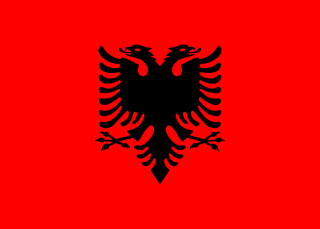
Albania
Republic of Albania
Population: UN WPP 2024, revision 1, projection for 1 July 2026. Sources and methodology.
Geography and territory
Albania sits in southeastern Europe on the western edge of the Balkan Peninsula, covering 28,748 square kilometers along the shores of the Adriatic and Ionian seas. Its coastline stretches roughly 450 kilometers, and at its narrowest point the Strait of Otranto separates Albania from Italy by just 72 kilometers, giving this small country an outsized strategic position in the central Mediterranean.
More than 70 percent of Albanian territory is covered by mountains and hills. The Albanian Alps, also known as the North Albanian Alps or Accursed Mountains, form one of the wildest and least-explored corners of Europe, with peaks exceeding 2,500 meters, deep valleys, and villages reachable only on foot. Mount Korab, shared with North Macedonia, is the country’s highest point at 2,764 meters. Albania borders Montenegro, Kosovo, North Macedonia, and Greece, and its landscape softens toward the coastal plains and interior basins, offering a striking contrast to the northern highlands.
Water defines much of the Albanian landscape, with rivers tumbling from the mountains toward the sea and three major lakes anchoring its borders: Lake Ohrid, shared with North Macedonia; Lake Prespa; and Lake Shkodra, shared with Montenegro. Lake Ohrid ranks among Europe’s oldest and deepest lakes, harboring species found nowhere else on the planet. The climate ranges from Mediterranean along the coast to continental in the interior basins and alpine across the northern mountains, and this diversity of elevation and rainfall packs an unusually wide range of habitats, from coastal wetlands to subalpine forest, into a comparatively small national territory.
History
Albania’s story begins with the Illyrians, an ancient people who inhabited the western Balkans from the Bronze Age onward and resisted Greek, Macedonian, and Roman expansion for centuries before finally falling under Roman control in the second century BC. The region later passed to the Byzantine Empire, leaving behind a rich archaeological legacy still visible at sites such as Butrint, now a UNESCO World Heritage property.
The country’s most celebrated historical figure is Gjergj Kastrioti, known as Skanderbeg, who led a fierce twenty-five-year resistance against Ottoman expansion in the fifteenth century, uniting rival Albanian chieftains under a single banner from his mountain stronghold at Krujë. Although the Ottomans finally subdued Albania after Skanderbeg’s death in 1468, his legacy as a defender of freedom became a cornerstone of Albanian national identity and is still celebrated in statues, currency, and street names across the country today. Ottoman rule lasted nearly five centuries and reshaped Albanian society profoundly, including a widespread conversion to Islam.
Albania declared independence from the Ottoman Empire on 28 November 1912, but its modern history proved turbulent. After a period of instability and the monarchy of Ahmet Zogu, the country fell under the communist dictatorship of Enver Hoxha from 1944 to 1985, one of the most closed and repressive regimes in the world. Hoxha severed ties with both the Soviet Union and China, sealed the country off almost entirely, and had more than 170,000 concrete bunkers built across the landscape. Democratic transition began in 1991, and Albania has since moved steadily toward European integration, joining NATO in 2009 and pursuing candidacy for European Union membership.
Culture and society
Albanian culture stands apart as one of the most distinctive in Europe, rooted in traditions that trace back to Illyrian times and shared today among a population of about 2.8 million. The Albanian language itself is a linguistic outlier: it forms its own independent branch of the Indo-European family, unrelated to any neighboring tongue, a striking marker of the culture’s antiquity and historical isolation.
Oral tradition runs deep, preserved through heroic epics, polyphonic songs, and legends passed down across generations. Albanian iso-polyphony, sung in multiple unaccompanied voices, has been recognized by UNESCO as part of humanity’s intangible cultural heritage. The Kanun, an ancient customary code attributed to the prince Lekë Dukagjini, governed social life in the northern highlands for centuries, laying out detailed rules on honor, hospitality, and conflict resolution.
Hospitality is treated as something close to sacred in Albanian society, captured in the saying that an Albanian’s home belongs first to God and then to the guest. The country also offers a striking example of religious coexistence, with Muslims, Orthodox Christians, and Catholics living side by side in harmony, and interfaith families are far from unusual. Albanians mark both religious and civic holidays with equal enthusiasm, and traditional weddings can unfold as elaborate, multi-day celebrations involving entire communities.
Economy
The Albanian economy has grown considerably since the fall of communism in 1991, though it remains among the less developed in Europe, with a gross domestic product of roughly $30.54 billion. The country has transformed from a fully closed state-run system into an open market economy, sustained by decades of structural reform and expanding foreign trade.
Services now lead the economy, accounting for more than half of GDP, with tourism emerging as an increasingly important growth engine. International visitors have discovered Albania in recent years, drawn by its unspoiled beaches, affordable prices, and rich cultural heritage. Agriculture still employs a substantial share of the workforce, producing olive oil, fruit, vegetables, and dairy products, while mining, particularly of chromium, for which Albania ranks among the world’s leading producers, remains an important sector.
Remittances sent home by the large Albanian diaspora, especially from Greece and Italy, provide vital income for many families and have historically rivaled foreign direct investment as a source of hard currency. Construction has also boomed alongside infrastructure modernization and real estate development in the country’s main cities, particularly along the coast where new resorts and marinas continue to reshape the shoreline. Ongoing challenges include a sizable informal economy, infrastructure gaps, corruption, and the continued emigration of young, skilled workers seeking opportunities in wealthier European Union countries.
Food and cuisine
Albanian cuisine draws on Mediterranean and Balkan traditions, filtered through centuries of Ottoman, Greek, and Italian influence and built on high-quality local ingredients. Olive oil, fresh vegetables, sheep and goat cheeses, lamb, and aromatic herbs form the foundation of a generous and flavorful table. Byrek, a flaky pastry filled with spinach, cheese, or meat, may be the country’s single most popular dish, eaten equally for breakfast or as a snack throughout the day.
Among the most emblematic dishes are tavë kosi, baked lamb with yogurt and rice widely regarded as the national dish; fërgesë, a rich stew of peppers, tomato, and cottage cheese; qofte, grilled meatballs; and pasticio, an Albanian take on baked pasta with minced meat and béchamel. Northern cooking tends toward heartier, meat-forward dishes, while the south and the coast lean into seafood and fresh produce. Meze spreads of small shared plates echo culinary traditions found across the wider Mediterranean.
Rakia, a grape or fruit brandy, is the national drink and a customary gesture of welcome offered in nearly every home and restaurant. Albanian wine, though little known internationally, has ancient roots and is enjoying a modern revival through a new generation of quality-focused wineries. Turkish coffee and espresso are woven into everyday social life, and pastry shops sell Ottoman-inherited sweets such as baklava, kadaif, and trileçe, a milk-soaked cake layered with three kinds of cream.
Tourism and landmarks
Albania has emerged as one of Europe’s most exciting up-and-coming destinations. The Albanian Riviera, along the southern Ionian coast, offers crystalline turquoise waters that rival the Caribbean at a fraction of the cost of other Mediterranean getaways. Ksamil, Dhërmi, Himarë, and Porto Palermo are coastal gems set against mountains that plunge dramatically toward the sea.
Berat, the “city of a thousand windows,” and Gjirokastër, the “city of stone,” are twin jewels of Ottoman-era heritage recognized as UNESCO World Heritage sites. Their tiered stone houses climbing the hillsides, medieval fortresses, and mosques and churches offer a genuine journey back in time. Butrint, near the southern tip of the country, is an exceptional archaeological site spanning Greek through Venetian periods, set within a landscape of lagoons and Mediterranean forest.
Tirana, the capital, surprises visitors with its vibrant urban renewal, pastel-colored buildings, buzzing café culture, and youthful energy. The Albanian Alps, accessible from the villages of Theth and Valbona, offer some of the most spectacular and untouched mountain scenery in Europe, with hiking trails winding through glacial valleys and remote hamlets. Lake Ohrid, in the southeast, pairs freshwater beaches with centuries of cultural heritage, while the thousands of communist-era bunkers scattered across the country add a uniquely surreal touch to the landscape.
Fun facts about Albania
- Albania is dotted with more than 170,000 concrete bunkers built under Enver Hoxha’s communist dictatorship, roughly one for every eighteen people alive at the time.
- The Albanian language forms its own independent branch of the Indo-European family, with no close living relatives.
- Albania ranks among the world’s most religiously tolerant countries, with Muslims, Orthodox Christians, and Catholics coexisting peacefully, including within the same families.
- Mother Teresa was of Albanian descent, born in Skopje to ethnic Albanian parents.
- The two-headed eagle on the national flag gives Albania its native name, Shqipëria, meaning “land of the eagles.”
- Lake Ohrid, shared with North Macedonia, is one of the oldest lakes on Earth and home to species found nowhere else.
Albania in numbers
Latest World Bank and UNDP observations, each with its own year. “World median” is the middle value among the countries that report the same indicator; “#” ranks from the highest value.
Population since 1960
Albania had 1.6 million people in 1960 and 2.3 million in 2025 — 46% more.
The population peaked at 3.3 million in 1990 and has since declined.
People
58.9% of people live in towns and cities (world median 63.4%). 16.6% are under 15 and 17.6% are 65 or older — an ageing population. Women have 1.34 children on average, below the replacement level of about 2.1 needed to keep a population stable in the long run without migration.
Economy
The economy grew by 3.8% in real terms in 2025. Consumer prices rose by 2.1% in 2025. Services make up the largest share of output (49.7% of GDP); agriculture contributes 14.8%.
Development and environment
UNDP rates human development in Albania as very high, with an index of 0.810 in 2023 (rank 71 of 193). 85.9% of people use the internet and 100.0% have access to electricity. Forest covers 34.3% of the land (world median 32.8%).
Sources: World Bank, World Development Indicators (CC BY 4.0), most recent observation from 2015 onward; UNDP Human Development Report 2025. Retrieved 2026-10-10. Sector shares need not add up to 100% because taxes and subsidies on products are excluded. Missing values are left blank rather than estimated. Sources and methodology.
Climate of Albania
Averaged across Albania, the warmest month is August (22.5 °C) and the coolest is January (3.2 °C), a seasonal swing of 19.3 °C. The annual mean is 12.4 °C.
About 1,120 mm of precipitation falls in a typical year. November is the wettest month (152 mm) and July the driest (37 mm). The wettest stretch is November to January, with 38% of the year's total.
Show monthly values as a table
| Month | Mean °C | Low °C | High °C | Precipitation, mm |
|---|---|---|---|---|
| January | 3.2 | −0.7 | 7.1 | 119 |
| February | 4.1 | 0.0 | 8.3 | 100 |
| March | 7.1 | 2.5 | 11.8 | 95 |
| April | 10.9 | 6.1 | 15.8 | 89 |
| May | 15.6 | 10.2 | 21.0 | 77 |
| June | 19.4 | 13.5 | 25.4 | 55 |
| July | 22.2 | 15.9 | 28.5 | 37 |
| August | 22.5 | 16.1 | 28.9 | 43 |
| September | 17.9 | 12.3 | 23.7 | 93 |
| October | 13.3 | 8.4 | 18.3 | 110 |
| November | 8.7 | 4.7 | 12.9 | 152 |
| December | 4.4 | 0.8 | 8.1 | 150 |
Figures are 1991–2020 averages across the whole land area of Albania, from the World Bank Climate Change Knowledge Portal, CRU TS 4.08 (CC BY 4.0). They are not readings from one weather station: the capital, the coast and high ground can be much warmer, cooler, wetter or drier.
Travel essentials for Albania
The practical details visitors ask about first. Traffic in Albania drives on the right, like most of the world. Mains electricity is 230 V at 50 Hz, so devices made only for 110–120 V (common in North America) need a converter unless they are dual-voltage — most phone and laptop chargers are.
- Emergency number
- 112
- Driving side
- Right
- Plug types
- Type C, Type FC: two round pins (Europlug); F: two round pins with side earth clips (Schuko)
- Voltage
- 230 V50 Hz
- Dialling code
- +355From abroad: your exit code, then 355 and the number
- Currency
- Albanian Lek (ALL)
- Time zone
- CET (UTC+1)Current local time in Albania
Compiled from IEC plug and voltage standards, national emergency-service listings and the UN road-traffic conventions. Emergency numbers and local coverage can change — confirm them locally on arrival. Albania's internet domain is .al.
Where Albania ranks in the world
Each position counts only the countries with data in that ranking guide. First place is the highest value — for price levels, the most expensive. Select a card to see the full table.
- Population142nd of 1962.8 millionUN projection, July 2026
- Land area142nd of 19527,400 km²World Bank, 2023
- Population density97th of 19488 per km²World Bank, 2023
- GDP (nominal)109th of 187$27.0BWorld Bank, 2024, current US$
- GDP per capita77th of 187$11,374World Bank, 2024, current US$
- Life expectancy42nd of 19479.8 yearsWorld Bank, 2024
- Price level73rd of 16549 (US = 100)ICP 2021, household consumption
Bordering countries of Albania


Compare Albania with another country
Frequently asked questions about Albania
What is the capital of Albania?
The capital of Albania is Tirana.
What is the population of Albania?
The UN World Population Prospects projection for Albania is 2,751,025 people (2.8 million) on 1 July 2026. National statistical offices may publish different estimates.
What language is spoken in Albania?
The official language of Albania is Albanian.
What currency is used in Albania?
The currency of Albania is the Albanian Lek (ALL).
How big is Albania?
Albania covers an area of 28,748 km².
What type of government does Albania have?
Albania is a parliamentary republic.
Which countries border Albania?
Albania shares land borders with Montenegro, Kosovo, North Macedonia, Greece.
What is the highest point in Albania?
The highest point in Albania is Mount Korab (2,764 m).


