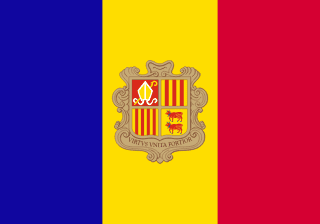
Andorra
Principality of Andorra
Population: UN WPP 2024, revision 1, projection for 1 July 2026. Sources and methodology.
Geography and territory
Andorra is a tiny mountain state tucked between Spain and France, covering just 468 square kilometers, making it one of the smallest countries in Europe. Its territory is entirely mountainous, with an average elevation of nearly 2,000 meters above sea level that makes it the highest country on the continent. Narrow valleys, jagged ridgelines, and glacial cirques define a dramatic alpine landscape packed into a remarkably compact space.
The country’s highest point is Coma Pedrosa, reaching 2,942 meters in the parish of La Massana. Andorra is organized around the Gran Valira river valley and its tributaries, mountain streams that converge at the capital, Andorra la Vella, itself the highest capital city in Europe at 1,023 meters above sea level. Forests of black pine and fir blanket the slopes up to roughly 2,300 meters, giving way above that line to alpine meadows and high-mountain terrain. Andorra shares its only two borders with Spain and France.
The climate is thoroughly alpine, with cold, snowy winters that sustain an excellent ski season and cool, pleasant summers ideal for hiking. Precipitation is moderate, with frequent snowfall between November and April. For such a small territory, biodiversity is notable, including species such as the Pyrenean chamois, the alpine marmot, and the bearded vulture, protected within areas like Sorteny Natural Park and the Comapedrosa Valleys Natural Park, which together safeguard a significant share of the country’s alpine meadows and rocky highlands from development.
History
Andorra’s early history blends legend with documented fact. Tradition credits Charlemagne with granting the valley’s inhabitants a charter of liberties in gratitude for their help against Muslim forces, though the earliest surviving document to mention Andorra dates only to the year 839, when a consecration record for the cathedral of La Seu d’Urgell listed the Andorran parishes among the bishop’s possessions.
The true founding moment of the Andorran state came with the Paréages of 1278 and 1288, agreements establishing joint sovereignty between the Bishop of Urgell and the Count of Foix. These accords created the singular system of government that endures today, under which Andorra has two co-princes serving simultaneously as heads of state: the Bishop of La Seu d’Urgell and the holder of the rights once belonging to the Count of Foix, a title that passed to the kings of France and now rests with the President of the French Republic.
For centuries, Andorra remained a rural, isolated society built around livestock herding, smuggling, and cross-border trade. Dramatic change arrived in the second half of the twentieth century with the rise of commercial and ski tourism. In 1993, Andorra adopted its first written constitution, formally establishing itself as a democratic state under the rule of law, and joined both the United Nations and the Council of Europe, cementing its international sovereignty while preserving the co-principality as its distinctive form of government.
Culture and society
Andorran culture is rooted in Catalan Pyrenean tradition, and Catalan is the country’s sole official language, making Andorra the only sovereign state in the world where Catalan holds that status. Local traditions include patron saint festivals with sardana dancing, summer solstice fire rituals recognized by UNESCO as part of the intangible heritage of Pyrenean fire festivals, and the celebration of the Diada de Meritxell, honoring the country’s patron saint, on September 8.
Andorra’s architectural heritage is modest in scale but historically significant. Romanesque churches dating to the eleventh and twelfth centuries, such as Sant Joan de Caselles, Santa Coloma, and Sant Martí de la Cortinada, preserve medieval frescoes and stone bell towers from the era when these valleys belonged to the bishopric of Urgell. The Casa de la Vall, seat of the Consell General since 1702, stands as the enduring symbol of Andorran self-government and houses one of the smallest parliaments in the world.
Modern Andorran society, numbering 82,904 people, is remarkably cosmopolitan: Andorran nationals make up less than half of all residents, alongside sizable communities of Spaniards, Portuguese, and French who have settled in the country over recent decades to work in tourism, retail, and construction. Living standards are high, with life expectancy exceeding 83 years, among the highest in the world, and low crime rates reinforce Andorra’s reputation as one of the safest places to live in Europe. The country maintains no army of its own, relying on Spain and France for defense, and its tradition of neutrality is reflected in the Cos de Policia, the sole domestic security force in this peaceful microstate.
Economy
Tourism forms the backbone of Andorra’s economy, generating more than 80 percent of GDP and drawing over ten million visitors a year, an extraordinary figure for a country of roughly 83,000 residents. Ski tourism centered on Grandvalira, the largest ski domain in the Pyrenees, and Vallnord draws hundreds of thousands of skiers each winter, while retail tourism, fueled by favorable tax rates and competitive prices, sustains a shopping sector disproportionately large for the country’s size.
The financial sector is the second pillar of the economy. Andorran banking, traditionally known for its discretion, has had to adapt to international standards of fiscal transparency in recent years. Andorra introduced a personal income tax in 2015 and has signed multiple tax information-sharing agreements, gradually shedding its old reputation as a tax haven. Real estate and construction round out the productive base, supported by a gross domestic product of roughly $4.5 billion.
Andorra is not a member of the European Union, though it uses the euro as its official currency under a monetary agreement, and it continues to negotiate an association agreement with the EU that could reshape its economic model significantly. The absence of income tax until recent years, together with a reduced value-added tax of 4.5 percent, continues to draw high-net-worth residents and businesses seeking favorable fiscal conditions.
Food and cuisine
Andorran cuisine reflects its Pyrenean mountain setting: hearty and warming, built to sustain people through harsh high-altitude winters. Escudella, a stew of pork, beef, chicken, and vegetables served with galets pasta and pilota, a large meatball of ground meat and bread, is the great festive dish of the country, inherited from Catalan tradition and traditionally served in two courses, first the broth with pasta, then the meat and vegetables.
Trinxat, a thick pan-fried cake of potato and cabbage topped with crispy bacon, may be the single most representative dish of Andorran mountain cooking. Grilled meats, especially lamb and pork cooked over wood fires, take center stage at family gatherings, while artisanal cured sausages such as llonganissa and bull, a type of blood sausage, follow recipes handed down from the traditional winter pig slaughter.
Mountain dairy products, including artisanal cheeses made from cow’s and sheep’s milk, and honey gathered from alpine wildflowers, round out the local pantry as prized delicacies. Coca, a flat sweet or savory cake with many regional variations, along with simple apple and walnut desserts, complete an unpretentious but authentic dessert tradition. High-altitude vineyards, a recent initiative capitalizing on the Pyrenean terroir, and herbal liqueurs such as ratafia accompany the Andorran table.
Tourism and landmarks
Ski resorts are Andorra’s premier tourist draw. Grandvalira, with more than 200 kilometers of slopes spread across the Soldeu, El Tarter, Pas de la Casa, Grau Roig, Canillo, and Encamp sectors, is the largest ski area in the Pyrenees and one of the biggest in southern Europe. Vallnord, encompassing the Pal-Arinsal and Ordino-Arcalís sectors, offers a more family-oriented atmosphere amid spectacular high-mountain scenery.
In summer, Andorra transforms into a haven for hiking, mountain biking, and rock climbing. The Camí de Ferro trail winds through former mining sites, while the paths of Sorteny Natural Park reveal alpine flora and glacial cirque lakes. The Caldea thermal spa complex in Escaldes-Engordany is the largest thermal water center in southern Europe, offering pools, jacuzzis, and treatments inside a striking glass-and-steel building designed by architect Jean-Michel Ruols.
Andorra’s Romanesque heritage is scattered across small churches throughout the valleys, including Sant Joan de Caselles with its Gothic altarpiece, Santa Coloma with its distinctive circular bell tower, and Sant Martí de la Cortinada with its medieval frescoes. The Casa de la Vall in Andorra la Vella offers guided tours through the chambers where the Consell General has governed the country for centuries. The medieval Margineda Bridge and the Tobacco Museum in Sant Julià de Lòria round out a cultural itinerary through this singular Pyrenean microstate.
Fun facts about Andorra
- Andorra is the only sovereign country in the world with Catalan as its sole official language.
- The country has no army of its own; Spain and France provide for its defense, and its only security force is the local police.
- Andorra la Vella is the highest capital city in Europe, sitting at 1,023 meters above sea level.
- The President of France serves as co-prince of Andorra, the only instance of a democratically elected head of state simultaneously reigning as co-monarch of another country.
- Andorra welcomes more than ten million visitors each year, well over one hundred times its resident population.
- Until 1993, Andorra had no written constitution and was governed under the medieval Paréages of 1278.
Andorra in numbers
Latest World Bank and UNDP observations, each with its own year. “World median” is the middle value among the countries that report the same indicator; “#” ranks from the highest value.
Population since 1960
Andorra had 9,510 people in 1960 and 82,904 in 2025 — 8.7 times as many.
People
88.9% of people live in towns and cities (world median 63.4%). 11.6% are under 15 and 16.6% are 65 or older — an ageing population. Women have 1.09 children on average, below the replacement level of about 2.1 needed to keep a population stable in the long run without migration.
Economy
The economy grew by 3.9% in real terms in 2025. Services make up the largest share of output (77.8% of GDP); agriculture contributes 0.5%.
Development and environment
UNDP rates human development in Andorra as very high, with an index of 0.913 in 2023 (rank 32 of 193). 94.4% of people use the internet and 100.0% have access to electricity. Forest covers 38.9% of the land (world median 32.8%).
Sources: World Bank, World Development Indicators (CC BY 4.0), most recent observation from 2015 onward; UNDP Human Development Report 2025. Retrieved 2026-10-10. Sector shares need not add up to 100% because taxes and subsidies on products are excluded. Missing values are left blank rather than estimated. Sources and methodology.
Climate of Andorra
Averaged across Andorra, the warmest month is July (17.0 °C) and the coolest is February (1.0 °C), a seasonal swing of 16.0 °C. The annual mean is 8.2 °C.
About 1,043 mm of precipitation falls in a typical year. October is the wettest month (113 mm) and February the driest (54 mm). Rain is spread fairly evenly through the year.
Show monthly values as a table
| Month | Mean °C | Low °C | High °C | Precipitation, mm |
|---|---|---|---|---|
| January | 1.1 | −2.6 | 4.9 | 87 |
| February | 1.0 | −3.3 | 5.4 | 54 |
| March | 3.8 | −0.9 | 8.6 | 85 |
| April | 5.8 | 1.0 | 10.6 | 90 |
| May | 9.8 | 4.7 | 15.0 | 108 |
| June | 13.9 | 8.4 | 19.6 | 91 |
| July | 17.0 | 11.2 | 22.9 | 68 |
| August | 17.0 | 11.2 | 22.8 | 80 |
| September | 13.6 | 8.5 | 18.8 | 91 |
| October | 9.4 | 5.1 | 13.7 | 113 |
| November | 4.5 | 0.6 | 8.4 | 98 |
| December | 1.9 | −1.7 | 5.4 | 79 |
Figures are 1991–2020 averages across the whole land area of Andorra, from the World Bank Climate Change Knowledge Portal, CRU TS 4.08 (CC BY 4.0). They are not readings from one weather station: the capital, the coast and high ground can be much warmer, cooler, wetter or drier.
Travel essentials for Andorra
The practical details visitors ask about first. Traffic in Andorra drives on the right, like most of the world. Mains electricity is 230 V at 50 Hz, so devices made only for 110–120 V (common in North America) need a converter unless they are dual-voltage — most phone and laptop chargers are.
- Emergency number
- 112
- Driving side
- Right
- Plug types
- Type C, Type FC: two round pins (Europlug); F: two round pins with side earth clips (Schuko)
- Voltage
- 230 V50 Hz
- Dialling code
- +376From abroad: your exit code, then 376 and the number
- Currency
- Euro (EUR)
- Time zone
- CET (UTC+1)Current local time in Andorra
Compiled from IEC plug and voltage standards, national emergency-service listings and the UN road-traffic conventions. Emergency numbers and local coverage can change — confirm them locally on arrival. Andorra's internet domain is .ad.
Where Andorra ranks in the world
Each position counts only the countries with data in that ranking guide. First place is the highest value — for price levels, the most expensive. Select a card to see the full table.
- Population186th of 19683,753UN projection, July 2026
- Land area179th of 195470 km²World Bank, 2023
- Population density54th of 194172 per km²World Bank, 2023
- GDP (nominal)159th of 187$4.0BWorld Bank, 2024, current US$
- GDP per capita24th of 187$49,357World Bank, 2024, current US$
- Life expectancy6th of 19484.2 yearsWorld Bank, 2024
Bordering countries of Andorra


Compare Andorra with another country
Frequently asked questions about Andorra
What is the capital of Andorra?
The capital of Andorra is Andorra la Vella.
What is the population of Andorra?
The UN World Population Prospects projection for Andorra is 83,753 people (83,753) on 1 July 2026. National statistical offices may publish different estimates.
What language is spoken in Andorra?
The official language of Andorra is Catalan.
What currency is used in Andorra?
The currency of Andorra is the Euro (EUR).
How big is Andorra?
Andorra covers an area of 468 km².
What type of government does Andorra have?
Andorra is a parliamentary co-principality.
Which countries border Andorra?
Andorra shares land borders with Spain, France.
What is the highest point in Andorra?
The highest point in Andorra is Coma Pedrosa (2,942 m).


