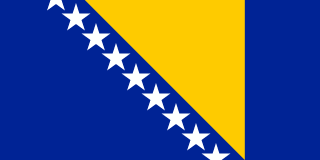
Bosnia and Herzegovina
Bosnia and Herzegovina
Population: UN WPP 2024, revision 1, projection for 1 July 2026. Sources and methodology.
Geography and territory
Bosnia and Herzegovina sits in southeastern Europe, at the heart of the Balkan Peninsula. Covering 51,197 square kilometers, the country borders Croatia to the north, west, and south, Serbia to the east, and Montenegro to the southeast. Although overwhelmingly landlocked, Bosnia and Herzegovina holds a tiny stretch of Adriatic coastline, barely 20 kilometers long, around the town of Neum, making it one of the countries with the shortest coastline in the world.
The terrain is predominantly mountainous and heavily forested, with the Dinaric Alps running the length of the country from northwest to southeast. Forest covers more than 60 percent of the land, including some of the last old-growth woodlands remaining in Europe. Mount Maglić, on the border with Montenegro, rises to 2,386 meters as the country’s highest peak. The Neretva, Vrbas, Bosna, and Una rivers carve dramatic valleys and canyons, their emerald waters ranking among the purest in Europe.
The country’s name reflects its geographic duality: Bosnia refers to the larger northern and central region, named for the Bosna River, while Herzegovina occupies the south, a region of more Mediterranean character named for the medieval title of “herceg,” or duke. This split produces marked climatic variety, with cold, snowy winters in the mountains of the center and north, and warm, dry summers across southern Herzegovina.
History
The history of Bosnia and Herzegovina is a dense weave of civilizations, empires, and cultures that has made it one of the most multicultural regions in Europe. Roman settlement left a lasting mark before Slavic peoples arrived in the sixth century. The medieval Kingdom of Bosnia, under Ban Kulin and later King Tvrtko I in the fourteenth century, enjoyed a period of independence and prosperity unusual among the Balkan states of its time.
The Ottoman conquest of 1463 reshaped society profoundly. Over more than four centuries of Ottoman rule, a substantial part of the population converted to Islam, producing the distinctive ethnic and religious makeup that still defines the country today: Bosniaks, who are predominantly Muslim; Serbs, who are predominantly Orthodox Christian; and Croats, who are predominantly Catholic. Sarajevo grew into one of the most important Ottoman cities in Europe, its mosques, bazaars, bathhouses, and libraries earning it the nickname the “Jerusalem of Europe.”
The assassination of Archduke Franz Ferdinand in Sarajevo in 1914 triggered the outbreak of the First World War. Bosnia and Herzegovina became part of Yugoslavia through most of the twentieth century, and Yugoslavia’s breakup in the 1990s led to the devastating Bosnian War (1992-1995), one of the bloodiest conflicts in Europe since the Second World War. The 1995 Dayton Accords ended the fighting and established the country’s current political structure, split between two entities, the Federation of Bosnia and Herzegovina and Republika Srpska.
Culture and society
The culture of Bosnia and Herzegovina is an extraordinary meeting point of East and West, where Ottoman and Austro-Hungarian traditions, along with Islamic, Orthodox, and Catholic faiths, are woven into a social fabric found nowhere else in Europe. This multiculturalism shows plainly in the country’s architecture, where mosques, Orthodox churches, Catholic cathedrals, and synagogues stand within a short walk of one another, especially in Sarajevo.
Bosnia’s literary tradition is rich and internationally recognized. Ivo Andrić, born in Bosnia, won the Nobel Prize in Literature in 1961 for works including “The Bridge on the Drina,” which traces the country’s centuries-long history through the story of an Ottoman-era bridge at Višegrad. Meša Selimović, author of “Death and the Dervish,” is another towering figure in Bosnian letters. Bosnian cinema has earned international acclaim as well, with directors such as Emir Kusturica and Danis Tanović, whose film “No Man’s Land” won the Academy Award for Best Foreign Language Film in 2002.
Sevdalinka, a melancholic love song with Ottoman-Bosnian roots, is the country’s most emblematic musical form, sung with deep emotion to capture “sevdah,” a distinctly Bosnian feeling of longing and nostalgia. Despite the lingering wounds of war, Bosnian society is known for its proverbial hospitality, resilient sense of humor, and a coffee culture that goes well beyond the everyday to become a genuine social ritual. Bosnian coffee, brewed in a copper džezva pot, is served with ceremony and meant to be savored slowly.
Economy
The economy of Bosnia and Herzegovina has recovered considerably since the devastation of the 1990s war, though structural challenges remain. With a gross domestic product of roughly $32.6 billion, the country runs a developing market economy that leans on services, manufacturing, and agriculture. Its decentralized political structure, split across two entities and one district, adds a layer of administrative complexity that complicates economic reform.
The industrial sector includes metalworking, mining, timber processing, textiles, and electricity generation. Abundant water resources feed hydroelectric plants, making Bosnia and Herzegovina a net exporter of electricity. Agriculture yields fruit, particularly plums, along with vegetables, tobacco, and dairy products. Remittances from the Bosnian diaspora, one of the largest in Europe relative to population size, represent a significant source of national income.
Tourism has emerged as a promising growth sector, with Sarajevo and Mostar serving as the country’s leading draws for a rising number of international visitors. The country offers competitive prices and authentic experiences that set it apart from more heavily trafficked destinations. Leading economic challenges include unemployment, particularly among young people, the emigration of skilled workers, a sizable informal economy, and the need for institutional reform to advance European integration.
Food and cuisine
The cuisine of Bosnia and Herzegovina ranks among the most satisfying in the Balkans, the product of a distinctive fusion of Ottoman, Mediterranean, and Central European traditions. Ćevapi, small grilled minced-meat rolls served in somun flatbread with raw onion and kajmak, a rich clotted cream, stands as the country’s most iconic dish and a genuine source of local pride. Sarajevo and Banja Luka maintain a friendly rivalry over which city makes the best version.
Ottoman influence appears throughout, in dishes such as burek, a rolled pastry filled with meat, and its cheese, spinach, and potato variants known as sirnica, zeljanica, and krompiruša; dolma, vegetables stuffed with rice and meat; begova čorba, a thick and creamy chicken soup; and sogan dolma, stuffed onions. Bosnian cooking tends to be generous and communal, with meals serving as occasions for family and social gathering.
Bosnian pastry carries forward the Ottoman sweet-making tradition directly. Baklava, made with walnuts and syrup, hurmašice, syrup-soaked sponge cakes, tufahije, apples stuffed with walnuts and poached in syrup, and sutlijaš, a rice pudding, round out any festive meal. Bosnian coffee, prepared according to a precise ritual in a copper džezva and served with rahat lokum and a sugar cube, is a cultural experience in its own right. Plum rakia is the spirit of choice for toasts and celebrations.
Tourism and landmarks
Sarajevo, the capital, ranks among the most fascinating cities in Europe, a place where East and West blend seamlessly. The Ottoman quarter of Baščaršija, with its copper bazaar, mosques, and cafés, gives way within a few blocks to the Austro-Hungarian elegance of nineteenth-century boulevards. The Latin Bridge, site of the assassination that set off the First World War, and the wartime Tunnel of Hope stand as moving reminders of the city’s layered history.
Mostar and its iconic Old Bridge, or Stari Most, form the country’s most photographed image. This sixteenth-century Ottoman bridge, destroyed during the war in 1993 and rebuilt in 2004, arches gracefully over the emerald waters of the Neretva River and is recognized as a UNESCO World Heritage Site. Divers who leap from its 24-meter span into the river below carry on a tradition that stretches back centuries. Around Mostar, visitors can also explore the Ottoman village of Počitelj, the Kravice waterfalls, and the medieval town of Blagaj, with its dervish lodge perched beside the source of the Buna River.
Bosnian nature is spectacular and, in large part, untouched. Sutjeska National Park protects Perućica, one of the last two primeval forests remaining in Europe, along with Mount Maglić. Una National Park, with its terraced turquoise waterfalls, is a haven for rafting and kayaking. Jajce, with an urban waterfall dropping 22 meters in the middle of town, the prehistoric-claimed pyramids of Visoko, and the Ottoman town of Travnik round out a diverse and authentic tourism offering that positions Bosnia and Herzegovina among Europe’s most compelling emerging destinations.
Fun facts about Bosnia and Herzegovina
- Sarajevo was the first city in continental Europe to run an electric tram, introduced in 1885, ahead of many major Western European capitals.
- Bosnia and Herzegovina has one of the shortest coastlines in the world, just 20 kilometers around Neum, which also interrupts the continuity of Croatia’s own coast.
- Mostar’s Old Bridge was rebuilt stone by stone after its destruction in 1993, using original sixteenth-century Ottoman construction techniques.
- Bosnian coffee follows its own distinct preparation and serving ritual, separate from Turkish coffee, and is always accompanied by rahat lokum and a sugar cube.
- Perućica, within Sutjeska National Park, is one of only two primeval forests still surviving in Europe.
Bosnia and Herzegovina in numbers
Latest World Bank and UNDP observations, each with its own year. “World median” is the middle value among the countries that report the same indicator; “#” ranks from the highest value.
Population since 1960
Bosnia and Herzegovina had 3.3 million people in 1960 and 3.1 million in 2025 — almost the same number.
The population peaked at 4.5 million in 1991 and has since declined.
People
52.7% of people live in towns and cities (world median 63.4%). 12.8% are under 15 and 22.9% are 65 or older — one of the oldest age structures in the world. Women have 1.49 children on average, below the replacement level of about 2.1 needed to keep a population stable in the long run without migration.
Economy
The economy grew by 2.1% in real terms in 2025. Consumer prices rose by 4.0% in 2025. Services make up the largest share of output (57.7% of GDP); agriculture contributes 4.4%.
Development and environment
UNDP rates human development in Bosnia and Herzegovina as very high, with an index of 0.804 in 2023 (rank 74 of 193). 86.1% of people use the internet and 100.0% have access to electricity. Forest covers 42.2% of the land (world median 32.8%).
Sources: World Bank, World Development Indicators (CC BY 4.0), most recent observation from 2015 onward; UNDP Human Development Report 2025. Retrieved 2026-10-10. Sector shares need not add up to 100% because taxes and subsidies on products are excluded. Missing values are left blank rather than estimated. Sources and methodology.
Climate of Bosnia and Herzegovina
Averaged across Bosnia and Herzegovina, the warmest month is August (20.3 °C) and the coolest is January (0.4 °C), a seasonal swing of 19.9 °C. The annual mean is 10.3 °C.
About 1,104 mm of precipitation falls in a typical year. November is the wettest month (120 mm) and August the driest (68 mm).
Show monthly values as a table
| Month | Mean °C | Low °C | High °C | Precipitation, mm |
|---|---|---|---|---|
| January | 0.4 | −2.9 | 3.8 | 76 |
| February | 1.7 | −2.2 | 5.7 | 78 |
| March | 5.4 | 0.7 | 10.2 | 69 |
| April | 9.9 | 4.9 | 15.0 | 84 |
| May | 14.4 | 9.0 | 19.8 | 98 |
| June | 18.0 | 12.6 | 23.5 | 93 |
| July | 20.1 | 14.1 | 26.2 | 87 |
| August | 20.3 | 14.1 | 26.5 | 68 |
| September | 15.6 | 9.8 | 21.4 | 109 |
| October | 10.8 | 5.9 | 15.7 | 107 |
| November | 6.0 | 2.2 | 9.8 | 120 |
| December | 0.9 | −2.3 | 4.1 | 114 |
Figures are 1991–2020 averages across the whole land area of Bosnia and Herzegovina, from the World Bank Climate Change Knowledge Portal, CRU TS 4.08 (CC BY 4.0). They are not readings from one weather station: the capital, the coast and high ground can be much warmer, cooler, wetter or drier.
Travel essentials for Bosnia and Herzegovina
The practical details visitors ask about first. Traffic in Bosnia and Herzegovina drives on the right, like most of the world. Mains electricity is 230 V at 50 Hz, so devices made only for 110–120 V (common in North America) need a converter unless they are dual-voltage — most phone and laptop chargers are.
- Emergency number
- 112
- Driving side
- Right
- Plug types
- Type C, Type FC: two round pins (Europlug); F: two round pins with side earth clips (Schuko)
- Voltage
- 230 V50 Hz
- Dialling code
- +387From abroad: your exit code, then 387 and the number
- Currency
- Convertible Mark (BAM)
- Time zone
- CET (UTC+1)Current local time in Bosnia and Herzegovina
Compiled from IEC plug and voltage standards, national emergency-service listings and the UN road-traffic conventions. Emergency numbers and local coverage can change — confirm them locally on arrival. Bosnia and Herzegovina's internet domain is .ba.
Where Bosnia and Herzegovina ranks in the world
Each position counts only the countries with data in that ranking guide. First place is the highest value — for price levels, the most expensive. Select a card to see the full table.
- Population136th of 1963.1 millionUN projection, July 2026
- Land area125th of 19551,200 km²World Bank, 2023
- Population density123rd of 19462 per km²World Bank, 2023
- GDP (nominal)108th of 187$29.7BWorld Bank, 2024, current US$
- GDP per capita81st of 187$9,398World Bank, 2024, current US$
- Life expectancy53rd of 19478.0 yearsWorld Bank, 2024
- Price level89th of 16545 (US = 100)ICP 2021, household consumption
Bordering countries of Bosnia and Herzegovina


Compare Bosnia and Herzegovina with another country
Frequently asked questions about Bosnia and Herzegovina
What is the capital of Bosnia and Herzegovina?
The capital of Bosnia and Herzegovina is Sarajevo.
What is the population of Bosnia and Herzegovina?
The UN World Population Prospects projection for Bosnia and Herzegovina is 3,114,242 people (3.1 million) on 1 July 2026. National statistical offices may publish different estimates.
What language is spoken in Bosnia and Herzegovina?
The official language of Bosnia and Herzegovina is Bosnian, Croatian, Serbian.
What currency is used in Bosnia and Herzegovina?
The currency of Bosnia and Herzegovina is the Convertible Mark (BAM).
How big is Bosnia and Herzegovina?
Bosnia and Herzegovina covers an area of 51,197 km².
What type of government does Bosnia and Herzegovina have?
Bosnia and Herzegovina is a federal parliamentary republic.
Which countries border Bosnia and Herzegovina?
Bosnia and Herzegovina shares land borders with Croatia, Serbia, Montenegro.
What is the highest point in Bosnia and Herzegovina?
The highest point in Bosnia and Herzegovina is Maglić (2,386 m).


