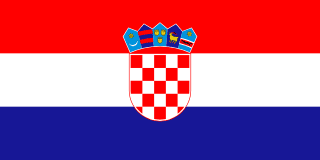
Croatia
Republic of Croatia
Population: UN WPP 2024, revision 1, projection for 1 July 2026. Sources and methodology.
Geography and territory
Croatia sits at a crossroads in southeastern Europe, linking Central Europe, the Mediterranean, and the Balkans. Covering 56,594 square kilometers, the country has an unusual crescent shape, curving from the flat Pannonian plains in the northeast down to a dramatic Adriatic coastline in the southwest. That coastline is among the most striking in Europe, running for more than 1,700 kilometers along the mainland alone and nearly 6,000 kilometers once its islands are counted.
Croatian territory includes more than 1,200 islands and islets, of which only around 50 are permanently inhabited; Hvar, Brač, Korčula, and Vis are the best known. The interior looks and feels entirely different from the coast. The plains of Slavonia in the east are fertile farmland watered by the Drava and Danube rivers, while the mountainous Lika and Gorski Kotar regions, part of the Dinaric Alps, form a rugged buffer between the interior and the sea. Croatia’s highest point, Dinara, rises to 1,831 meters along the border with Bosnia and Herzegovina.
The climate shifts sharply from region to region. The Adriatic coast enjoys a Mediterranean climate of hot, dry summers and mild winters, while the interior has a continental climate with hot summers and cold, often snowy winters. This variety supports rich biodiversity, protected across eight national parks and eleven nature parks that shelter everything from karst waterfalls to old-growth forest.
Rivers and lakes complement the coastline in shaping everyday Croatian life. The Sava and Drava cut across the northern plains before feeding into the Danube, historically important trade arteries and still central to agriculture and transport in Slavonia. Along the coast, a mild, breezy microclimate supports vineyards and olive groves on hillsides that drop almost directly into the sea, a landscape that has drawn settlers and traders to the Adriatic for thousands of years.
History
Croatia’s story begins with the arrival of Slavic Croats in the region during the seventh century. In 925, Tomislav became the first Croatian king, founding a medieval kingdom that remained independent until 1102, when Croatia entered a personal union with the Kingdom of Hungary. For centuries afterward, Croatian lands were contested ground among the Ottoman, Habsburg, and Venetian empires. Under Habsburg rule, Croatia retained a degree of autonomy and served as a military frontier against Ottoman advances, while the city of Dubrovnik flourished separately as the Republic of Ragusa, an independent maritime power that rivaled Venice in Mediterranean trade from the fourteenth century until Napoleon’s forces absorbed it in 1808.
After the First World War, Croatia became part of the Kingdom of Serbs, Croats and Slovenes, renamed Yugoslavia in 1929. A Nazi-backed puppet state controlled Croatian territory during the Second World War, after which Croatia was absorbed into Tito’s socialist Yugoslavia. Independence finally arrived on 25 June 1991, but it came at a heavy price: a four-year war that left deep scars across the country and its population.
In the decades since, Croatia has rebuilt its economy and institutions with striking speed, joining NATO in 2009, the European Union in 2013, and adopting the euro as its currency in 2023. That trajectory, from a war-torn breakaway republic to a fully integrated EU member state, is one of the notable success stories of postwar Europe.
Culture and society
Croatian culture blends Central European, Mediterranean, and Slavic influences into something distinctly its own. The country’s literary tradition runs deep, from Marko Marulić, regarded as the father of Croatian Renaissance literature, to the poet Ivan Gundulić, whose work captures the splendor of Ragusan Dubrovnik. In more recent times, novelist Miroslav Krleža and Nobel laureate Ivo Andrić, of Bosnian-Croatian background, left an indelible mark on twentieth-century letters.
Music varies markedly by region. Along the Dalmatian coast, klapa groups perform close-harmony a cappella singing recognized by UNESCO as intangible cultural heritage. Inland, the tamburica, a mandolin-like stringed instrument, drives the folk music of Slavonia, and the country has also produced respected classical composers such as Ivan Zajc.
Croatian society is predominantly Catholic, and religious feeling shapes many of its festivals and family traditions; Christmas and Easter are celebrated with particular warmth, and family ties remain central to social life in both the cities and the countryside. Sport occupies an outsized place in national life, with Croatians excelling in soccer, water polo, tennis, and basketball. The national soccer team’s run to the 2018 World Cup final in Russia was a landmark achievement for a country of fewer than four million people, and it remains a touchstone of national pride, alongside a long list of Olympic medalists in handball, rowing, and sailing.
Economy
Croatia’s economy is diversified and services-oriented, with a gross domestic product of roughly $105.06 billion. Tourism is the single largest driver of that output, and the country draws tens of millions of visitors annually, an extraordinary figure relative to its population and land area. That seasonal influx shapes much of the country’s economic rhythm, particularly along the coast.
Beyond tourism, Croatian industry is notable for shipbuilding, food processing, pharmaceuticals, and information technology. The port of Rijeka ranks among the most important on the northern Adriatic and serves as a key hub for regional maritime trade. Agriculture contributes a smaller share of output but yields quality wine, olive oil, and lavender, especially from the Dalmatian islands.
Since joining the European Union and adopting the euro in 2023, Croatia has become more tightly woven into the broader European market, easing cross-border trade and investment. The country still faces real challenges, including the emigration of skilled young workers toward wealthier parts of Western Europe and an economy that leans heavily on seasonal tourism concentrated in just a few summer months. Even so, growing investment in infrastructure, technology, and renewable energy points toward a more balanced and resilient economic future, and highways and rail links completed in recent years have made the country’s regions more accessible to one another than at any point in its history.
Food and cuisine
Croatian cuisine splits along the same geographic line that defines the rest of the country. Coastal cooking follows Mediterranean tradition, built around fresh fish, shellfish, olive oil, and vegetables. Black risotto colored with squid ink, brodetto fish stew, and oysters from the bay of Mali Ston are celebrated specialties, typically paired with crisp white wines such as Pošip and Malvasia grown on the coast.
Inland cooking feels more Central European. Kulen, a spicy cured pork sausage from Slavonia, is treated almost as a national treasure. Sarma, cabbage rolls stuffed with meat, čobanac, a peppery meat stew, and štrukli, a baked cheese pastry associated with Zagreb, all reflect Hungarian and Austrian influence and remain popular comfort food across the interior.
Coffee culture runs deep in Croatian daily life; a single cup on a café terrace can easily stretch into an hour or more of conversation. Regional pastries include kremšnita, a custard cream cake from Samobor, and rapska torta, an almond cake from the island of Rab made from a recipe kept within families for generations. Homemade liqueurs infused with herbs, cherries, and walnuts round out a food culture that is genuinely varied from one region to the next.
Tourism and landmarks
Croatia has become one of Europe’s most sought-after travel destinations. Dubrovnik, often called the “Pearl of the Adriatic,” is a UNESCO World Heritage walled city famed for its imposing medieval ramparts overlooking the sea and for its role as a filming location for the television series Game of Thrones. Walking its polished limestone streets and looking out over its terra-cotta rooftops from atop the city walls is one of the country’s signature experiences.
Plitvice Lakes National Park is another world-renowned natural attraction, a chain of sixteen turquoise lakes linked by waterfalls and surrounded by dense forest, forming one of the most photographed landscapes in Europe. In Split, Diocletian’s Palace, a fourth-century Roman structure, still functions as the living heart of the city, its ancient walls now filled with shops, cafés, and homes. Farther north, the Istrian Peninsula pairs medieval hill towns like Rovinj and Motovun with a food culture built around truffles and olive oil.
Croatia’s islands each offer something different: Hvar draws visitors with nightlife and lavender fields, Korčula claims to be the birthplace of Marco Polo, and Vis retains an unspoiled charm that has largely escaped mass tourism. The city of Zadar is known for its Sea Organ, an architectural installation that turns wave motion into music, and its Sun Salutation, a solar panel that stages a light display each evening at sunset. Inland, the capital Zagreb rewards visitors with a well-preserved Austro-Hungarian old town, a lively café culture, and a museum scene that ranges from the Museum of Broken Relationships to the Croatian Natural History Museum, making it a worthwhile stop rather than a mere gateway to the coast.
Fun facts about Croatia
- The modern necktie traces its origins to Croatia: seventeenth-century Croatian soldiers wore neck scarves that the French adopted as the “cravate,” a word derived from “Croat.”
- Nikola Tesla, one of history’s most important inventors, was born in Smiljan, in the Croatian region of Lika, in 1856.
- The Dalmatian dog breed takes its name from the historic Dalmatia region along the Croatian coast.
- Zagreb’s Kino Europa, open since 1924, is one of the oldest cinemas in the world still in operation.
- The modern fountain pen was patented by Croatian engineer Slavoljub Eduard Penkala in 1906.
Croatia in numbers
Latest World Bank and UNDP observations, each with its own year. “World median” is the middle value among the countries that report the same indicator; “#” ranks from the highest value.
Population since 1960
Croatia had 4.1 million people in 1960 and 3.9 million in 2025 — 6% fewer.
The population peaked at 4.8 million in 1990 and has since declined.
People
57.8% of people live in towns and cities (world median 63.4%). 13.7% are under 15 and 23.6% are 65 or older — one of the oldest age structures in the world. Women have 1.46 children on average, below the replacement level of about 2.1 needed to keep a population stable in the long run without migration.
Economy
The economy grew by 3.4% in real terms in 2025. Consumer prices rose by 3.7% in 2025. Services make up the largest share of output (60.9% of GDP); agriculture contributes 2.8%.
Development and environment
UNDP rates human development in Croatia as very high, with an index of 0.889 in 2023 (rank 41 of 193). 83.6% of people use the internet and 100.0% have access to electricity. Forest covers 34.8% of the land (world median 32.8%).
Sources: World Bank, World Development Indicators (CC BY 4.0), most recent observation from 2015 onward; UNDP Human Development Report 2025. Retrieved 2026-10-10. Sector shares need not add up to 100% because taxes and subsidies on products are excluded. Missing values are left blank rather than estimated. Sources and methodology.
Climate of Croatia
Averaged across Croatia, the warmest month is July (21.9 °C) and the coolest is January (1.9 °C), a seasonal swing of 20.0 °C. The annual mean is 11.9 °C.
About 1,103 mm of precipitation falls in a typical year. November is the wettest month (121 mm) and March the driest (69 mm).
Show monthly values as a table
| Month | Mean °C | Low °C | High °C | Precipitation, mm |
|---|---|---|---|---|
| January | 1.9 | −1.4 | 5.2 | 72 |
| February | 3.4 | −0.5 | 7.2 | 73 |
| March | 7.2 | 2.5 | 11.9 | 69 |
| April | 11.7 | 6.6 | 16.8 | 84 |
| May | 16.0 | 10.7 | 21.3 | 94 |
| June | 19.8 | 14.4 | 25.2 | 92 |
| July | 21.9 | 16.0 | 27.8 | 82 |
| August | 21.8 | 16.0 | 27.7 | 82 |
| September | 17.1 | 11.6 | 22.7 | 116 |
| October | 12.3 | 7.7 | 17.0 | 114 |
| November | 7.5 | 3.9 | 11.2 | 121 |
| December | 2.6 | −0.5 | 5.6 | 106 |
Figures are 1991–2020 averages across the whole land area of Croatia, from the World Bank Climate Change Knowledge Portal, CRU TS 4.08 (CC BY 4.0). They are not readings from one weather station: the capital, the coast and high ground can be much warmer, cooler, wetter or drier.
Travel essentials for Croatia
The practical details visitors ask about first. Traffic in Croatia drives on the right, like most of the world. Mains electricity is 230 V at 50 Hz, so devices made only for 110–120 V (common in North America) need a converter unless they are dual-voltage — most phone and laptop chargers are.
- Emergency number
- 112
- Driving side
- Right
- Plug types
- Type C, Type FC: two round pins (Europlug); F: two round pins with side earth clips (Schuko)
- Voltage
- 230 V50 Hz
- Dialling code
- +385From abroad: your exit code, then 385 and the number
- Currency
- Euro (EUR)
- Time zone
- CET (UTC+1)Current local time in Croatia
Compiled from IEC plug and voltage standards, national emergency-service listings and the UN road-traffic conventions. Emergency numbers and local coverage can change — confirm them locally on arrival. Croatia's internet domain is .hr.
Where Croatia ranks in the world
Each position counts only the countries with data in that ranking guide. First place is the highest value — for price levels, the most expensive. Select a card to see the full table.
- Population129th of 1963.8 millionUN projection, July 2026
- Land area123rd of 19555,960 km²World Bank, 2023
- Population density118th of 19469 per km²World Bank, 2023
- GDP (nominal)73rd of 187$93.0BWorld Bank, 2024, current US$
- GDP per capita48th of 187$24,050World Bank, 2024, current US$
- Life expectancy46th of 19478.9 yearsWorld Bank, 2024
- Price level55th of 16557 (US = 100)ICP 2021, household consumption
Bordering countries of Croatia


Compare Croatia with another country
Frequently asked questions about Croatia
What is the capital of Croatia?
The capital of Croatia is Zagreb.
What is the population of Croatia?
The UN World Population Prospects projection for Croatia is 3,822,345 people (3.8 million) on 1 July 2026. National statistical offices may publish different estimates.
What language is spoken in Croatia?
The official language of Croatia is Croatian.
What currency is used in Croatia?
The currency of Croatia is the Euro (EUR).
How big is Croatia?
Croatia covers an area of 56,594 km².
What type of government does Croatia have?
Croatia is a parliamentary republic.
Which countries border Croatia?
Croatia shares land borders with Slovenia, Hungary, Serbia, Bosnia and Herzegovina, Montenegro.
What is the highest point in Croatia?
The highest point in Croatia is Dinara (1,831 m).


