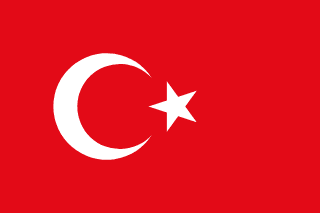
Turkey
Republic of Türkiye
Population: UN WPP 2024, revision 1, projection for 1 July 2026. Sources and methodology.
Geography and territory
Turkey occupies a rare geographic position spanning two continents across 783,356 square kilometers: most of the country lies within the Anatolian Peninsula in Asia, while eastern Thrace sits in Europe. The Bosphorus Strait, the Sea of Marmara, and the Dardanelles separate the two halves, making Istanbul the only major city in the world built across two continents. Turkey is bordered by three seas: the Black Sea to the north, the Aegean to the west, and the Mediterranean to the south.
Turkish terrain is predominantly mountainous and elevated. The Central Anatolian Plateau, averaging around 1,000 meters, is flanked by the Pontic Mountains to the north and the Taurus Mountains to the south. The east grows even more rugged, capped by the majestic Mount Ararat at 5,137 meters, the country’s highest peak and, according to biblical tradition, the resting place of Noah’s Ark. The Tigris and Euphrates rivers, cradles of Mesopotamian civilization, both rise in this eastern region. Turkey shares land borders with Greece, Bulgaria, Georgia, Armenia, Iran, Iraq, and Syria, a span of frontiers that places the country at the meeting point of Europe, the Caucasus, and the Middle East.
Turkey’s climate is as varied as its geography: Mediterranean along the southern and western coasts, oceanic in the Black Sea region, continental with harsh winters on the central plateau, and semi-arid in the east. The Aegean and Mediterranean coasts enjoy long, dry summers and mild winters, while inland Anatolia experiences extreme temperature swings and heavy snowfall. The Black Sea region receives the country’s highest rainfall, sustaining dense forests and lush vegetation.
History
Turkey’s history spans millennia of overlapping civilizations. Anatolia was home to Çatalhöyük, one of the oldest known human settlements at roughly 9,000 years old, as well as the great Hittite, Phrygian, Lydian, and Lycian civilizations. Greek cities along the Aegean coast, including Ephesus, Miletus, and Pergamon, served as centers of philosophy, science, and art. Troy, immortalized by Homer, lies in the country’s northwest.
Constantinople, founded by Emperor Constantine in 330 AD on the site of ancient Byzantium, served for more than a thousand years as the capital of the Byzantine Empire and the largest, richest city in Europe. Its conquest by Sultan Mehmed II in 1453 marked the emergence of the Ottoman Empire as a world power. Across the sixteenth and seventeenth centuries the empire expanded over three continents, controlling the Balkans, the Middle East, and North Africa, with Istanbul as its magnificent capital and Suleiman the Magnificent presiding over its cultural and military golden age.
Defeat in the First World War brought the empire’s dismemberment. Mustafa Kemal Atatürk led the War of Independence and founded the Republic of Turkey on October 29, 1923, launching a sweeping secularizing transformation that included adoption of the Latin alphabet, legal equality between the sexes, and the separation of state and religion. Ankara, rather than Istanbul, was chosen as the new republic’s capital, symbolizing a deliberate break with the imperial past. In the twenty-first century, Turkey has moved between its European aspirations, its Islamic identity, and its regional ambitions, emerging as a rising power at the crossroads of civilizations.
Culture and society
Turkish culture is a fascinating synthesis of Central Asian, Islamic, Byzantine, and Western traditions. Ottoman architecture, epitomized by the imperial mosques designed by the master architect Mimar Sinan, most notably the Süleymaniye Mosque in Istanbul, ranks among the high points of Islamic art. Ottoman calligraphy, Iznik tilework, miniature painting, and the art of marbling known as ebru all display extraordinary refinement.
Turkish literature carries a rich tradition, running from the mystical poetry of Yunus Emre and the folk tales of Nasreddin Hodja to the contemporary novels of Orhan Pamuk, awarded the Nobel Prize in Literature in 2006. Turkish music ranges from refined Ottoman classical music and the Sufi whirling-dervish tradition of Konya to modern pop and rock. Turkish cinema has enjoyed a renaissance, led by directors such as Nuri Bilge Ceylan, a Palme d’Or winner at Cannes.
Contemporary Turkish society lives in a creative tension between modernity and tradition. Major cities such as Istanbul, Ankara, and Izmir are cosmopolitan and fast-moving, while rural Anatolia preserves ancestral customs. Tea, served in the ubiquitous tulip-shaped glass, accompanies nearly every social interaction, and the country consumes it in famously large quantities. Turkish hospitality is legendary, and offering tea or coffee to any visitor is an unbreakable custom, often paired with generous helpings of food regardless of how briefly a guest intends to stay.
Economy
Turkey has the nineteenth-largest economy in the world and is a member of the G20. Its economic base is highly diversified, with a strong industrial sector spanning automotive manufacturing, textiles, home appliances, electronics, construction, and defense. The country ranks among the world’s largest producers of automobiles, televisions, and textiles, with Turkish firms competing in global markets.
Tourism is a fundamental pillar of the economy, drawing more than 50 million international visitors a year. The Aegean and Mediterranean coasts, historic sites, and Istanbul’s vibrant cultural life make Turkey one of the most popular destinations in the world. Agriculture remains important as well, with Turkey the world’s leading producer of hazelnuts, cherries, figs, and apricots.
Turkish construction and infrastructure firms have a global footprint, executing major projects across Africa, Central Asia, the Middle East, and Europe. The defense sector has expanded dramatically, with Turkish drones and armored vehicles exported to numerous countries around the world. Even so, the economy, with a gross domestic product of roughly $1.60 trillion, faces persistent challenges including high inflation, a depreciating lira, and a sizable current account deficit that together fuel ongoing macroeconomic volatility for households and businesses alike.
Food and cuisine
Turkish cuisine is often ranked among the world’s three great culinary traditions, alongside French and Chinese, heir to the rich cooking of the Ottoman Empire, which fused Central Asian, Arab, Persian, Greek, and Balkan influences. Kebab, in its countless regional forms, is perhaps the best-known Turkish dish internationally, ranging from rotating döner kebab to Bursa’s İskender kebab, doused in butter and tomato sauce, to the spicy Adana kebab and grilled şiş kebab.
Meze, small dishes served as starters, form a culinary tradition of their own: hummus, baba ghanoush, dolma, börek pastry filled with cheese or spinach, bulgur-based kısır, and many more can add up to a full feast on their own. The Turkish breakfast is legendary for its abundance, typically including an array of cheeses, olives, honey, kaymak (clotted cream), eggs, tomato, cucumber, freshly baked bread, and tea.
Turkish pastry making is celebrated the world over. Baklava, layers of filo pastry filled with pistachios or walnuts and soaked in syrup, reaches its finest expression in Gaziantep, widely regarded as the country’s culinary capital. Turkish delight, or lokum, künefe from Hatay with melted cheese and pistachios, and Maraş ice cream, famous for its stretchy texture, are all irresistible specialties. Turkish coffee, brewed in a cezve and served with its grounds, has been recognized by UNESCO as part of humanity’s intangible cultural heritage.
Tourism and landmarks
Turkey holds 19 UNESCO World Heritage Sites and ranks among the most visited countries in the world. Istanbul is a city without equal, combining the majesty of the Hagia Sophia, the Blue Mosque, Topkapi Palace, and the Grand Bazaar with a thriving contemporary energy. The Bosphorus, navigable by ferry, offers unforgettable views of palaces, fortresses, and wooden Ottoman-era mansions along its shores.
Cappadocia, in central Anatolia, is a surreal landscape of fairy chimneys, underground cities carved by early Christians, and cave churches decorated with Byzantine frescoes. Sunrise hot-air balloon flights over this moonlike terrain have become one of the most iconic travel experiences in the world. Ephesus preserves one of the best-conserved Greco-Roman archaeological complexes anywhere, with its Library of Celsus, a theater seating 25,000, and the Temple of Artemis.
Turkey’s turquoise coast in the south offers crystalline coves, half-submerged Lycian ruins, and charming harbor towns such as Kaş and Kalkan, drawing sailors and sun-seekers along a shoreline dotted with ancient ruins. Pamukkale dazzles with its white travertine terraces and the ruins of ancient Hierapolis rising above them. The country’s east holds lesser-known treasures: Mount Nemrut with its colossal stone heads of ancient gods, the ancient Armenian city of Ani, and the volcanic scenery around Lake Van. Konya, the city of Rumi, draws visitors with its ceremonies of the whirling dervishes, a Sufi ritual of devotional spinning that has been performed for centuries.
Fun facts about Turkey
- The Hagia Sophia in Istanbul served as a church for 916 years, a mosque for 482 years, and a museum for 86 years before being reconverted into a mosque in 2020.
- Turkey is the world’s largest producer of hazelnuts, growing roughly 70 percent of the global supply.
- Istanbul’s Grand Bazaar, with more than 4,000 shops, is one of the largest and oldest covered markets in the world, drawing up to 400,000 visitors a day.
- The tulip, a flower closely associated with the Netherlands, was actually introduced to Europe from Turkey in the sixteenth century, and its name derives from the Turkish word “tülbent,” meaning turban.
- Turkey is home to Göbekli Tepe, humanity’s oldest known temple complex, dating back roughly 12,000 years, older than Stonehenge and the pyramids of Egypt.
Turkey in numbers
Latest World Bank and UNDP observations, each with its own year. “World median” is the middle value among the countries that report the same indicator; “#” ranks from the highest value.
Population since 1960
Turkey had 28.3 million people in 1960 and 85.9 million in 2025 — 3.0 times as many.
People
89.5% of people live in towns and cities (world median 63.4%). 21.0% are under 15 and 10.6% are 65 or older — a middle-aged population. Women have 1.48 children on average, below the replacement level of about 2.1 needed to keep a population stable in the long run without migration.
Economy
The economy grew by 3.6% in real terms in 2025. Consumer prices rose by 34.9% in 2025 — very high inflation. Services make up the largest share of output (59.4% of GDP); agriculture contributes 5.2%.
Development and environment
UNDP rates human development in Turkey as very high, with an index of 0.853 in 2023 (rank 51 of 193). 89.8% of people use the internet and 100.0% have access to electricity. Forest covers 29.5% of the land (world median 32.8%).
Sources: World Bank, World Development Indicators (CC BY 4.0), most recent observation from 2015 onward; UNDP Human Development Report 2025. Retrieved 2026-10-10. Sector shares need not add up to 100% because taxes and subsidies on products are excluded. Missing values are left blank rather than estimated. Sources and methodology.
Climate of Turkey
Averaged across Turkey, the warmest month is August (22.9 °C) and the coolest is January (0.2 °C), a seasonal swing of 22.7 °C. The annual mean is 11.6 °C.
About 601 mm of precipitation falls in a typical year. December is the wettest month (77 mm) and August the driest (15 mm).
Show monthly values as a table
| Month | Mean °C | Low °C | High °C | Precipitation, mm |
|---|---|---|---|---|
| January | 0.2 | −3.9 | 4.2 | 74 |
| February | 1.6 | −2.9 | 6.2 | 63 |
| March | 5.5 | 0.4 | 10.6 | 66 |
| April | 10.3 | 4.6 | 16.0 | 61 |
| May | 15.0 | 8.8 | 21.3 | 60 |
| June | 19.4 | 12.7 | 26.2 | 38 |
| July | 22.8 | 15.7 | 29.9 | 17 |
| August | 22.9 | 15.7 | 30.1 | 15 |
| September | 18.9 | 11.8 | 26.0 | 23 |
| October | 13.7 | 7.5 | 19.8 | 49 |
| November | 7.1 | 1.9 | 12.3 | 60 |
| December | 2.2 | −1.8 | 6.2 | 77 |
Figures are 1991–2020 averages across the whole land area of Turkey, from the World Bank Climate Change Knowledge Portal, CRU TS 4.08 (CC BY 4.0). They are not readings from one weather station: the capital, the coast and high ground can be much warmer, cooler, wetter or drier.
Travel essentials for Turkey
The practical details visitors ask about first. Traffic in Turkey drives on the right, like most of the world. Mains electricity is 230 V at 50 Hz, so devices made only for 110–120 V (common in North America) need a converter unless they are dual-voltage — most phone and laptop chargers are.
- Emergency number
- 112
- Driving side
- Right
- Plug types
- Type C, Type FC: two round pins (Europlug); F: two round pins with side earth clips (Schuko)
- Voltage
- 230 V50 Hz
- Dialling code
- +90From abroad: your exit code, then 90 and the number
- Currency
- Turkish Lira (TRY)
- Time zone
- TRT (UTC+3)Current local time in Turkey
Compiled from IEC plug and voltage standards, national emergency-service listings and the UN road-traffic conventions. Emergency numbers and local coverage can change — confirm them locally on arrival. Turkey's internet domain is .tr.
Where Turkey ranks in the world
Each position counts only the countries with data in that ranking guide. First place is the highest value — for price levels, the most expensive. Select a card to see the full table.
- Population18th of 19687.9 millionUN projection, July 2026
- Land area36th of 195769,630 km²World Bank, 2023
- Population density80th of 194111 per km²World Bank, 2023
- GDP (nominal)17th of 187$1.36TWorld Bank, 2024, current US$
- GDP per capita62nd of 187$15,893World Bank, 2024, current US$
- Life expectancy65th of 19477.4 yearsWorld Bank, 2024
- Price level131st of 16534 (US = 100)ICP 2021, household consumption
Bordering countries of Turkey


Compare Turkey with another country
Frequently asked questions about Turkey
What is the capital of Turkey?
The capital of Turkey is Ankara.
What is the population of Turkey?
The UN World Population Prospects projection for Turkey is 87,926,082 people (87.9 million) on 1 July 2026. National statistical offices may publish different estimates.
What language is spoken in Turkey?
The official language of Turkey is Turkish.
What currency is used in Turkey?
The currency of Turkey is the Turkish Lira (TRY).
How big is Turkey?
Turkey covers an area of 783,356 km².
What type of government does Turkey have?
Turkey is a presidential republic.
Which countries border Turkey?
Turkey shares land borders with Greece, Bulgaria, Georgia, Armenia, Azerbaijan, Iran, Iraq, Syria.
What is the highest point in Turkey?
The highest point in Turkey is Mount Ararat (5,137 m).


