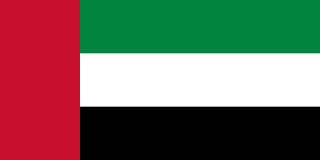
United Arab Emirates
United Arab Emirates
Population: UN WPP 2024, revision 1, projection for 1 July 2026. Sources and methodology.
Geography and territory
The United Arab Emirates is a federation of seven emirates on the southeastern coast of the Arabian Peninsula, covering 83,600 square kilometers. It borders Saudi Arabia to the south and west and Oman to the east, with coastlines on both the Persian Gulf to the north and the Gulf of Oman to the east. Abu Dhabi, the largest of the seven emirates, accounts for the vast majority of the federation’s total land area.
Sweeping desert defines much of the UAE’s interior, part of the broader Rub al Khali, or Empty Quarter, one of the largest sand deserts on the planet. Yet the country holds more variety than that image suggests: the Hajar Mountains along the eastern border with Oman rise above 1,500 meters and cut through spectacular wadis, expansive coastal salt flats known as sabkhas mark the western reaches, and a mix of natural and artificial islands dotted along the Persian Gulf extends the country’s coastline considerably.
The climate is desert and subtropical, with summers that turn extremely hot and humid, pushing coastal temperatures well above 45 degrees Celsius alongside oppressive humidity. Winters are far more pleasant, with temperatures generally between 15 and 25 degrees Celsius, making the months from November through March the prime season for travel. Rainfall is minimal, averaging under 100 millimeters a year, though occasional storms can trigger sudden flash flooding. With a population of about 11.6 million spread across largely urban centers along the coast, the UAE ranks among the most densely populated pockets of the Arabian Peninsula, even as much of its interior remains sparsely inhabited desert.
History
The history of the territory that is now the UAE stretches back thousands of years, with evidence of human settlement dating to the Neolithic period. The region was part of the Umm al-Nar civilization roughly 5,000 years ago and later linked to the trading world of Dilmun. For centuries, coastal communities depended on pearl diving, seafaring, and maritime trade, while inland tribes lived as nomadic herders. The pearling industry anchored the regional economy until it collapsed in the 1930s with the arrival of cultured Japanese pearls.
From the nineteenth century onward, the region became known to outsiders as the Trucial States, following treaties signed with the British Empire aimed at suppressing piracy along the coast. Britain took responsibility for the region’s external affairs while local sheikhs retained authority over internal governance. The discovery of oil in Abu Dhabi in 1958 and in Dubai in 1966 transformed the economic outlook of the entire region.
On December 2, 1971, six emirates joined together to form the United Arab Emirates, with Ras al-Khaimah joining the federation the following year. Sheikh Zayed bin Sultan Al Nahyan, ruler of Abu Dhabi and the federation’s first president, is revered as the country’s founding father for his vision of unity and development. In just a few decades, the UAE transformed from a desert territory built on subsistence economies into one of the most developed and cosmopolitan nations in the world.
Culture and society
Authentic Emirati culture is rooted in Bedouin and maritime traditions of hospitality, poetry, falconry, and camel racing. Contemporary Emirati society, however, is unusual in one striking respect: Emirati citizens make up only a small share of the total population, with the overwhelming majority of residents being expatriates from India, Pakistan, Bangladesh, the Philippines, Europe, and across the Arab world. This demographic makeup has produced an extraordinarily multicultural society.
Falconry, the ancient art of hunting with birds of prey, is perhaps the most cherished cultural tradition and has been recognized by UNESCO as an element of intangible cultural heritage. Camel racing, now often conducted with lightweight robotic jockeys, alongside traditional dhow boat races and Nabati poetry competitions, keeps older customs alive. Modern Emirati architecture, epitomized by the Burj Khalifa and the Louvre Abu Dhabi, expresses the country’s ambition to stand as a global cultural center.
The UAE has invested heavily in culture and the arts as a pillar of national development. Abu Dhabi has built a cultural district on Saadiyat Island anchored by the Louvre Abu Dhabi, designed by Jean Nouvel, with a Guggenheim museum also planned for the site. Dubai is home to the Dubai Opera, numerous art galleries, and the Dubai Design District. The country hosts literary, film, and music festivals of international standing, positioning itself as a cultural bridge between East and West. Family and faith remain central to Emirati social life even amid rapid modernization: Islam shapes the rhythm of public life, from the daily call to prayer to the observance of Ramadan, and respect for elders and pride in tribal lineage continue to anchor Emirati identity across generations.
Economy
The UAE possesses one of the most diversified economies in the Persian Gulf. Abu Dhabi still relies substantially on oil, while Dubai has achieved notable diversification through tourism, aviation, financial services, trade, and logistics. Emirates airline and Dubai International Airport have become pillars of global air travel, connecting the emirate to destinations across the world.
Dubai has established itself as a first-tier financial and commercial hub, with free zones that attract thousands of international businesses. The Dubai International Financial Centre, Jebel Ali Free Zone, and Dubai Internet City reflect a deliberate strategy that has positioned the emirate as a bridge linking the markets of Asia, Europe, and Africa. The UAE also functions as a major global trading center for gold, diamonds, and luxury goods.
The country has invested heavily in renewable energy, with projects such as the Mohammed bin Rashid Al Maktoum Solar Park in Dubai and the Barakah nuclear plant in Abu Dhabi. Expo 2020, hosted in Dubai, spurred billions of dollars in infrastructure development. The UAE has also launched an ambitious space program, sending a probe to Mars in 2021, the first interplanetary mission from the Arab world, and the economy overall, with a gross domestic product of approximately $507 billion, remains among the strongest per capita in the region.
Food and cuisine
Traditional Emirati cuisine is simple but flavorful, shaped by the conditions of the desert and the sea. Machboos, spiced rice cooked with lamb, chicken, or fish, is the national dish, prepared with a spice blend called bezar that includes cinnamon, cardamom, cumin, and dried lime. Harees, a slow-cooked porridge of wheat and meat pounded into a creamy consistency, is especially popular during Ramadan.
Seafood plays a prominent role in coastal cooking, with safi, hammour, and gulf shrimp grilled, curried, or served over rice. Luqaimat, deep-fried dough balls drizzled with honey or date syrup, is the country’s favorite sweet treat and is typically served alongside Arabic coffee. Dates are ubiquitous, eaten fresh, stuffed with almonds, or processed into syrup, and remain an essential element of Emirati hospitality.
The UAE’s remarkable demographic diversity, especially in Dubai, has turned the country into a global culinary destination. Restaurants representing more than 200 nationalities operate side by side, from Indian and Pakistani street food stalls to Michelin-starred fine dining establishments. Dubai boasts a cutting-edge culinary scene led by internationally renowned chefs, while Abu Dhabi and Sharjah tend to offer more traditional expressions of Emirati and regional Arab cooking.
Tourism and landmarks
The UAE has become one of the world’s most popular travel destinations, drawing tens of millions of international visitors each year. Dubai is the undisputed headline act: the Burj Khalifa, at 828 meters, is the tallest building in the world; the Dubai Mall ranks among the largest shopping complexes anywhere; Palm Jumeirah, the palm-shaped artificial island, redefined coastal engineering; and the Dubai Frame offers panoramic views spanning both the old city and the new.
Abu Dhabi offers a more cultural and refined experience. The Louvre Abu Dhabi, an architectural masterpiece by Jean Nouvel that appears to float above the water, houses art collections drawn from across the globe. The Sheikh Zayed Grand Mosque, with its 82 domes, thousands of columns, and the world’s largest hand-knotted carpet, ranks among the most spectacular mosques ever built. Yas Island is home to a Formula 1 circuit and the Ferrari World theme park.
Beyond the two flagship cities, the UAE offers a wide range of experiences: desert safaris with dinners under the stars, the Hatta Mountains with their wadis and hiking trails, kayak-friendly mangroves near Abu Dhabi, reef diving off the coast of Fujairah, and the city of Sharjah, designated a Cultural Capital of the Arab World, with its many museums and traditional markets.
Fun facts about United Arab Emirates
- The Burj Khalifa is so tall that residents on its upper floors see the sunset several minutes later than people at ground level, a quirk that once prompted a religious ruling on the timing of the Ramadan fast.
- The UAE was the first Arab nation to send a probe to Mars, with the Hope (Al-Amal) mission reaching the red planet in February 2021.
- Dubai operates the Middle East’s first fully automated metro system, which opened in 2009.
- Dubai’s police force maintains a fleet of supercar patrol vehicles that includes Lamborghinis, Ferraris, and Bugattis.
- The UAE shifted to a Monday-through-Friday workweek in 2022, moving away from the traditional Sunday-to-Thursday schedule common across much of the Arab world.
- Ski Dubai, an indoor ski resort built inside a shopping mall, offers real snow slopes year-round despite outdoor temperatures that regularly exceed 40 degrees Celsius.
The United Arab Emirates in numbers
Latest World Bank and UNDP observations, each with its own year. “World median” is the middle value among the countries that report the same indicator; “#” ranks from the highest value.
Population since 1960
The United Arab Emirates had 131,334 people in 1960 and 11.5 million in 2025 — 87.7 times as many.
People
86.0% of people live in towns and cities (world median 63.4%). 16.0% are under 15 and 1.8% are 65 or older — a middle-aged population. Women have 1.21 children on average, below the replacement level of about 2.1 needed to keep a population stable in the long run without migration.
Economy
The economy grew by 4.0% in real terms in 2024. Consumer prices rose by 1.3% in 2025. Services make up the largest share of output (54.9% of GDP); agriculture contributes 0.8%.
Development and environment
UNDP rates human development in the United Arab Emirates as very high, with an index of 0.940 in 2023 (rank 15 of 193). 100.0% of people use the internet and 100.0% have access to electricity. Forest covers 4.6% of the land (world median 32.8%).
Sources: World Bank, World Development Indicators (CC BY 4.0), most recent observation from 2015 onward; UNDP Human Development Report 2025. Retrieved 2026-10-10. Sector shares need not add up to 100% because taxes and subsidies on products are excluded. Missing values are left blank rather than estimated. Sources and methodology.
Climate of the United Arab Emirates
Averaged across the United Arab Emirates, the warmest month is July (36.2 °C) and the coolest is January (18.5 °C), a seasonal swing of 17.7 °C. The annual mean is 28.2 °C.
About 60 mm of precipitation falls in a typical year. February is the wettest month (17 mm) and September the driest (0 mm). What little rain there is falls mostly from January to March (68% of the total).
Less than 250 mm a year is typical of desert climates.
Show monthly values as a table
| Month | Mean °C | Low °C | High °C | Precipitation, mm |
|---|---|---|---|---|
| January | 18.5 | 13.1 | 24.0 | 7 |
| February | 20.2 | 14.8 | 25.7 | 17 |
| March | 23.3 | 17.3 | 29.4 | 16 |
| April | 28.4 | 21.7 | 35.0 | 6 |
| May | 32.7 | 25.6 | 40.0 | 2 |
| June | 34.8 | 27.9 | 41.8 | 0 |
| July | 36.2 | 29.9 | 42.5 | 0 |
| August | 36.0 | 29.9 | 42.0 | 1 |
| September | 33.6 | 27.2 | 40.0 | 0 |
| October | 29.8 | 23.5 | 36.2 | 0 |
| November | 24.6 | 18.6 | 30.7 | 2 |
| December | 20.7 | 15.2 | 26.2 | 7 |
Figures are 1991–2020 averages across the whole land area of the United Arab Emirates, from the World Bank Climate Change Knowledge Portal, CRU TS 4.08 (CC BY 4.0). They are not readings from one weather station: the capital, the coast and high ground can be much warmer, cooler, wetter or drier.
Travel essentials for the United Arab Emirates
The practical details visitors ask about first. Traffic in the United Arab Emirates drives on the right, like most of the world. Mains electricity is 230 V at 50 Hz, so devices made only for 110–120 V (common in North America) need a converter unless they are dual-voltage — most phone and laptop chargers are.
- Emergency number
- 999Ambulance 998 · Fire 997
- Driving side
- Right
- Plug types
- Type C, Type D, Type GC: two round pins (Europlug); D: three large round pins in a triangle; G: three rectangular pins (British)
- Voltage
- 230 V50 Hz
- Dialling code
- +971From abroad: your exit code, then 971 and the number
- Currency
- UAE Dirham (AED)
- Time zone
- GST (UTC+4)Current local time in the United Arab Emirates
Compiled from IEC plug and voltage standards, national emergency-service listings and the UN road-traffic conventions. Emergency numbers and local coverage can change — confirm them locally on arrival. The United Arab Emirates's internet domain is .ae.
Where the United Arab Emirates ranks in the world
Each position counts only the countries with data in that ranking guide. First place is the highest value — for price levels, the most expensive. Select a card to see the full table.
- Population86th of 19611.6 millionUN projection, July 2026
- Land area117th of 19571,020 km²World Bank, 2023
- Population density63rd of 194148 per km²World Bank, 2023
- GDP (nominal)27th of 187$552.3BWorld Bank, 2024, current US$
- GDP per capita22nd of 187$50,274World Bank, 2024, current US$
- Life expectancy16th of 19483.1 yearsWorld Bank, 2024
- Price level28th of 16574 (US = 100)ICP 2021, household consumption
Bordering countries of the United Arab Emirates


Compare the United Arab Emirates with another country
Frequently asked questions about the United Arab Emirates
What is the capital of the United Arab Emirates?
The capital of the United Arab Emirates is Abu Dhabi.
What is the population of the United Arab Emirates?
The UN World Population Prospects projection for the United Arab Emirates is 11,574,682 people (11.6 million) on 1 July 2026. National statistical offices may publish different estimates.
What language is spoken in the United Arab Emirates?
The official language of the United Arab Emirates is Arabic.
What currency is used in the United Arab Emirates?
The currency of the United Arab Emirates is the UAE Dirham (AED).
How big is the United Arab Emirates?
The United Arab Emirates covers an area of 83,600 km².
What type of government does the United Arab Emirates have?
The United Arab Emirates is a federation of constitutional monarchies.
Which countries border the United Arab Emirates?
The United Arab Emirates shares land borders with Saudi Arabia, Oman.
What is the highest point in the United Arab Emirates?
The highest point in the United Arab Emirates is Jabal Yibir (1,527 m).


