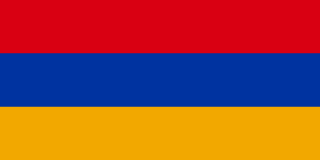
Armenia
Republic of Armenia
Population: UN WPP 2024, revision 1, projection for 1 July 2026. Sources and methodology.
Geography and territory
Armenia lies in the South Caucasus, at the crossroads of Europe and Asia, occupying 29,743 square kilometers of predominantly mountainous terrain. The country sits atop the Armenian Highland, a region of volcanic plateaus with an average elevation above 1,800 meters, making it one of the highest-lying countries in the region. Landlocked and compact, Armenia is bordered by Georgia to the north, Azerbaijan to the east, Iran to the south, and Turkey to the west.
Mount Aragats, at 4,090 meters, is the country’s highest point, an extinct volcano whose summit crater cradles a small lake. Although Mount Ararat, the sacred symbol of Armenian identity, now lies across the border in Turkey, its snow-capped silhouette still dominates the skyline above Yerevan and appears on the national coat of arms. Lake Sevan, sitting at 1,900 meters, is one of the largest high-altitude lakes in the world and serves as the country’s principal reservoir of fresh water.
Armenia’s climate is continental and mountainous, bringing cold winters and hot, dry summers to the valley floors. Rainfall varies enormously with elevation and exposure, ranging from semi-desert conditions in the Ararat valley to alpine meadows near the summit of Aragats. This dramatic altitudinal range packs a surprising diversity of ecosystems into a relatively small territory, from arid steppe to subalpine forest and high mountain pasture.
With a population of about 2.9 million, Armenia is one of the more compact nations of the Caucasus, and its people are concentrated heavily in and around Yerevan, which sits in the fertile Ararat valley at the foot of the mountain that gives the plain its name. Beyond the capital, settlement thins rapidly across the country’s rugged uplands, where small towns and villages cling to mountain valleys and highland basins.
History
Armenia is one of the world’s oldest civilizations, with a documented history stretching back more than 3,500 years. The kingdom of Urartu, regarded as the precursor of the Armenian state, flourished around Lake Van between the ninth and sixth centuries BCE. In 301 CE, Armenia became the first nation on earth to adopt Christianity as its official state religion, a decision that would define its cultural identity for millennia and set it apart from its predominantly Muslim neighbors.
In 405 CE, the monk Mesrop Mashtots devised the Armenian alphabet, originally comprising 36 letters and later expanded to 39, a cultural achievement that preserved the Armenian language, faith, and national identity through centuries of foreign domination. Over time Armenia came under the successive rule of Persians, Arabs, Byzantines, Mongols, Ottomans, and Russians. The Armenian Genocide of 1915, carried out by the Ottoman Empire, killed an estimated 1.5 million Armenians and destroyed ancient communities across Anatolia.
The First Republic of Armenia, established briefly in 1918, was absorbed into the Soviet Union in 1920. During the Soviet era Armenia industrialized and achieved high levels of education, though the catastrophic Spitak earthquake of 1988, which killed more than 25,000 people, exposed serious weaknesses in the Soviet system. Independence came on 21 September 1991, and the years that followed were shaped by the conflict over Nagorno-Karabakh with Azerbaijan, a dispute that has continued to weigh on the country’s foreign policy and economy ever since.
Culture and society
Armenian culture is marked by remarkable depth and resilience, forged across millennia of civilization and centuries of hardship. The Armenian alphabet is not merely a writing system but a sacred symbol of national identity, and its creation is celebrated annually across the country. Illuminated Armenian manuscripts, prized for the extraordinary beauty of their miniatures, are preserved at the Matenadaran in Yerevan, one of the world’s great repositories of ancient manuscripts.
Armenian music ranges from medieval liturgical chant to the haunting sound of the duduk, a woodwind instrument whose melancholic tone has been recognized by UNESCO as part of the Intangible Cultural Heritage of Humanity, as well as the tradition of the ashughs, wandering troubadours who combined poetry, music, and improvisation. Khachkars, intricately carved stone crosses bearing unique ornamental motifs, represent an exclusively Armenian art form, also inscribed on UNESCO’s list, with more than 50,000 examples scattered across the country.
Armenian society is defined by strong family bonds and a deep sense of community that extends far beyond the country’s borders. The Armenian diaspora, a legacy of persecution and genocide, maintains an intense emotional connection to the ancestral homeland. The Armenian Apostolic Church, among the oldest Christian churches in the world, plays a central role in preserving national identity, and Genocide Remembrance Day on 24 April is the most solemn date on the national calendar.
Economy
Armenia’s economy has undergone a significant transformation since independence, shifting from a centrally planned Soviet model to an open market economy. The information technology sector has become the country’s most dynamic engine of growth, with Yerevan emerging as a regional technology hub. International companies including Microsoft, Google, and Oracle have established research centers in the country, drawn by a workforce highly skilled in mathematics and engineering.
Mining remains a strategic sector, with significant reserves of copper, molybdenum, and gold, while a diamond-processing industry inherited from the Soviet period retains some relevance. Agriculture is concentrated in the Ararat valley, where farmers grow apricots, peaches, grapes, and pomegranates. Armenian brandy, produced since 1887 and famously praised by Winston Churchill, remains one of the country’s signature export products.
Remittances from the Armenian diaspora make up a substantial share of GDP, reflecting both the generosity of emigrant communities and the economic dependency that such flows imply. Tourism has grown considerably, drawing visitors attracted by the country’s cultural heritage, cuisine, and mountain scenery. Even so, the economic blockade imposed by Turkey and Azerbaijan, combined with Armenia’s lack of direct access to the sea, continues to impose real structural constraints on economic development.
Food and cuisine
Armenian cuisine ranks among the oldest and most refined in the Caucasus, the product of thousands of years of culinary tradition. Khorovats, meat, typically pork, lamb, or chicken, grilled over an open flame and marinated with spices before being served alongside roasted vegetables, is the centerpiece of family gatherings and is traditionally prepared by the men of the household during outdoor celebrations.
Lavash, a thin flatbread baked in a clay pit oven called a tonir, has been recognized by UNESCO as Intangible Cultural Heritage of Humanity. Its preparation is a communal act, typically carried out by women who skillfully stretch the dough and press it against the walls of the scorching oven. Armenian dolma, grape leaves or vegetables stuffed with spiced meat, rice, herbs, and nuts, is another culinary masterpiece included on UNESCO’s heritage list.
Armenian appetizers offer a feast of flavors: hummus, baba ghanoush, legume salads, fresh herbed cheeses, and homemade pickles are served generously alongside lavash. Ghapama, a pumpkin stuffed with rice, dried fruit, honey, and cinnamon, is a festive dish reserved for special occasions. Armenian coffee, brewed in a small copper pot called a jazzve, is served thick and aromatic, and it remains customary to read one’s fortune in the grounds left at the bottom of the cup.
Tourism and landmarks
Yerevan, one of the oldest continuously inhabited cities in the world at nearly 2,800 years old, charms visitors with its pink tuff-stone architecture, which has earned it the nickname the Pink City. The Cascade, a monumental limestone staircase housing a contemporary art museum within its structure, offers panoramic views of Mount Ararat. Republic Square, with its illuminated dancing fountains, and the Matenadaran, home to a collection of more than 17,000 ancient manuscripts, are essential stops for any visitor.
Geghard Monastery, partly carved directly into the surrounding rock and recognized as a UNESCO World Heritage Site, stands as a masterpiece of medieval Armenian architecture. The Temple of Garni, the only surviving Greco-Roman pagan temple in Armenia, rises above a dramatic gorge lined with basalt columns. Khor Virap Monastery, with its unforgettable view of Mount Ararat, is one of the country’s most moving pilgrimage sites, traditionally linked to the imprisonment of Gregory the Illuminator before he converted the Armenian king to Christianity.
Lake Sevan, its deep blue waters ringed by mountains, offers beaches, monasteries, and profound tranquility nearly 2,000 meters above sea level. In the southern region of Syunik, Tatev Monastery is reached by what is billed as the longest reversible cable car in the world, while the megalithic site of Karahunj is regarded by some researchers as an Armenian equivalent of Stonehenge. Trails of the Transcaucasian Trail wind through wild, dramatic landscapes that still lie well off the beaten tourist path.
Fun facts about Armenia
- Armenia became the first country in the world to adopt Christianity as its official state religion, in the year 301 CE.
- The apricot is considered the national fruit, and its scientific name, Prunus armeniaca, refers directly to Armenia.
- Chess has been a mandatory school subject in Armenia since 2011, making it the first country in the world to implement such a policy.
- The Matenadaran in Yerevan houses one of the world’s largest collections of ancient manuscripts, with more than 17,000 items.
- The Armenian duduk, a woodwind instrument carved from apricot wood, has been recognized by UNESCO for its unique and haunting sound.
- Armenia has one of the highest numbers of chess grandmasters per capita of any country in the world.
Armenia in numbers
Latest World Bank and UNDP observations, each with its own year. “World median” is the middle value among the countries that report the same indicator; “#” ranks from the highest value.
Population since 1960
Armenia had 1.9 million people in 1960 and 3.1 million in 2025 — 66% more.
The population peaked at 3.6 million in 1991 and has since declined.
People
65.9% of people live in towns and cities (world median 63.4%). 19.0% are under 15 and 14.4% are 65 or older — an ageing population. Women have 1.70 children on average, below the replacement level of about 2.1 needed to keep a population stable in the long run without migration.
Economy
The economy grew by 7.2% in real terms in 2025. Consumer prices rose by 3.3% in 2025. Services make up the largest share of output (61.3% of GDP); agriculture contributes 7.9%.
Development and environment
UNDP rates human development in Armenia as very high, with an index of 0.811 in 2023 (rank 69 of 193). 81.3% of people use the internet and 100.0% have access to electricity. Forest covers 11.8% of the land (world median 32.8%).
Sources: World Bank, World Development Indicators (CC BY 4.0), most recent observation from 2015 onward; UNDP Human Development Report 2025. Retrieved 2026-10-10. Sector shares need not add up to 100% because taxes and subsidies on products are excluded. Missing values are left blank rather than estimated. Sources and methodology.
Climate of Armenia
Averaged across Armenia, the warmest month is July (20.8 °C) and the coolest is January (−6.6 °C), a seasonal swing of 27.4 °C. The annual mean is 7.7 °C.
3 months have a national mean temperature below freezing.
About 552 mm of precipitation falls in a typical year. May is the wettest month (88 mm) and December the driest (25 mm). The wettest stretch is April to June, with 41% of the year's total.
Show monthly values as a table
| Month | Mean °C | Low °C | High °C | Precipitation, mm |
|---|---|---|---|---|
| January | −6.6 | −11.4 | −1.9 | 26 |
| February | −4.9 | −9.8 | −0.1 | 29 |
| March | 1.0 | −4.2 | 6.3 | 46 |
| April | 7.6 | 1.8 | 13.6 | 68 |
| May | 12.3 | 6.2 | 18.4 | 88 |
| June | 17.0 | 10.2 | 23.8 | 70 |
| July | 20.8 | 13.9 | 27.7 | 58 |
| August | 20.7 | 13.5 | 28.0 | 34 |
| September | 16.1 | 8.9 | 23.3 | 35 |
| October | 9.6 | 3.1 | 16.2 | 40 |
| November | 2.4 | −3.1 | 7.8 | 35 |
| December | −3.8 | −8.4 | 0.7 | 25 |
Figures are 1991–2020 averages across the whole land area of Armenia, from the World Bank Climate Change Knowledge Portal, CRU TS 4.08 (CC BY 4.0). They are not readings from one weather station: the capital, the coast and high ground can be much warmer, cooler, wetter or drier.
Travel essentials for Armenia
The practical details visitors ask about first. Traffic in Armenia drives on the right, like most of the world. Mains electricity is 230 V at 50 Hz, so devices made only for 110–120 V (common in North America) need a converter unless they are dual-voltage — most phone and laptop chargers are.
- Emergency number
- 112
- Driving side
- Right
- Plug types
- Type C, Type FC: two round pins (Europlug); F: two round pins with side earth clips (Schuko)
- Voltage
- 230 V50 Hz
- Dialling code
- +374From abroad: your exit code, then 374 and the number
- Currency
- Armenian Dram (AMD)
- Time zone
- AMT (UTC+4)Current local time in Armenia
Compiled from IEC plug and voltage standards, national emergency-service listings and the UN road-traffic conventions. Emergency numbers and local coverage can change — confirm them locally on arrival. Armenia's internet domain is .am.
Where Armenia ranks in the world
Each position counts only the countries with data in that ranking guide. First place is the highest value — for price levels, the most expensive. Select a card to see the full table.
- Population138th of 1962.9 millionUN projection, July 2026
- Land area137th of 19528,199 km²World Bank, 2023
- Population density85th of 194105 per km²World Bank, 2023
- GDP (nominal)112th of 187$26.0BWorld Bank, 2024, current US$
- GDP per capita85th of 187$8,556World Bank, 2024, current US$
- Life expectancy50th of 19478.3 yearsWorld Bank, 2024
- Price level139th of 16533 (US = 100)ICP 2021, household consumption
Bordering countries of Armenia


Compare Armenia with another country
Frequently asked questions about Armenia
What is the capital of Armenia?
The capital of Armenia is Yerevan.
What is the population of Armenia?
The UN World Population Prospects projection for Armenia is 2,930,915 people (2.9 million) on 1 July 2026. National statistical offices may publish different estimates.
What language is spoken in Armenia?
The official language of Armenia is Armenian.
What currency is used in Armenia?
The currency of Armenia is the Armenian Dram (AMD).
How big is Armenia?
Armenia covers an area of 29,743 km².
What type of government does Armenia have?
Armenia is a parliamentary republic.
Which countries border Armenia?
Armenia shares land borders with Georgia, Azerbaijan, Iran, Turkey.
What is the highest point in Armenia?
The highest point in Armenia is Mount Aragats (4,090 m).