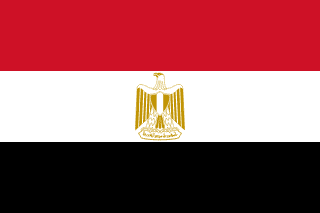
Egypt
Arab Republic of Egypt
Population: UN WPP 2024, revision 1, projection for 1 July 2026. Sources and methodology.
Geography and territory
Egypt occupies the northeastern corner of Africa and extends into Asia across the Sinai Peninsula, making it a transcontinental nation. With a land area of 1,001,450 km², it ranks among Africa’s largest countries by size, yet its single most defining geographic fact is that more than 95 percent of that territory is desert. Nearly the entire population is packed into the narrow Nile Valley and Delta, which together make up only about 4 percent of the country’s land but are home to well over 100 million people, producing some of the highest population densities found anywhere on Earth.
The Nile River, stretching some 6,650 kilometers, has been Egypt’s lifeline for more than 5,000 years. From the Aswan High Dam in the south to the fan-shaped delta that opens onto the Mediterranean in the north, the river carves a ribbon of green through an otherwise arid landscape. The Nile Delta, roughly 240 kilometers wide, is among the most productive farmland in the world. The Aswan High Dam, completed in the 1960s with Soviet assistance, impounds Lake Nasser, one of the largest artificial reservoirs on the planet.
The Western Desert, stretching toward Libya, is a vast plain of sand and rock punctuated by dramatic depressions such as the Siwa Oasis, Wadi al-Hitan (Whale Valley), and the Great Sand Sea. The Eastern Desert, between the Nile and the Red Sea, is more rugged, with mountains exceeding 2,000 meters. The Sinai Peninsula, a triangular expanse of desert and mountains between the Gulf of Suez and the Gulf of Aqaba, holds Mount Catherine (2,629 meters), Egypt’s highest point. The Red Sea coastline is famous for some of the most spectacular coral reefs on Earth.
History
Egypt is the cradle of one of the oldest and most captivating civilizations in human history. Ancient Egyptian civilization emerged around 3100 BCE with the unification of Upper and Lower Egypt under the pharaoh Narmer and endured for more than three millennia, producing architectural, artistic, scientific, and literary achievements that still astonish the world today. The pyramids of Giza, built more than 4,500 years ago as tombs for the pharaohs Khufu, Khafre, and Menkaure, are the only one of the Seven Wonders of the Ancient World still standing.
Egyptian history is a long chronicle of splendor, conquest, and cultural exchange. After the pharaonic period, the country was ruled in succession by Persians, Ptolemaic Greeks (whose last queen was Cleopatra), Romans, Byzantines, and Arabs. The Arab conquest of 641 CE profoundly reshaped Egyptian identity, introducing Islam and the Arabic language. Cairo, founded by the Fatimid dynasty in 969, grew into one of the most important cultural and religious centers of the Islamic world; it is home to Al-Azhar University, founded in 970 and the oldest continuously operating institution of higher learning on Earth.
In the modern era, Napoleon’s troops occupied Egypt in 1798, sparking European fascination with Egyptology. Muhammad Ali, regarded as the founder of modern Egypt, launched an ambitious modernization drive in the nineteenth century. The opening of the Suez Canal in 1869 turned Egypt into a strategic linchpin of world trade. The twentieth century brought the 1952 revolution that toppled the monarchy, the presidency of Gamal Abdel Nasser and his pan-Arabist agenda, conflicts with Israel, and the peace process launched by Anwar Sadat at Camp David in 1978. The 2011 Arab Spring opened a new chapter in the country’s political life.
Culture and society
Egyptian culture is an extraordinary palimpsest, its layers of civilization accumulated over millennia. The pharaonic legacy — visible not only in monuments but in popular customs reaching back into antiquity — coexists with a profound Islamic identity that has shaped daily life for fourteen centuries. The Coptic community, a direct descendant of the ancient Egyptians and custodian of one of the world’s oldest Christian traditions, makes up roughly a tenth of the population and adds another layer to the country’s cultural richness.
Modern Arabic literature has its epicenter in Egypt. Naguib Mahfouz, awarded the Nobel Prize in Literature in 1988, remains its most celebrated author, with his Cairo Trilogy standing as a landmark of twentieth-century Arabic fiction. Egyptian music, from the classic melodies of Umm Kulthum, whose voice still moves millions across the Arab world, to today’s pop and the electro-shaabi sound of Cairo’s working-class neighborhoods, dominates the wider Arab cultural landscape. Egyptian cinema, nicknamed “Hollywood on the Nile,” has produced more films than any other Arab film industry and has shaped popular culture across the entire region.
Contemporary Egyptian society lives in a creative tension between tradition and modernity. Cairo, with a metropolitan population exceeding 20 million, is one of the most vibrant and chaotic megacities on Earth, where the minarets of hundreds of mosques rise alongside skyscrapers and shopping malls. Wedding ceremonies, the rhythms of Ramadan, the tradition of drinking tea over shisha, and Friday family gatherings structure an intense social life. Egyptian hospitality is legendary — a simple stroll through almost any neighborhood can end in an invitation to tea with a family of total strangers.
Economy
Egypt runs the second-largest economy in Africa by nominal GDP and the third-largest measured by purchasing power parity. Its economic structure rests on several pillars: tourism, which brings in substantial foreign currency thanks to the country’s archaeological wealth and Red Sea coastline; remittances from the millions of Egyptians working abroad, especially in the Gulf states; revenue from the Suez Canal, through which roughly 12 percent of world trade passes; and the production of oil and natural gas.
Agriculture, while contributing a modest share of GDP, employs a significant part of the population and has anchored the Egyptian economy since pharaonic times. Long-staple Egyptian cotton is among the most prized in the world, and the production of fruit, vegetables, grains, and sugarcane supports both domestic consumption and exports. The Suez Canal, widened in 2015, generates annual revenue in the billions of dollars and cements Egypt’s role as a strategic node of global maritime trade.
In recent years the Egyptian government has pursued ambitious modernization projects, including construction of a new administrative capital east of Cairo, expansion of the road and metro networks, and development of special economic zones. Substantial challenges remain: rapid population growth places steady pressure on resources, inflation has eroded the purchasing power of the middle class, and creating jobs for a large, young population is an urgent priority. The technology sector and renewable energy offer promising avenues for further diversification.
Food and cuisine
Egyptian cuisine is one of the oldest and most flavorful in the Mediterranean, rooted in pharaonic times and enriched over centuries by Arab, Ottoman, Persian, and Mediterranean influences. Ful medames, fava beans slow-cooked for hours and seasoned with olive oil, lemon, cumin, and garlic, is the undisputed national dish and the breakfast of millions of Egyptians every morning. Koshari, a deceptively simple mix of rice, lentils, macaroni, chickpeas, tomato sauce, and crispy fried onions, is Cairo’s most popular street food and an icon of Egyptian urban cooking.
Egyptian tables are rich in vegetarian dishes, a legacy of long fasting periods observed in both Coptic and Islamic tradition. Taamiya (Egyptian falafel), made with fava beans instead of chickpeas, is served in pita bread with salad, tahini, and pickles. Molokhia, a green soup made from cooked jute leaves in a garlicky chicken broth, is another staple, typically served over rice. Stuffed vegetables (mahshi) — eggplant, zucchini, peppers, and grape leaves filled with spiced rice — are centerpieces of family and holiday meals.
Egyptian pastry making deserves a chapter of its own. Konafa, shredded phyllo dough layered with nuts, pistachios, or cream and soaked in rose-water syrup, is the star dessert of Ramadan. Basbousa, a semolina cake soaked in syrup; umm ali, a warm bread pudding with milk, nuts, and coconut; and Ottoman-influenced baklava round out an irresistible selection of sweets. Sweet black tea and thick, aromatic Turkish coffee are the national drinks, while karkade (hibiscus infusion) and fresh sugarcane juice are popular refreshments nationwide.
Tourism and landmarks
The pyramids of Giza and the Great Sphinx form one of the most iconic destinations on the planet. These monumental structures, standing for more than 4,500 years, continue to astonish visitors with their geometric precision and the enduring mystery of how they were built. The Egyptian Museum in Cairo, along with the new Grand Egyptian Museum near the pyramids, holds the world’s most complete collection of pharaonic antiquities, including the treasures of Tutankhamun and his celebrated solid-gold death mask.
Luxor, ancient Thebes, is often described as the world’s greatest open-air museum. On the Nile’s east bank stand the temples of Karnak and Luxor, linked by a recently restored avenue of sphinxes. On the west bank, the Valley of the Kings holds the tombs of pharaohs such as Tutankhamun, Ramesses II, and Seti I, decorated with astonishingly vivid murals. Farther south, Aswan and Philae Island offer striking Nubian scenery, and the temple of Abu Simbel — carved into the rock by Ramesses II and relocated piece by piece to save it from the rising waters of Lake Nasser — stands as a feat of both ancient Egyptian and modern engineering.
The Red Sea coast offers a completely different experience: Sharm el-Sheikh and Hurghada are world-class diving destinations, with extraordinarily biodiverse coral reefs, dazzling tropical fish, sharks, dolphins, and shipwrecks. The White Desert, with chalk formations sculpted by the wind into fantastical shapes, and the Siwa Oasis, with its salt lake, palm groves, and distinct Berber culture, round out an offering of remarkable depth and variety.
Fun facts about Egypt
- The Great Pyramid of Giza was the tallest structure built by humans for nearly 4,000 years, until England’s Lincoln Cathedral surpassed it in 1311.
- Al-Azhar University, founded in Cairo in 970, is the oldest continuously operating institution of higher education in the world.
- The 193-kilometer Suez Canal spares ships a detour of more than 8,900 kilometers around Africa, and roughly 12 percent of world trade passes through it.
- The ancient Egyptians invented the 365-day calendar, paper (papyrus), toothpaste, locks, and wigs, among many other innovations still part of everyday life.
- Cleopatra, Egypt’s last pharaoh, lived chronologically closer to the invention of the iPhone than to the construction of the Great Pyramid of Giza — a striking illustration of just how ancient Egyptian civilization is.
Egypt in numbers
Latest World Bank and UNDP observations, each with its own year. “World median” is the middle value among the countries that report the same indicator; “#” ranks from the highest value.
Population since 1960
Egypt had 26.9 million people in 1960 and 118.4 million in 2025 — 4.4 times as many.
People
42.9% of people live in towns and cities (world median 63.4%). 31.6% are under 15 and 5.3% are 65 or older — a young population. Women have 2.73 children on average, above the replacement level of about 2.1.
Economy
The economy grew by 4.4% in real terms in 2025. Consumer prices rose by 14.1% in 2025. Services make up the largest share of output (47.3% of GDP); agriculture contributes 16.6%.
Development and environment
UNDP rates human development in Egypt as high, with an index of 0.754 in 2023 (rank 100 of 193). 74.6% of people use the internet and 100.0% have access to electricity. Forest covers 0.0% of the land (world median 32.8%).
Sources: World Bank, World Development Indicators (CC BY 4.0), most recent observation from 2015 onward; UNDP Human Development Report 2025. Retrieved 2026-10-10. Sector shares need not add up to 100% because taxes and subsidies on products are excluded. Missing values are left blank rather than estimated. Sources and methodology.
Climate of Egypt
Averaged across Egypt, the warmest month is July (30.5 °C) and the coolest is January (13.7 °C), a seasonal swing of 16.8 °C. The annual mean is 23.1 °C.
About 21 mm of precipitation falls in a typical year. January is the wettest month (4 mm) and September the driest (0 mm). What little rain there is falls mostly from December to February (52% of the total).
Less than 250 mm a year is typical of desert climates.
Show monthly values as a table
| Month | Mean °C | Low °C | High °C | Precipitation, mm |
|---|---|---|---|---|
| January | 13.7 | 6.6 | 20.8 | 4 |
| February | 15.1 | 7.6 | 22.7 | 3 |
| March | 18.7 | 11.0 | 26.6 | 2 |
| April | 23.2 | 15.1 | 31.4 | 2 |
| May | 27.1 | 19.2 | 35.0 | 1 |
| June | 29.7 | 21.9 | 37.5 | 0 |
| July | 30.5 | 23.2 | 37.9 | 1 |
| August | 30.5 | 23.3 | 37.9 | 1 |
| September | 28.7 | 21.5 | 35.9 | 0 |
| October | 25.1 | 17.8 | 32.4 | 1 |
| November | 19.5 | 12.3 | 26.7 | 2 |
| December | 15.2 | 8.1 | 22.2 | 3 |
Figures are 1991–2020 averages across the whole land area of Egypt, from the World Bank Climate Change Knowledge Portal, CRU TS 4.08 (CC BY 4.0). They are not readings from one weather station: the capital, the coast and high ground can be much warmer, cooler, wetter or drier.
Travel essentials for Egypt
The practical details visitors ask about first. Traffic in Egypt drives on the right, like most of the world. Mains electricity is 220 V at 50 Hz, so devices made only for 110–120 V (common in North America) need a converter unless they are dual-voltage — most phone and laptop chargers are.
- Emergency number
- 122Ambulance 123 · Fire 180
- Driving side
- Right
- Plug types
- Type C, Type FC: two round pins (Europlug); F: two round pins with side earth clips (Schuko)
- Voltage
- 220 V50 Hz
- Dialling code
- +20From abroad: your exit code, then 20 and the number
- Currency
- Egyptian Pound (EGP)
- Time zone
- EET (UTC+2)Current local time in Egypt
Compiled from IEC plug and voltage standards, national emergency-service listings and the UN road-traffic conventions. Emergency numbers and local coverage can change — confirm them locally on arrival. Egypt's internet domain is .eg.
Where Egypt ranks in the world
Each position counts only the countries with data in that ranking guide. First place is the highest value — for price levels, the most expensive. Select a card to see the full table.
- Population13th of 196120.1 millionUN projection, July 2026
- Land area29th of 195995,450 km²World Bank, 2023
- Population density77th of 194115 per km²World Bank, 2023
- GDP (nominal)40th of 187$389.1BWorld Bank, 2024, current US$
- GDP per capita133rd of 187$3,338World Bank, 2024, current US$
- Life expectancy118th of 19471.8 yearsWorld Bank, 2024
- Price level163rd of 16526 (US = 100)ICP 2021, household consumption
Bordering countries of Egypt


Compare Egypt with another country
Frequently asked questions about Egypt
What is the capital of Egypt?
The capital of Egypt is Cairo.
What is the population of Egypt?
The UN World Population Prospects projection for Egypt is 120,101,175 people (120.1 million) on 1 July 2026. National statistical offices may publish different estimates.
What language is spoken in Egypt?
The official language of Egypt is Arabic.
What currency is used in Egypt?
The currency of Egypt is the Egyptian Pound (EGP).
How big is Egypt?
Egypt covers an area of 1,001,450 km².
What type of government does Egypt have?
Egypt is a presidential republic.
Which countries border Egypt?
Egypt shares land borders with Libya, Sudan, Israel, Palestine (Gaza Strip).
What is the highest point in Egypt?
The highest point in Egypt is Mount Catherine (2,629 m).


