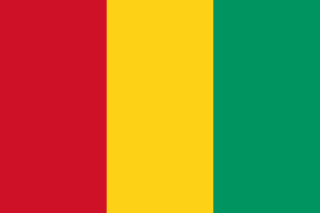
Guinea
Republic of Guinea
Population: UN WPP 2024, revision 1, projection for 1 July 2026. Sources and methodology.
Geography and territory
Guinea sits on the Atlantic coast of West Africa, often called Guinea-Conakry to set it apart from its similarly named neighbors Guinea-Bissau and Equatorial Guinea. Covering 245,857 square kilometers, with a population of about 15.4 million people, the country is shared among four distinct natural regions: Maritime Guinea, a low, humid coastal belt; Middle Guinea, dominated by the highlands of Fouta Djallon; Upper Guinea, a rolling savanna drained by the Niger River; and Forest Guinea, a tract of tropical rainforest in the southeast bordering Liberia and Côte d’Ivoire. Guinea also shares land borders with Senegal, Mali, and Sierra Leone, giving it a pivotal position at the crossroads of West Africa.
The Fouta Djallon massif, rising above 1,500 meters in places, is Guinea’s defining geographic feature and one of the most hydrologically important landscapes in West Africa. Countless rivers of continental significance, including the Niger, the Senegal, and the Gambia, all originate in these highlands, earning Guinea its nickname as the “water tower of West Africa.” Among the massif’s most striking features are the Kambadaga and Ditinn waterfalls, which tumble through green, mountainous terrain and draw a steady trickle of adventurous travelers.
Guinea’s coastline stretches roughly 320 kilometers, alternating sandy beaches with mangrove-fringed estuaries teeming with marine life. Near the southeastern border, Mount Nimba reaches 1,752 meters, Guinea’s highest point, and shelters a UNESCO World Heritage nature reserve shared with Côte d’Ivoire, home to endemic amphibians and plants found nowhere else on Earth. Climate varies considerably across the country, from tropical humidity along the coast to cooler, subtropical conditions in the Fouta Djallon highlands and a drier tropical climate in Upper Guinea.
History
Long before European contact, the lands that make up modern Guinea formed part of several great medieval West African empires, including Ghana, Mali, and Songhai, all of which left lasting cultural and commercial legacies across the region. In the eighteenth century, Fulani leaders founded the Imamate of Fouta Djallon, an Islamic theocratic state that became one of West Africa’s foremost centers of learning, with Quranic schools and a sophisticated system of governance that endured for over a century.
French colonization began along the coast in the mid-nineteenth century and gradually pushed inland, meeting fierce resistance from figures such as Samory Touré, founder of the Wassoulou Empire, who fought French forces for more than fifteen years before his capture in 1898. Guinea was subsequently absorbed into French West Africa, and its people endured forced labor and the extraction of natural resources for the benefit of the colonial power.
Guinea made history on October 2, 1958, becoming the first French-speaking African nation to gain independence, after voters under the leadership of Ahmed Sékou Touré overwhelmingly rejected Charles de Gaulle’s proposal to fold the territory into the French Community as an autonomous member state. Touré’s famous declaration that Guineans “preferred poverty in freedom to riches in slavery” became a rallying cry across francophone Africa. His government, however, hardened into an authoritarian one-party state that lasted until his death in 1984. In the decades since, Guinea has cycled through political transitions, military coups, and fragile attempts at democratic governance.
Culture and society
Guinea is home to a remarkable ethnic tapestry, with more than two dozen groups preserving distinct languages, customs, and artistic traditions. The three largest communities are the Fulani, concentrated in the Fouta Djallon highlands; the Malinke, prominent in Upper Guinea; and the Susu, who dominate the coastal region around Conakry. Each group contributes its own music, oral literature, and ceremonial life to a national culture of striking depth and variety.
Guinean music enjoys an outsized reputation across Africa and beyond. Les Ballets Africains, founded in 1952 by Keita Fodeba, was Africa’s first professional dance company and remains an internationally celebrated ambassador for the continent’s performing arts. The djembe, a goblet-shaped drum carved from a single piece of wood, traces its roots to Malinke tradition in Guinea and has since become one of the most recognized percussion instruments in the world.
The balafon, a wooden xylophone recognized by UNESCO as an Intangible Cultural Heritage of Humanity, is another emblematic instrument whose construction and playing techniques are passed down within families of griots, the hereditary oral historians who safeguard genealogies, epic tales, and ancestral knowledge as living archives. Guinean craftsmanship is equally admired, particularly in leatherwork, goldsmithing, indigo-dyed textiles, and finely woven basketry.
Economy
Guinea’s economy rests heavily on its extraordinary mineral wealth, with bauxite as the dominant export. The country holds the world’s largest proven bauxite reserves, estimated at more than a third of the global total, placing it among the top three bauxite producers on Earth and making it an essential supplier of the raw material used to manufacture aluminum. Gold, diamonds, and iron ore round out an economy driven largely by extractive industry.
Agriculture, meanwhile, employs the majority of Guinea’s workforce, centered on rice, cassava, corn, plantains, and coffee, though domestic production still falls short of the country’s food needs, forcing significant imports. Guinea also possesses one of the largest untapped hydroelectric potentials in West Africa, yet only a small fraction of it has been developed, leaving much of the population without reliable access to electricity.
Despite this natural abundance, Guinea remains one of the poorest countries in the world, a textbook case of the so-called resource curse, in which mineral riches fail to translate into broad human development. Corruption, political instability, weak transportation infrastructure, and a shortage of skilled labor remain the chief obstacles to growth. Roads linking mining regions to the coast are often in poor repair, and the national power grid reaches only a fraction of rural communities, further complicating efforts to diversify the economy. Even so, the scale of Guinea’s mineral and hydrological resources means the country’s long-term economic potential remains considerable if governance challenges can be overcome.
Food and cuisine
Rice forms the backbone of Guinean cuisine, appearing in nearly every meal alongside a rotating cast of sauces and stews that vary by region and ethnicity. Sauce feuilles, made from cassava, sweet potato, or spinach leaves simmered with palm oil, smoked fish, and spices, is one of the most beloved accompaniments. Riz gras, a one-pot rice dish cooked with tomato, meat, and vegetables, appears at family tables across the country almost daily.
Peanut sauce, known locally as tiga dega na or mafé, ranks among Guinea’s signature dishes. Made from ground peanut paste simmered with tomato, onion, and beef or chicken, it is ladled over white rice and prized for its creamy, faintly sweet flavor. Poulet yassa, chicken marinated in lemon and onion, is another regional specialty shared with neighboring countries. Along the coast, fresh fish and shellfish take center stage in daily meals.
Guinea’s markets overflow with tropical fruit, including exceptionally sweet mangoes, papayas, pineapples, bananas, and oranges depending on the season. Ginger juice, a refreshing drink made with ginger, lemon, and sugar, is hugely popular, as is bissap juice, brewed from hibiscus flowers. Perhaps most distinctive is the ceremonial preparation of tea, traditionally served in three successive rounds symbolizing friendship, love, and death, a ritual woven into the fabric of everyday Guinean social life.
Tourism and landmarks
Guinea offers travelers an authentic, off-the-beaten-path experience geared toward those seeking untouched nature and living traditions rather than polished tourist infrastructure. The Fouta Djallon highlands form the country’s premier natural attraction, with sweeping grassy plateaus, deep valleys, and dramatic waterfalls. The Kambadaga Falls, plunging more than 100 meters through lush vegetation, rank among the most impressive cascades in all of West Africa.
The Mount Nimba Strict Nature Reserve, a World Heritage site shared with Côte d’Ivoire, protects a unique highland ecosystem rich in endemic species, including the Nimba viviparous toad, a remarkable amphibian that gives birth to live young rather than laying eggs. Off the coast near Conakry, the Los Islands offer quiet beaches and traditional fishing villages, providing an easy escape from the bustle of the capital.
Conakry itself buzzes with vibrant markets, live music, and the National Museum of Guinea, which houses an impressive collection of ceremonial masks and sculptures. Farther afield, the historic mosques of Fouta Djallon, the ruins of Samory Touré’s fortified tata in Upper Guinea, and traditional villages of round, thatched-roof houses immerse visitors in the country’s deep history. Community-based ecotourism, though still in its infancy, is emerging as a promising and sustainable way for travelers to engage directly with local populations.
Fun facts about Guinea
- Guinea holds the world’s largest known bauxite reserves, accounting for more than a third of the global total.
- The djembe drum, now popular worldwide, originated in Malinke tradition within Guinea’s borders.
- Guinea was the first country in French-speaking Africa to gain independence, in 1958, after rejecting integration into the French Community.
- The Fouta Djallon highlands are nicknamed the “water tower of West Africa” because they feed major rivers such as the Niger, Senegal, and Gambia.
- The Nimba viviparous toad, found only in the Mount Nimba reserve, is unique among amphibians for giving birth to live young.
- The sacred balafon of Nyagassola, safeguarded by Malinke griots, is recognized by UNESCO as an Intangible Cultural Heritage of Humanity.
Guinea in numbers
Latest World Bank and UNDP observations, each with its own year. “World median” is the middle value among the countries that report the same indicator; “#” ranks from the highest value.
Population since 1960
Guinea had 3.6 million people in 1960 and 15.1 million in 2025 — 4.2 times as many.
People
38.5% of people live in towns and cities (world median 63.4%). 40.5% are under 15 and 3.5% are 65 or older — a very young population. Women have 4.13 children on average, above the replacement level of about 2.1.
Economy
The economy grew by 7.4% in real terms in 2025. Consumer prices rose by 3.6% in 2025. Services make up the largest share of output (35.7% of GDP); agriculture contributes 31.3%, a large share that points to a farming-based economy.
Development and environment
UNDP rates human development in Guinea as low, with an index of 0.500 in 2023 (rank 179 of 193). 33.3% of people use the internet and 53.8% have access to electricity. Forest covers 20.0% of the land (world median 32.8%).
Sources: World Bank, World Development Indicators (CC BY 4.0), most recent observation from 2015 onward; UNDP Human Development Report 2025. Retrieved 2026-10-10. Sector shares need not add up to 100% because taxes and subsidies on products are excluded. Missing values are left blank rather than estimated. Sources and methodology.
Climate of Guinea
Averaged across Guinea, the warmest month is April (28.9 °C) and the coolest is December (23.9 °C), a seasonal swing of 5.0 °C. The annual mean is 25.9 °C.
About 1,784 mm of precipitation falls in a typical year. August is the wettest month (437 mm) and January the driest (3 mm). The three wettest consecutive months, July to September, bring 62% of the year's total — a pronounced rainy season.
Show monthly values as a table
| Month | Mean °C | Low °C | High °C | Precipitation, mm |
|---|---|---|---|---|
| January | 24.1 | 16.2 | 32.1 | 3 |
| February | 25.8 | 17.9 | 33.7 | 9 |
| March | 27.8 | 20.6 | 35.0 | 24 |
| April | 28.9 | 22.6 | 35.3 | 61 |
| May | 28.1 | 22.6 | 33.7 | 128 |
| June | 26.4 | 21.6 | 31.2 | 210 |
| July | 25.1 | 21.1 | 29.2 | 324 |
| August | 25.0 | 21.6 | 28.5 | 437 |
| September | 25.1 | 20.7 | 29.6 | 348 |
| October | 25.5 | 20.4 | 30.6 | 192 |
| November | 24.9 | 18.4 | 31.4 | 43 |
| December | 23.9 | 16.2 | 31.5 | 5 |
Figures are 1991–2020 averages across the whole land area of Guinea, from the World Bank Climate Change Knowledge Portal, CRU TS 4.08 (CC BY 4.0). They are not readings from one weather station: the capital, the coast and high ground can be much warmer, cooler, wetter or drier.
Travel essentials for Guinea
The practical details visitors ask about first. Traffic in Guinea drives on the right, like most of the world. Mains electricity is 220 V at 50 Hz, so devices made only for 110–120 V (common in North America) need a converter unless they are dual-voltage — most phone and laptop chargers are.
- Emergency number
- 117
- Driving side
- Right
- Plug types
- Type C, Type F, Type KC: two round pins (Europlug); F: two round pins with side earth clips (Schuko); K: three round pins (Danish)
- Voltage
- 220 V50 Hz
- Dialling code
- +224From abroad: your exit code, then 224 and the number
- Currency
- Guinean Franc (GNF)
- Time zone
- GMT (UTC+0)Current local time in Guinea
Compiled from IEC plug and voltage standards, national emergency-service listings and the UN road-traffic conventions. Emergency numbers and local coverage can change — confirm them locally on arrival. Guinea's internet domain is .gn.
Where Guinea ranks in the world
Each position counts only the countries with data in that ranking guide. First place is the highest value — for price levels, the most expensive. Select a card to see the full table.
- Population75th of 19615.4 millionUN projection, July 2026
- Land area77th of 195245,720 km²World Bank, 2023
- Population density127th of 19459 per km²World Bank, 2023
- GDP (nominal)116th of 187$25.0BWorld Bank, 2024, current US$
- GDP per capita156th of 187$1,695World Bank, 2024, current US$
- Life expectancy187th of 19460.9 yearsWorld Bank, 2024
- Price level138th of 16533 (US = 100)ICP 2021, household consumption
Bordering countries of Guinea


Compare Guinea with another country
Frequently asked questions about Guinea
What is the capital of Guinea?
The capital of Guinea is Conakry.
What is the population of Guinea?
The UN World Population Prospects projection for Guinea is 15,441,993 people (15.4 million) on 1 July 2026. National statistical offices may publish different estimates.
What language is spoken in Guinea?
The official language of Guinea is French.
What currency is used in Guinea?
The currency of Guinea is the Guinean Franc (GNF).
How big is Guinea?
Guinea covers an area of 245,857 km².
What type of government does Guinea have?
Guinea is a presidential republic (military transitional government).
Which countries border Guinea?
Guinea shares land borders with Senegal, Mali, Ivory Coast, Liberia, Sierra Leone, Guinea-Bissau.
What is the highest point in Guinea?
The highest point in Guinea is Mount Nimba (1,752 m).


