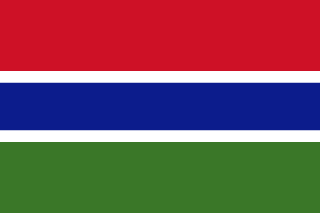
Gambia
Republic of the Gambia
Population: UN WPP 2024, revision 1, projection for 1 July 2026. Sources and methodology.
Geography and territory
Gambia is the smallest country on mainland Africa, occupying just 11,295 square kilometers in one of the most unusual shapes on the map: a narrow ribbon of land tracing both banks of the Gambia River as it pushes inland like a finger through Senegal, which surrounds it on three sides. Only a short 80-kilometer stretch of Atlantic coastline breaks Senegal’s encirclement. This odd configuration is a direct legacy of colonial-era boundary drawing, and it leaves Gambia with one of the strangest national outlines anywhere in the world.
The Gambia River is the country’s organizing feature, running 450 kilometers from east to west and remaining navigable along most of its length. Its banks are lined with extensive mangroves, wetlands, and gallery forests that form ecologically valuable habitats. Fertile floodplains flank the river on both sides, giving way further out to savanna dotted with baobabs, palms, and acacias.
The terrain is almost entirely flat, with no point rising above 53 meters, making Gambia one of the lowest-lying countries on the continent. The climate is tropical, split between a long dry season from November to May, when the harmattan wind blows dust south from the Sahara, and a rainy season from June to October that revives the river and its surrounding wetlands. Despite its small footprint, the country supports remarkable biodiversity: more than 560 bird species have been recorded within its borders, making it one of West Africa’s premier destinations for birdwatchers, alongside monkeys, crocodiles, and the occasional hippopotamus found along quieter stretches of the river.
History
The Gambia River valley has been inhabited since prehistoric times and played a meaningful role in the trans-Saharan trade networks of medieval West Africa. The empires of Ghana, Mali, and Songhai extended their influence over the region at different points, and the Mandinka, the area’s dominant ethnic group, built river-based kingdoms that grew wealthy trading gold, salt, and, tragically, enslaved people. The stone circles of Wassu and Kerbatch, dating from roughly the 3rd to the 16th century, stand as evidence of complex, organized societies that once flourished along the river.
Portuguese sailors were the first Europeans to explore the Gambia River, in the 15th century, but it was England that ultimately secured control of the region beginning in the 17th century, using James Island — now known as Kunta Kinteh Island — as a key post in the transatlantic slave trade. Alex Haley’s novel “Roots,” which traces the story of Kunta Kinte, a Mandinka man captured in Gambia and sold into slavery in America, brought this painful chapter of the country’s history to a worldwide audience.
Gambia gained independence from Britain on February 18, 1965, with Dawda Jawara as its first president, and became a republic within the Commonwealth a few years later. After a failed attempt at confederation with Senegal between 1982 and 1989, the country was rocked by a military coup in 1994 that installed Yahya Jammeh, who ruled with an authoritarian hand for 22 years, marked by human rights abuses and a personality cult that grew increasingly eccentric over time. When Jammeh lost the 2016 election to Adama Barrow, he initially refused to cede power, prompting a regional military intervention led by the Economic Community of West African States that ultimately secured a peaceful democratic transition in 2017, an outcome widely praised across the continent.
Culture and society
Gambian society is a genuinely multicultural fabric, with the Mandinka, Wolof, and Fula among its largest communities. Despite this ethnic and religious diversity, the country is known for an unusually high degree of tolerance, with Muslim and Christian families often sharing celebrations and family ties. Islam, practiced by more than 90 percent of the population, is followed in an open, inclusive way that readily incorporates traditional African customs.
Music sits at the center of Gambian cultural life, and no instrument represents the country better than the kora. This 21-string harp-lute, built from a halved gourd covered in cowhide, produces hauntingly beautiful melodies and is traditionally played by griots, the hereditary keepers of family history and genealogy among the Mandinka. The balafon, a wooden xylophone fitted with gourd resonators, and the djembe drum round out the country’s rich musical heritage.
Griots serve an essential social function as storytellers, mediators, advisers, and ceremonial performers, passing down the oral history of family lineages, moral lessons, and epic tales from one generation to the next. Gambian craftsmanship shows up in batik textiles, traditional weaving, silver jewelry, and woodcarving, all of which can be found in the lively markets of Banjul and Serrekunda. English remains the official language of government and schooling, a legacy of British colonial rule, while Mandinka, Wolof, and Fula are widely spoken in daily life across the country’s towns and villages.
Economy
Gambia’s economy is one of the smallest in Africa and leans heavily on agriculture, fishing, and tourism. Groundnut farming has historically been the backbone of the economy and remains a significant agricultural export, though its relative importance has declined in recent decades. Rice, millet, sorghum, and maize serve as the main subsistence crops, supplemented by fruit and vegetable growing along the riverbanks.
Tourism is the country’s second-largest source of foreign currency and a vital economic engine, particularly along the coastal strip where hotel resorts cater largely to European visitors drawn by sun, beaches, and West African culture. The fishing sector, both artisanal and industrial, supplies essential protein to the national diet and generates export income, though it faces mounting pressure from overfishing by foreign fleets operating in Gambian waters.
Remittances sent home by the Gambian diaspora in Europe and North America represent a crucial income source for thousands of families and contribute meaningfully to national GDP. The country continues to face structural economic challenges, including widespread poverty, heavy reliance on food and fuel imports, a narrow industrial base, and vulnerability to climate shocks that affect agricultural output. Small-scale trade and informal commerce also employ a large share of the workforce, particularly in and around the bustling markets of Banjul and Serrekunda.
Food and cuisine
Gambian cuisine faithfully reflects Mandinka culinary tradition and the natural bounty of the river and sea that frame the country. The national dish is benachin — Wolof for “one pot” — a rice dish cooked in a single pot with fish or meat, tomato, onion, palm oil, and a mix of vegetables such as eggplant, cassava, and squash. Every family has its own version, and the skill of a cook is often judged by how well they prepare it.
Domoda is another signature dish, a hearty peanut stew made with beef, chicken, or fish and served over white rice. The thick, aromatic peanut sauce coats every ingredient with a sweet, comforting flavor that captures the essence of West African home cooking. Yassa, chicken or fish marinated in lemon and onion, and supakanja, a thick okra soup made with smoked fish, round out the country’s classic dishes.
Meals are traditionally eaten together, gathered around a single large communal bowl and eaten with the right hand according to customs that reflect family hierarchy and values of generosity. Attaya, a Chinese green tea brewed ceremonially in three rounds of decreasing strength and served heavily sweetened and frothy, is the country’s essential social drink, and the ritual of preparing it is woven into nearly every aspect of Gambian daily life.
Tourism and landmarks
Gambia draws visitors with a compact but compelling mix of Atlantic beaches, riverine wilderness, and historical heritage, all easily explored within a small territory. The beaches of Kololi, Kotu, and Sanyang offer golden sand, warm water, and a lively nightlife scene, while the mangroves and wetlands along the Gambia River provide exceptional birdwatching opportunities, with species as striking as the osprey, giant kingfisher, and ground hornbill.
Kunta Kinteh Island, formerly James Island, is a UNESCO World Heritage Site that preserves the remains of a fort used during the transatlantic slave trade. Visiting the island together with the associated sites of Albreda and Jufureh — the birthplace of the legendary Kunta Kinte — offers a sobering and moving encounter with one of history’s darkest chapters.
Kiang West National Park is Gambia’s largest protected area, a haven of mangroves, floodplains, and woodland home to antelope, monkeys, hippos, and crocodiles. The stone circles of Wassu, another UNESCO World Heritage Site, form one of the most significant megalithic complexes in Africa. River cruises upstream from Banjul let visitors watch fishing villages, colonial-era trading posts, and dense riverine forest slide by at an unhurried pace. For a full dose of everyday culture, the markets of Albert in Banjul and of Serrekunda deliver a vivid display of color, aroma, and the warmth that defines Gambian society.
Fun facts about Gambia
- Gambia is the smallest country on mainland Africa, measuring just 48 kilometers across at its widest point.
- With more than 560 recorded bird species packed into such a small territory, Gambia is considered one of the finest birdwatching destinations in Africa.
- The story of Kunta Kinte, told in Alex Haley’s novel “Roots,” put Gambia on the world’s cultural map and sparked a wave of African American heritage tourism.
- The Gambia River is one of the few major rivers in West Africa that remains undammed, preserving its natural flow.
- The 2017 democratic transition, in which a regional coalition secured the peaceful exit of dictator Yahya Jammeh, is often cited as a model for resolving political crises in Africa.
- Gambia’s highest point rises just 53 meters above sea level, making it one of the flattest countries in the world.
The Gambia in numbers
Latest World Bank and UNDP observations, each with its own year. “World median” is the middle value among the countries that report the same indicator; “#” ranks from the highest value.
Population since 1960
The Gambia had 398,060 people in 1960 and 2.8 million in 2025 — 7.1 times as many.
People
65.0% of people live in towns and cities (world median 63.4%). 39.7% are under 15 and 3.2% are 65 or older — a young population. Women have 3.91 children on average, above the replacement level of about 2.1.
Economy
The economy grew by 5.9% in real terms in 2025. Consumer prices rose by 11.6% in 2024. Services make up the largest share of output (53.1% of GDP); agriculture contributes 23.8%, a large share that points to a farming-based economy.
Development and environment
UNDP rates human development in the Gambia as low, with an index of 0.524 in 2023 (rank 170 of 193). 49.5% of people use the internet and 69.0% have access to electricity. Forest covers 21.3% of the land (world median 32.8%).
Sources: World Bank, World Development Indicators (CC BY 4.0), most recent observation from 2015 onward; UNDP Human Development Report 2025. Retrieved 2026-10-10. Sector shares need not add up to 100% because taxes and subsidies on products are excluded. Missing values are left blank rather than estimated. Sources and methodology.
Climate of the Gambia
Averaged across the Gambia, the warmest month is May (30.9 °C) and the coolest is January (25.3 °C), a seasonal swing of 5.6 °C. The annual mean is 28.3 °C.
About 998 mm of precipitation falls in a typical year. August is the wettest month (345 mm) and March the driest (0 mm). The three wettest consecutive months, July to September, bring 82% of the year's total — a pronounced rainy season.
Show monthly values as a table
| Month | Mean °C | Low °C | High °C | Precipitation, mm |
|---|---|---|---|---|
| January | 25.3 | 16.2 | 34.5 | 0 |
| February | 27.3 | 17.7 | 37.0 | 0 |
| March | 29.3 | 20.0 | 38.6 | 0 |
| April | 30.5 | 21.5 | 39.5 | 0 |
| May | 30.9 | 23.0 | 38.8 | 8 |
| June | 30.1 | 24.2 | 36.1 | 87 |
| July | 28.5 | 24.0 | 33.2 | 203 |
| August | 27.8 | 23.7 | 32.0 | 345 |
| September | 27.9 | 23.3 | 32.6 | 267 |
| October | 29.0 | 23.1 | 34.8 | 85 |
| November | 27.9 | 19.9 | 35.9 | 3 |
| December | 25.7 | 16.8 | 34.7 | 0 |
Figures are 1991–2020 averages across the whole land area of the Gambia, from the World Bank Climate Change Knowledge Portal, CRU TS 4.08 (CC BY 4.0). They are not readings from one weather station: the capital, the coast and high ground can be much warmer, cooler, wetter or drier.
Travel essentials for the Gambia
The practical details visitors ask about first. Traffic in the Gambia drives on the right, like most of the world. Mains electricity is 230 V at 50 Hz, so devices made only for 110–120 V (common in North America) need a converter unless they are dual-voltage — most phone and laptop chargers are.
- Emergency number
- 117Fire 118
- Driving side
- Right
- Plug types
- Type GG: three rectangular pins (British)
- Voltage
- 230 V50 Hz
- Dialling code
- +220From abroad: your exit code, then 220 and the number
- Currency
- Dalasi (GMD)
- Time zone
- GMT (UTC+0)Current local time in the Gambia
Compiled from IEC plug and voltage standards, national emergency-service listings and the UN road-traffic conventions. Emergency numbers and local coverage can change — confirm them locally on arrival. The Gambia's internet domain is .gm.
Where the Gambia ranks in the world
Each position counts only the countries with data in that ranking guide. First place is the highest value — for price levels, the most expensive. Select a card to see the full table.
- Population139th of 1962.9 millionUN projection, July 2026
- Land area160th of 19510,120 km²World Bank, 2023
- Population density33rd of 194267 per km²World Bank, 2023
- GDP (nominal)166th of 187$2.4BWorld Bank, 2024, current US$
- GDP per capita176th of 187$871World Bank, 2024, current US$
- Life expectancy164th of 19466.1 yearsWorld Bank, 2024
- Price level147th of 16530 (US = 100)ICP 2021, household consumption
Bordering countries of the Gambia

Compare the Gambia with another country
Frequently asked questions about the Gambia
What is the capital of the Gambia?
The capital of the Gambia is Banjul.
What is the population of the Gambia?
The UN World Population Prospects projection for the Gambia is 2,884,079 people (2.9 million) on 1 July 2026. National statistical offices may publish different estimates.
What language is spoken in the Gambia?
The official language of the Gambia is English.
What currency is used in the Gambia?
The currency of the Gambia is the Dalasi (GMD).
How big is the Gambia?
The Gambia covers an area of 11,295 km².
What type of government does the Gambia have?
The Gambia is a presidential republic.
Which countries border the Gambia?
The Gambia shares land borders with Senegal.
What is the highest point in the Gambia?
The highest point in the Gambia is Unnamed point (53 m).


