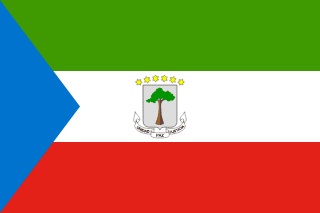
Equatorial Guinea
Republic of Equatorial Guinea
Population: UN WPP 2024, revision 1, projection for 1 July 2026. Sources and methodology.
Geography and territory
Decree-Law 1/2026, dated 2 January 2026, designated Ciudad de la Paz in Djibloho as the national capital, replacing Malabo.
Equatorial Guinea is a small Central African nation covering 28,051 km², made up of a mainland region and a cluster of volcanic islands in the Gulf of Guinea. The mainland territory, known as Río Muni, borders Cameroon to the north and Gabon to the south and east, and is covered for the most part by dense equatorial rainforest. The island territory includes Bioko, home to the former capital, Malabo, and Annobón, along with the smaller islets of Corisco, Elobey Grande, and Elobey Chico.
Bioko Island, of volcanic origin, is the largest and most mountainous part of the country. Peak Basile, rising 3,011 meters, is the country’s highest point, its slopes cloaked in cloud forest of exceptional biodiversity. Bioko’s volcanic craters cradle high-altitude lakes and endemic vegetation, including orchids, tree ferns, and an extraordinary variety of mosses. The mainland region of Río Muni is defined by coastal lowlands that rise gradually toward interior plateaus blanketed in equatorial rainforest.
The equatorial climate — warm and humid year-round, with average temperatures between 24 and 28 degrees Celsius and abundant rainfall — sustains one of the densest forest covers in Africa. The Mbia, Mbini, and Ntem rivers drain the mainland region, while the coastal waters support rich marine life. Equatorial Guinea’s biodiversity includes western lowland gorillas, chimpanzees, drills, and numerous bird species endemic to Bioko Island. This combination of volcanic highlands, dense lowland rainforest, and largely undeveloped coastline makes the country one of the most biologically rich, if least explored, corners of Central Africa.
History
The territory of Equatorial Guinea has been inhabited since ancient times by Pygmy and Bantu peoples. The Fang, the majority ethnic group on the mainland, and the Bubi, the original inhabitants of Bioko Island, were its principal pre-colonial communities. Portuguese navigators discovered the island of Fernando Pó (present-day Bioko) in 1472 and Annobón in 1473, establishing the first European contact with the region.
Portugal ceded the territories to Spain under the Treaty of El Pardo in 1778, and Spanish presence gradually consolidated over the nineteenth century, making the region Spain’s only colony in sub-Saharan Africa. Known as Spanish Guinea, the territory was administered as an overseas province and built an economy centered on cacao and coffee plantations on Fernando Pó, drawing labor from Nigeria and Río Muni.
Equatorial Guinea won independence on October 12, 1968, with Francisco Macías Nguema as its first president. His government quickly descended into a brutal dictatorship that devastated the country and drove roughly a third of the population into exile. In 1979, Teodoro Obiang Nguema Mbasogo overthrew his uncle in a coup and became president, a position he still holds today, making him one of the longest-serving heads of state anywhere in the world. The discovery of oil in the 1990s transformed the economy dramatically, turning a small, largely agrarian nation into one of Africa’s leading crude producers within a single generation, although that wealth has not been evenly shared.
Culture and society
Equatorial Guinea is the only African country where Spanish is an official language, giving it a singular cultural identity on the continent. Alongside Spanish, French and Portuguese also hold official status, reflecting a complex linguistic heritage. In daily life, indigenous languages such as Fang, Bubi, Ndowe, Bisio, and Annobonese — a Portuguese-based creole spoken on Annobón Island — remain very much alive.
Fang culture, dominant on the mainland, expresses itself through a rich tradition of sculpture, dance, and initiation rituals. Fang masks, with their stylized geometric lines and austere beauty, have profoundly influenced Western art and are displayed in major museums around the world. The Bubi of Bioko maintain their own traditions, including ceremonies tied to agricultural cycles and an ancestral social structure rooted in reverence for the forces of nature.
Equatoguinean literature written in Spanish is a unique cultural phenomenon on the African continent. Writers such as Donato Ndongo, María Nsue Angüe, Juan Tomás Ávila Laurel, and Justo Bolekia Boléka have built a body of work that explores African identity through the Spanish language, addressing themes of colonization, dictatorship, exile, and the search for roots. Equatoguinean music fuses African rhythms such as balélé and ivanga with Hispanic and Caribbean influences, producing festive sounds that animate celebrations and everyday social life.
Economy
Equatorial Guinea’s economy underwent a dramatic transformation following the discovery of oil fields in the 1990s, which turned the country into the third-largest oil producer in sub-Saharan Africa. Oil revenue sharply lifted per capita GDP to among the highest on the continent, though that wealth has largely concentrated among a small elite while much of the population continues to live in poverty.
Before the oil boom, the economy rested on agriculture, particularly the production of high-quality cacao, coffee, and tropical timber. Bioko’s cacao was especially prized on international markets for its exceptional aroma and flavor. Although agriculture has since taken a back seat to petroleum, the government has promoted diversification plans aimed at revitalizing the farm sector and building processing industries to reduce dependence on crude oil.
Infrastructure development has been a priority in recent decades, including construction of a new administrative capital at Oyala, now called Ciudad de la Paz, in the interior of Río Muni, along with modern highways, ports, and airports. Liquefied natural gas has emerged as an important complement to oil revenue. Even so, the economy faces the looming challenge of declining hydrocarbon reserves and a pressing need to diversify its productive base to ensure long-term sustainability, with fishing, forestry, and tourism all identified as potential growth areas for the coming decades.
Food and cuisine
Equatoguinean cuisine blends African culinary traditions with Spanish influences, producing flavors found nowhere else on the continent. The national dish is pepesup, a thick, spicy pepper soup made with fresh fish, meat, or shellfish, seasoned with grains of Guinea pepper, palm oil, and aromatic herbs. This intensely flavored, warming soup is typically served with fried plantain, cassava, or rice.
Cassava and plantain form the backbone of the Equatoguinean diet, prepared in countless ways. Malamba is a paste of mashed plantain that accompanies stews and sauces, while cassava is eaten boiled, fried, or fermented into stick-shaped preparations similar to those found elsewhere in Central Africa. Bushmeat, including pangolin and porcupine, was once part of the traditional diet, though its consumption has declined for conservation reasons. Fish and shellfish are especially abundant and varied on the islands.
Spanish influence shows up in dishes like tortillas, croquettes, and stews that echo peninsular cooking but use tropical ingredients. Equatoguinean cacao is used both in beverages and desserts. Topé, a potent spirit distilled from sugarcane, is the local liquor of choice, while palm wine, tapped from incisions in the trunks of palm trees, accompanies social gatherings and family ceremonies.
Tourism and landmarks
Equatorial Guinea offers largely undiscovered attractions ranging from tropical beaches to virgin rainforest and volcanic scenery. Bioko Island is the main destination, with Peak Basile as its dramatic backdrop; its cloud-forested slopes hold one of the highest concentrations of primates in Africa, including the drill, a critically endangered primate. The black volcanic-sand beaches on Bioko’s southern coast, such as Moraka and Arena Blanca, serve as nesting grounds for sea turtles between November and March.
Malabo, the former island capital, retains a historic center with Spanish colonial architecture, the neo-Gothic Cathedral of Santa Isabel, and tree-lined streets that recall its past as the capital of Spanish Guinea. Nearby, the crater lakes and forested slopes of Bioko’s interior are increasingly popular with hikers and birdwatchers seeking a quieter, more adventurous side of the island. Monte Alén National Park, on the mainland in Río Muni, protects 2,000 km² of equatorial rainforest that is home to western lowland gorillas, chimpanzees, forest elephants, and an extraordinary diversity of tropical butterflies.
Annobón Island, the most remote and least visited part of the country, offers spectacular volcanic scenery with a crater lake at its summit and fishing villages where time seems to have stood still. Bata, the mainland’s main urban center, has modernized considerably and now boasts a lively seaside promenade. For ecotourism enthusiasts, the Moca waterfalls in Bioko’s highlands and the rainforest trails of Río Muni offer immersive nature experiences in one of Africa’s least-visited countries.
Fun facts about Equatorial Guinea
- Equatorial Guinea is the only country in Africa where Spanish is an official language, a legacy of its history as a Spanish colony.
- Peak Basile, on Bioko Island, is one of the tallest volcanic peaks in West-Central Africa and hosts unique mountain ecosystems.
- President Teodoro Obiang Nguema Mbasogo has held power since 1979, making him one of the longest-serving heads of state in the world.
- Cacao from Equatorial Guinea, especially from Bioko Island, is considered among the finest in the world for its aroma and purity.
- Oyala, renamed Ciudad de la Paz, is a new administrative capital being built from scratch in the middle of the Río Muni rainforest.
- Equatorial Guinea is the smallest country in continental Africa to be a member of OPEC.
Sources and review
Checked : Capital designation only: Ciudad de la Paz under Decree-Law 1/2026. Other descriptive claims were not part of this review..
Equatorial Guinea in numbers
Latest World Bank and UNDP observations, each with its own year. “World median” is the middle value among the countries that report the same indicator; “#” ranks from the highest value.
Population since 1960
Equatorial Guinea had 269,807 people in 1960 and 1.9 million in 2025 — 7.2 times as many.
People
71.6% of people live in towns and cities (world median 63.4%). 37.1% are under 15 and 3.8% are 65 or older — a young population. Women have 4.12 children on average, above the replacement level of about 2.1.
Economy
The economy shrank by 5.8% in real terms in 2025. Consumer prices rose by 2.9% in 2024. Services make up the largest share of output (55.5% of GDP); agriculture contributes 3.2%.
Development and environment
UNDP rates human development in Equatorial Guinea as medium, with an index of 0.674 in 2023 (rank 133 of 193). 63.3% of people use the internet and 65.1% have access to electricity. Forest covers 86.1% of the land (world median 32.8%).
Sources: World Bank, World Development Indicators (CC BY 4.0), most recent observation from 2015 onward; UNDP Human Development Report 2025. Retrieved 2026-10-10. Sector shares need not add up to 100% because taxes and subsidies on products are excluded. Missing values are left blank rather than estimated. Sources and methodology.
Climate of Equatorial Guinea
Averaged across Equatorial Guinea, the mean temperature stays between 23.4 °C (August) and 25.6 °C (February) — a swing of only 2.2 °C, so seasons are marked by rainfall rather than by heat.
About 2,440 mm of precipitation falls in a typical year. October is the wettest month (452 mm) and July the driest (68 mm). There are two rainy seasons: September to November brings 42% of the year's total and March to May another 30%.
Show monthly values as a table
| Month | Mean °C | Low °C | High °C | Precipitation, mm |
|---|---|---|---|---|
| January | 25.3 | 21.5 | 29.2 | 110 |
| February | 25.6 | 21.3 | 29.9 | 131 |
| March | 25.5 | 21.3 | 29.8 | 231 |
| April | 25.3 | 20.9 | 29.6 | 231 |
| May | 25.3 | 21.2 | 29.3 | 259 |
| June | 24.4 | 20.9 | 28.0 | 142 |
| July | 23.5 | 20.2 | 26.8 | 68 |
| August | 23.4 | 20.1 | 26.8 | 103 |
| September | 24.2 | 20.5 | 28.0 | 279 |
| October | 24.3 | 20.6 | 28.0 | 452 |
| November | 24.6 | 20.8 | 28.4 | 289 |
| December | 24.8 | 21.1 | 28.6 | 145 |
Figures are 1991–2020 averages across the whole land area of Equatorial Guinea, from the World Bank Climate Change Knowledge Portal, CRU TS 4.08 (CC BY 4.0). They are not readings from one weather station: the capital, the coast and high ground can be much warmer, cooler, wetter or drier.
Travel essentials for Equatorial Guinea
The practical details visitors ask about first. Traffic in Equatorial Guinea drives on the right, like most of the world. Mains electricity is 220 V at 50 Hz, so devices made only for 110–120 V (common in North America) need a converter unless they are dual-voltage — most phone and laptop chargers are.
- Emergency number
- 114
- Driving side
- Right
- Plug types
- Type C, Type EC: two round pins (Europlug); E: two round pins, earth pin in the socket
- Voltage
- 220 V50 Hz
- Dialling code
- +240From abroad: your exit code, then 240 and the number
- Currency
- Central African CFA Franc (XAF)
- Time zone
- WAT (UTC+1)Current local time in Equatorial Guinea
Compiled from IEC plug and voltage standards, national emergency-service listings and the UN road-traffic conventions. Emergency numbers and local coverage can change — confirm them locally on arrival. Equatorial Guinea's internet domain is .gq.
Where Equatorial Guinea ranks in the world
Each position counts only the countries with data in that ranking guide. First place is the highest value — for price levels, the most expensive. Select a card to see the full table.
- Population148th of 1962.0 millionUN projection, July 2026
- Land area139th of 19528,050 km²World Bank, 2023
- Population density120th of 19466 per km²World Bank, 2023
- GDP (nominal)143rd of 187$13.3BWorld Bank, 2024, current US$
- GDP per capita96th of 187$7,004World Bank, 2024, current US$
- Life expectancy172nd of 19463.9 yearsWorld Bank, 2024
- Price level67th of 16552 (US = 100)ICP 2021, household consumption
Bordering countries of Equatorial Guinea


Compare Equatorial Guinea with another country
Frequently asked questions about Equatorial Guinea
What is the capital of Equatorial Guinea?
The capital of Equatorial Guinea is Ciudad de la Paz.
What is the population of Equatorial Guinea?
The UN World Population Prospects projection for Equatorial Guinea is 1,984,468 people (2.0 million) on 1 July 2026. National statistical offices may publish different estimates.
What language is spoken in Equatorial Guinea?
The official language of Equatorial Guinea is Spanish, French and Portuguese.
What currency is used in Equatorial Guinea?
The currency of Equatorial Guinea is the Central African CFA Franc (XAF).
How big is Equatorial Guinea?
Equatorial Guinea covers an area of 28,051 km².
What type of government does Equatorial Guinea have?
Equatorial Guinea is a presidential republic.
Which countries border Equatorial Guinea?
Equatorial Guinea shares land borders with Cameroon, Gabon.
What is the highest point in Equatorial Guinea?
The highest point in Equatorial Guinea is Peak Basilé (3,011 m).


