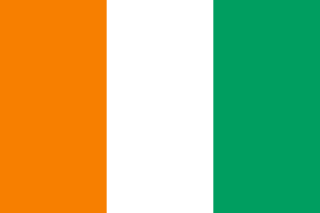
Ivory Coast
Republic of Cote d'Ivoire
Population: UN WPP 2024, revision 1, projection for 1 July 2026. Sources and methodology.
Geography and territory
Ivory Coast lies on the west coast of Africa, fronting the Gulf of Guinea along more than 500 kilometers of coastline. Covering 322,463 square kilometers, an area comparable in size to Germany, the country transitions gradually from coastal lagoons and beaches along the Atlantic to interior savannas and mountains in the west, supporting a rich variety of ecosystems along the way. The coastal strip is defined by a chain of lagoons running east to west, the largest of which, the Ébrié Lagoon, is the site of Abidjan, the country’s economic capital.
The terrain is generally flat, with an average elevation of around 350 meters. In the west, however, the landscape breaks into mountains along the foothills of the Guinea Highlands, where Mount Nimba rises to 1,752 meters, the country’s highest point, shared with neighboring Guinea and Liberia. This region shelters montane forests of considerable ecological value. The center and north are covered by wooded savanna that grows progressively drier toward the borders with Mali and Burkina Faso.
The south of Ivory Coast still holds remnants of the dense tropical rainforest that once covered much of the country. Although deforestation has sharply reduced the original forest cover, national parks such as Taï, a UNESCO World Heritage Site, protect globally significant tracts of primary rainforest. The tropical climate of the south, warm and humid with two rainy seasons, contrasts with the drier tropical climate of the north, which has a single rainy season. The Bandama, Comoé, Sassandra, and Cavally rivers drain the country from north to south into the Atlantic.
History
The territory that is now Ivory Coast has been inhabited since ancient times by peoples who built complex societies and rich cultural traditions. The Senufo in the north, and the Bété and Baoulé in the center and south, established chiefdoms and kingdoms with elaborate social structures. The Kong Empire, founded in the seventeenth century by Dyula traders, grew into an important Islamic commercial and religious center that controlled trade routes linking the savanna to the forests of the south.
Europeans began visiting the coast in the fifteenth century, drawn by the ivory trade that would later give the country its name. French colonization was consolidated in the late nineteenth century, and Ivory Coast was folded into French West Africa. Colonial economic policy centered on export crops, especially coffee and cocoa, relying on forced labor and drawing migrant workers from neighboring territories. Félix Houphouët-Boigny, leader of the independence movement and the country’s first president following independence on August 7, 1960, governed for more than three decades, pursuing a policy of economic openness and close ties with France.
The so-called Ivorian miracle of the early decades of independence, built on sustained growth from cocoa and coffee exports, faded in the 1980s as commodity prices fell. Houphouët-Boigny’s death in 1993 opened a period of political instability that culminated in a coup in 1999 and two civil wars, in 2002 and 2010–2011. The post-election crisis of 2010–2011, which claimed thousands of lives, was the most severe and traumatic of these episodes. Since then, Ivory Coast has pursued a path of reconciliation and reconstruction that has restored the country to a position of strong economic momentum.
Culture and society
Ivory Coast is a country of extraordinary cultural diversity, home to more than 60 ethnic groups organized into four major families: the Akan (including the Baoulé and Agni) in the east and center, the Mandé (Malinké, Dyula) in the northwest, the Kru (Bété, Dida) in the southwest, and the Voltaic peoples (Senufo, Lobi) in the north. Each group contributes its own languages, dances, ritual masks, and oral traditions to a strikingly rich cultural mosaic.
Music is one of the most vibrant expressions of Ivorian culture and has had a significant impact on the African and international music scenes. Zouglou, born on the university campuses of Abidjan in the 1990s as a form of social protest, has become a popular genre known for its infectious rhythms and socially engaged lyrics. Coupé-décalé, which emerged among the Ivorian diaspora in Paris in the early 2000s, is a burst of energy, flamboyance, and optimism that has taken over dance floors across the continent. Artists such as Alpha Blondy, Africa’s most famous reggae musician, and DJ Arafat have carried Ivorian music to the world stage.
Masks play a central role in the ceremonies and rituals of many ethnic groups. The circular-eyed masks of the Yacouba, believed to mediate between the spiritual and human worlds, the Senufo masks associated with the Poro secret society, and the stylized, elegant Baoulé masks are all artistic achievements of the first order, exhibited in major art museums around the world. The Basilica of Our Lady of Peace in Yamoussoukro, built by Houphouët-Boigny and modeled on St. Peter’s Basilica in the Vatican, is the largest Christian church in the world by floor area.
Economy
Ivory Coast is the leading economic power in West Africa and the third-largest economy in francophone sub-Saharan Africa. The country is the world’s top cocoa producer, accounting for more than 40% of global output, meaning that nearly every chocolate bar sold anywhere in the world very likely contains Ivorian cocoa. Beyond cocoa, Ivory Coast is a major producer of coffee, palm oil, rubber, cashews, cotton, and bananas, giving it a diversified agricultural base that employs the majority of its rural population.
Abidjan, the economic capital, is the financial and commercial hub of francophone West Africa. The city hosts the regional headquarters of numerous multinational corporations, banks, and international institutions, including the African Development Bank. The Autonomous Port of Abidjan is the largest in West Africa and a crucial logistics node for regional trade. The services sector, telecommunications, construction, and agro-industrial processing have all seen vigorous growth over the past decade.
The Ivorian economy has posted some of the fastest GDP growth rates in Africa since 2012, fueled by ambitious infrastructure programs, a recovering agricultural sector, and policies aimed at attracting foreign investment. Even so, heavy dependence on cocoa leaves the country exposed to swings in international commodity prices and raises questions about environmental sustainability. Social inequality, rural poverty, child labor on cocoa plantations, and the need to diversify the economy toward industrial processing of raw materials remain the country’s principal economic challenges.
Food and cuisine
Ivorian cuisine is generous, spicy, and full of character, reflecting both the country’s ethnic diversity and the abundance of its agricultural resources. Attiéké, a granulated semolina made from fermented cassava that resembles couscous, is the country’s essential side dish. It is served with grilled fish, chicken, or any number of sauces, and its artisanal preparation — which involves several days of fermentation, grating, and steaming — is a craft mastered largely by women in coastal and lagoon communities.
Kédjenou, a chicken or guinea fowl stew slow-cooked in a sealed clay pot lined with banana leaves, is widely considered the country’s signature dish. Because no water is added, the meat cooks in its own juices along with tomato, eggplant, pepper, and spices, producing deeply concentrated flavors. Foutou, an elastic dough made from pounded plantain and cassava and served with peanut soup or leaf sauce, is another staple of the Ivorian table. Garba, a combination of attiéké with fried tuna and onion, is Abidjan’s most popular street food, eaten by millions of people every day.
Grilled meat skewers known as choukouya are sold on nearly every street corner, alongside alloco (fried ripe plantain) and bananes braisées (grilled plantains). Millet beer, bangui (palm wine), and koutoukou, a potent artisanal spirit, are the traditional drinks that liven up evenings and celebrations. Ginger juice, bissap (hibiscus), and tamarind drinks are refreshing staples found at street stalls and casual restaurants throughout the country.
Tourism and landmarks
Taï National Park, a UNESCO World Heritage Site, is one of the last great expanses of primary rainforest left in West Africa. Its 3,300 square kilometers shelter exceptional biodiversity, including chimpanzees, pygmy hippopotamuses, forest elephants, and more than 1,000 plant species. It was here that primatologists first documented chimpanzees using stone tools to crack nuts, a discovery that reshaped scientific understanding of animal intelligence. The park offers trekking and rainforest immersion experiences considered among the most authentic on the continent.
Grand-Bassam, the former colonial capital located 40 kilometers from Abidjan, was designated a UNESCO World Heritage Site for its architectural ensemble documenting the French colonial era and trade with coastal peoples. Its colonial-style buildings, beaches, and relaxed atmosphere offer a striking contrast to the bustle of nearby Abidjan. The Basilica of Our Lady of Peace in Yamoussoukro, with a dome standing 158 meters tall and 7,000 square meters of stained glass, is a monumental structure that astonishes visitors both for its scale and its setting amid the African savanna.
Abidjan, a vibrant metropolis of more than five million people, offers one of the most dynamic cultural and nightlife scenes in Africa. The Treichville district, with its bustling market and popular maquis restaurants, is the beating heart of everyday life in the city. Le Plateau, the business district, impresses with its skyline of high-rises. The beaches of Assinie, east of the city, offer a tropical escape with coconut palms, lagoons, and resorts. In the north, the Senufo villages around Korhogo showcase traditional crafts such as bogolan-style cloth weaving and mask carving.
Fun facts about Ivory Coast
- Ivory Coast produces more than 40% of the world’s cocoa, meaning nearly half of all the chocolate consumed on Earth traces its origin to Ivorian soil.
- The Basilica of Our Lady of Peace in Yamoussoukro, built by President Houphouët-Boigny and consecrated by Pope John Paul II in 1990, is the largest Christian church in the world by floor area, surpassing St. Peter’s Basilica in the Vatican.
- Under a 1986 government request, the country’s official French name, Côte d’Ivoire, is not meant to be translated into other languages.
- Abidjan is often nicknamed the “Paris of West Africa” for its urban sophistication, cultural life, and dining scene.
- The chimpanzees of Taï National Park are the only ones in the world documented using stone tools to crack nuts, a behavior passed down culturally from generation to generation.
Ivory Coast in numbers
Latest World Bank and UNDP observations, each with its own year. “World median” is the middle value among the countries that report the same indicator; “#” ranks from the highest value.
Population since 1960
Ivory Coast had 3.7 million people in 1960 and 32.7 million in 2025 — 8.9 times as many.
People
54.5% of people live in towns and cities (world median 63.4%). 40.5% are under 15 and 2.7% are 65 or older — a very young population. Women have 4.23 children on average, above the replacement level of about 2.1.
Economy
The economy grew by 6.5% in real terms in 2025. Consumer prices rose by 0.1% in 2025. Services make up the largest share of output (51.2% of GDP); agriculture contributes 16.8%.
Development and environment
UNDP rates human development in Ivory Coast as medium, with an index of 0.582 in 2023 (rank 157 of 193). 41.4% of people use the internet and 72.9% have access to electricity. Forest covers 12.1% of the land (world median 32.8%).
Sources: World Bank, World Development Indicators (CC BY 4.0), most recent observation from 2015 onward; UNDP Human Development Report 2025. Retrieved 2026-10-10. Sector shares need not add up to 100% because taxes and subsidies on products are excluded. Missing values are left blank rather than estimated. Sources and methodology.
Climate of Ivory Coast
Averaged across Ivory Coast, the warmest month is March (29.1 °C) and the coolest is August (25.1 °C), a seasonal swing of 4.0 °C. The annual mean is 26.8 °C.
About 1,298 mm of precipitation falls in a typical year. September is the wettest month (186 mm) and January the driest (13 mm). The wettest stretch is August to October, with 38% of the year's total.
Show monthly values as a table
| Month | Mean °C | Low °C | High °C | Precipitation, mm |
|---|---|---|---|---|
| January | 26.3 | 19.3 | 33.3 | 13 |
| February | 28.3 | 21.7 | 34.8 | 34 |
| March | 29.1 | 23.2 | 34.9 | 79 |
| April | 28.6 | 23.3 | 33.9 | 123 |
| May | 27.6 | 22.9 | 32.4 | 150 |
| June | 26.4 | 22.2 | 30.7 | 181 |
| July | 25.4 | 21.6 | 29.1 | 148 |
| August | 25.1 | 21.5 | 28.7 | 155 |
| September | 25.7 | 21.7 | 29.7 | 186 |
| October | 26.4 | 21.9 | 30.9 | 152 |
| November | 26.9 | 21.6 | 32.3 | 58 |
| December | 26.2 | 20.0 | 32.4 | 20 |
Figures are 1991–2020 averages across the whole land area of Ivory Coast, from the World Bank Climate Change Knowledge Portal, CRU TS 4.08 (CC BY 4.0). They are not readings from one weather station: the capital, the coast and high ground can be much warmer, cooler, wetter or drier.
Travel essentials for Ivory Coast
The practical details visitors ask about first. Traffic in Ivory Coast drives on the right, like most of the world. Mains electricity is 230 V at 50 Hz, so devices made only for 110–120 V (common in North America) need a converter unless they are dual-voltage — most phone and laptop chargers are.
- Emergency number
- 110Ambulance 185 · Fire 180
- Driving side
- Right
- Plug types
- Type C, Type EC: two round pins (Europlug); E: two round pins, earth pin in the socket
- Voltage
- 230 V50 Hz
- Dialling code
- +225From abroad: your exit code, then 225 and the number
- Currency
- CFA Franc (XOF)
- Time zone
- GMT (UTC+0)Current local time in Ivory Coast
Compiled from IEC plug and voltage standards, national emergency-service listings and the UN road-traffic conventions. Emergency numbers and local coverage can change — confirm them locally on arrival. Ivory Coast's internet domain is .ci.
Where Ivory Coast ranks in the world
Each position counts only the countries with data in that ranking guide. First place is the highest value — for price levels, the most expensive. Select a card to see the full table.
- Population50th of 19633.5 millionUN projection, July 2026
- Land area66th of 195318,000 km²World Bank, 2023
- Population density90th of 19498 per km²World Bank, 2023
- GDP (nominal)75th of 187$87.1BWorld Bank, 2024, current US$
- GDP per capita138th of 187$2,728World Bank, 2024, current US$
- Life expectancy181st of 19462.1 yearsWorld Bank, 2024
- Price level97th of 16543 (US = 100)ICP 2021, household consumption
Bordering countries of Ivory Coast


Compare Ivory Coast with another country
Frequently asked questions about Ivory Coast
What is the capital of Ivory Coast?
The capital of Ivory Coast is Yamoussoukro.
What is the population of Ivory Coast?
The UN World Population Prospects projection for Ivory Coast is 33,494,346 people (33.5 million) on 1 July 2026. National statistical offices may publish different estimates.
What language is spoken in Ivory Coast?
The official language of Ivory Coast is French.
What currency is used in Ivory Coast?
The currency of Ivory Coast is the CFA Franc (XOF).
How big is Ivory Coast?
Ivory Coast covers an area of 322,463 km².
What type of government does Ivory Coast have?
Ivory Coast is a presidential republic.
Which countries border Ivory Coast?
Ivory Coast shares land borders with Liberia, Guinea, Mali, Burkina Faso, Ghana.
What is the highest point in Ivory Coast?
The highest point in Ivory Coast is Mount Nimba (1,752 m).


