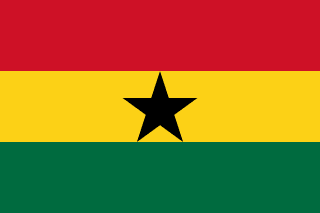
Ghana
Republic of Ghana
Population: UN WPP 2024, revision 1, projection for 1 July 2026. Sources and methodology.
Geography and territory
Ghana occupies a stretch of the Gulf of Guinea coastline in West Africa, covering 238,533 square kilometers and home to a population of about 35.7 million. Its neighbors are Côte d’Ivoire to the west, Burkina Faso to the north, and Togo to the east, with the Atlantic Ocean forming its entire southern border. The terrain is largely low-lying, transitioning from coastal plains and lagoons in the south through dense tropical forest to open savanna in the north, with the elevated Ashanti Plateau anchoring the country’s interior.
Lake Volta dominates the eastern half of the country and ranks as the largest artificial lake in the world by surface area, covering roughly 8,502 square kilometers. It was formed in 1965 when the Akosombo Dam impounded the Volta River, and it now supplies hydroelectric power to Ghana and its neighbors while sustaining a substantial freshwater fishing industry. The Black Volta, White Volta, and Oti rivers feed this system and together form the backbone of the country’s drainage network.
Ghana’s climate is tropical but far from uniform: the humid south experiences two rainy seasons a year, while the drier north gets by with a single wet season. Coastal vegetation runs to mangroves and coconut palms, while the interior rainforests shelter elephants, antelope, colobus monkeys, and more than 700 recorded bird species. Kakum National Park, famous for its canopy walkway strung high above the forest floor, showcases this ecological richness and draws naturalists from around the world.
History
Ghana’s history reaches back to the great medieval empires of West Africa. The modern nation’s name is itself a tribute to the ancient Empire of Ghana, which flourished between the eighth and eleventh centuries in a region well north of the country’s present borders. The land that is now Ghana was home to the Akan, Mole-Dagbani, Ewe, and Ga-Dangme peoples, who built sophisticated political and trading systems, none more powerful than the Ashanti Empire, centered on the city of Kumasi.
Starting in the fifteenth century, Portuguese traders reached the coast in search of gold and named the region the Gold Coast. Over the following centuries the Dutch, Danish, Swedish, and British all built forts and trading posts along the shoreline, which became grim hubs of the transatlantic slave trade. Cape Coast Castle and Elmina Castle, built by Swedish and Portuguese traders respectively, still stand today as UNESCO World Heritage Sites and sobering monuments to that era.
On March 6, 1957, Ghana became the first sub-Saharan African nation to win independence from European colonial rule, under the charismatic leadership of Kwame Nkrumah, a central figure of the pan-Africanist movement. Nkrumah pushed an ambitious agenda of modernization and African unity, though his increasingly authoritarian rule led to his overthrow in 1966. After decades of political instability and military coups, Ghana emerged from the 1990s onward as one of Africa’s most stable and mature democracies.
Culture and society
Ghana’s culture is vivid and varied, mirroring the diversity of its ethnic makeup. The Akan, which include the Ashanti and Fante peoples, form the largest group, followed by the Mole-Dagbani of the north, the Ewe of the east, and the Ga-Adangbe centered around Accra. Each community contributes its own traditions, festivals, music, and forms of governance to the national mosaic. The Akan concept of “sankofa,” roughly “go back and get it,” meaning that one must draw on the past to move forward, runs through Ghanaian life as a guiding philosophy.
Traditional festivals remain vibrant expressions of this heritage. Homowo, celebrated by the Ga people of Accra, commemorates an ancient famine overcome through a bountiful harvest. Panafest, a pan-African festival held in Cape Coast, draws members of the African diaspora back to reconnect with their roots. The Aboakyir festival of the Effutu people and the Hogbetsotso of the Ewe are among many other celebrations that keep ancestral customs alive.
Music sits at the heart of Ghanaian identity. Highlife, a genre born in Ghana in the early twentieth century that fuses African rhythms with Western melodic structures, is widely regarded as Africa’s first modern popular music style. Hiplife, its contemporary descendant blending highlife with hip-hop, and azonto, a dance and music craze that went viral worldwide, show the enduring creative energy of Ghana’s music scene. Kente, the brilliantly colored woven cloth of the Ashanti, with geometric patterns that each carry symbolic meaning, stands as one of the world’s most recognized African textile arts.
Economy
Ghana runs one of the most dynamic and diversified economies in West Africa. The country is the world’s second-largest producer of cocoa, behind only Côte d’Ivoire, and the crop provides a livelihood for millions of rural families. Gold mining, the industry that gave the old Gold Coast its name, remains a pillar of the economy, and Ghana consistently ranks among Africa’s leading gold producers.
The discovery of the Jubilee oil field in 2007 and the start of crude production in 2010 added a new dimension to the national economy. Oil revenue, though subject to price swings, has helped fund infrastructure development and supported overall growth. Beyond cocoa, agriculture spans palm oil, rubber, timber, cashews, and horticultural products, while the fishing sector contributes to both food security and export earnings.
The services sector has expanded rapidly, driven by telecommunications, banking, trade, and tourism. Accra has emerged as a growing technology hub, drawing startups and digital investment from across the continent. International investors frequently rank Ghana among Africa’s most reliable destinations for capital, citing its political stability, relatively transparent legal framework, and a skilled workforce trained at institutions such as the University of Ghana in Legon and the Kwame Nkrumah University of Science and Technology in Kumasi.
Food and cuisine
Ghanaian cuisine delivers bold flavors, contrasting textures, and rich aromas that reflect the country’s cultural diversity. Fufu, a smooth, elastic dough pounded from boiled plantain and cassava, is the classic companion to Ghana’s soups and stews. It is eaten by hand, small portions pinched off and dipped into dishes such as palm nut soup, groundnut soup, or okra soup with smoked fish.
Jollof rice is perhaps West Africa’s most argued-over dish, with Ghana and Nigeria locked in a good-natured culinary rivalry over whose version reigns supreme. The Ghanaian rendition is rice simmered in a spiced tomato sauce with onion and chili, typically served alongside fried chicken, fish, or meat. Banku, a fermented dough of corn and cassava served with pepper sauce and grilled tilapia, is another staple, especially beloved along the coast.
Waakye, rice and black-eyed peas cooked together to a distinctive reddish hue, is eaten for breakfast or lunch and traditionally piled high with sides such as shito (a spicy black pepper sauce), spaghetti, fried egg, and salad. Kelewele, cubes of ripe plantain fried with ginger, chili, and spices, is Ghana’s favorite street snack. To drink, sobolo (hibiscus infusion) and asaana (a fermented corn beverage) offer refreshing relief on hot tropical days.
Tourism and landmarks
Ghana offers travelers a rounded experience that blends historical weight, lush nature, and a lively cultural scene. The coastal castles and forts, above all Cape Coast Castle and Elmina Castle, both UNESCO World Heritage Sites, are essential stops for understanding the scale of the transatlantic slave trade. The dark dungeons where captives were held before being shipped across the Atlantic make for a profoundly moving historical experience.
Kakum National Park, in the Central Region, offers a singular thrill: a 350-meter-long canopy walkway suspended 30 meters above the rainforest floor. Mole National Park, in the north, is Ghana’s largest wildlife reserve, where visitors can spot elephants, antelope, warthogs, and primates on guided walking safaris, an affordable and authentic alternative to the safari circuits of East Africa.
Accra, the capital, buzzes with energy across its markets, contemporary art galleries, restaurants, and the lively Labadi Beach. Kumasi, seat of the historic Ashanti kingdom, is home to the Manhyia Palace, residence of the Asantehene, and the sprawling Kejetia Market, one of the largest in West Africa. Wli Falls, Ghana’s tallest waterfall, and Lake Bosumtwi, cradled inside a meteorite crater, round out a tourism offering that surprises visitors with its variety and authenticity.
Fun facts about Ghana
- Ghana was the first sub-Saharan African nation to gain independence, doing so in 1957 and becoming a symbol of the continent’s decolonization movement.
- Lake Volta is the largest artificial lake in the world by surface area, large enough to be visible from space.
- Ghana’s figurative “fantasy coffins,” shaped like airplanes, cars, fish, or cell phones to reflect the deceased’s profession or passion, are celebrated as fine art and displayed in museums worldwide.
- Ashanti kente cloth is one of the most recognized textiles on earth, and every combination of colors and patterns carries its own specific meaning.
- Kofi Annan, the seventh Secretary-General of the United Nations and a Nobel Peace Prize laureate, was born in Kumasi, Ghana.
- Ghana has one of the highest literacy rates in West Africa and is home to some of the continent’s oldest universities.
Ghana in numbers
Latest World Bank and UNDP observations, each with its own year. “World median” is the middle value among the countries that report the same indicator; “#” ranks from the highest value.
Population since 1960
Ghana had 7.0 million people in 1960 and 35.1 million in 2025 — 5.0 times as many.
People
58.9% of people live in towns and cities (world median 63.4%). 35.4% are under 15 and 3.8% are 65 or older — a young population. Women have 3.34 children on average, above the replacement level of about 2.1.
Economy
The economy grew by 6.0% in real terms in 2025. Consumer prices rose by 14.2% in 2025. Services make up the largest share of output (42.9% of GDP); agriculture contributes 21.3%, a large share that points to a farming-based economy.
Development and environment
UNDP rates human development in Ghana as medium, with an index of 0.628 in 2023 (rank 143 of 193). 72.2% of people use the internet and 91.9% have access to electricity. Forest covers 30.9% of the land (world median 32.8%).
Sources: World Bank, World Development Indicators (CC BY 4.0), most recent observation from 2015 onward; UNDP Human Development Report 2025. Retrieved 2026-10-10. Sector shares need not add up to 100% because taxes and subsidies on products are excluded. Missing values are left blank rather than estimated. Sources and methodology.
Climate of Ghana
Averaged across Ghana, the warmest month is March (30.3 °C) and the coolest is August (25.6 °C), a seasonal swing of 4.7 °C. The annual mean is 27.7 °C.
About 1,210 mm of precipitation falls in a typical year. September is the wettest month (178 mm) and January the driest (9 mm). The wettest stretch is August to October, with 39% of the year's total.
Show monthly values as a table
| Month | Mean °C | Low °C | High °C | Precipitation, mm |
|---|---|---|---|---|
| January | 27.4 | 20.8 | 34.1 | 9 |
| February | 29.5 | 23.2 | 35.9 | 29 |
| March | 30.3 | 24.6 | 36.0 | 68 |
| April | 29.7 | 24.7 | 34.7 | 114 |
| May | 28.5 | 23.9 | 33.2 | 148 |
| June | 27.1 | 23.0 | 31.2 | 171 |
| July | 26.1 | 22.5 | 29.7 | 145 |
| August | 25.6 | 22.2 | 29.1 | 140 |
| September | 26.2 | 22.3 | 30.1 | 178 |
| October | 27.2 | 22.6 | 31.8 | 150 |
| November | 27.9 | 22.2 | 33.8 | 44 |
| December | 27.3 | 20.9 | 33.7 | 14 |
Figures are 1991–2020 averages across the whole land area of Ghana, from the World Bank Climate Change Knowledge Portal, CRU TS 4.08 (CC BY 4.0). They are not readings from one weather station: the capital, the coast and high ground can be much warmer, cooler, wetter or drier.
Travel essentials for Ghana
The practical details visitors ask about first. Traffic in Ghana drives on the right, like most of the world. Mains electricity is 230 V at 50 Hz, so devices made only for 110–120 V (common in North America) need a converter unless they are dual-voltage — most phone and laptop chargers are.
- Emergency number
- 112Police 191 · Ambulance 193 · Fire 192
- Driving side
- Right
- Plug types
- Type D, Type GD: three large round pins in a triangle; G: three rectangular pins (British)
- Voltage
- 230 V50 Hz
- Dialling code
- +233From abroad: your exit code, then 233 and the number
- Currency
- Ghanaian Cedi (GHS)
- Time zone
- GMT (UTC+0)Current local time in Ghana
Compiled from IEC plug and voltage standards, national emergency-service listings and the UN road-traffic conventions. Emergency numbers and local coverage can change — confirm them locally on arrival. Ghana's internet domain is .gh.
Where Ghana ranks in the world
Each position counts only the countries with data in that ranking guide. First place is the highest value — for price levels, the most expensive. Select a card to see the full table.
- Population46th of 19635.7 millionUN projection, July 2026
- Land area81st of 195227,533 km²World Bank, 2023
- Population density62nd of 194148 per km²World Bank, 2023
- GDP (nominal)78th of 187$83.3BWorld Bank, 2024, current US$
- GDP per capita147th of 187$2,419World Bank, 2024, current US$
- Life expectancy166th of 19465.7 yearsWorld Bank, 2024
- Price level99th of 16542 (US = 100)ICP 2021, household consumption
Bordering countries of Ghana


Compare Ghana with another country
Frequently asked questions about Ghana
What is the capital of Ghana?
The capital of Ghana is Accra.
What is the population of Ghana?
The UN World Population Prospects projection for Ghana is 35,697,557 people (35.7 million) on 1 July 2026. National statistical offices may publish different estimates.
What language is spoken in Ghana?
The official language of Ghana is English.
What currency is used in Ghana?
The currency of Ghana is the Ghanaian Cedi (GHS).
How big is Ghana?
Ghana covers an area of 238,533 km².
What type of government does Ghana have?
Ghana is a presidential republic.
Which countries border Ghana?
Ghana shares land borders with Ivory Coast, Burkina Faso, Togo.
What is the highest point in Ghana?
The highest point in Ghana is Mount Afadjato (885 m).


