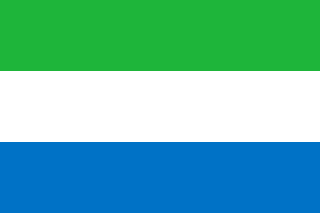
Sierra Leone
Republic of Sierra Leone
Population: UN WPP 2024, revision 1, projection for 1 July 2026. Sources and methodology.
Geography and territory
Sierra Leone sits on the west coast of Africa, its shores washed by the Atlantic Ocean to the west and south, while Guinea borders it to the north and east and Liberia lies to the southeast. Within its 71,740 square kilometers, the country packs in remarkable geographic variety, from tropical beaches and coastal mangroves to rolling hills and rainforest-clad mountains in the interior. The peninsula on which the capital, Freetown, sits is framed by mountains that plunge steeply toward the sea, giving the city one of the most dramatic natural harbors in West Africa.
The terrain divides into four broad zones: a coastal belt of wide beaches, estuaries, and mangrove swamps; interior plains given over mostly to farming; central and northern plateaus of rounded hills and gallery forest; and the northeastern highlands, where Mount Bintumani rises to 1,948 meters as the country’s highest point. The Rokel River, Sierra Leone’s longest, cuts across the country from east to west before emptying into the Atlantic near Freetown.
The climate is tropical and monsoonal, with a pronounced rainy season from May to November that can bring more than 3,000 millimeters of rainfall to the Freetown area, making it one of the wettest capitals on Earth. The dry season, from December to April, carries the harmattan wind down from the Sahara. Though reduced by decades of deforestation, the country’s rainforests still shelter a rich array of wildlife, including chimpanzees, pygmy hippopotamuses, and numerous endemic bird species.
With a population of roughly 9.0 million spread across 71,740 square kilometers, Sierra Leone is one of the more densely settled countries in West Africa, and the pressure of a growing population on land, forests, and coastal resources remains an ongoing challenge for planners and conservationists alike.
History
The land that is now Sierra Leone has been home to African peoples for thousands of years, among them the Temne and the Mende, still the country’s two largest ethnic groups. The name itself was coined by the Portuguese explorer Pedro de Sintra in 1462, who called the Freetown peninsula Serra Lyoa, or Lion Mountains, possibly for the shape of its hills or the sound of thunder echoing off them.
Sierra Leone’s modern history is closely bound up with the transatlantic slave trade and its abolition. In 1787, British philanthropists founded the Province of Freedom on the Freetown peninsula as a refuge for freed slaves from Britain, Canada, and Jamaica. The colony, formally established in 1808, became a symbol of the abolitionist movement. The descendants of these freed settlers, known as the Krio, developed a distinctive culture blending African and European elements that still shapes national identity.
Sierra Leone gained independence from the United Kingdom on April 27, 1961, but the decades that followed were marked by political instability and military coups. Between 1991 and 2002, the country endured a devastating civil war fueled by the trade in so-called blood diamonds, which killed tens of thousands and displaced far more. Since the conflict’s end, Sierra Leone has pursued a difficult path of reconstruction and reconciliation, one further tested by the 2014-2016 Ebola epidemic, which pushed the resilience of its people to the limit.
Culture and society
Sierra Leonean society comprises more than a dozen ethnic groups, with the Temne of the north and the Mende of the south the most numerous. Each community keeps its own traditions, languages, and social structures, but Krio, an English-based creole with African influences, serves as a lingua franca uniting the country’s different peoples. Traditional secret societies, such as Poro for men and Sande for women, continue to play an important role in community life and cultural transmission.
Music runs through Sierra Leonean identity. The country has produced internationally recognized artists and sustains a lively music scene ranging from traditional rhythms played on instruments like the balafon and djembe to modern genres such as afrobeat and hip-hop. Traditional masquerades, in which dancers wear elaborate carved wooden masks representing ancestral spirits, remain culturally significant ceremonies performed at festivals, funerals, and initiations.
Despite economic hardship, Sierra Leonean society is known for extraordinary hospitality and a deep sense of community. The extended family remains central to social life, and collective celebrations such as weddings and religious festivals draw in whole neighborhoods. Rebuilding the education system after the civil war has been a national priority, and access to primary schooling has improved significantly, though challenges around quality and rural coverage persist.
Economy
Sierra Leone’s economy rests chiefly on agriculture, mining, and fishing. The agricultural sector employs most of the working population and produces rice, cassava, coffee, cocoa, and palm oil for both domestic consumption and export. Much of this farming, however, remains subsistence-level, relying on traditional techniques and little mechanization, which limits productivity and keeps food security a persistent concern.
Mining is the country’s leading source of export revenue. Sierra Leone holds significant deposits of diamonds, iron ore, bauxite, rutile, and gold. Its diamonds gained grim international notoriety during the civil war as blood diamonds used to finance the fighting. Since then, the country has adopted the Kimberley Process and other reforms intended to ensure that the diamond trade benefits ordinary people rather than fueling violence.
Following the civil war and the Ebola crisis, Sierra Leone has seen gradual economic growth, though it remains among the poorest countries in the world. The government has prioritized economic diversification, infrastructure improvement, and attracting foreign investment. The fishing sector holds substantial untapped potential given the richness of the Atlantic waters off the coast, and tourism is beginning to emerge as an alternative source of income thanks to unspoiled beaches and a rich cultural heritage.
Food and cuisine
Sierra Leonean cuisine reflects the country’s ethnic diversity and its abundance of tropical produce. Rice is the essential staple, eaten at nearly every main meal. The national dish is jollof rice, cooked with tomato, onion, peppers, and spices and usually served with chicken or fish. Cassava leaf soup, known locally as plasas, prepared with palm oil and ladled over rice, is another pillar of everyday cooking.
Red palm oil is the signature ingredient of Sierra Leonean cooking, lending its distinctive color and flavor to countless stews and sauces. Groundnut soup, a thick peanut stew made with meat or fish, is a comforting dish enjoyed year-round. Fresh fish and shellfish are plentiful along the coast, grilled, fried, or stewed with vegetables and local spices. Tropical fruits such as mango, pineapple, papaya, and banana appear both as dessert and as ingredients in main dishes.
Among traditional drinks, palm wine, tapped from the sap of the palm tree and drunk fresh or fermented, holds pride of place, alongside ginger beer, a spicy, refreshing drink made from ginger root, sugar, and lime. Palm wine, known locally as poyo, carries strong social significance and is shared at community gatherings and celebrations. Freetown’s street stalls offer a vibrant food scene where visitors can sample akara, fried bean fritters, and savory pastries filled with meat or fish.
Tourism and landmarks
Sierra Leone holds extraordinary tourism potential that has only just begun to be explored. Its white-sand beaches rank among the most beautiful and unspoiled in West Africa. Banana Island, reachable by boat from the southern coast of the Freetown peninsula, offers pristine beaches and crystal-clear water ideal for snorkeling and quiet retreat. The Turtle Islands, a small archipelago off the coast, are a haven for divers and lovers of untouched nature.
Freetown, the capital, blends history with urban vitality in a way few cities can match. The Cotton Tree, a towering ceiba more than 500 years old standing at the heart of the city, is the symbol of freedom and the capital’s most emblematic landmark. The National Museum preserves artifacts spanning the country’s history, from archaeological finds to objects tied to the slave trade. Freetown’s Big Market is the place to soak up everyday life while shopping for local crafts, textiles, and fresh produce.
For nature lovers, Outamba-Kilimi National Park in the north offers the chance to spot chimpanzees, hippos, and numerous primate species in their natural habitat. Gola Rainforest, on the border with Liberia, protects one of the last stretches of virgin rainforest in West Africa and is home to the pygmy hippopotamus, a critically endangered species. Tacugama Chimpanzee Sanctuary, in the hills surrounding Freetown, carries out exemplary work rehabilitating and conserving orphaned chimpanzees.
Fun facts about Sierra Leone
- The name Sierra Leone comes from the Portuguese Serra Lyoa, or Lion Mountains, coined by explorer Pedro de Sintra in 1462
- Freetown was founded as a refuge for freed slaves, and its name literally means Free Town
- Sierra Leone is home to the third-largest natural harbor in the world, at Freetown
- The country is one of the world’s leading producers of rutile, a titanium mineral used in the aerospace industry
- The Krio people, descendants of freed slaves, developed a unique language and culture that form an important part of the nation’s intangible heritage
- Sierra Leone possesses some of the highest-quality diamond reserves on Earth
Sierra Leone in numbers
Latest World Bank and UNDP observations, each with its own year. “World median” is the middle value among the countries that report the same indicator; “#” ranks from the highest value.
Population since 1960
Sierra Leone had 2.3 million people in 1960 and 8.8 million in 2025 — 3.9 times as many.
People
45.9% of people live in towns and cities (world median 63.4%). 37.7% are under 15 and 3.3% are 65 or older — a young population. Women have 3.70 children on average, above the replacement level of about 2.1.
Economy
The economy grew by 4.6% in real terms in 2025. Consumer prices rose by 7.5% in 2025. Services make up the largest share of output (41.6% of GDP); agriculture contributes 29.5%, a large share that points to a farming-based economy.
Development and environment
UNDP rates human development in Sierra Leone as low, with an index of 0.467 in 2023 (rank 185 of 193). 25.1% of people use the internet and 39.2% have access to electricity. Forest covers 34.0% of the land (world median 32.8%).
Sources: World Bank, World Development Indicators (CC BY 4.0), most recent observation from 2015 onward; UNDP Human Development Report 2025. Retrieved 2026-10-10. Sector shares need not add up to 100% because taxes and subsidies on products are excluded. Missing values are left blank rather than estimated. Sources and methodology.
Climate of Sierra Leone
Averaged across Sierra Leone, the mean temperature stays between 25.2 °C (August) and 28.4 °C (March) — a swing of only 3.2 °C, so seasons are marked by rainfall rather than by heat.
About 2,650 mm of precipitation falls in a typical year. August is the wettest month (597 mm) and January the driest (7 mm). The three wettest consecutive months, July to September, bring 56% of the year's total — a pronounced rainy season.
Show monthly values as a table
| Month | Mean °C | Low °C | High °C | Precipitation, mm |
|---|---|---|---|---|
| January | 25.4 | 18.8 | 32.1 | 7 |
| February | 27.3 | 20.6 | 34.1 | 17 |
| March | 28.4 | 22.1 | 34.8 | 39 |
| April | 28.4 | 22.9 | 33.9 | 101 |
| May | 27.5 | 22.8 | 32.2 | 220 |
| June | 26.4 | 22.3 | 30.6 | 318 |
| July | 25.4 | 22.0 | 28.9 | 447 |
| August | 25.2 | 21.9 | 28.6 | 597 |
| September | 25.7 | 21.8 | 29.7 | 439 |
| October | 26.3 | 21.8 | 30.8 | 321 |
| November | 26.5 | 21.5 | 31.5 | 123 |
| December | 25.7 | 19.7 | 31.8 | 22 |
Figures are 1991–2020 averages across the whole land area of Sierra Leone, from the World Bank Climate Change Knowledge Portal, CRU TS 4.08 (CC BY 4.0). They are not readings from one weather station: the capital, the coast and high ground can be much warmer, cooler, wetter or drier.
Travel essentials for Sierra Leone
The practical details visitors ask about first. Traffic in Sierra Leone drives on the right, like most of the world. Mains electricity is 230 V at 50 Hz, so devices made only for 110–120 V (common in North America) need a converter unless they are dual-voltage — most phone and laptop chargers are.
- Emergency number
- 999
- Driving side
- Right
- Plug types
- Type D, Type GD: three large round pins in a triangle; G: three rectangular pins (British)
- Voltage
- 230 V50 Hz
- Dialling code
- +232From abroad: your exit code, then 232 and the number
- Currency
- Leone (SLL)
- Time zone
- GMT (UTC+0)Current local time in Sierra Leone
Compiled from IEC plug and voltage standards, national emergency-service listings and the UN road-traffic conventions. Emergency numbers and local coverage can change — confirm them locally on arrival. Sierra Leone's internet domain is .sl.
Where Sierra Leone ranks in the world
Each position counts only the countries with data in that ranking guide. First place is the highest value — for price levels, the most expensive. Select a card to see the full table.
- Population101st of 1969.0 millionUN projection, July 2026
- Land area116th of 19572,180 km²World Bank, 2023
- Population density75th of 194117 per km²World Bank, 2023
- GDP (nominal)153rd of 187$7.0BWorld Bank, 2024, current US$
- GDP per capita178th of 187$807World Bank, 2024, current US$
- Life expectancy183rd of 19462.0 yearsWorld Bank, 2024
- Price level142nd of 16532 (US = 100)ICP 2021, household consumption
Bordering countries of Sierra Leone


Compare Sierra Leone with another country
Frequently asked questions about Sierra Leone
What is the capital of Sierra Leone?
The capital of Sierra Leone is Freetown.
What is the population of Sierra Leone?
The UN World Population Prospects projection for Sierra Leone is 8,996,745 people (9.0 million) on 1 July 2026. National statistical offices may publish different estimates.
What language is spoken in Sierra Leone?
The official language of Sierra Leone is English.
What currency is used in Sierra Leone?
The currency of Sierra Leone is the Leone (SLL).
How big is Sierra Leone?
Sierra Leone covers an area of 71,740 km².
What type of government does Sierra Leone have?
Sierra Leone is a presidential republic.
Which countries border Sierra Leone?
Sierra Leone shares land borders with Guinea, Liberia.
What is the highest point in Sierra Leone?
The highest point in Sierra Leone is Mount Bintumani (1,948 m).


