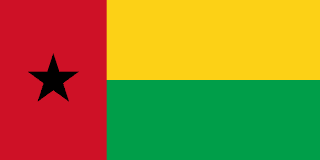
Guinea-Bissau
Republic of Guinea-Bissau
Population: UN WPP 2024, revision 1, projection for 1 July 2026. Sources and methodology.
Geography and territory
Guinea-Bissau is a small, low-lying coastal nation in West Africa, covering 36,125 square kilometers between Senegal to the north and Guinea to the south and east, with a population of roughly 2.3 million people. Its Atlantic coastline, deeply cut by rias and estuaries, runs for roughly 350 kilometers and extends offshore into the Bijagós Archipelago, a scattering of about 88 islands and islets, many uninhabited, that ranks among the most distinctive natural landscapes in Africa. Despite being one of the smallest nations on the continent, Guinea-Bissau packs an outsized range of habitats into its borders, from tidal mangrove forests to inland savanna.
The mainland is overwhelmingly flat, with elevations that barely reach 300 meters at their highest. Coastal plains blanketed in mangroves and flooded rice paddies give way gradually to wooded savanna further inland. The Geba, Corubal, and Cacheu rivers are the country’s principal waterways, their broad mouths forming the tidal estuaries that define the coast and creating a maze of channels, islets, and sandbanks.
Guinea-Bissau’s climate is tropical, with a rainy season running from June through November and a dry season for the remainder of the year. Biodiversity here is remarkable given the country’s modest size, especially within the Bijagós Archipelago, designated a UNESCO Biosphere Reserve. This island ecosystem supports populations of saltwater hippopotamuses, manatees, nesting sea turtles, dolphins, and an exceptional variety of birdlife, making the archipelago a marine sanctuary of genuine global importance.
History
Long before European contact, the territory now known as Guinea-Bissau was home to peoples such as the Balanta, Manjaco, Papel, and Fulani, who built agrarian and trading societies with their own political structures, some tied loosely to the great Mali Empire further inland. Portuguese navigators reached the coast in the fifteenth century and established trading posts that became hubs for the slave trade, along with ivory and wax destined for the Americas and the Cape Verde islands.
Unlike many other African colonies, Portugal exercised only limited territorial control over Guinea-Bissau well into the twentieth century, concentrating its presence in coastal outposts while the interior remained largely under the authority of local chiefs. In 1956, Amílcar Cabral founded the African Party for the Independence of Guinea and Cape Verde (PAIGC), which launched an armed liberation struggle in 1963 that became one of the most successful anti-colonial campaigns on the continent.
Cabral, widely regarded as one of the most brilliant revolutionary thinkers of the twentieth century, was assassinated in 1973, just months before Guinea-Bissau unilaterally declared independence on September 24 of that year. Portugal formally recognized the new nation the following year, after the Carnation Revolution toppled its own authoritarian government. Since independence, Guinea-Bissau has endured a turbulent history of coups and political instability that has hampered development, even as its civil society has shown remarkable resilience.
Culture and society
Guinea-Bissau supports a striking degree of ethnic diversity within a relatively compact territory, with more than twenty groups coexisting side by side. The Balanta, renowned rice farmers, form the largest community, followed by the Fulani, pastoralists and traders with a strong Islamic tradition, along with the Manjaco, Mandinka, and Papel peoples. Each group maintains distinct customs, initiation rites, and forms of social organization that together create an unusually rich cultural mosaic.
Guinean Creole, a Portuguese-based creole language, serves as the lingua franca that binds these communities together and functions as a powerful marker of national identity. Although Portuguese is the official language, it is spoken fluently by only a minority of the population; Creole, by contrast, dominates everyday communication, commerce, music, and emotional expression, while ethnic languages remain vital within families and ceremonial life. Religious life is similarly layered, blending Islam, Christianity, and animist traditions that often coexist within the same family or village.
Guinean music has earned international recognition through gumbé, a genre that blends African rhythms with Portuguese and Caribbean influences into an irresistibly festive sound. Musicians such as José Carlos Schwarz, Manecas Costa, and the band Super Mama Djombo carried Guinean music well beyond the country’s borders. The ceremonies of the Bijagós people, featuring elaborate animal-shaped masks and ritual dances that dramatize the relationship between humans and nature, stand among the most original cultural expressions found anywhere in West Africa.
Economy
Guinea-Bissau ranks among the poorest countries in the world, with a fragile economy heavily dependent on subsistence agriculture and cashew exports, which supply the great majority of the nation’s foreign earnings. The country is one of the world’s leading cashew producers, and the nut accounts for the overwhelming share of total exports, leaving the economy acutely vulnerable to swings in global prices and weather conditions.
Artisanal and industrial fishing form the second pillar of the economy, drawing on coastal waters unusually rich in marine resources. Illegal fishing by foreign fleets, however, poses a serious threat both to the sustainability of the resource and to the livelihoods of local fishing communities. Timber extraction, palm oil production, and rice farming, the staple of the national diet, round out the country’s productive base, though most of this activity remains small-scale and largely outside the formal economy.
Guinea-Bissau confronts formidable structural obstacles, including a nearly nonexistent road network, unreliable electricity supply, a fragile healthcare system, and a public administration weakened by decades of political instability. Frequent changes of government have also discouraged long-term foreign investment, leaving much of the economy dependent on smallholder farming and informal trade. Drug trafficking, which has used the country as a transit point between Latin America and Europe, adds a further layer of risk to governance and development. International organizations and bilateral partners continue to support reform efforts aimed at breaking this cycle of fragility.
Food and cuisine
Guinea-Bissau’s cuisine mirrors both the country’s ethnic diversity and the bounty of its natural surroundings, with rice serving as the everyday staple. Caldo de mancarra, a thick peanut soup made with chicken, fish, or meat, ranks among the most beloved and representative dishes in the national repertoire. Chabéu, rice cooked with palm oil, dried fish, and leafy greens, is another specialty enjoyed throughout the country.
Seafood and fresh fish hold pride of place in the diets of coastal and island communities alike. Mangrove oysters, gathered by women along the estuaries, are a local delicacy prized for their intense, mineral flavor, typically grilled or served in sauces. Grilled fish, seasoned with lemon, pepper, and salt and served with rice and tomato salad, is an everyday dish found in homes and restaurants throughout Bissau and along the coast.
Guinea-Bissau’s cuisine also shares deep ties with Cape Verdean cooking, a legacy of the historic bond between the two nations. Cachupa, a slow-cooked stew of corn, beans, and meat or fish, appears alongside dishes of creole origin. Tropical fruits, including mangoes, papayas, and fresh cashew apples, are abundant and used both as snacks and as the base for refreshing juices. Vinho de cajú, an alcoholic drink fermented from the juice of the cashew apple, remains the country’s signature traditional beverage.
Tourism and landmarks
The crown jewel of Guinea-Bissau’s tourism scene is the Bijagós Archipelago, a cluster of 88 islands and islets recognized as a UNESCO Biosphere Reserve and considered one of the best-preserved island ecosystems in Africa. The islands of Orango, Bubaque, Bolama, and Caravela offer pristine white-sand beaches, crystalline waters, and untouched wilderness where visitors can spot saltwater hippos bathing in the ocean, sea turtles nesting on the beaches, and dolphins leaping through the waves.
Orango Island is home to Orango National Park, where a unique population of saltwater hippopotamuses, unlike any other in the world, has adapted to a marine environment alongside crocodiles, monkeys, and hundreds of bird species. The matrilineal culture of the Bijagós people, with its initiation ceremonies and ritual masks that give women a leading role in community life, adds a fascinating anthropological dimension to any visit.
Bissau, the capital, retains a weathered but charming historic center of Portuguese colonial architecture, bustling markets such as the Bandim Market, and a nightlife energized by gumbé music. Visitors can also explore the old Portuguese fortress overlooking the Geba estuary, a reminder of the city’s centuries-long role as a colonial trading post. The ruins of Bolama, the former colonial capital, with its abandoned buildings overtaken by vegetation, create a surreal atmosphere that draws photographers and curious travelers alike. In the south, Cufada Lagoons Natural Park protects ecologically valuable wetlands home to manatees, hippos, and an extraordinary diversity of waterbirds.
Fun facts about Guinea-Bissau
- The Bijagós Archipelago is home to the world’s only population of hippopotamuses that live in saltwater.
- Guinea-Bissau ranks among the world’s top cashew producers, with the nut accounting for the vast majority of its exports.
- Amílcar Cabral, the country’s independence hero, is considered one of the twentieth century’s foremost theorists of African liberation.
- Guinean Creole, the national lingua franca, is spoken by the majority of the population, far outpacing the official language, Portuguese.
- Among the Bijagós people, women traditionally choose their husbands and build the marital home, an unusually matrilineal arrangement for the region.
- Guinea-Bissau declared independence unilaterally in 1973, a year before Portugal’s own revolution led to formal recognition.
Guinea-Bissau in numbers
Latest World Bank and UNDP observations, each with its own year. “World median” is the middle value among the countries that report the same indicator; “#” ranks from the highest value.
Population since 1960
Guinea-Bissau had 577,633 people in 1960 and 2.2 million in 2025 — 3.9 times as many.
People
46.7% of people live in towns and cities (world median 63.4%). 38.3% are under 15 and 3.2% are 65 or older — a young population. Women have 3.76 children on average, above the replacement level of about 2.1.
Economy
The economy grew by 5.8% in real terms in 2025. Consumer prices rose by 0.9% in 2025. Agriculture makes up the largest share of output (40.6% of GDP); agriculture contributes 40.6%, a large share that points to a farming-based economy.
Development and environment
UNDP rates human development in Guinea-Bissau as low, with an index of 0.514 in 2023 (rank 174 of 193). 29.8% of people use the internet and 43.7% have access to electricity. Forest covers 74.8% of the land (world median 32.8%).
Sources: World Bank, World Development Indicators (CC BY 4.0), most recent observation from 2015 onward; UNDP Human Development Report 2025. Retrieved 2026-10-10. Sector shares need not add up to 100% because taxes and subsidies on products are excluded. Missing values are left blank rather than estimated. Sources and methodology.
Climate of Guinea-Bissau
Averaged across Guinea-Bissau, the warmest month is May (30.2 °C) and the coolest is December (25.9 °C), a seasonal swing of 4.3 °C. The annual mean is 27.9 °C.
About 1,643 mm of precipitation falls in a typical year. August is the wettest month (524 mm) and January the driest (0 mm). The three wettest consecutive months, July to September, bring 77% of the year's total — a pronounced rainy season.
Show monthly values as a table
| Month | Mean °C | Low °C | High °C | Precipitation, mm |
|---|---|---|---|---|
| January | 26.1 | 17.9 | 34.3 | 0 |
| February | 27.4 | 18.9 | 35.9 | 0 |
| March | 29.2 | 21.3 | 37.2 | 0 |
| April | 30.1 | 22.6 | 37.6 | 1 |
| May | 30.2 | 23.8 | 36.7 | 30 |
| June | 28.9 | 23.9 | 33.9 | 157 |
| July | 27.4 | 23.6 | 31.2 | 344 |
| August | 27.1 | 23.9 | 30.4 | 524 |
| September | 27.2 | 23.1 | 31.2 | 393 |
| October | 28.1 | 23.2 | 33.0 | 174 |
| November | 27.6 | 21.1 | 34.2 | 19 |
| December | 25.9 | 18.2 | 33.8 | 1 |
Figures are 1991–2020 averages across the whole land area of Guinea-Bissau, from the World Bank Climate Change Knowledge Portal, CRU TS 4.08 (CC BY 4.0). They are not readings from one weather station: the capital, the coast and high ground can be much warmer, cooler, wetter or drier.
Travel essentials for Guinea-Bissau
The practical details visitors ask about first. Traffic in Guinea-Bissau drives on the right, like most of the world. Mains electricity is 220 V at 50 Hz, so devices made only for 110–120 V (common in North America) need a converter unless they are dual-voltage — most phone and laptop chargers are.
- Emergency number
- 117
- Driving side
- Right
- Plug types
- Type CC: two round pins (Europlug)
- Voltage
- 220 V50 Hz
- Dialling code
- +245From abroad: your exit code, then 245 and the number
- Currency
- West African CFA Franc (XOF)
- Time zone
- GMT (UTC+0)Current local time in Guinea-Bissau
Compiled from IEC plug and voltage standards, national emergency-service listings and the UN road-traffic conventions. Emergency numbers and local coverage can change — confirm them locally on arrival. Guinea-Bissau's internet domain is .gw.
Where Guinea-Bissau ranks in the world
Each position counts only the countries with data in that ranking guide. First place is the highest value — for price levels, the most expensive. Select a card to see the full table.
- Population146th of 1962.3 millionUN projection, July 2026
- Land area138th of 19528,120 km²World Bank, 2023
- Population density109th of 19477 per km²World Bank, 2023
- GDP (nominal)169th of 187$2.2BWorld Bank, 2024, current US$
- GDP per capita172nd of 187$998World Bank, 2024, current US$
- Life expectancy170th of 19464.3 yearsWorld Bank, 2024
- Price level111th of 16539 (US = 100)ICP 2021, household consumption
Bordering countries of Guinea-Bissau


Compare Guinea-Bissau with another country
Frequently asked questions about Guinea-Bissau
What is the capital of Guinea-Bissau?
The capital of Guinea-Bissau is Bissau.
What is the population of Guinea-Bissau?
The UN World Population Prospects projection for Guinea-Bissau is 2,297,808 people (2.3 million) on 1 July 2026. National statistical offices may publish different estimates.
What language is spoken in Guinea-Bissau?
The official language of Guinea-Bissau is Portuguese.
What currency is used in Guinea-Bissau?
The currency of Guinea-Bissau is the West African CFA Franc (XOF).
How big is Guinea-Bissau?
Guinea-Bissau covers an area of 36,125 km².
What type of government does Guinea-Bissau have?
Guinea-Bissau is a semi-presidential republic.
Which countries border Guinea-Bissau?
Guinea-Bissau shares land borders with Senegal, Guinea.
What is the highest point in Guinea-Bissau?
The highest point in Guinea-Bissau is Unnamed hill (300 m).


