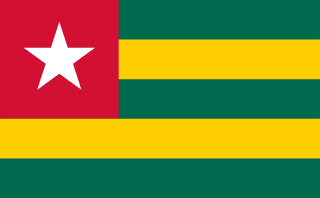
Togo
Togolese Republic
Population: UN WPP 2024, revision 1, projection for 1 July 2026. Sources and methodology.
Geography and territory
Togo ranks among Africa’s smallest countries, covering just 56,785 square kilometers in a narrow strip wedged between Ghana to the west and Benin to the east, with Burkina Faso to the north and the Gulf of Guinea to the south. This unusual shape gives the country a maximum width of only about 150 kilometers, even as it stretches roughly 580 kilometers from south to north. Despite its modest size, Togo packs in remarkable landscape diversity, from tropical beaches to savanna and mountains.
The southern coastline, a mere 50 kilometers long and fronting the Atlantic Ocean, is lined with lagoons, coconut palms, and sandy beaches. Farther inland, the Togo Mountains run from southwest to northeast across the center of the country, culminating at Mount Agou, the national high point at 986 meters. This mountain chain acts as a watershed and creates microclimates that support lush vegetation. North of the mountains, the landscape opens into broad grass-and-shrub savanna that defines the character of northern Togo.
Togo’s climate is tropical, with sharp contrasts between south and north. The coast follows an equatorial pattern with two rainy seasons, roughly April through June and September through November, separated by two dry spells, while the north experiences a single rainy season running from May to October. Average temperatures hover between 24 and 30 degrees Celsius year-round. Togolese biodiversity spans tropical forest in the central mountains, mangroves along the coast, and wooded savanna in the north that shelters monkeys, antelope, birds of prey, and a variety of reptile species.
History
Togo’s territory has been inhabited since prehistoric times by peoples who arrived in successive waves of migration. The Ewe settled in the south between the 14th and 16th centuries, while the Kabye occupied the mountains of the center-north. Before European colonization, the region was never a single political entity but rather a patchwork of independent chiefdoms and small kingdoms linked by extensive trade networks connecting the coast to the interior.
European contact beginning in the 15th century ushered in the transatlantic slave trade, which devastated the region for generations. In 1884, German explorer Gustav Nachtigal signed a protection treaty with the chief of Togoville, establishing the German protectorate of Togoland. Germany built up infrastructure and plantations there, treating the colony as something of a showcase among its African possessions. After the First World War, Togoland was split between France and Britain under a League of Nations mandate: the British share was folded into the Gold Coast, present-day Ghana, while the French share became modern Togo.
Togo gained independence on April 27, 1960, with Sylvanus Olympio as its first president; he was assassinated in a 1963 coup, the first to strike a postcolonial African state. In 1967, General Gnassingbé Eyadéma seized power and held it for 38 years until his death in 2005, one of the longest tenures of any head of state in Africa. His son Faure Gnassingbé succeeded him and remains in power today, repeatedly facing calls for democratic reform and periods of popular protest that reflect ongoing political tension in the country.
Culture and society
Togolese society encompasses more than 40 ethnic groups, with the Ewe in the south and the Kabye in the north the largest and most politically influential. This diversity produces a striking cultural richness in which ancestral animist traditions, Islam in the north, and Christianity introduced during colonization all coexist. Vodun, or voodoo, which originated in this stretch of West Africa, remains a deeply rooted spiritual practice, and Togo is frequently cited as the birthplace of a tradition that enslaved people later carried to the Americas.
Oral tradition, music, and dance are woven into everyday Togolese life. Each ethnic group maintains its own ceremonial dances, performed with drums and call-and-response singing at funerals, harvests, initiations, and religious festivals. The fire dance of the Temba people in the north is a striking spectacle in which participants handle burning embers while in a ritual trance. Togolese craftsmanship is known for kente-style woven cloth, basketry, pottery, and carved ceremonial masks.
Lomé’s fetish market, known as the Marché des Féticheurs, is one of the most singular sights in West Africa. This open-air market sells the ingredients used in traditional medicine and vodun ritual: animal skulls, hides, herbs, powders, and talismans. Though it can seem startling to outside visitors, the market reflects the continued vitality of ancestral medicinal and spiritual practices that exist alongside modern medicine and imported religions as an integral part of Togolese identity.
Economy
Agriculture forms the backbone of the Togolese economy, employing more than 60 percent of the workforce and generating a substantial share of GDP. Coffee, cocoa, cotton, and palm oil are the principal export crops, while maize, cassava, millet, and sorghum are grown for domestic consumption. Farming remains largely subsistence-based, worked on family plots with traditional tools, though the government has pushed programs aimed at modernizing agricultural output.
Phosphate mining is the country’s leading extractive industry and a major source of foreign currency. Togo holds one of West Africa’s largest phosphate reserves, a mineral used widely in fertilizer production. The Port of Lomé, situated on the region’s only natural deep-water bay, functions as a major logistics hub serving as a gateway for imports bound for landlocked neighbors such as Burkina Faso, Niger, and Mali, generating substantial revenue from port and transit services.
In recent years Togo has posted moderate economic growth, driven by infrastructure investment, an expanding services sector, and efforts to attract foreign investment. Significant challenges remain, however: poverty affects a large share of the population, youth unemployment is high, and the gap between the urbanized south and the rural north persists. The informal sector dominates the economy, with small-scale trade and street markets providing the primary livelihood for millions of Togolese.
Food and cuisine
Togolese cuisine is varied and flavorful, drawing on the traditions of the country’s many ethnic groups and its abundance of tropical ingredients. Fufu, a stretchy dough pounded from yam, cassava, or plantain, forms the base of the Togolese diet. It is served with an array of sauces, most commonly tomato sauce with meat or fish, peanut sauce, and sauces made from gboma or ademe leaves. Eating fufu by hand, tearing off small portions to dip into sauce, is a daily ritual shared around the family table.
Akume, a maize-flour dough similar to East African ugali, is another staple across the south, often paired with a viscous, nutritious okra sauce made with smoked fish. In the north, a millet- or sorghum-based dough known as pâte replaces fufu as the principal accompaniment. Grilled meat skewers called tchichinga are Togo’s most popular street snack, sold on nearly every corner by vendors grilling over charcoal as evening falls.
Among traditional drinks, sodabi, a spirit distilled from palm wine, is the country’s most widely consumed liquor. Tchoukoutou, a home-brewed millet beer from northern Togo, plays a central social role, shared from communal calabashes at gatherings and celebrations. Bissap juice, a chilled, sweetened hibiscus infusion, is a ubiquitous refreshment found in markets and homes alike, prized for both its tart-sweet flavor and its nutritional value.
Tourism and landmarks
Togo offers an authentic travel experience well off the beaten path, appealing to visitors seeking a more genuine slice of West Africa. Lomé, the capital, ranks among the region’s more pleasant cities, with its long seaside promenade, the bustling Grand Marché where the famous “Nana Benz” traders dominate the wax-print textile trade, and the National Museum, which displays traditional art, jewelry, and pottery from Togo’s many peoples.
The country’s interior reveals surprisingly striking mountain scenery. The Kpalimé region, set in the Togo Mountains, is a hiking destination surrounded by waterfalls, coffee and cocoa plantations, and villages where artisans still work clay and wood using age-old techniques. Fazao-Malfakassa National Park, Togo’s largest at roughly 1,920 square kilometers, protects montane forest and savanna home to antelope, buffalo, monkeys, and a wide range of birdlife. The Kpimé and Akloa waterfalls are natural highlights reachable on guided hikes.
In the north, the Koutammakou region, inscribed as a UNESCO World Heritage Site in 2004, is home to the celebrated tata somba, two-story mud fortress-houses built by the Batammariba people. These distinctive structures, with their cylindrical towers and rooftop terraces used for drying grain, stand as an exceptional example of vernacular architecture perfectly adapted to its environment. Togoville, a small town on the shore of Lake Togo where the treaty establishing German colonial rule was signed, preserves an important historical and spiritual heritage tied to voodoo tradition.
Fun facts about Togo
- Togo is widely regarded as the birthplace of voodoo, a spiritual tradition carried to the Americas by enslaved people and still actively practiced today.
- Lomé’s Marché des Féticheurs is considered the world’s largest market dedicated to voodoo ritual ingredients.
- Togo’s 1963 coup was the first to occur in postcolonial Africa.
- The Gnassingbé family has governed Togo since 1967, amassing more than half a century in power.
- Koutammakou, home to the Batammariba people and their tata somba houses, holds UNESCO World Heritage status.
- Togo is one of Africa’s narrowest countries, measuring only about 150 kilometers across at its widest point.
Togo in numbers
Latest World Bank and UNDP observations, each with its own year. “World median” is the middle value among the countries that report the same indicator; “#” ranks from the highest value.
Population since 1960
Togo had 1.7 million people in 1960 and 8.6 million in 2025 — 5.1 times as many.
People
44.4% of people live in towns and cities (world median 63.4%). 40.4% are under 15 and 3.5% are 65 or older — a very young population. Women have 4.12 children on average, above the replacement level of about 2.1.
Economy
The economy grew by 6.3% in real terms in 2025. Consumer prices rose by 0.4% in 2025. Services make up the largest share of output (61.7% of GDP); agriculture contributes 20.3%, a large share that points to a farming-based economy.
Development and environment
UNDP rates human development in Togo as medium, with an index of 0.571 in 2023 (rank 161 of 193). 39.5% of people use the internet and 61.1% have access to electricity. Forest covers 22.5% of the land (world median 32.8%).
Sources: World Bank, World Development Indicators (CC BY 4.0), most recent observation from 2015 onward; UNDP Human Development Report 2025. Retrieved 2026-10-10. Sector shares need not add up to 100% because taxes and subsidies on products are excluded. Missing values are left blank rather than estimated. Sources and methodology.
Climate of Togo
Averaged across Togo, the warmest month is March (30.1 °C) and the coolest is August (25.2 °C), a seasonal swing of 4.9 °C. The annual mean is 27.4 °C.
About 1,217 mm of precipitation falls in a typical year. September is the wettest month (210 mm) and January the driest (6 mm). The wettest stretch is July to September, with 47% of the year's total.
Show monthly values as a table
| Month | Mean °C | Low °C | High °C | Precipitation, mm |
|---|---|---|---|---|
| January | 27.3 | 20.3 | 34.3 | 6 |
| February | 29.2 | 22.4 | 36.1 | 20 |
| March | 30.1 | 23.9 | 36.2 | 56 |
| April | 29.4 | 24.0 | 34.8 | 97 |
| May | 28.1 | 23.2 | 33.1 | 135 |
| June | 26.6 | 22.2 | 31.1 | 163 |
| July | 25.6 | 21.7 | 29.4 | 178 |
| August | 25.2 | 21.4 | 29.0 | 186 |
| September | 25.8 | 21.6 | 30.1 | 210 |
| October | 26.7 | 21.6 | 31.9 | 136 |
| November | 27.5 | 20.9 | 34.1 | 24 |
| December | 27.2 | 20.2 | 34.1 | 8 |
Figures are 1991–2020 averages across the whole land area of Togo, from the World Bank Climate Change Knowledge Portal, CRU TS 4.08 (CC BY 4.0). They are not readings from one weather station: the capital, the coast and high ground can be much warmer, cooler, wetter or drier.
Travel essentials for Togo
The practical details visitors ask about first. Traffic in Togo drives on the right, like most of the world. Mains electricity is 220 V at 50 Hz, so devices made only for 110–120 V (common in North America) need a converter unless they are dual-voltage — most phone and laptop chargers are.
- Emergency number
- 117Fire 118
- Driving side
- Right
- Plug types
- Type CC: two round pins (Europlug)
- Voltage
- 220 V50 Hz
- Dialling code
- +228From abroad: your exit code, then 228 and the number
- Currency
- West African CFA Franc (XOF)
- Time zone
- GMT (UTC+0)Current local time in Togo
Compiled from IEC plug and voltage standards, national emergency-service listings and the UN road-traffic conventions. Emergency numbers and local coverage can change — confirm them locally on arrival. Togo's internet domain is .tg.
Where Togo ranks in the world
Each position counts only the countries with data in that ranking guide. First place is the highest value — for price levels, the most expensive. Select a card to see the full table.
- Population95th of 1969.9 millionUN projection, July 2026
- Land area124th of 19554,390 km²World Bank, 2023
- Population density58th of 194151 per km²World Bank, 2023
- GDP (nominal)148th of 187$10.6BWorld Bank, 2024, current US$
- GDP per capita163rd of 187$1,266World Bank, 2024, current US$
- Life expectancy178th of 19462.9 yearsWorld Bank, 2024
- Price level107th of 16540 (US = 100)ICP 2021, household consumption
Bordering countries of Togo


Compare Togo with another country
Frequently asked questions about Togo
What is the capital of Togo?
The capital of Togo is Lomé.
What is the population of Togo?
The UN World Population Prospects projection for Togo is 9,930,918 people (9.9 million) on 1 July 2026. National statistical offices may publish different estimates.
What language is spoken in Togo?
The official language of Togo is French.
What currency is used in Togo?
The currency of Togo is the West African CFA Franc (XOF).
How big is Togo?
Togo covers an area of 56,785 km².
What type of government does Togo have?
Togo is a presidential republic.
Which countries border Togo?
Togo shares land borders with Ghana, Burkina Faso, Benin.
What is the highest point in Togo?
The highest point in Togo is Mount Agou (986 m).


