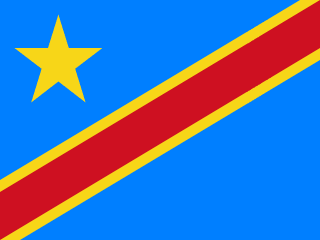
Democratic Republic of the Congo
Democratic Republic of the Congo
Population: UN WPP 2024, revision 1, projection for 1 July 2026. Sources and methodology.
Geography and territory
The Democratic Republic of the Congo, often called DR Congo or Congo-Kinshasa, is the second-largest country in Africa and one of the largest in the world, covering 2,344,858 km² of equatorial rainforest, savanna, and volcanic highlands. It shares borders with nine neighbors — the Republic of the Congo, the Central African Republic, South Sudan, Uganda, Rwanda, Burundi, Tanzania, Zambia, and Angola — and touches the Atlantic Ocean through a narrow coastal strip. Few countries on Earth pack such geographic and ecological diversity into a single territory.
The Congo River, Africa’s second-longest and one of the world’s mightiest by volume, is the country’s lifeline, feeding a vast basin laced with navigable tributaries that form the continent’s most extensive inland waterway network. The surrounding rainforest, covering roughly 60 percent of the national territory, ranks as the largest tropical forest in Africa and the second largest on Earth, playing an outsized role in regulating the planet’s climate.
In the east, the landscape changes dramatically along the western branch of the Great Rift Valley, where a chain of deep lakes, active volcanoes, and mountains exceeding 5,000 meters rises above the forest canopy. Margherita Peak on Mount Stanley, part of the Rwenzori range, reaches 5,109 meters and is capped by equatorial glaciers, while the volcanoes near Goma, including Nyiragongo, rank among Africa’s most active. Lake Tanganyika, one of the deepest lakes on the planet, lines the country’s southeastern border, and a string of Rift Valley lakes, including Kivu, Edward, and Albert, punctuates the eastern frontier with Rwanda and Uganda.
With a population of about 116.5 million spread across such an enormous territory, the Democratic Republic of the Congo is one of the most sparsely served countries in the world in terms of paved infrastructure, and the Congo River and its tributaries remain, in many regions, the only practical means of transport. This combination of scale, isolation, and ecological richness makes the country simultaneously one of the continent’s greatest natural treasures and one of its most difficult places to govern and develop.
History
Human presence in the Congo basin stretches back tens of thousands of years, with Pygmy peoples among the region’s earliest inhabitants. Bantu migrations beginning roughly two millennia ago established organized states, most notably the powerful Kingdom of Kongo, founded in the fourteenth century, which controlled a vast territory near the mouth of the Congo River and maintained sophisticated administration and diplomatic ties with Portugal.
The darkest chapter of Congolese history began with colonization under Belgium’s King Leopold II, who claimed the territory as his personal property following the 1884-85 Berlin Conference, creating the so-called Congo Free State. Leopold’s regime imposed a brutal system of forced labor centered on rubber and ivory extraction, marked by systematic atrocities that killed millions of Congolese before international outcry forced Belgium to annex the territory as a formal colony in 1908.
Independence, proclaimed hastily on June 30, 1960, was followed almost immediately by political crisis, including the secession of Katanga province, the assassination of Prime Minister Patrice Lumumba, and the rise of Mobutu Sese Seko, who ruled as dictator for 32 years under the renamed state of Zaire. Mobutu’s fall in 1997 and the subsequent Congo Wars, which drew in nine African nations and caused millions of deaths, rank among the deadliest conflicts since World War II. Despite a transition to democratic governance, instability has persisted in the country’s eastern provinces.
Culture and society
The Democratic Republic of the Congo is a vast cultural mosaic, home to more than 200 ethnic groups speaking some 250 languages. French serves as the official language, while four national languages — Lingala, Swahili, Kikongo, and Tshiluba — function as vehicles of interethnic communication across the country’s many regions, reflecting both the scale of the territory and the complexity of its societies.
Congolese music has exerted an influence on the continent matched by few other national traditions. Congolese rumba, born in Kinshasa and Brazzaville during the 1940s and 1950s, became the most popular musical genre across Africa and was inscribed on UNESCO’s list of intangible cultural heritage in 2021. Legendary artists such as Franco Luambo, Tabu Ley Rochereau, and Papa Wemba carried Congolese sound to every corner of the continent, and a new generation continues that tradition of innovation today.
Congolese visual art enjoys global recognition, from the traditional sculpture and masks of the Luba, Kuba, and Mangbetu peoples displayed in major world museums to the vibrant contemporary art scene of Kinshasa. The sapeurs of Kinshasa, celebrated for their flamboyant, meticulously coordinated fashion, have become an internationally recognized cultural phenomenon, and dance remains an inseparable, everyday expression of community and resilience throughout the country.
Economy
The Democratic Republic of the Congo sits atop one of the greatest concentrations of mineral wealth on the planet, with vast reserves of cobalt, coltan, copper, diamonds, gold, and tin that make it a pivotal player in global raw materials markets. The country supplies the majority of the world’s cobalt, a mineral essential to electric-vehicle batteries and electronics, giving it growing strategic importance in the global energy transition. With a GDP of roughly $91.0 billion and a Human Development Index of 0.522, classified as low, the country remains among the poorest in the world despite this extraordinary natural endowment.
Both industrial and artisanal mining anchor the export economy, with copper as the leading export, followed by diamonds and cobalt. The mineral-rich Katanga region hosts the country’s largest operations, drawing international and Chinese investment into world-class deposits, though artisanal mining, which employs millions under often hazardous conditions, poses serious social and environmental challenges.
Subsistence agriculture employs more than 60 percent of the population, producing cassava, corn, rice, and palm oil, even as the country’s agricultural potential remains vastly underdeveloped. The rainforest itself represents an economic and ecological asset of global significance, with potential for sustainable timber, carbon credits, and ecotourism — though economists often describe the persistence of poverty alongside such abundance as a textbook case of the “resource curse.”
Food and cuisine
Congolese cuisine reflects the country’s immensity and diversity, with culinary traditions that vary by region and ethnic group but share a common foundation of cassava, plantain, corn, and rice. Fufu, a smooth, elastic dough made from cassava or plantain flour and shaped by hand, is the universal accompaniment to Congolese meals, served alongside the rich sauces that form the true heart of the cuisine.
Pondu, also known as saka-saka, made from pounded cassava leaves slow-cooked in palm oil, is the most iconic everyday dish, while poulet à la moambé, chicken simmered in a rich palm-nut sauce, is widely regarded as the national dish and a centerpiece of family celebrations. Liboke, fish or meat wrapped in banana leaves and steamed or grilled over coals, showcases a traditional cooking technique that yields delicate, aromatic flavors.
Makayabu, salted dried fish from the Congo River, lends its intense flavor to countless sauces and stews, while edible insects such as palm caterpillars and flying termites are prized delicacies that supply valuable protein. Locally brewed corn beer and palm wine remain traditional favorites in rural areas, while industrial lagers dominate the urban market, and fermented cassava bread, wrapped in leaves, accompanies nearly every meal in Kinshasa.
Tourism and landmarks
Virunga National Park, Africa’s oldest national park and a UNESCO World Heritage Site, is the country’s most iconic destination. Located in the east near the borders with Uganda and Rwanda, it shelters some of the world’s last mountain gorillas alongside the volcano Nyiragongo, famous for its permanent lava lake, and an extraordinary array of wildlife. Climbing to the crater rim to see the glowing lava at night ranks among the most extraordinary experiences on the African continent.
Kahuzi-Biega National Park, also a World Heritage Site, protects the Grauer’s gorilla, the largest of all great ape subspecies, within a habitat spanning rainforest and highland terrain. Lake Kivu, shared with Rwanda, offers serene scenery of blue water framed by green hills, with the city of Bukavu serving as a gateway for exploring the surrounding region, while the glacier-capped Rwenzori Mountains, known as the “Mountains of the Moon,” draw serious trekkers.
Kinshasa itself, one of Africa’s largest cities, offers an intense urban experience, from its recording studios and lively markets to the nightlife of its Matonge district. The Congo River remains navigable for thousands of kilometers into the interior, and multi-day riverboat journeys connecting Kinshasa with Kisangani offer travelers a rare glimpse of remote villages and untouched forest along the way.
Fun facts about Democratic Republic of the Congo
- The Congo River is the only major river in the world to cross the equator twice, and its depths reach roughly 220 meters, making it the deepest river on Earth.
- The volcano Nyiragongo holds the world’s largest permanent lava lake, its red glow visible from tens of kilometers away at night.
- The country supplies the majority of the world’s cobalt, a mineral essential to batteries in smartphones, laptops, and electric vehicles.
- More than 250 languages are spoken within its borders, making it one of the most linguistically diverse nations on Earth.
- Congolese rumba was inscribed on UNESCO’s list of intangible cultural heritage in 2021, recognized as a shared artistic tradition of both Congos.
- The country’s land area is so vast that it would cover most of Western Europe if superimposed on the continent.
The Democratic Republic of the Congo in numbers
Latest World Bank and UNDP observations, each with its own year. “World median” is the middle value among the countries that report the same indicator; “#” ranks from the highest value.
Population since 1960
The Democratic Republic of the Congo had 15.3 million people in 1960 and 112.8 million in 2025 — 7.4 times as many.
People
45.1% of people live in towns and cities (world median 63.4%). 45.9% are under 15 and 3.1% are 65 or older — a very young population. Women have 5.98 children on average, above the replacement level of about 2.1.
Economy
The economy grew by 5.8% in real terms in 2025. Consumer prices rose by 2.9% in 2016. Services make up the largest share of output (48.0% of GDP); agriculture contributes 8.9%.
Development and environment
UNDP rates human development in the Democratic Republic of the Congo as low, with an index of 0.522 in 2023 (rank 171 of 193). 19.7% of people use the internet and 22.5% have access to electricity. Forest covers 61.5% of the land (world median 32.8%).
Sources: World Bank, World Development Indicators (CC BY 4.0), most recent observation from 2015 onward; UNDP Human Development Report 2025. Retrieved 2026-10-10. Sector shares need not add up to 100% because taxes and subsidies on products are excluded. Missing values are left blank rather than estimated. Sources and methodology.
Climate of the Democratic Republic of the Congo
Averaged across the Democratic Republic of the Congo, the mean temperature stays between 23.3 °C (July) and 25.0 °C (March) — a swing of only 1.7 °C, so seasons are marked by rainfall rather than by heat.
About 1,504 mm of precipitation falls in a typical year. November is the wettest month (176 mm) and July the driest (62 mm).
Show monthly values as a table
| Month | Mean °C | Low °C | High °C | Precipitation, mm |
|---|---|---|---|---|
| January | 24.4 | 18.9 | 29.9 | 129 |
| February | 24.8 | 19.2 | 30.5 | 117 |
| March | 25.0 | 19.5 | 30.6 | 163 |
| April | 24.9 | 19.4 | 30.3 | 151 |
| May | 24.6 | 18.8 | 30.4 | 107 |
| June | 23.7 | 17.6 | 29.8 | 63 |
| July | 23.3 | 17.2 | 29.3 | 62 |
| August | 23.9 | 18.0 | 29.8 | 91 |
| September | 24.3 | 18.5 | 30.2 | 123 |
| October | 24.5 | 19.0 | 30.1 | 168 |
| November | 24.4 | 19.0 | 29.9 | 176 |
| December | 24.3 | 19.0 | 29.6 | 153 |
Figures are 1991–2020 averages across the whole land area of the Democratic Republic of the Congo, from the World Bank Climate Change Knowledge Portal, CRU TS 4.08 (CC BY 4.0). They are not readings from one weather station: the capital, the coast and high ground can be much warmer, cooler, wetter or drier.
Travel essentials for the Democratic Republic of the Congo
The practical details visitors ask about first. Traffic in the Democratic Republic of the Congo drives on the right, like most of the world. Mains electricity is 220 V at 50 Hz, so devices made only for 110–120 V (common in North America) need a converter unless they are dual-voltage — most phone and laptop chargers are.
- Emergency number
- 112
- Driving side
- Right
- Plug types
- Type C, Type D, Type EC: two round pins (Europlug); D: three large round pins in a triangle; E: two round pins, earth pin in the socket
- Voltage
- 220 V50 Hz
- Dialling code
- +243From abroad: your exit code, then 243 and the number
- Currency
- Congolese Franc (CDF)
- Time zone
- WAT (UTC+1) / CAT (UTC+2)Current local time in the Democratic Republic of the Congo
Compiled from IEC plug and voltage standards, national emergency-service listings and the UN road-traffic conventions. Emergency numbers and local coverage can change — confirm them locally on arrival. The Democratic Republic of the Congo's internet domain is .cd.
Where the Democratic Republic of the Congo ranks in the world
Each position counts only the countries with data in that ranking guide. First place is the highest value — for price levels, the most expensive. Select a card to see the full table.
- Population15th of 196116.5 millionUN projection, July 2026
- Land area11th of 1952,267,050 km²World Bank, 2023
- Population density137th of 19447 per km²World Bank, 2023
- GDP (nominal)82nd of 187$75.7BWorld Bank, 2024, current US$
- GDP per capita180th of 187$693World Bank, 2024, current US$
- Life expectancy182nd of 19462.1 yearsWorld Bank, 2024
- Price level82nd of 16547 (US = 100)ICP 2021, household consumption
Bordering countries of the Democratic Republic of the Congo


Compare the Democratic Republic of the Congo with another country
Frequently asked questions about the Democratic Republic of the Congo
What is the capital of the Democratic Republic of the Congo?
The capital of the Democratic Republic of the Congo is Kinshasa.
What is the population of the Democratic Republic of the Congo?
The UN World Population Prospects projection for the Democratic Republic of the Congo is 116,452,162 people (116.5 million) on 1 July 2026. National statistical offices may publish different estimates.
What language is spoken in the Democratic Republic of the Congo?
The official language of the Democratic Republic of the Congo is French.
What currency is used in the Democratic Republic of the Congo?
The currency of the Democratic Republic of the Congo is the Congolese Franc (CDF).
How big is the Democratic Republic of the Congo?
The Democratic Republic of the Congo covers an area of 2,344,858 km².
What type of government does the Democratic Republic of the Congo have?
The Democratic Republic of the Congo is a semi-presidential republic.
Which countries border the Democratic Republic of the Congo?
The Democratic Republic of the Congo shares land borders with Republic of the Congo, Central African Republic, South Sudan, Uganda, Rwanda, Burundi, Tanzania, Zambia, Angola.
What is the highest point in the Democratic Republic of the Congo?
The highest point in the Democratic Republic of the Congo is Mount Stanley / Margherita Peak (5,109 m).


