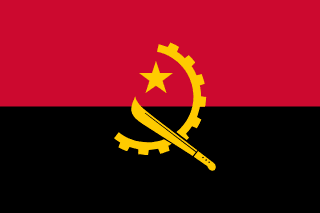
Angola
Republic of Angola
Population: UN WPP 2024, revision 1, projection for 1 July 2026. Sources and methodology.
Geography and territory
Angola occupies a vast stretch of southwestern Africa, its coastline running for more than 1,000 miles along the South Atlantic. Covering 1,246,700 square kilometers, it ranks among the largest countries on the continent, and its landscape shifts dramatically from region to region: parched coastal plains give way to savanna, highland plateaus, and pockets of dense tropical rainforest. Major rivers, including the Kwanza, the Congo, and the Zambezi, drain the interior and have long shaped patterns of settlement and trade.
At the heart of the country lies the Bié Plateau, a highland region rising above 1,500 meters that forms the watershed between the Congo basin to the north and the Zambezi basin to the south. It is here, in the Huambo highlands, that Mount Moco reaches 2,620 meters, the highest point in Angola. The elevation moderates the climate considerably, producing cooler, temperate conditions that contrast sharply with the tropical heat of the coast and the northern lowlands.
Angola’s territory includes the unusual exclave of Cabinda, separated from the rest of the country by a narrow corridor of the Democratic Republic of the Congo. Angola shares land borders with the Democratic Republic of the Congo, the Republic of the Congo, Zambia, and Namibia, giving it a strategic position in south-central Africa. The country’s biodiversity is remarkable, spanning coastal mangroves, the Maiombe rainforest in Cabinda, wooded savanna in the south, and the northern fringe of the Namib Desert, where red dunes tumble spectacularly toward the ocean.
With a population of about 40.2 million spread across this immense territory, Angola remains sparsely settled in comparison to its area, and population density varies enormously between the crowded capital region and the vast, thinly inhabited plateaus of the interior. This uneven distribution has long shaped internal migration, infrastructure planning, and the pace of development across the country’s eighteen provinces.
History
Angola’s history stretches back to Bantu-speaking peoples who migrated into the region over a thousand years ago, founding powerful kingdoms such as Kongo, Ndongo, Matamba, and Lunda. The Kingdom of Kongo, spanning northern Angola and parts of the present-day Congo, had developed a sophisticated political and social order long before Europeans arrived. Portuguese navigators reached the mouth of the Congo River in 1483, opening a relationship that would reshape the region for centuries to come.
Portuguese colonization lasted nearly five hundred years and was inseparable from the transatlantic slave trade, which devastated communities and forced millions of Africans onto ships bound for Brazil and the Caribbean. Luanda, founded in 1575, became the principal slaving port of the South Atlantic. The gradual abolition of slavery in the nineteenth century gave way to a colonial economy built on resource extraction and forced labor, a legacy that shaped Angolan society well into the twentieth century.
The struggle for independence erupted in 1961 with the outbreak of an armed anti-colonial war, waged by movements including the MPLA, UNITA, and the FNLA. Independence was proclaimed on 11 November 1975, but it was followed almost immediately by a brutal civil war that lasted until 2002, fueled by Cold War rivalries and by the country’s oil and diamond wealth. Today Angola is organized as a presidential republic, with a government structure built during the postwar period to consolidate national unity after nearly three decades of internal conflict.
In the decades since the war ended, Angola has pursued reconstruction and rapid economic growth, rebuilding roads, railways, and cities that had been shattered by fighting. Foreign investment, particularly from Portugal, China, and Brazil, has financed much of this recovery, though deep social challenges, including unequal access to education, healthcare, and clean water, remain a pressing legacy of the conflict years.
Culture and society
Angola is a cultural mosaic, home to more than ninety ethnic groups, each with its own language, customs, and artistic traditions. The Ovimbundu, Kimbundu, and Bakongo are the largest communities, but ethnic diversity extends across dozens of smaller groups with distinct identities. Portuguese, the official language inherited from colonial rule, coexists with national languages such as Umbundu, Kimbundu, Kikongo, and Chokwe, all of which remain vital to everyday life outside the largest cities.
Angolan music has achieved genuine international reach. Semba, often described as the forerunner of Brazilian samba, and kuduro, an energetic urban style born in the neighborhoods of Luanda that fuses electronic beats with African percussion, are the country’s best-known exports. Musicians such as Bonga and Paulo Flores, along with the pioneers of the kuduro scene, have carried Angolan sound to audiences worldwide, while dance remains central to social life, from traditional ceremony to contemporary street culture.
Angolan literature, written predominantly in Portuguese, boasts major figures including Agostinho Neto, the poet who became the country’s first president, along with Pepetela and José Eduardo Agualusa. Angolan society is remarkably young, with a median age of only about sixteen years, and this demographic reality fuels an extraordinary cultural dynamism. Luanda in particular pulses with creative energy expressed through fashion, street art, cuisine, and an ever-evolving music scene.
Economy
Angola possesses one of the largest economies in sub-Saharan Africa, built primarily on oil and natural gas production. It is the region’s second-largest oil producer after Nigeria and a member of OPEC. Hydrocarbons account for the overwhelming majority of exports and roughly half of national output, leaving the economy heavily exposed to swings in global crude prices, a vulnerability that has repeatedly shaped Angolan fiscal policy.
Beyond petroleum, Angola holds substantial diamond reserves and ranks among the world’s leading producers of these gemstones, alongside significant deposits of iron ore, copper, and gold. In recent years the government has pushed diversification policies aimed at developing agriculture, fisheries, manufacturing, and tourism, sectors with enormous untapped potential that were historically neglected in favor of extractive industries.
Inequality remains one of Angola’s defining economic challenges. Luanda has at times ranked among the most expensive cities in the world for expatriates, a striking paradox given the widespread poverty found elsewhere in the country. Ongoing reforms seek to improve the business climate, curb corruption, and attract foreign investment into non-oil sectors, efforts that will determine whether Angola’s considerable natural wealth translates into broader prosperity.
Food and cuisine
Angolan cuisine reflects centuries of exchange between African and Portuguese culinary traditions. Cassava is the defining staple, appearing in countless forms: as funge, a dense paste served alongside stews; as farinha, a toasted flour sprinkled over dishes; or ground into cornmeal-based variations. Deep red palm oil is the signature cooking fat, lending many dishes their characteristic color and rich, earthy flavor.
Among the most celebrated dishes is muamba de galinha, a chicken stew simmered with palm oil, okra, and spices, widely regarded as the national dish. Calulu, a stew of dried fish and vegetables cooked in palm oil, and pirão, a thick cassava-flour porridge, are similarly beloved. Fresh Atlantic seafood dominates the coastal table, grilled over charcoal, prepared as a hearty caldeirada stew, or served with beans cooked in palm oil.
Traditional beverages hold a special place in Angolan culture. Kissangua, a home-brewed beer made from fermented maize, and caporroto, a cassava-based spirit, are among the most emblematic. Angolan coffee, particularly the robusta grown in the highlands, was once among the most prized in the world, and the industry is now slowly rebuilding after decades of conflict disrupted production.
Tourism and landmarks
Angola remains an emerging destination offering landscapes of striking, untamed beauty. Kissama National Park, roughly 70 kilometers south of Luanda, is the country’s most accessible reserve, home to elephants, giraffes, buffalo, and antelope reintroduced under a major wildlife restoration effort. The Kalandula Falls, plunging 105 meters over a 400-meter-wide curtain of water, rank among the most impressive cascades on the African continent.
Luanda itself blends a historic core of Portuguese colonial churches and the sixteenth-century São Miguel Fortress with a skyline of modern towers and lively waterfront promenades. Mussulo Island, a sandy peninsula reachable by boat from the capital, offers white-sand beaches and calm waters. Farther south, the Angolan stretch of the Namib Desert unfolds into an otherworldly landscape where red dunes meet the Atlantic surf.
The Serra da Leba, famous for its dramatic switchback highway descending from the Humpata plateau toward the city of Namibe, is one of Angola’s iconic sights. The Pungo Andongo rock formations, immense black stone monoliths rising from the savanna of Malanje province, are wrapped in local legend and offer striking photographic backdrops. Mbanza Kongo, the former capital of the Kingdom of Kongo and a UNESCO World Heritage Site, rounds out a tourism offering as varied as it remains unexplored.
Fun facts about Angola
- Angola is the largest Portuguese-speaking country in Africa and the second largest in the world by area, after Brazil.
- Kuduro, a music genre born in the neighborhoods of Luanda in the 1990s, has become a global phenomenon that continues to influence electronic music worldwide.
- The giant sable antelope, endemic to Angola, is the national symbol and appears on the country’s coat of arms and on its national football team’s jerseys.
- Luanda was for years ranked among the most expensive cities in the world for expatriates, at times surpassing Tokyo and Zurich.
- Before its civil war, Angola was one of the world’s largest coffee exporters, and the sector is now undergoing a slow but determined revival.
Angola in numbers
Latest World Bank and UNDP observations, each with its own year. “World median” is the middle value among the countries that report the same indicator; “#” ranks from the highest value.
Population since 1960
Angola had 5.2 million people in 1960 and 39.0 million in 2025 — 7.5 times as many.
People
71.5% of people live in towns and cities (world median 63.4%). 44.1% are under 15 and 2.9% are 65 or older — a very young population. Women have 5.05 children on average, above the replacement level of about 2.1.
Economy
The economy grew by 3.1% in real terms in 2025. Consumer prices rose by 20.2% in 2025 — very high inflation. Services make up the largest share of output (46.8% of GDP); agriculture contributes 25.2%, a large share that points to a farming-based economy.
Development and environment
UNDP rates human development in Angola as medium, with an index of 0.616 in 2023 (rank 148 of 193). 40.7% of people use the internet and 55.5% have access to electricity. Forest covers 51.2% of the land (world median 32.8%).
Sources: World Bank, World Development Indicators (CC BY 4.0), most recent observation from 2015 onward; UNDP Human Development Report 2025. Retrieved 2026-10-10. Sector shares need not add up to 100% because taxes and subsidies on products are excluded. Missing values are left blank rather than estimated. Sources and methodology.
Climate of Angola
Averaged across Angola, the warmest month is October (23.3 °C) and the coolest is July (18.4 °C), a seasonal swing of 4.9 °C. The annual mean is 21.7 °C.
About 1,044 mm of precipitation falls in a typical year. March is the wettest month (182 mm) and June the driest (1 mm). The wettest stretch is January to March, with 47% of the year's total.
Show monthly values as a table
| Month | Mean °C | Low °C | High °C | Precipitation, mm |
|---|---|---|---|---|
| January | 22.7 | 17.2 | 28.4 | 161 |
| February | 22.9 | 17.3 | 28.4 | 151 |
| March | 22.9 | 17.3 | 28.6 | 182 |
| April | 22.5 | 16.2 | 28.8 | 113 |
| May | 21.1 | 13.5 | 28.7 | 17 |
| June | 18.8 | 10.5 | 27.2 | 1 |
| July | 18.4 | 10.0 | 26.9 | 1 |
| August | 20.3 | 12.0 | 28.7 | 4 |
| September | 22.3 | 14.6 | 30.1 | 23 |
| October | 23.3 | 16.6 | 30.1 | 77 |
| November | 22.9 | 17.0 | 28.9 | 150 |
| December | 22.8 | 17.2 | 28.4 | 166 |
Figures are 1991–2020 averages across the whole land area of Angola, from the World Bank Climate Change Knowledge Portal, CRU TS 4.08 (CC BY 4.0). They are not readings from one weather station: the capital, the coast and high ground can be much warmer, cooler, wetter or drier.
Travel essentials for Angola
The practical details visitors ask about first. Traffic in Angola drives on the right, like most of the world. Mains electricity is 230 V at 50 Hz, so devices made only for 110–120 V (common in North America) need a converter unless they are dual-voltage — most phone and laptop chargers are.
- Emergency number
- 113Ambulance 112 · Fire 115
- Driving side
- Right
- Plug types
- Type C, Type FC: two round pins (Europlug); F: two round pins with side earth clips (Schuko)
- Voltage
- 230 V50 Hz
- Dialling code
- +244From abroad: your exit code, then 244 and the number
- Currency
- Kwanza (AOA)
- Time zone
- WAT (UTC+1)Current local time in Angola
Compiled from IEC plug and voltage standards, national emergency-service listings and the UN road-traffic conventions. Emergency numbers and local coverage can change — confirm them locally on arrival. Angola's internet domain is .ao.
Where Angola ranks in the world
Each position counts only the countries with data in that ranking guide. First place is the highest value — for price levels, the most expensive. Select a card to see the full table.
- Population39th of 19640.2 millionUN projection, July 2026
- Land area22nd of 1951,246,700 km²World Bank, 2023
- Population density151st of 19429 per km²World Bank, 2023
- GDP (nominal)69th of 187$103.1BWorld Bank, 2024, current US$
- GDP per capita139th of 187$2,721World Bank, 2024, current US$
- Life expectancy168th of 19464.8 yearsWorld Bank, 2024
- Price level141st of 16532 (US = 100)ICP 2021, household consumption
Bordering countries of Angola


Compare Angola with another country
Frequently asked questions about Angola
What is the capital of Angola?
The capital of Angola is Luanda.
What is the population of Angola?
The UN World Population Prospects projection for Angola is 40,215,179 people (40.2 million) on 1 July 2026. National statistical offices may publish different estimates.
What language is spoken in Angola?
The official language of Angola is Portuguese.
What currency is used in Angola?
The currency of Angola is the Kwanza (AOA).
How big is Angola?
Angola covers an area of 1,246,700 km².
What type of government does Angola have?
Angola is a presidential republic.
Which countries border Angola?
Angola shares land borders with Democratic Republic of the Congo, Republic of the Congo, Zambia, Namibia.
What is the highest point in Angola?
The highest point in Angola is Mount Moco (2,620 m).


