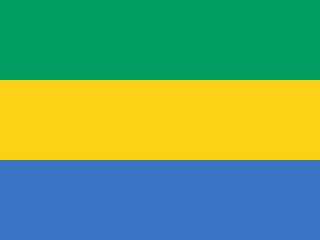
Gabon
Gabonese Republic
Population: UN WPP 2024, revision 1, projection for 1 July 2026. Sources and methodology.
Geography and territory
Straddling the equator on the Atlantic coast of Central Africa, Gabon covers 267,668 square kilometers of some of the most intact rainforest left on the planet. Roughly 88 percent of the country lies under a thick canopy of tropical forest, a proportion so extreme that Gabon ranks among the most heavily forested nations on Earth. Locals sometimes call it the land of a thousand rivers, a nod to the dense network of waterways threading through the trees and feeding the country’s swamps, lagoons, and estuaries.
The dominant geographic feature is the Ogooué River, Gabon’s longest waterway at roughly 1,200 kilometers, which rises on the Batéké Plateau and empties into the Atlantic through a broad, marshy delta. The Crystal Mountains rise in the north and the Chaillu Massif dominates the south-central interior, but neither range climbs particularly high; the country’s tallest peak, Mount Iboundji, reaches only 1,575 meters. Along the roughly 800-kilometer coastline, untouched sandy beaches alternate with mangrove forests and coastal lagoons that shelter an unusual amount of marine life for a shoreline of its length.
Gabon’s climate is hot, humid, and remarkably consistent year-round, with average temperatures near 26 degrees Celsius and heavy rainfall feeding the rainforest ecosystem. Two distinct rainy seasons, separated by a shorter and a longer dry spell, keep the forest canopy green throughout the year and sustain rivers that rarely run low even in the driest months. That climate underwrites an extraordinary concentration of wildlife: Gabon holds some of the largest surviving populations of western lowland gorillas, forest elephants, mandrills, and chimpanzees anywhere in Africa. Offshore, its waters serve as a nesting ground for leatherback sea turtles and a migratory corridor for humpback whales, cementing the country’s reputation as one of the continent’s last great wilderness strongholds and a priority for global conservation efforts.
History
Long before written records, the forests of Gabon were home to Pygmy peoples, whose way of life predates the later arrival of Bantu-speaking migrants who brought agriculture and ironworking to the region. The Fang, today the country’s largest ethnic group, moved into the area from the north around the 18th century, gradually displacing or absorbing earlier populations. European contact began in the 15th century when Portuguese sailors named the region “Gabão,” after an estuary they thought resembled a hooded sailor’s cloak of that name.
France formalized its presence in the mid-19th century, founding Libreville in 1849 as a settlement for freed slaves, a gesture that echoed the founding of Freetown in nearby Sierra Leone. The territory was absorbed into French Equatorial Africa and heavily exploited for timber, rubber, and minerals under colonial rule. Resistance to French control persisted throughout the period, surfacing in scattered armed uprisings as well as quieter forms of civil disobedience.
Gabon became independent on August 17, 1960, with Léon M’ba as its first president. Following his death in 1967, Omar Bongo Ondimba took power and ruled for more than four decades until his death in 2009, when his son Ali Bongo Ondimba succeeded him. The Bongo era coincided with the country’s rise as an oil producer, and the family’s dominance over Gabonese politics became one of the longest-running in postcolonial Africa. In August 2023, a military coup brought the Bongo family’s long grip on power to an abrupt end, opening a period of political transition as the country works to redefine its institutions and chart a new constitutional path.
Culture and society
Gabonese culture blends Bantu tradition, French colonial influence, and a resilient spiritual heritage into a distinctive whole. More than forty ethnic groups call the country home, with the Fang, Myene, Punu, and Nzebi among the largest. Each community maintains its own traditions of sculpture, dance, music, and rites of passage marking the pivotal moments of life.
Gabonese art has left a surprisingly deep mark on Western art history, particularly through Fang and Punu ritual masks, whose stylized forms captivated early 20th-century artists such as Pablo Picasso and Amedeo Modigliani. The white Punu masks, which render idealized female faces with serene, mask-like calm, are counted among the masterpieces of African art and are held in major museums worldwide. Fang reliquary figures, carved to guard the bones of ancestors, offer further evidence of the sophistication of Gabonese sculptural tradition.
Bwiti stands as Gabon’s most distinctive spiritual practice, an elaborate system of initiation rituals built around iboga, a psychoactive plant native to the country’s forests. Recognized as national cultural heritage, Bwiti weaves animist beliefs together with Christian elements and remains a cornerstone of identity for many communities, guiding initiates through ceremonies that can last several days and involve music, dance, and communal reflection. Contemporary Gabonese music, which fuses traditional rhythms with hip-hop and Afrobeat, has also found a growing audience across French-speaking Africa, while French remains the language of administration, education, and everyday communication across the country’s many ethnic communities.
Economy
Oil has driven Gabon’s economy since the 1970s, and petroleum revenue still accounts for a substantial share of both GDP and export earnings, giving the country a per capita income that stands out by regional standards. That wealth, however, has not been shared evenly, and a significant portion of the population continues to live in poverty despite the country’s resource riches.
Timber is the second pillar of the economy, with okoumé — a lightweight wood prized for plywood manufacturing — the leading forestry export. Gabon is also a major mining player, ranking as the world’s second-largest producer of manganese, a mineral essential to steelmaking. Reserves of gold, uranium, and niobium add further potential to the mining sector, though most of these deposits remain only lightly developed.
Aware that oil reserves will eventually run down, Gabon has made a deliberate bet on ecotourism and a greener economic model. In 2002, President Omar Bongo created a network of thirteen national parks covering 11 percent of the country’s territory, positioning Gabon as a premier sustainable-tourism destination and a rare example of a resource-rich state prioritizing forest conservation on a national scale. Agriculture, aquaculture, and services are all growing sectors that the government hopes will gradually reduce the country’s reliance on oil revenue, alongside efforts to build up domestic processing industries so that raw timber and minerals generate more value before leaving the country.
Food and cuisine
Gabonese cooking draws on the abundance of the rainforest and the long Atlantic coastline, blending indigenous ingredients with techniques shaped by both Bantu tradition and French colonial influence. Cassava and plantain form the backbone of the everyday diet, prepared boiled, fried, mashed, or fermented into bâtonnets de manioc — cassava dough wrapped and steamed in leaves — which accompany nearly every meal.
Nyembwe is arguably the country’s signature dish, a chicken or fish stew simmered in palm-nut sauce that gives it a rich, unmistakably silky flavor. Grilled fish seasoned with local spices and served alongside fried plantain is another coastal staple. In rural areas, bushmeat such as porcupine, antelope, and wild boar remains part of the traditional diet, though hunting is increasingly regulated to protect the country’s wildlife.
Tropical fruit fills Gabonese markets: mangoes, papayas, pineapples, passion fruit, and atanga, a tart native fruit typically boiled or roasted before eating. Peanuts and okra thicken many sauces, and dishes are often finished with fiery chili pepper for those who like their food with a kick. Régab, a locally brewed beer, is the everyday social drink of choice, while palm wine, fermented from palm sap, is reserved for community celebrations and traditional ceremonies.
Tourism and landmarks
Gabon has carved out a niche as one of Africa’s most exclusive ecotourism destinations thanks to its network of thirteen national parks. Lopé National Park, a UNESCO World Heritage Site, combines rainforest and savanna and shelters significant populations of western lowland gorillas, chimpanzees, forest elephants, and mandrills; ancient petroglyphs found within the park attest to a human presence stretching back millennia.
Loango National Park, often billed as “Africa’s last Eden,” offers travelers the rare chance to see hippos and elephants roaming pristine Atlantic beaches, along with humpback whales passing offshore between July and September. The park’s lagoons teem with crocodiles, manatees, and remarkable birdlife. Ivindo National Park protects the spectacular Kongou and Mingouli waterfalls, among the most impressive in Central Africa, set within untouched primary forest.
Libreville, the capital, presents a more cosmopolitan face, with restaurants, craft markets, and the National Museum of Arts and Traditions. The Trans-Gabon Railway, which links Libreville to Franceville across 700 kilometers of rainforest, offers a singular travel experience, carrying passengers through lush landscapes and over numerous bridges spanning the rivers and ravines of the Ogooué basin. Along the way, Lambaréné, on the Ogooué River, draws visitors interested in the legacy of Albert Schweitzer’s hospital, while the region around Franceville offers access to waterfalls, caves, and further pockets of protected forest.
Fun facts about Gabon
- About 88 percent of Gabon’s land area is covered by tropical rainforest, one of the highest forest-cover ratios anywhere in the world.
- Iboga, the plant at the heart of the Bwiti ritual, is the subject of ongoing scientific research into its potential to treat addiction.
- Okoumé, a tree native to Gabon, can grow up to 60 meters tall and is the country’s most widely exported timber species.
- Libreville, whose name means “free town,” was founded in 1849 by freed captives from a slave ship intercepted by the French navy.
- Gabon was the first African country to set aside more than 10 percent of its territory as national parkland.
- Nobel Peace Prize winner Albert Schweitzer built his famous hospital in Lambaréné, on the banks of the Ogooué River, where he treated patients for decades.
Gabon in numbers
Latest World Bank and UNDP observations, each with its own year. “World median” is the middle value among the countries that report the same indicator; “#” ranks from the highest value.
Population since 1960
Gabon had 512,316 people in 1960 and 2.6 million in 2025 — 5.1 times as many.
People
92.1% of people live in towns and cities (world median 63.4%). 36.2% are under 15 and 4.1% are 65 or older — a young population. Women have 3.59 children on average, above the replacement level of about 2.1.
Economy
The economy grew by 2.5% in real terms in 2025. Consumer prices rose by 1.8% in 2025. Industry makes up the largest share of output (47.2% of GDP); agriculture contributes 6.8%.
Development and environment
UNDP rates human development in Gabon as high, with an index of 0.733 in 2023 (rank 108 of 193). 68.7% of people use the internet and 95.1% have access to electricity. Forest covers 91.4% of the land (world median 32.8%).
Sources: World Bank, World Development Indicators (CC BY 4.0), most recent observation from 2015 onward; UNDP Human Development Report 2025. Retrieved 2026-10-10. Sector shares need not add up to 100% because taxes and subsidies on products are excluded. Missing values are left blank rather than estimated. Sources and methodology.
Climate of Gabon
Averaged across Gabon, the mean temperature stays between 23.5 °C (July) and 26.3 °C (March) — a swing of only 2.8 °C, so seasons are marked by rainfall rather than by heat.
About 1,861 mm of precipitation falls in a typical year. October is the wettest month (288 mm) and July the driest (13 mm). The wettest stretch is October to December, with 41% of the year's total.
Show monthly values as a table
| Month | Mean °C | Low °C | High °C | Precipitation, mm |
|---|---|---|---|---|
| January | 25.9 | 21.9 | 30.0 | 147 |
| February | 26.1 | 21.5 | 30.7 | 160 |
| March | 26.3 | 21.6 | 31.1 | 223 |
| April | 26.2 | 21.6 | 31.0 | 206 |
| May | 25.8 | 21.6 | 30.1 | 177 |
| June | 24.4 | 20.6 | 28.2 | 45 |
| July | 23.5 | 19.8 | 27.2 | 13 |
| August | 23.7 | 19.9 | 27.4 | 21 |
| September | 24.7 | 20.7 | 28.8 | 114 |
| October | 25.3 | 21.2 | 29.5 | 288 |
| November | 25.2 | 21.1 | 29.4 | 286 |
| December | 25.2 | 21.3 | 29.2 | 181 |
Figures are 1991–2020 averages across the whole land area of Gabon, from the World Bank Climate Change Knowledge Portal, CRU TS 4.08 (CC BY 4.0). They are not readings from one weather station: the capital, the coast and high ground can be much warmer, cooler, wetter or drier.
Travel essentials for Gabon
The practical details visitors ask about first. Traffic in Gabon drives on the right, like most of the world. Mains electricity is 220 V at 50 Hz, so devices made only for 110–120 V (common in North America) need a converter unless they are dual-voltage — most phone and laptop chargers are.
- Emergency number
- 1730
- Driving side
- Right
- Plug types
- Type CC: two round pins (Europlug)
- Voltage
- 220 V50 Hz
- Dialling code
- +241From abroad: your exit code, then 241 and the number
- Currency
- Central African CFA Franc (XAF)
- Time zone
- WAT (UTC+1)Current local time in Gabon
Compiled from IEC plug and voltage standards, national emergency-service listings and the UN road-traffic conventions. Emergency numbers and local coverage can change — confirm them locally on arrival. Gabon's internet domain is .ga.
Where Gabon ranks in the world
Each position counts only the countries with data in that ranking guide. First place is the highest value — for price levels, the most expensive. Select a card to see the full table.
- Population143rd of 1962.6 millionUN projection, July 2026
- Land area75th of 195257,670 km²World Bank, 2023
- Population density181st of 1949.6 per km²World Bank, 2023
- GDP (nominal)124th of 187$20.9BWorld Bank, 2024, current US$
- GDP per capita87th of 187$8,230World Bank, 2024, current US$
- Life expectancy142nd of 19468.5 yearsWorld Bank, 2024
- Price level64th of 16554 (US = 100)ICP 2021, household consumption
Bordering countries of Gabon


Compare Gabon with another country
Frequently asked questions about Gabon
What is the capital of Gabon?
The capital of Gabon is Libreville.
What is the population of Gabon?
The UN World Population Prospects projection for Gabon is 2,647,399 people (2.6 million) on 1 July 2026. National statistical offices may publish different estimates.
What language is spoken in Gabon?
The official language of Gabon is French.
What currency is used in Gabon?
The currency of Gabon is the Central African CFA Franc (XAF).
How big is Gabon?
Gabon covers an area of 267,668 km².
What type of government does Gabon have?
Gabon is a presidential republic.
Which countries border Gabon?
Gabon shares land borders with Cameroon, Republic of the Congo, Equatorial Guinea.
What is the highest point in Gabon?
The highest point in Gabon is Mount Iboundji (1,575 m).


