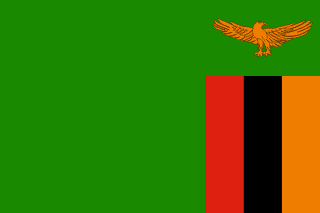
Zambia
Republic of Zambia
Population: UN WPP 2024, revision 1, projection for 1 July 2026. Sources and methodology.
Geography and territory
Zambia is a large, landlocked nation at the heart of southern Africa, covering 752,612 square kilometers, which places it among the largest countries on the continent. Its territory borders no fewer than eight other nations and sits on an elevated plateau, generally between 1,000 and 1,600 meters above sea level, a feature that moderates temperatures considerably despite the country’s tropical latitude. The Zambezi River, which gives the country its name, is the defining geographical feature, tracing much of the southern and western border before plunging spectacularly over Victoria Falls.
Broad stretches of miombo woodland savanna dominate the Zambian landscape, an open, tropical forest ecosystem that blankets much of the central plateau and supports rich biodiversity. The north of the country grows noticeably more rugged, with the Mafinga Hills reaching 2,339 meters, the highest point in Zambia. To the east, the Luangwa Valley forms part of Africa’s great rift system, a dramatic landscape of floodplains, riverine woodland, and eroded clay gullies that hosts one of the densest concentrations of wildlife found anywhere on the continent.
Zambia’s river network is exceptionally rich. Beyond the Zambezi, the Luangwa and Kafue rivers, along with numerous tributaries, feed extensive wetlands and lagoons across the country. Lake Bangweulu in the northeast and the southern tip of Lake Tanganyika support fisheries vital to local communities. The rainy season, running from November through April, transforms low-lying floodplains into vast wetlands, while the dry season reveals the golden grasslands and scattered baobabs that define the classic African savanna image.
History
Human presence in what is now Zambia stretches back to the Stone Age, evidenced by rock art at Nachikufu and other sites across the country. Bantu-speaking peoples began migrating into the region from around the fourth century, bringing agriculture, ironworking, and the languages that would come to define the country’s linguistic landscape. Between the sixteenth and nineteenth centuries, a series of kingdoms and chiefdoms organized political life across the territory, among them the Lozi kingdom of the west, notable for its sophisticated seasonal system of governance, and the powerful Bemba kingdom of the north.
European explorers arrived in the nineteenth century. Scottish missionary and explorer David Livingstone became the first European to lay eyes on Victoria Falls in 1855, naming the cataract after the British queen, although local communities had long known it as Mosi-oa-Tunya, “the smoke that thunders.” British colonization followed, carried out through Cecil Rhodes’s British South Africa Company, which established the protectorate of Northern Rhodesia in 1911. The exploitation of enormous copper deposits in what became known as the Copperbelt drew thousands of African and European miners and shaped an economic structure that still defines the country today.
Zambia gained independence on October 24, 1964, under the leadership of Kenneth Kaunda, who governed for 27 years under a one-party system. In 1991, the country made a peaceful transition to multiparty democracy, becoming one of the first African nations to achieve a democratic change of government through the ballot box. Since then, Zambia has built a durable, if imperfect, democratic tradition, earning international recognition and standing as one of the more politically stable countries in the region, having overseen several peaceful transfers of power between rival parties.
Culture and society
Zambian society comprises more than 70 ethnic groups that coexist with notable harmony, an achievement often credited in part to Kenneth Kaunda’s unifying political vision, captured in the national motto “One Zambia, One Nation,” which forged a shared identity above ethnic division. The Bemba of the north, the Tonga of the south, the Lozi of the west, the Ngoni of the east, and the Lunda of the northwest number among the country’s major groups, each preserving distinct customs, ceremonies, and leadership structures. English serves as the official and unifying language, though more than 70 Bantu languages are spoken across the country.
Traditional ceremonies rank among the most vivid expressions of Zambian culture. The Kuomboka of the Lozi people is the most spectacular: a royal procession in which the litunga, or king, travels by ceremonial barge from the flooded plains of the Zambezi to higher ground, accompanied by hundreds of paddlers, drummers, and singers. The Ncwala of the Ngoni, which celebrates the season’s first harvest, and the Likumbi Lya Mize of the Luvale, featuring elaborate makishi ceremonial masks, are further cultural events of major significance that draw visitors from across the country and abroad.
Zambian music carries a distinct identity, none more striking than zamrock, a genre unique to the country that fused psychedelic rock of the 1970s with African rhythms, producing a sound that has been rediscovered and celebrated internationally in recent decades. Bands such as WITCH and Ngozi Family are now revered among record collectors worldwide. Kalindula, a dance music genre built around the percussion instrument of the same name, along with a thriving contemporary music scene, round out a vibrant cultural landscape. Zambians are widely known for their warmth and hospitality, and the phrase “Copperbelt spirit” reflects the community solidarity forged in the country’s historic mining settlements.
Economy
Zambia’s economy has historically revolved around copper mining, the driving force of the national economy since the colonial era. The country ranks among the world’s largest copper producers, and the metal accounts for the majority of export revenue. The Copperbelt region in northern Zambia remains one of the most productive mining zones on the planet, with mines extracting millions of tonnes of ore each year. Cobalt, uranium, nickel, and emeralds round out the country’s mineral production.
This reliance on copper has proven to be both a blessing and a vulnerability. Swings in the international copper price feed directly and immediately into the national economy, government revenue, and the value of the kwacha. Successive governments have sought to diversify the economy by promoting commercial agriculture, tourism, and manufacturing. Agriculture employs the majority of the population, producing maize, tobacco, cotton, soybeans, and flowers for export. Tourism, centered on Victoria Falls and the country’s wildlife parks, continues to generate growing revenue.
Zambia’s economic challenges include a heavy external debt burden that in recent years pushed the government to seek restructuring of its obligations to international creditors. Poverty remains widespread, particularly in rural areas, and infrastructure, while more developed than in many neighboring countries, still requires substantial investment. Even so, abundant natural resources, political stability, and a young and growing population provide a solid foundation for future development.
Food and cuisine
Zambian cuisine centers on nshima, a firm dough made from white maize flour cooked in water, the undisputed staple food of the country. Nshima appears at nearly every meal, hand-rolled into small balls and dipped into relish, the general term for the accompanying dishes, which range from vegetable stews to meat, fish, or legumes. Eating nshima with the right hand while seated on the floor or on low stools remains the traditional way families share a meal together.
The most popular relishes include ifisashi, a stew of leafy greens cooked in groundnut paste that may be the single most representative dish in Zambian cooking; chibwabwa, cooked pumpkin leaves; and delele, an okra preparation with a distinctive slightly gelatinous texture. Beef, chicken, and goat are commonly stewed with tomato and onion, while dried fish, particularly kapenta, a small fish harvested from Lake Tanganyika, provides an essential source of protein nationwide. Chikanda, often called “African polony” or the African steak substitute, is a savory cake made from wild orchid tubers and groundnuts that mimics the texture of meat surprisingly well.
Traditional Zambian beverages include munkoyo, a fermented drink made from munkoyo roots and maize meal with a mildly tart, sweet flavor, and chibuku, a thick, milky-looking sorghum or millet beer consumed in large quantities at celebrations and community gatherings. Maheu, a fermented maize beverage, is a nutritious refreshment especially popular among children. The commercial lager Mosi, named for Victoria Falls, is the country’s best-selling beer brand and something of a national symbol.
Tourism and landmarks
Zambia ranks among Africa’s most authentic and least crowded safari destinations, offering wildlife encounters set against genuinely untouched wilderness. Victoria Falls, known locally as Mosi-oa-Tunya, “the smoke that thunders,” is unquestionably the country’s most famous attraction. Stretching 1,708 meters wide with a drop of up to 108 meters, it forms the largest sheet of falling water on Earth, throwing up a spray cloud visible from more than 30 kilometers away. The falls hold UNESCO World Heritage status, shared jointly with Zimbabwe.
South Luangwa National Park is widely regarded as one of the finest walking-safari destinations in the world, a style pioneered here that lets visitors experience the savanna at ground level, guided by expert trackers and at intimate distances from wildlife. The Luangwa Valley shelters one of the densest leopard populations anywhere in Africa, alongside large herds of buffalo, elephant, hippopotamus, and a notable population of the endemic Thornicroft’s giraffe. Night drives reveal a parallel world of nocturnal predators, genets, pangolins, and other creatures rarely seen by day.
Kafue National Park, covering 22,400 square kilometers, ranks among the largest parks in Africa and spans landscapes from floodplains to teak forests and granite hills. The Liuwa Plain, in the west, hosts the second-largest wildebeest migration on the continent and remains one of the most remote and wild parks in Africa. Lake Kariba, formed by the dam of the same name on the Zambezi River, offers houseboat cruises, wildlife viewing, tiger fish angling, and sunsets that paint an endless horizon of water and African sky in shades of orange.
Fun facts about Zambia
- Victoria Falls forms the largest single sheet of falling water in the world, and its spray cloud is visible from more than 30 kilometers away.
- Zambia was among the first African nations to achieve a peaceful democratic transition through elections, in 1991.
- Zamrock, a fusion of 1970s psychedelic rock and African rhythms born in Zambia, is now a cult genre celebrated by music collectors worldwide.
- The Kuomboka ceremony of the Lozi people, in which the king travels by ceremonial barge, ranks among Africa’s oldest and most spectacular royal traditions.
- Zambia shares borders with eight countries, more than most nations on the African continent.
- Chikanda, a vegetarian dish made from wild orchid tubers, is nicknamed “African polony” for its uncanny resemblance to the texture of meat.
Zambia in numbers
Latest World Bank and UNDP observations, each with its own year. “World median” is the middle value among the countries that report the same indicator; “#” ranks from the highest value.
Population since 1960
Zambia had 3.2 million people in 1960 and 21.9 million in 2025 — 6.9 times as many.
People
45.9% of people live in towns and cities (world median 63.4%). 41.0% are under 15 and 2.0% are 65 or older — a very young population. Women have 4.04 children on average, above the replacement level of about 2.1.
Economy
The economy grew by 3.8% in real terms in 2025. Consumer prices rose by 13.9% in 2025. Services make up the largest share of output (57.0% of GDP); agriculture contributes 4.1%.
Development and environment
UNDP rates human development in Zambia as medium, with an index of 0.595 in 2023 (rank 154 of 193). 17.1% of people use the internet and 53.6% have access to electricity. Forest covers 60.5% of the land (world median 32.8%).
Sources: World Bank, World Development Indicators (CC BY 4.0), most recent observation from 2015 onward; UNDP Human Development Report 2025. Retrieved 2026-10-10. Sector shares need not add up to 100% because taxes and subsidies on products are excluded. Missing values are left blank rather than estimated. Sources and methodology.
Climate of Zambia
Averaged across Zambia, the warmest month is October (25.4 °C) and the coolest is July (17.7 °C), a seasonal swing of 7.7 °C. The annual mean is 22.2 °C.
About 984 mm of precipitation falls in a typical year. January is the wettest month (233 mm) and July the driest (0 mm). The three wettest consecutive months, December to February, bring 65% of the year's total — a pronounced rainy season.
Show monthly values as a table
| Month | Mean °C | Low °C | High °C | Precipitation, mm |
|---|---|---|---|---|
| January | 23.3 | 18.2 | 28.5 | 233 |
| February | 23.5 | 18.2 | 28.8 | 197 |
| March | 23.4 | 17.8 | 29.0 | 162 |
| April | 22.2 | 15.7 | 28.8 | 42 |
| May | 20.2 | 12.4 | 28.1 | 6 |
| June | 18.1 | 9.7 | 26.6 | 1 |
| July | 17.7 | 9.1 | 26.3 | 0 |
| August | 20.2 | 11.6 | 28.8 | 0 |
| September | 23.4 | 15.0 | 32.0 | 3 |
| October | 25.4 | 17.7 | 33.1 | 24 |
| November | 25.0 | 18.6 | 31.5 | 110 |
| December | 23.8 | 18.4 | 29.2 | 206 |
Figures are 1991–2020 averages across the whole land area of Zambia, from the World Bank Climate Change Knowledge Portal, CRU TS 4.08 (CC BY 4.0). They are not readings from one weather station: the capital, the coast and high ground can be much warmer, cooler, wetter or drier.
Travel essentials for Zambia
The practical details visitors ask about first. Traffic in Zambia drives on the left, one of 54 of the 196 countries profiled here that do — see the full list. Mains electricity is 230 V at 50 Hz, so devices made only for 110–120 V (common in North America) need a converter unless they are dual-voltage — most phone and laptop chargers are.
- Emergency number
- 999Police 991 · Ambulance 992 · Fire 993
- Driving side
- Left
- Plug types
- Type C, Type D, Type GC: two round pins (Europlug); D: three large round pins in a triangle; G: three rectangular pins (British)
- Voltage
- 230 V50 Hz
- Dialling code
- +260From abroad: your exit code, then 260 and the number
- Currency
- Zambian Kwacha (ZMW)
- Time zone
- CAT (UTC+2)Current local time in Zambia
Compiled from IEC plug and voltage standards, national emergency-service listings and the UN road-traffic conventions. Emergency numbers and local coverage can change — confirm them locally on arrival. Zambia's internet domain is .zm.
Where Zambia ranks in the world
Each position counts only the countries with data in that ranking guide. First place is the highest value — for price levels, the most expensive. Select a card to see the full table.
- Population63rd of 19622.5 millionUN projection, July 2026
- Land area37th of 195743,390 km²World Bank, 2023
- Population density155th of 19428 per km²World Bank, 2023
- GDP (nominal)114th of 187$25.3BWorld Bank, 2024, current US$
- GDP per capita165th of 187$1,187World Bank, 2024, current US$
- Life expectancy158th of 19466.5 yearsWorld Bank, 2024
- Price level146th of 16531 (US = 100)ICP 2021, household consumption
Bordering countries of Zambia


Compare Zambia with another country
Frequently asked questions about Zambia
What is the capital of Zambia?
The capital of Zambia is Lusaka.
What is the population of Zambia?
The UN World Population Prospects projection for Zambia is 22,521,915 people (22.5 million) on 1 July 2026. National statistical offices may publish different estimates.
What language is spoken in Zambia?
The official language of Zambia is English.
What currency is used in Zambia?
The currency of Zambia is the Zambian Kwacha (ZMW).
How big is Zambia?
Zambia covers an area of 752,612 km².
What type of government does Zambia have?
Zambia is a presidential republic.
Which countries border Zambia?
Zambia shares land borders with Democratic Republic of the Congo, Tanzania, Malawi, Mozambique, Zimbabwe, Botswana, Namibia, Angola.
What is the highest point in Zambia?
The highest point in Zambia is Mafinga Central (2,339 m).


