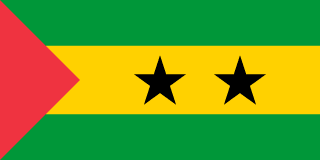
Sao Tome and Principe
Democratic Republic of São Tomé and Príncipe
Population: UN WPP 2024, revision 1, projection for 1 July 2026. Sources and methodology.
Geography and territory
Sao Tome and Principe sits in the Gulf of Guinea off the west coast of Central Africa, roughly 300 kilometers from the shores of Gabon and Equatorial Guinea. It is the smallest country on the African continent, with a total land area of just 964 square kilometers spread across two main volcanic islands, Sao Tome and Principe, along with a scattering of uninhabited islets. Despite its tiny footprint, the archipelago packs in an outsized range of landscapes, from dense rainforest and jagged volcanic peaks to black- and gold-sand beaches and coral-fringed shores.
Sao Tome, the larger island, is dominated by the volcanic cone of Pico de Sao Tome, which rises to 2,024 meters and anchors a mountainous interior laced with rivers that tumble down through lush tropical forest toward the coast. Principe, about 150 kilometers to the northeast, is smaller and far less populated, its rolling, forest-cloaked hills earning it recognition as a UNESCO Biosphere Reserve in 2012. Together the two islands, though close neighbors, feel distinct in character and pace of life.
The climate is equatorial, warm and humid throughout the year, with average temperatures hovering around 26 degrees Celsius and abundant rainfall concentrated on the southwestern slopes of the islands. The equator itself passes just south of Sao Tome through the small islet of Rolas, and the archipelago’s remoteness from the mainland has allowed a wealth of endemic plant and animal species to evolve in isolation. Obo Natural Park, which shelters primary forest on both islands, protects birds, amphibians, and plants found nowhere else on Earth, making the country a magnet for naturalists despite its modest size.
History
The islands were uninhabited when Portuguese navigators sighted them between 1470 and 1472, finding a dense, untouched tropical wilderness. Settlement began in 1485 with colonists arriving from Portugal alongside enslaved Africans and deported Portuguese Jews, forging a mixed, creole society whose culture still defines the islands today. The fertile volcanic soil and equatorial climate quickly made the archipelago a major agricultural producer.
By the 16th and 17th centuries, Sao Tome had become the world’s leading sugar producer and a key hub in the transatlantic slave trade. As the sugar economy faded, coffee and later cocoa took its place in the 19th century, reshaping both the land and the social order. Large plantation estates known as roças dominated economic life, functioning as largely self-contained communities with their own schools, clinics, and chapels; their weathered colonial buildings still dot the countryside today.
Independence came on July 12, 1975, amid the upheaval of Portugal’s Carnation Revolution, which brought down the colonial empire. Manuel Pinto da Costa became the country’s first president and led a one-party socialist government until a democratic transition took hold in 1990. In the decades since, Sao Tome and Principe has stood out as one of the more stable democracies in Portuguese-speaking Africa, with peaceful transfers of power and protected civil liberties, even as it continues to grapple with the economic constraints of being a small island state.
Culture and society
Santomean culture blends African, Portuguese, and creole influences into artistic traditions found nowhere else on the continent. Portuguese is the official language, but daily life is also shaped by several local creoles: Forro, spoken by descendants of freed slaves; Angolar, associated with descendants of runaway slaves; and Lung’Ie, spoken on Principe. These creole languages carry a rich oral heritage of folktales, proverbs, and song.
Music and dance sit at the heart of social life. Ussua and socope are homegrown musical styles that fuse African rhythms with Portuguese-inflected melodies, played on guitar, drums, and the scraped percussion instrument known as reco-reco during festivals and gatherings. Tchiloli, a popular theatrical tradition of Portuguese origin that reimagines the legend of Charlemagne through a Santomean lens, is among the most distinctive cultural forms in Africa, staged outdoors with elaborate costumes and masks.
With a population of just 240,254, Santomean society is known for its warmth and easy sociability, sustained by close-knit communities where everyone tends to know everyone else. Catholic feast days, layered with African customs, anchor the social calendar. The capital, Sao Tome city, still wears its colonial past visibly, with pastel-colored houses, wrought-iron balconies, and the cathedral of Nossa Senhora da Graca. Many of the old roça estates, some now converted into guesthouses, stand as a valuable architectural and historical legacy.
Economy
Sao Tome and Principe has one of the smallest economies in Africa, shaped by its island geography, limited domestic market, and heavy reliance on imports. Cocoa has long been the backbone of its export economy, at one point accounting for roughly 95 percent of exports. Production has declined considerably since independence, but Santomean cocoa retains a strong reputation among fine chocolate makers for its exceptional quality and distinctive flavor profile.
Prospects for offshore oil in waters shared with Nigeria have raised hopes of economic transformation, though commercial results have so far been modest. Artisanal fishing sustains many coastal families and supplies local markets with fresh catch. Diversified agriculture also produces copra, coffee, pepper, vanilla, and tropical fruit, with growing interest in organic and fair-trade production aimed at niche international buyers.
Tourism is increasingly seen as the sector with the greatest growth potential, built on unspoiled beaches, rainforest, exceptional biodiversity, and the appeal of a destination still largely untouched by mass tourism. Ecotourism and nature travel, centered on birdwatching, humpback whale sightings, and hikes through Obo Natural Park, are drawing a growing stream of visitors, and small-scale hospitality ventures tied to the old plantation estates are creating new income for rural communities. International development aid and cooperation programs remain an important source of financing for the country’s infrastructure and public services.
Food and cuisine
Santomean cooking carries the imprint of Portuguese colonial heritage, enriched by local tropical ingredients and African techniques. Fish and shellfish form the foundation of the island diet, drawing on the rich waters that surround the archipelago. The national dish, calulu, is a slow-cooked stew of fresh or smoked fish, leafy greens, tomatoes, okra, and palm oil, simmered until thick and fragrant, typically served with funji, a firm cornmeal porridge.
Bananas and plantains are the ever-present side dish, prepared fried, boiled, roasted, or mashed. Sao Tome coffee, grown in the shade of old roça plantations, is prized for its quality and consumed widely. Breadfruit, coconut, cassava, and tropical fruits such as jackfruit, guava, and papaya round out a varied and flavorful table, while mussels and lobster are often served with spicy local pepper sauces.
Sao Tome’s cocoa deserves special mention, regarded by chocolate makers as among the finest in the world. A handful of plantations have begun producing premium bean-to-bar chocolate for export to European markets. Palm wine, the local Rosema beer, and tropical fruit liqueurs are the most popular drinks, and communal meals shared from a single dish reflect the spirit of togetherness that runs through Santomean life.
Tourism and landmarks
The beaches of Sao Tome and Principe rank among the most beautiful and unspoiled in Africa, their sands ranging from pristine white to volcanic black, framed by palm trees and clear water. Praia Banana on Principe is frequently ranked among the world’s most beautiful beaches, a postcard scene of golden sand, coconut palms, and forest. Praia Jale, on the south coast of Sao Tome, is a sea turtle nesting site where hatchlings can be observed between November and March.
Obo Natural Park, covering roughly 30 percent of the archipelago, protects primary forest that shelters exceptional endemic biodiversity. Trails wind past hidden waterfalls and mist-wrapped volcanic peaks through vegetation that includes orchids, begonias, and towering tree ferns. Birdwatching is a major draw, with endemic species such as the Sao Tome ibis, the giant sunbird, and the Principe weaver attracting ornithologists from around the world.
The islands’ old colonial roças form a unique architectural record of the cocoa era and its history. Some, including Roca Sao Joao dos Angolares and Roca Sundy on Principe, where astronomer Arthur Eddington confirmed Einstein’s theory of general relativity during the 1919 solar eclipse, have been converted into atmospheric guesthouses. Ilheu das Rolas, sitting directly on the equator, lets visitors stand simultaneously in the Northern and Southern Hemispheres. Sao Tome city itself, with its central market, the Sao Sebastiao fortress, and quiet colonial streets, offers a relaxed and authentic introduction to the country.
Fun facts about Sao Tome and Principe
- Sao Tome and Principe is the smallest country in Africa, with a land area roughly comparable to the city of Los Angeles.
- On Principe’s Roca Sundy in 1919, astronomer Arthur Eddington observed a solar eclipse that provided the first experimental confirmation of Albert Einstein’s theory of general relativity.
- The equator runs directly through the archipelago, and at Ilheu das Rolas visitors can stand with one foot in each hemisphere.
- In the 16th century, Sao Tome was the world’s largest sugar producer, before Brazil eventually took over that role.
- Principe was named a UNESCO Biosphere Reserve in 2012, the first in Central Africa to receive the designation.
- Tchiloli, the archipelago’s traditional theatrical retelling of the Charlemagne legend, has been performed for more than 500 years, making it one of the oldest surviving folk theater traditions in the world.
Sao Tome and Principe in numbers
Latest World Bank and UNDP observations, each with its own year. “World median” is the middle value among the countries that report the same indicator; “#” ranks from the highest value.
Population since 1960
Sao Tome and Principe had 68,012 people in 1960 and 240,254 in 2025 — 3.5 times as many.
People
69.2% of people live in towns and cities (world median 63.4%). 37.5% are under 15 and 3.9% are 65 or older — a young population. Women have 3.60 children on average, above the replacement level of about 2.1.
Economy
The economy grew by 1.0% in real terms in 2025. Consumer prices rose by 11.0% in 2025. Services make up the largest share of output (81.4% of GDP); agriculture contributes 12.2%.
Development and environment
UNDP rates human development in Sao Tome and Principe as medium, with an index of 0.637 in 2023 (rank 141 of 193). 59.1% of people use the internet and 77.7% have access to electricity. Forest covers 57.6% of the land (world median 32.8%).
Sources: World Bank, World Development Indicators (CC BY 4.0), most recent observation from 2015 onward; UNDP Human Development Report 2025. Retrieved 2026-10-10. Sector shares need not add up to 100% because taxes and subsidies on products are excluded. Missing values are left blank rather than estimated. Sources and methodology.
Climate of Sao Tome and Principe
Averaged across Sao Tome and Principe, the mean temperature stays between 22.8 °C (July) and 25.7 °C (March) — a swing of only 2.9 °C, so seasons are marked by rainfall rather than by heat.
About 2,201 mm of precipitation falls in a typical year. October is the wettest month (342 mm) and July the driest (40 mm). The wettest stretch is October to December, with 38% of the year's total.
Show monthly values as a table
| Month | Mean °C | Low °C | High °C | Precipitation, mm |
|---|---|---|---|---|
| January | 25.3 | 22.0 | 28.7 | 186 |
| February | 25.6 | 22.1 | 29.1 | 149 |
| March | 25.7 | 22.1 | 29.3 | 211 |
| April | 25.7 | 22.2 | 29.3 | 213 |
| May | 25.2 | 22.1 | 28.5 | 228 |
| June | 23.7 | 20.8 | 26.8 | 55 |
| July | 22.8 | 20.0 | 25.7 | 40 |
| August | 22.9 | 20.2 | 25.6 | 89 |
| September | 23.6 | 20.9 | 26.3 | 187 |
| October | 24.0 | 21.2 | 26.8 | 342 |
| November | 24.6 | 21.6 | 27.6 | 283 |
| December | 24.9 | 21.7 | 28.1 | 217 |
Figures are 1991–2020 averages across the whole land area of Sao Tome and Principe, from the World Bank Climate Change Knowledge Portal, CRU TS 4.08 (CC BY 4.0). They are not readings from one weather station: the capital, the coast and high ground can be much warmer, cooler, wetter or drier.
Travel essentials for Sao Tome and Principe
The practical details visitors ask about first. Traffic in Sao Tome and Principe drives on the right, like most of the world. Mains electricity is 220 V at 50 Hz, so devices made only for 110–120 V (common in North America) need a converter unless they are dual-voltage — most phone and laptop chargers are.
- Emergency number
- 112
- Driving side
- Right
- Plug types
- Type C, Type FC: two round pins (Europlug); F: two round pins with side earth clips (Schuko)
- Voltage
- 220 V50 Hz
- Dialling code
- +239From abroad: your exit code, then 239 and the number
- Currency
- Dobra (STN)
- Time zone
- GMT (UTC+0)Current local time in Sao Tome and Principe
Compiled from IEC plug and voltage standards, national emergency-service listings and the UN road-traffic conventions. Emergency numbers and local coverage can change — confirm them locally on arrival. Sao Tome and Principe's internet domain is .st.
Where Sao Tome and Principe ranks in the world
Each position counts only the countries with data in that ranking guide. First place is the highest value — for price levels, the most expensive. Select a card to see the full table.
- Population176th of 196244,994UN projection, July 2026
- Land area171st of 195960 km²World Bank, 2023
- Population density42nd of 194240 per km²World Bank, 2023
- GDP (nominal)179th of 187$825MWorld Bank, 2024, current US$
- GDP per capita131st of 187$3,503World Bank, 2024, current US$
- Life expectancy132nd of 19469.9 yearsWorld Bank, 2024
- Price level83rd of 16546 (US = 100)ICP 2021, household consumption
Compare Sao Tome and Principe with another country
Frequently asked questions about Sao Tome and Principe
What is the capital of Sao Tome and Principe?
The capital of Sao Tome and Principe is São Tomé.
What is the population of Sao Tome and Principe?
The UN World Population Prospects projection for Sao Tome and Principe is 244,994 people (244,994) on 1 July 2026. National statistical offices may publish different estimates.
What language is spoken in Sao Tome and Principe?
The official language of Sao Tome and Principe is Portuguese.
What currency is used in Sao Tome and Principe?
The currency of Sao Tome and Principe is the Dobra (STN).
How big is Sao Tome and Principe?
Sao Tome and Principe covers an area of 964 km².
What type of government does Sao Tome and Principe have?
Sao Tome and Principe is a semi-presidential republic.
What is the highest point in Sao Tome and Principe?
The highest point in Sao Tome and Principe is São Tomé Peak (2,024 m).


