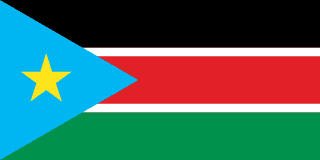
South Sudan
Republic of South Sudan
Population: UN WPP 2024, revision 1, projection for 1 July 2026. Sources and methodology.
Geography and territory
South Sudan is a landlocked country at the heart of East Africa, covering 619,745 square kilometers, making it the world’s forty-second largest nation. It borders six countries: Sudan to the north, Ethiopia to the east, Kenya and Uganda to the south, the Democratic Republic of the Congo to the southwest, and the Central African Republic to the west. This central position gives it significant geostrategic weight in the Great Lakes and Horn of Africa regions.
The White Nile runs through the country from south to north as its vital artery, feeding one of the largest wetland ecosystems in the world, the Sudd. This vast swampy region, which can expand to cover more than 30,000 square kilometers during the rainy season, is one of the planet’s largest tropical wetlands and a sanctuary of global biodiversity significance. The country’s terrain is predominantly flat, covered mostly by savanna and grassland, though mountains in the south and southeast break up the topography, reaching 3,187 meters at Mount Kinyeti near the Ugandan border.
South Sudan’s climate is tropical, with a rainy season running from April to November and a dry season from December to March. Rainfall is abundant, especially in the south, where it exceeds 1,500 millimeters annually, sustaining lush vegetation of tropical forest and gallery woodland. Temperatures remain high year-round, averaging between 25 and 35 degrees Celsius. This climate supports exceptional biodiversity, including large mammal populations that undertake seasonal migrations comparable in scale to those of the Serengeti.
History
The region that is now South Sudan has been home for millennia to diverse Nilotic, Nilo-Saharan, and Bantu peoples. The Dinka, Nuer, Shilluk, Azande, and other ethnic groups developed pastoral and agricultural societies with complex social and spiritual structures. For centuries, southern Sudan remained relatively isolated from the Arab and Islamic influences that transformed the north, a divergence that would go on to shape the cultural, religious, and ethnic identity of the region and its later fate.
The nineteenth century brought the devastation of the Arab and Turco-Egyptian slave trade, which decimated entire communities and left deep scars in the collective memory of southern peoples. Anglo-Egyptian colonial rule, which administered the region as part of a unified Sudan, pursued separatist policies that sharpened north-south divisions. Sudan’s independence in 1956 brought no relief: political and economic marginalization of the south triggered two devastating civil wars, from 1955 to 1972 and from 1983 to 2005, which killed millions and displaced far more.
The 2005 Comprehensive Peace Agreement ended the second civil war and paved the way for a self-determination referendum held in January 2011, in which 98.83 percent of voters chose independence. On July 9, 2011, South Sudan became the world’s youngest country, the 193rd member of the United Nations. The euphoria of independence, however, was cut short by the outbreak of internal civil war in December 2013, fueled by ethnic and political rivalries between Dinka and Nuer leaderships, producing one of the worst humanitarian crises of the twenty-first century.
Culture and society
South Sudanese society is profoundly diverse, with more than 60 ethnic groups speaking dozens of different languages. The Dinka, the largest group, and the Nuer form the two principal communities, but groups such as the Shilluk, Azande, Bari, and Murle carry equally rich and distinct cultural identities. English is the official language, a legacy of British colonial rule, but Juba Arabic, a pidgin Arabic developed in the capital, serves as a lingua franca in urban settings, while indigenous languages predominate in rural areas.
Cattle herding is far more than an economic activity for the Nilotic peoples of South Sudan: cattle occupy a central place in worldview, identity, and social relationships. The Dinka and Nuer measure wealth in head of cattle, pay bride price in livestock, and observe sacred rituals tied to their herds. The distinctive scarification marks on the foreheads of Dinka and Nuer men, made during initiation into adulthood, symbolize cattle horns and represent a deep spiritual bond with these animals.
Music and dance are essential expressions of South Sudanese cultural identity. Each ethnic group maintains its own musical traditions, performed with drums, lyres, flutes, and choral singing that accompany initiation ceremonies, weddings, funerals, and seasonal festivals. Traditional wrestling is a widely popular sport, especially among young Dinka and Nuer men, and functions as both a form of dispute resolution and a demonstration of courage. Despite the conflicts that have afflicted the country, South Sudanese communities maintain extraordinary resilience and a deeply rooted sense of collective solidarity.
Economy
South Sudan’s economy depends overwhelmingly on oil, which generates more than 90 percent of government revenue and nearly all of the country’s exports. The country holds the third-largest oil reserves in sub-Saharan Africa, concentrated mainly in Unity and Upper Nile states near the border with Sudan. This extreme dependence on a single resource, however, has created a fragile economy vulnerable to swings in international crude prices, and oil revenues have failed to translate into meaningful improvements for the broader population.
Subsistence farming employs the majority of the population, but production falls short of feeding the country despite some of the most fertile soils in Africa. Armed conflict, mass displacement, and lack of infrastructure have devastated the agricultural sector. Main crops include sorghum, millet, maize, sesame, and groundnut. Livestock, especially cattle, is essential to rural communities, and South Sudan holds one of the largest cattle herds in East Africa.
South Sudan faces economic challenges of staggering proportions. The civil war that erupted in 2013 destroyed much of the country’s already fragile infrastructure, drove runaway inflation, and pushed millions into food insecurity. Paved roads are extremely scarce, access to electricity and clean water is severely limited, and the banking system remains rudimentary. International humanitarian aid provides a vital lifeline for millions of South Sudanese, as the country tries to advance a fragile peace process that could lay the groundwork for economic development.
Food and cuisine
South Sudanese cuisine reflects the pastoral and agricultural traditions of its diverse peoples, built on a simple but nourishing diet of grains, legumes, meat, and dairy products. Asida, a stiff dough made from sorghum or wheat flour cooked in water into a thick paste, is the essential staple food. It is molded into a mound on a plate and served with meat stews, vegetables, or peanut sauces, always eaten with the right hand.
Beef, goat, and chicken are typically prepared stewed with tomato, onion, and local spices, or grilled over open flame. Kisra, thin, fermented sorghum flatbreads, are another staple South Sudan shares with its northern neighbor. Legumes, especially beans and lentils, provide essential protein in the everyday diet. Near rivers, fresh fish from the White Nile and its tributaries supplements the diet, prepared grilled or in spiced broths.
Dairy products hold a prominent place in the diet of pastoral peoples. Fresh cow’s milk is widely consumed, and fermented milk is a refreshing and nutritious drink much appreciated across communities. Tea, usually black and heavily sweetened, is the essential social drink shared at family and community gatherings. Sorghum beer, brewed traditionally through fermentation, is a ceremonial drink present at celebrations and rituals. Mangoes, papayas, and other tropical fruits are eaten fresh during the rainy season, adding variety to a diet built predominantly on grains.
Tourism and landmarks
Despite the security challenges that severely limit tourism, South Sudan possesses natural heritage of extraordinary value. Boma National Park, in the far east of the country, is home to one of the most spectacular and least-known mammal migrations in the world. Millions of white-eared kob, tiang, and other antelope species undertake seasonal movements that rival in scale the famous Serengeti migration, a natural phenomenon scientists have called Africa’s second great migration.
The Sudd, the immense swampland fed by the White Nile, is a unique ecosystem of global significance. This labyrinth of channels, lagoons, and papyrus reeds is home to hippos, crocodiles, numerous antelope species, and remarkable birdlife, including the rare shoebill stork. Communities living along the margins of the Sudd have for centuries developed ways of life adapted to this amphibious environment, building villages on natural rises and moving between channels by canoe.
Juba, the capital, is a vibrant city that has grown exponentially since independence. The Independence Monument and the Mausoleum of John Garang, the historic leader of the independence movement, are significant landmarks. The White Nile, flowing majestically alongside the city, offers spectacular sunsets. The Imatong Mountains, in the far south near the Ugandan border, hold South Sudan’s highest point and mountain forests of great biological richness, largely unexplored by tourism.
Fun facts about South Sudan
- South Sudan is the world’s youngest country, having declared independence on July 9, 2011
- The 2011 independence referendum returned a 98.83 percent vote in favor, one of the most decisive results in the history of self-determination votes
- The Sudd is one of the largest wetlands in the world and can expand to cover an area comparable in size to Belgium
- The mammal migration in Boma National Park is estimated at several million animals, comparable in scale to that of the Serengeti
- For the Dinka and Nuer peoples, cattle hold such cultural importance that people are often given names related to the color and features of their cows
- South Sudan is home to more than 60 distinct ethnic groups within a relatively compact territory
South Sudan in numbers
Latest World Bank and UNDP observations, each with its own year. “World median” is the middle value among the countries that report the same indicator; “#” ranks from the highest value.
Population since 1960
South Sudan had 2.9 million people in 1960 and 12.2 million in 2025 — 4.2 times as many.
People
21.7% of people live in towns and cities (world median 63.4%). 38.0% are under 15 and 3.1% are 65 or older — a young population. Women have 3.79 children on average, above the replacement level of about 2.1.
Economy
The economy shrank by 10.8% in real terms in 2015. Consumer prices rose by 91.4% in 2024 — very high inflation. Services make up the largest share of output (56.6% of GDP); agriculture contributes 10.4%.
Development and environment
UNDP rates human development in South Sudan as low, with an index of 0.388 in 2023 (rank 193 of 193). 6.7% of people use the internet and 5.4% have access to electricity. Forest covers 11.3% of the land (world median 32.8%).
Sources: World Bank, World Development Indicators (CC BY 4.0), most recent observation from 2015 onward; UNDP Human Development Report 2025. Retrieved 2026-10-10. Sector shares need not add up to 100% because taxes and subsidies on products are excluded. Missing values are left blank rather than estimated. Sources and methodology.
Climate of South Sudan
Averaged across South Sudan, the warmest month is March (30.5 °C) and the coolest is August (26.3 °C), a seasonal swing of 4.2 °C. The annual mean is 28.0 °C.
About 995 mm of precipitation falls in a typical year. August is the wettest month (186 mm) and January the driest (3 mm). The three wettest consecutive months, July to September, bring 50% of the year's total — a pronounced rainy season.
Show monthly values as a table
| Month | Mean °C | Low °C | High °C | Precipitation, mm |
|---|---|---|---|---|
| January | 27.2 | 18.7 | 35.7 | 3 |
| February | 29.2 | 20.7 | 37.7 | 6 |
| March | 30.5 | 22.9 | 38.2 | 26 |
| April | 30.5 | 23.8 | 37.4 | 70 |
| May | 29.3 | 23.4 | 35.2 | 117 |
| June | 27.5 | 22.1 | 32.9 | 139 |
| July | 26.6 | 21.7 | 31.5 | 169 |
| August | 26.3 | 21.4 | 31.3 | 186 |
| September | 27.0 | 21.5 | 32.4 | 143 |
| October | 27.7 | 21.5 | 33.8 | 105 |
| November | 27.8 | 20.5 | 35.1 | 25 |
| December | 26.9 | 18.6 | 35.2 | 6 |
Figures are 1991–2020 averages across the whole land area of South Sudan, from the World Bank Climate Change Knowledge Portal, CRU TS 4.08 (CC BY 4.0). They are not readings from one weather station: the capital, the coast and high ground can be much warmer, cooler, wetter or drier.
Travel essentials for South Sudan
The practical details visitors ask about first. Traffic in South Sudan drives on the right, like most of the world. Mains electricity is 230 V at 50 Hz, so devices made only for 110–120 V (common in North America) need a converter unless they are dual-voltage — most phone and laptop chargers are.
- Emergency number
- 999
- Driving side
- Right
- Plug types
- Type C, Type DC: two round pins (Europlug); D: three large round pins in a triangle
- Voltage
- 230 V50 Hz
- Dialling code
- +211From abroad: your exit code, then 211 and the number
- Currency
- South Sudanese Pound (SSP)
- Time zone
- CAT (UTC+3)Current local time in South Sudan
Compiled from IEC plug and voltage standards, national emergency-service listings and the UN road-traffic conventions. Emergency numbers and local coverage can change — confirm them locally on arrival. South Sudan's internet domain is .ss.
Where South Sudan ranks in the world
Each position counts only the countries with data in that ranking guide. First place is the highest value — for price levels, the most expensive. Select a card to see the full table.
Bordering countries of South Sudan


Compare South Sudan with another country
Frequently asked questions about South Sudan
What is the capital of South Sudan?
The capital of South Sudan is Juba.
What is the population of South Sudan?
The UN World Population Prospects projection for South Sudan is 12,436,037 people (12.4 million) on 1 July 2026. National statistical offices may publish different estimates.
What language is spoken in South Sudan?
The official language of South Sudan is English.
What currency is used in South Sudan?
The currency of South Sudan is the South Sudanese Pound (SSP).
How big is South Sudan?
South Sudan covers an area of 619,745 km².
What type of government does South Sudan have?
South Sudan is a presidential republic.
Which countries border South Sudan?
South Sudan shares land borders with Sudan, Ethiopia, Kenya, Uganda, Democratic Republic of the Congo, Central African Republic.
What is the highest point in South Sudan?
The highest point in South Sudan is Mount Kinyeti (3,187 m).


