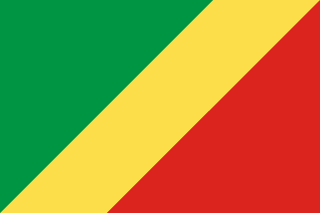
Republic of the Congo
Republic of the Congo
Population: UN WPP 2024, revision 1, projection for 1 July 2026. Sources and methodology.
Geography and territory
The Republic of the Congo, often called Congo-Brazzaville to distinguish it from its much larger neighbor the Democratic Republic of the Congo, covers 342,000 square kilometers in west-central Africa and is home to about 6.6 million people. The country straddles the equator and holds a modest Atlantic coastline of roughly 170 kilometers in the southwest, while its eastern border traces the Congo and Ubangi Rivers. Its capital, Brazzaville, sits directly across the Congo River from Kinshasa, making these the only two national capitals on Earth positioned face to face along the same waterway.
The Congolese landscape shifts dramatically from coast to interior. A narrow, hot coastal plain gives way to the Mayombe massif, a mountain chain draped in dense tropical forest, before opening onto the Niari Valley, a fertile lowland that serves as the country’s agricultural heartland. Farther north, the land flattens into the immense Congo River basin, one of the largest and least disturbed expanses of tropical rainforest left on the planet, stretching unbroken for hundreds of kilometers.
An equatorial and tropical climate governs most of the country, with average temperatures around 25 degrees Celsius and heavy rainfall exceeding 1,600 millimeters a year across much of the territory. The wet season runs from October to May, interrupted only by a short dry spell in January and February. Rainforest covers roughly 65 percent of the national territory, making the Republic of the Congo one of the planet’s great carbon reservoirs and a refuge for extraordinary wildlife, including western lowland gorillas, chimpanzees, forest elephants, and okapi.
History
Long before Bantu-speaking peoples migrated into the region from the northwest over two millennia, the territory that is now the Republic of the Congo was home to Pygmy communities. From the fourteenth century onward, the Kingdom of Kongo, one of precolonial Africa’s most formidable states, extended its authority over the southern part of the country, while the Teke and Loango kingdoms controlled the interior and coast respectively, sustaining trade networks that linked the African interior to the Atlantic seaboard.
European involvement intensified in the nineteenth century when the explorer Pierre Savorgnan de Brazza charted the Congo River. His expeditions in the 1880s produced treaties with local rulers and cemented French control over the river’s right bank. Brazzaville, founded in 1880 and named for the explorer, became the capital of French Equatorial Africa and later played a pivotal wartime role: from 1940 to 1943 it served as the capital of Free France under General Charles de Gaulle.
Independence arrived on August 15, 1960, under President Fulbert Youlou, a former Catholic priest. The postcolonial decades brought a Marxist-Leninist government between 1969 and 1991, when the country was officially known as the People’s Republic of the Congo. The democratic opening of the early 1990s gave way to a brutal civil war from 1997 to 1999 that devastated Brazzaville. Since then, under President Denis Sassou-Nguesso, the country has enjoyed relative stability underwritten by oil revenue, though governance and economic diversification remain persistent challenges.
Culture and society
Congolese society is woven from numerous ethnic groups, most prominently the Kongo in the south, the Teke in the center, the Mbochi in the north, and Pygmy communities in the northern forests. French serves as the official language, while Lingala and Kituba function as widely spoken linguae francae that bridge these communities. Oral tradition, expressed through storytelling, proverbs, and genealogies, remains a vital thread of cultural transmission, particularly in rural areas.
The country has made an outsized contribution to African music through Congolese rumba, a genre born in the 1940s in Brazzaville and Kinshasa that blended African rhythms with Cuban influences and became the continent’s most beloved popular music for decades. Brazzaville’s sapeurs, members of the Society of Ambianceurs and Elegant People (SAPE), have turned sharp dressing into both an art form and a philosophy of life, parading in couture suits through the dusty streets of working-class neighborhoods.
Congolese literature has produced internationally celebrated voices such as Alain Mabanckou, whose novels have been translated into dozens of languages and earned him a chair at the Collège de France, and Sony Labou Tansi, a playwright and novelist widely regarded as one of the great innovators of Francophone African literature. In the visual arts, the Poto-Poto painting school, founded in Brazzaville in 1951, developed a vivid, figurative style that has shaped art across Central Africa.
Economy
Oil dominates the Congolese economy, accounting for roughly 60 percent of GDP and more than 80 percent of export earnings. The country ranks as the fourth-largest oil producer in sub-Saharan Africa, with onshore fields and deepwater Atlantic reserves developed by international companies such as TotalEnergies and Eni. That dependence on crude, however, has left the economy exposed to swings in world prices and produced a familiar paradox: extractive wealth existing alongside widespread poverty.
Forestry ranks as the second pillar of the economy. The country holds one of Africa’s largest expanses of tropical forest, supplying prized hardwoods such as okoume, sapele, and mahogany for export, mainly to Asian and European markets. Agriculture, while employing a significant share of the population, contributes only modestly to GDP, centered on cassava, plantain, groundnuts, and sugarcane grown largely for domestic consumption.
The government has pursued ambitious diversification programs, channeling oil revenue into roads, ports, and special economic zones. Substantial potash reserves in the south and bauxite deposits offer avenues for mining diversification, while Brazzaville’s position as a gateway to the wider Congo Basin and the port of Pointe-Noire, the country’s principal harbor, provide logistical advantages for regional trade. Public debt, corruption, and limited transparency in the management of natural resources nonetheless remain significant obstacles to broader development.
Food and cuisine
Cassava forms the backbone of Congolese cooking, prepared in countless ways as the everyday staple. Chikwangue, fermented cassava steamed and wrapped in banana leaves, accompanies nearly every meal, while foufou, a thick, elastic cassava paste, is served alongside sauces built from leafy greens, meat, or fish. The sheer variety of dishes built around this single tuber speaks to the ingenuity of Congolese home cooking.
Poisson salé, salted and dried fish worked into sauces and stews, and saka-saka, pounded cassava leaves slow-cooked in palm oil, rank among the country’s signature dishes. Poulet moambé, chicken simmered in a rich palm-nut sauce, is widely considered the national dish and takes pride of place at festive occasions. Charcoal-grilled meat and fish skewers sold at Brazzaville’s street markets deliver bold, unmistakably African flavors.
Ingredients drawn from the surrounding rainforest add further depth: wild mushrooms, gnetum leaves known locally as koko, kola nuts, and tropical fruits such as safou, the African plum, all lend distinctive textures and tastes. Corn or millet beer, distilled into a stronger spirit called lotoko, is the traditional alcoholic drink, while palm wine tapped fresh from raffia palms is enjoyed as a natural refreshment. Peeled sugarcane, chewed for its sweet juice, is the most popular snack among Congolese youth.
Tourism and landmarks
Odzala-Kokoua National Park, tucked deep in the northern rainforest, is the crown jewel of Congolese ecotourism and one of Africa’s oldest national parks, established in 1935. Spanning more than 13,600 square kilometers of pristine forest, it shelters one of the largest populations of western lowland gorillas anywhere in the world, alongside chimpanzees, forest elephants, bongo antelope, and remarkable birdlife. Guided walking safaris led by local trackers offer visitors intimate encounters with great apes in their natural habitat.
Brazzaville delivers a lively urban counterpoint, anchored by its Total Market, one of Central Africa’s busiest, trading in fresh produce, fabrics, crafts, and goods of every description. The Basilica of Saint Anne, the Nabemba Tower, and the Pierre Savorgnan de Brazza Memorial, a marble mausoleum housing the explorer’s remains, are among the city’s architectural landmarks. The bars and live-music clubs of the Poto-Poto and Bacongo neighborhoods keep the tradition of Congolese rumba alive night after night.
Pointe-Noire, the country’s economic capital and second city, offers Atlantic beaches such as the Côte Sauvage, colorful markets, and a cosmopolitan energy fueled by the oil industry. Nearby, Conkouati-Douli National Park combines rainforest, lagoons, mangroves, and beaches where sea turtles nest between November and March. The Djoué Rapids near Brazzaville and Lake Télé, shrouded in legends of the mokele-mbembe, a mysterious dinosaur-like creature said to lurk in its waters, draw the more adventurous travelers.
Fun facts about Republic of the Congo
- Brazzaville and Kinshasa are the two closest national capitals on Earth, separated by just 1.6 kilometers of the Congo River, yet no bridge connects them, so travelers cross by ferry.
- During World War II, Brazzaville served as the capital of Free France under General de Gaulle, coordinating resistance efforts against Nazi-occupied France.
- Congolese sapeurs sometimes spend the equivalent of several months’ salary on a single designer suit, turning elegance into both a statement of dignity and a quiet protest against poverty.
- Lake Télé, deep in the northern forests, is famous for legends of the mokele-mbembe, a supposed dinosaur-like creature said by local tradition to inhabit its waters.
- The country holds a share of the world’s second-largest tropical rainforest after the Amazon, a vast carbon sink that helps regulate the planet’s climate.
- The Poto-Poto painting school, founded in Brazzaville in 1951, was one of Africa’s first modern art schools and continues to train artists whose work is exhibited in galleries worldwide.
The Republic of the Congo in numbers
Latest World Bank and UNDP observations, each with its own year. “World median” is the middle value among the countries that report the same indicator; “#” ranks from the highest value.
Population since 1960
The Republic of the Congo had 1.1 million people in 1960 and 6.5 million in 2025 — 6.1 times as many.
People
64.1% of people live in towns and cities (world median 63.4%). 39.9% are under 15 and 3.1% are 65 or older — a young population. Women have 4.11 children on average, above the replacement level of about 2.1.
Economy
The economy grew by 3.1% in real terms in 2025. Consumer prices rose by 2.4% in 2025. Services make up the largest share of output (54.3% of GDP); agriculture contributes 10.1%.
Development and environment
UNDP rates human development in the Republic of the Congo as medium, with an index of 0.649 in 2023 (rank 138 of 193). 47.3% of people use the internet and 53.0% have access to electricity. Forest covers 64.0% of the land (world median 32.8%).
Sources: World Bank, World Development Indicators (CC BY 4.0), most recent observation from 2015 onward; UNDP Human Development Report 2025. Retrieved 2026-10-10. Sector shares need not add up to 100% because taxes and subsidies on products are excluded. Missing values are left blank rather than estimated. Sources and methodology.
Climate of the Republic of the Congo
Averaged across the Republic of the Congo, the mean temperature stays between 23.6 °C (July) and 25.8 °C (March) — a swing of only 2.2 °C, so seasons are marked by rainfall rather than by heat.
About 1,635 mm of precipitation falls in a typical year. November is the wettest month (210 mm) and July the driest (51 mm).
Show monthly values as a table
| Month | Mean °C | Low °C | High °C | Precipitation, mm |
|---|---|---|---|---|
| January | 25.0 | 20.2 | 29.8 | 111 |
| February | 25.5 | 20.5 | 30.5 | 125 |
| March | 25.8 | 20.8 | 30.8 | 167 |
| April | 25.7 | 21.0 | 30.5 | 178 |
| May | 25.4 | 21.0 | 29.9 | 159 |
| June | 24.1 | 19.8 | 28.5 | 70 |
| July | 23.6 | 19.4 | 27.9 | 51 |
| August | 23.7 | 19.5 | 28.0 | 72 |
| September | 24.3 | 19.9 | 28.7 | 131 |
| October | 24.5 | 20.2 | 28.9 | 205 |
| November | 24.6 | 20.2 | 29.0 | 210 |
| December | 24.7 | 20.4 | 29.1 | 157 |
Figures are 1991–2020 averages across the whole land area of the Republic of the Congo, from the World Bank Climate Change Knowledge Portal, CRU TS 4.08 (CC BY 4.0). They are not readings from one weather station: the capital, the coast and high ground can be much warmer, cooler, wetter or drier.
Travel essentials for the Republic of the Congo
The practical details visitors ask about first. Traffic in the Republic of the Congo drives on the right, like most of the world. Mains electricity is 230 V at 50 Hz, so devices made only for 110–120 V (common in North America) need a converter unless they are dual-voltage — most phone and laptop chargers are.
- Emergency number
- 117
- Driving side
- Right
- Plug types
- Type C, Type EC: two round pins (Europlug); E: two round pins, earth pin in the socket
- Voltage
- 230 V50 Hz
- Dialling code
- +242From abroad: your exit code, then 242 and the number
- Currency
- Central African CFA Franc (XAF)
- Time zone
- WAT (UTC+1)Current local time in the Republic of the Congo
Compiled from IEC plug and voltage standards, national emergency-service listings and the UN road-traffic conventions. Emergency numbers and local coverage can change — confirm them locally on arrival. The Republic of the Congo's internet domain is .cg.
Where the Republic of the Congo ranks in the world
Each position counts only the countries with data in that ranking guide. First place is the highest value — for price levels, the most expensive. Select a card to see the full table.
- Population111th of 1966.6 millionUN projection, July 2026
- Land area64th of 195341,500 km²World Bank, 2023
- Population density171st of 19418 per km²World Bank, 2023
- GDP (nominal)137th of 187$15.7BWorld Bank, 2024, current US$
- GDP per capita146th of 187$2,482World Bank, 2024, current US$
- Life expectancy165th of 19466.0 yearsWorld Bank, 2024
- Price level96th of 16544 (US = 100)ICP 2021, household consumption
Bordering countries of the Republic of the Congo


Compare the Republic of the Congo with another country
Frequently asked questions about the Republic of the Congo
What is the capital of the Republic of the Congo?
The capital of the Republic of the Congo is Brazzaville.
What is the population of the Republic of the Congo?
The UN World Population Prospects projection for the Republic of the Congo is 6,637,785 people (6.6 million) on 1 July 2026. National statistical offices may publish different estimates.
What language is spoken in the Republic of the Congo?
The official language of the Republic of the Congo is French.
What currency is used in the Republic of the Congo?
The currency of the Republic of the Congo is the Central African CFA Franc (XAF).
How big is the Republic of the Congo?
The Republic of the Congo covers an area of 342,000 km².
What type of government does the Republic of the Congo have?
The Republic of the Congo is a presidential republic.
Which countries border the Republic of the Congo?
The Republic of the Congo shares land borders with Cameroon, Central African Republic, Democratic Republic of the Congo, Angola, Gabon.
What is the highest point in the Republic of the Congo?
The highest point in the Republic of the Congo is Mont Nabemba (1,020 m).


