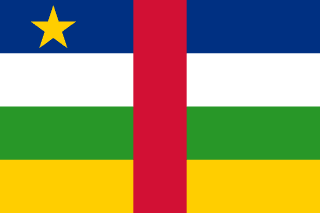
Central African Republic
Central African Republic
Population: UN WPP 2024, revision 1, projection for 1 July 2026. Sources and methodology.
Geography and territory
Landlocked at the very heart of Africa, the Central African Republic covers 622,984 square kilometers between the Lake Chad basin to the north and the Congo River basin to the south. The country shares borders with six neighbors — Chad, Sudan, South Sudan, the Democratic Republic of the Congo, the Republic of the Congo, and Cameroon — and its terrain forms a gradual ecological bridge between the dry Sahel and the humid equatorial forest, running from arid plateaus in the north down through rolling savanna to dense tropical woodland in the south.
Much of the country sits on a central plateau rising between 600 and 900 meters, bordered by mountain ranges in the northeast and northwest. Mont Ngaoui, at 1,410 meters near the Cameroonian border, is the highest point in the country. Two river systems define the landscape: the Ubangi and Sangha rivers, both major tributaries of the Congo, drain the southern half of the territory, while the Chari River and its tributaries flow northward toward Lake Chad. For generations these waterways have served as the principal routes for trade and travel in a nation with no coastline of its own.
The climate is tropical throughout, with a wet season running from May to October and a dry season from November to April. Rainfall increases steadily from north to south, ranging from roughly 800 millimeters a year near the Sahel to more than 1,800 millimeters in the equatorial forests of the southwest. That climatic gradient supports a remarkable range of ecosystems and wildlife, including forest elephants, western lowland gorillas, bongo antelope, and numerous primate species concentrated in the southern rainforest belt.
History
Human presence in this part of Central Africa dates back to prehistoric times, as confirmed by archaeological sites scattered across the country. Over the centuries the region was home to Pygmy hunter-gatherer communities — among the oldest inhabitants of the equatorial forest — alongside successive waves of Bantu- and Sudanic-speaking peoples who built their own kingdoms and chiefdoms. Groups such as the Gbaya, Banda, Mandja, and Zande developed distinct societies with their own systems of governance and cultural traditions.
The region suffered greatly during the eighteenth and nineteenth centuries from slave-raiding expeditions launched from the north and east, which decimated local populations and unraveled existing social structures. French colonization arrived in the late nineteenth century, and the territory was folded into French Equatorial Africa under the name Ubangi-Shari. The colonial period was marked by ruthless exploitation of natural resources, particularly rubber and ivory, through a concession system that subjected local people to forced labor.
Independence came on August 13, 1960, under President David Dacko, but the postcolonial era proved turbulent. Jean-Bédel Bokassa seized power in 1966 and crowned himself emperor in 1977 in a lavish ceremony that consumed a third of the national budget. Since his overthrow in 1979, the country has weathered repeated coups, rebellions, and armed conflict, culminating in the 2013 crisis, when fighting between Séléka and anti-balaka militias plunged the nation into one of Africa’s worst humanitarian emergencies of recent decades.
Culture and society
The Central African Republic is home to a striking degree of cultural diversity, with more than 80 ethnic groups sharing the territory. Sango, a creole language rooted in Ngbandi, functions as a lingua franca and a genuine symbol of national identity that cuts across ethnic lines — one of the few instances in Africa where an indigenous language enjoys truly widespread use alongside the former colonial tongue, French. This shared language has done much to hold the country together through decades marked by division and conflict.
Music and dance sit at the center of social life, with traditions that vary from one ethnic group to another but share a common rhythmic intensity and a deep connection to the spiritual world. Traditional instruments such as the balafon (a wooden xylophone), the ngombi harp, drums, and marimbas accompany ceremonies, festivals, and rites of passage. The Aka Pygmies of the southwest are internationally recognized for their vocal polyphony, a collective singing tradition of extraordinary complexity that has been recognized as part of humanity’s intangible cultural heritage.
Craftsmanship in the Central African Republic spans woodcarving, basketry, crocodile-hide work, and the making of musical instruments. The country’s exceptional butterfly diversity, with more than 600 recorded species, has even given rise to a distinctive local art form: framed pictures and decorative pieces assembled from butterfly wings, sold as souvenirs. Oral tradition — folktales, proverbs, and legends passed down through generations — remains the principal vehicle for cultural transmission and education in rural communities.
Economy
The economy of the Central African Republic is among the most fragile on the continent, battered by decades of political instability, armed conflict, and geographic isolation. Subsistence farming employs most of the population, producing cassava, millet, corn, groundnuts, and bananas, though output generally falls short of covering the country’s food needs. Cash crops such as cotton, coffee, and tobacco, once pillars of the colonial economy, have declined sharply because of conflict and crumbling infrastructure.
Diamond mining is the country’s leading export earner, drawing on alluvial deposits scattered across several regions. The Central African Republic was one of the first places in Africa where diamonds were discovered, back in 1910, and it continues to produce gem-quality stones prized on international markets — though a substantial share of production slips out of state control through smuggling. Gold, tropical timber, and uranium represent other natural resources with significant economic potential that remains largely untapped.
Extensive cattle herding, carried out mainly by Mbororo Fulani pastoralists across the northern savannas, forms another important economic activity, while the forestry sector harvests valuable hardwoods from the southern rainforests, even as illegal logging and weak resource management threaten this asset. The country’s lack of coastline and its poor transport infrastructure drive up the cost of both imports and exports dramatically, standing as one of the single greatest obstacles to broader economic development, with a gross domestic product of roughly $3.1 billion.
Food and cuisine
Central African cuisine is built around staple crops such as cassava, plantain, millet, and groundnuts, prepared with techniques passed down through generations. Cassava is the true dietary backbone, eaten as gozo (a thick paste made from fermented cassava flour), chikwangue (cassava wrapped in banana leaves and steamed), or simply boiled and served alongside a range of savory sauces made from leafy greens, oilseeds, and, when available, meat or fish.
Cassava-leaf sauce, known as ngbako, ranks among the country’s signature dishes, made by slow-cooking pounded leaves with palm oil and ground peanuts. Kanda — balls of seasoned minced meat wrapped in leaves and steamed — is reserved for festive occasions. Bushmeat, including antelope, wild boar, and monkey, has traditionally featured in the diet, particularly in rural areas near the forest, although its consumption today raises real conservation concerns.
Caterpillars, gathered from trees during the rainy season, are an important source of protein and are considered a delicacy, typically fried, smoked, or simmered in sauce; their distinctive flavor is appreciated across much of Central Africa. Mugunza, a fermented corn beverage, and traditional mead accompany meals and celebrations, while edible insects, wild forest fruits, and honey gathered from wild hives round out a diet that reflects the deep connection between Central African communities and their natural surroundings.
Tourism and landmarks
Dzanga-Sangha National Park, tucked into the far southwestern corner of the country, is the crown jewel of Central African nature and one of the most extraordinary ecotourism destinations anywhere in Africa. This rainforest sanctuary harbors one of the largest concentrations of western lowland gorillas on Earth, along with forest elephants that gather at the mineral-rich forest clearing known as Dzanga Bai, offering visitors rare and unforgettable wildlife encounters. The Ba’Aka Pygmies, the forest’s ancestral inhabitants, guide travelers through the reserve and share their encyclopedic knowledge of its ecosystems.
The Boali Falls, roughly 100 kilometers northwest of Bangui, rank as the country’s most accessible natural landmark. Spanning 250 meters in width with a drop of about 50 meters, the falls tumble over the Mbali River in a spectacular display, especially during the rainy season. The surrounding gallery forest and natural pools make the area a popular day-trip destination for residents of the capital.
Bangui itself stretches along the banks of the Ubangi River and offers several points of interest, including the Boganda Museum, dedicated to the country’s history and cultures, the Central Market, and Notre-Dame Cathedral. Emperor’s Rock, a natural overlook above the river, offers sweeping views of the city and of the Democratic Republic of the Congo on the opposite bank. Despite the country’s considerable tourism potential, insecurity across large parts of the territory has severely limited the sector’s growth, which today remains concentrated around Dzanga-Sangha and the capital’s immediate surroundings.
Fun facts about Central African Republic
- Jean-Bédel Bokassa crowned himself emperor of the “Central African Empire” in 1977 in a ceremony that cost roughly a third of the national budget and included a gold crown set with thousands of diamonds.
- The Aka Pygmies of the southwest practice a form of vocal polyphony so intricate that ethnomusicologists have compared it to the compositions of Bach.
- With minimal artificial lighting across most of its territory, the country offers some of the clearest, darkest night skies in the world for stargazing.
- Sango, the national language, is one of the few African creole languages to become the official language of a sovereign nation.
- Dzanga Bai, a large forest clearing in Dzanga-Sangha National Park, is nicknamed the “village of elephants” because dozens of forest elephants gather there at once to lick mineral-rich soil.
- Despite decades of hardship, the country retains some of the richest biodiversity in Africa, including species found nowhere else on Earth.
The Central African Republic in numbers
Latest World Bank and UNDP observations, each with its own year. “World median” is the middle value among the countries that report the same indicator; “#” ranks from the highest value.
Population since 1960
The Central African Republic had 1.7 million people in 1960 and 5.5 million in 2025 — 3.2 times as many.
People
44.6% of people live in towns and cities (world median 63.4%). 48.7% are under 15 and 2.2% are 65 or older — a very young population. Women have 5.95 children on average, above the replacement level of about 2.1.
Economy
The economy grew by 4.5% in real terms in 2025. Consumer prices rose by 1.0% in 2025. Services make up the largest share of output (41.4% of GDP); agriculture contributes 27.6%, a large share that points to a farming-based economy.
Development and environment
UNDP rates human development in the Central African Republic as low, with an index of 0.414 in 2023 (rank 191 of 193). 13.8% of people use the internet and 18.2% have access to electricity. Forest covers 72.5% of the land (world median 32.8%).
Sources: World Bank, World Development Indicators (CC BY 4.0), most recent observation from 2015 onward; UNDP Human Development Report 2025. Retrieved 2026-10-10. Sector shares need not add up to 100% because taxes and subsidies on products are excluded. Missing values are left blank rather than estimated. Sources and methodology.
Climate of the Central African Republic
Averaged across the Central African Republic, the mean temperature stays between 24.2 °C (August) and 27.7 °C (March) — a swing of only 3.5 °C, so seasons are marked by rainfall rather than by heat.
About 1,375 mm of precipitation falls in a typical year. August is the wettest month (237 mm) and January the driest (7 mm). The wettest stretch is July to September, with 48% of the year's total.
Show monthly values as a table
| Month | Mean °C | Low °C | High °C | Precipitation, mm |
|---|---|---|---|---|
| January | 24.6 | 16.0 | 33.2 | 7 |
| February | 26.7 | 18.5 | 34.9 | 14 |
| March | 27.7 | 20.4 | 35.1 | 55 |
| April | 27.4 | 21.5 | 33.4 | 99 |
| May | 26.5 | 21.0 | 32.0 | 148 |
| June | 25.2 | 20.3 | 30.2 | 167 |
| July | 24.5 | 19.9 | 29.0 | 203 |
| August | 24.2 | 19.6 | 28.9 | 237 |
| September | 24.4 | 19.4 | 29.5 | 220 |
| October | 24.8 | 19.3 | 30.4 | 183 |
| November | 25.0 | 17.5 | 32.5 | 37 |
| December | 24.3 | 16.2 | 32.6 | 7 |
Figures are 1991–2020 averages across the whole land area of the Central African Republic, from the World Bank Climate Change Knowledge Portal, CRU TS 4.08 (CC BY 4.0). They are not readings from one weather station: the capital, the coast and high ground can be much warmer, cooler, wetter or drier.
Travel essentials for the Central African Republic
The practical details visitors ask about first. Traffic in the Central African Republic drives on the right, like most of the world. Mains electricity is 220 V at 50 Hz, so devices made only for 110–120 V (common in North America) need a converter unless they are dual-voltage — most phone and laptop chargers are.
- Emergency number
- 117
- Driving side
- Right
- Plug types
- Type C, Type EC: two round pins (Europlug); E: two round pins, earth pin in the socket
- Voltage
- 220 V50 Hz
- Dialling code
- +236From abroad: your exit code, then 236 and the number
- Currency
- Central African CFA Franc (XAF)
- Time zone
- WAT (UTC+1)Current local time in the Central African Republic
Compiled from IEC plug and voltage standards, national emergency-service listings and the UN road-traffic conventions. Emergency numbers and local coverage can change — confirm them locally on arrival. The Central African Republic's internet domain is .cf.
Where the Central African Republic ranks in the world
Each position counts only the countries with data in that ranking guide. First place is the highest value — for price levels, the most expensive. Select a card to see the full table.
- Population117th of 1965.7 millionUN projection, July 2026
- Land area43rd of 195622,980 km²World Bank, 2023
- Population density183rd of 1948.3 per km²World Bank, 2023
- GDP (nominal)163rd of 187$2.8BWorld Bank, 2024, current US$
- GDP per capita185th of 187$516World Bank, 2024, current US$
- Life expectancy192nd of 19457.7 yearsWorld Bank, 2024
- Price level70th of 16550 (US = 100)ICP 2021, household consumption
Bordering countries of the Central African Republic


Compare the Central African Republic with another country
Frequently asked questions about the Central African Republic
What is the capital of the Central African Republic?
The capital of the Central African Republic is Bangui.
What is the population of the Central African Republic?
The UN World Population Prospects projection for the Central African Republic is 5,698,984 people (5.7 million) on 1 July 2026. National statistical offices may publish different estimates.
What language is spoken in the Central African Republic?
The official language of the Central African Republic is French and Sango.
What currency is used in the Central African Republic?
The currency of the Central African Republic is the Central African CFA Franc (XAF).
How big is the Central African Republic?
The Central African Republic covers an area of 622,984 km².
What type of government does the Central African Republic have?
The Central African Republic is a presidential republic.
Which countries border the Central African Republic?
The Central African Republic shares land borders with Chad, Sudan, South Sudan, Democratic Republic of the Congo, Republic of the Congo, Cameroon.
What is the highest point in the Central African Republic?
The highest point in the Central African Republic is Mont Ngaoui (1,410 m).


