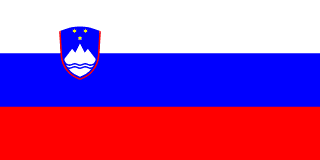
Slovenia
Republic of Slovenia
Population: UN WPP 2024, revision 1, projection for 1 July 2026. Sources and methodology.
Geography and territory
Slovenia is a small Central European country of 20,273 square kilometers that packs an astonishing range of landscapes into a compact footprint. Positioned where the Alps, the Mediterranean, the Pannonian plain, and the Dinaric karst world all meet, Slovenia is a true mosaic of terrain. To the northwest rise the Julian Alps, with Mount Triglav, at 2,864 meters, as the country’s highest peak and a national symbol that appears on both the flag and the coat of arms.
Forests cover more than 60 percent of Slovenian territory, making it the third most forested country in Europe, behind only Finland and Sweden. The Slovenian Karst region in the southwest gave its name to the karst phenomenon found worldwide, with its caves, sinkholes, and underground rivers. The Adriatic coastline, though brief at just 47 kilometers, offers a stretch of Mediterranean charm anchored by the picturesque town of Piran.
The country is rich in water, with crystal-clear rivers such as the Soča, famous for its intense emerald color, and numerous glacial lakes. Its river systems drain into the Danube, the Adriatic, and the Black Sea basins. Slovenia has one national park, Triglav, three regional parks, and numerous nature reserves, reflecting a commitment to sustainability that made it the first country in the world declared a “green destination.”
With a population of just over two million spread across its 20,273 square kilometers, Slovenia is one of the least crowded countries in Central Europe, and its compact geography means that a traveler can move from alpine peaks to Mediterranean coastline in a single day, a rare convenience that has become central to the country’s tourism identity.
History
The territory of present-day Slovenia has been inhabited since prehistoric times, with archaeological finds including a bone flute more than 50,000 years old, considered one of the oldest musical instruments in the world. Slavic ancestors of the Slovenes arrived in the region in the sixth century and established Carantania, one of the earliest Slavic states in history, whose ritual of investing rulers is said to have even influenced the drafting of the United States Constitution.
For centuries, Slovenia lay under Habsburg rule, part first of the Austrian Empire and later of Austria-Hungary. Despite pressures of Germanization, the Slovenes preserved their language and culture, in no small part thanks to figures such as the poet France Prešeren, whose poem “Zdravljica” became the national anthem. The sixteenth-century Protestant Reformation, led by Primož Trubar, proved decisive by producing the first printed books in the Slovene language.
After the First World War, Slovenia joined the Kingdom of Serbs, Croats and Slovenes, which became Yugoslavia. During the Second World War, the territory was divided among Germany, Italy, and Hungary. Under Tito’s socialist Yugoslavia, Slovenia became the most prosperous and industrialized of the republics. On June 25, 1991, it declared independence, defending it in the brief Ten-Day War. Since then, Slovenia has pursued a model course of European integration, joining NATO and the EU in 2004 and adopting the euro in 2007.
Culture and society
Slovenian culture is a unique blend of Alpine, Mediterranean, Pannonian, and Balkan influences, filtered through a strong national identity forged over centuries of cultural resistance. Literature holds a central place: France Prešeren is the national poet, and his Culture Day on February 8 is a public holiday. Ivan Cankar, regarded as Slovenia’s greatest prose writer, and the contemporary philosopher Slavoj Žižek are other figures of international standing.
Music and the performing arts flourish in Slovenia. Ljubljana is home to the Slovenian Philharmonic, one of the oldest in the world, founded in 1701. The country has produced notable classical musicians and sustains a vibrant alternative music scene, with the art collective Laibach its best-known international export. The architecture of Jože Plečnik, who reshaped Ljubljana in the twentieth century, forms a singular architectural heritage that defines the capital’s visual identity, with his bridges, colonnades, and riverside promenades still shaping how the city is experienced today.
Slovenian society is marked by a love of nature and outdoor activity. Hiking, cycling, skiing, and beekeeping are deeply rooted local pursuits. Slovenia has one of Europe’s oldest beekeeping traditions, with painted beehive panels standing as a distinctive folk art form. The country punches above its weight in sports such as ski jumping, cycling, with Tadej Pogačar and Primož Roglič as global stars, and alpine skiing.
Economy
Slovenia has one of the most developed economies in Central and Eastern Europe, with a GDP of roughly $79.65 billion and an income level approaching the European Union average. Its transition from a socialist to a market economy was one of the most successful in the region, striking a balance between economic efficiency and social cohesion.
Slovenia’s industrial sector is diversified and export-oriented, with strengths in automotive manufacturing, pharmaceuticals, appliances, and machinery and electrical equipment. Companies such as Gorenje in appliances, Krka in pharmaceuticals, and Revoz in automobiles are regional benchmarks. Services account for more than 60 percent of GDP, and tourism has grown significantly thanks to a positioning strategy built around sustainability and green credentials.
Sustainability and innovation define Slovenia’s economic outlook. The country invests in renewable energy, the circular economy, and clean technology. Sustainable tourism, marketed under the “I Feel Slovenia” brand, has proven a marketing success internationally. Organic farming and quality food production, together with a first-rate winemaking tradition, round out an economic model that seeks balance between development and the preservation of natural and cultural heritage.
Food and cuisine
Slovenian cuisine is surprisingly diverse for such a small country, a direct reflection of its position at the crossroads of four culinary worlds: Alpine, Mediterranean, Pannonian, and Balkan. Researchers have catalogued as many as 24 distinct culinary regions with more than 400 traditional dishes. Potica, a rolled bread filled with walnuts, is the country’s culinary symbol, present at every family celebration and especially on the Easter and Christmas table.
Slovenian cooking draws on influences from all its neighbors, reinterpreted with a character of its own. Jota, a bean, sauerkraut, and potato soup from the Primorska region, štruklji, rolled dumplings baked or boiled and filled with various stuffings, bograč, a Prekmurje-style goulash, žlikrofi, protected-origin ravioli from Idrija, and kraški pršut, cured ham from the Karst region, all speak to the country’s culinary richness.
Slovenian wines, though little known internationally, are of exceptional quality. The country’s three main wine regions produce both aromatic whites and full-bodied reds, and the tradition of aging wine in clay amphorae has been revived by producers in the Brda region. Honey is another emblematic product, thanks to the Carniolan bee, native to Slovenia and prized by beekeepers worldwide. Coffee and pastry culture is vibrant too, with bakeries offering everything from kremna rezina, the famous Bled cream cake, to sophisticated modern desserts.
Tourism and landmarks
Slovenia is a destination that surprises visitors with the concentration of natural and cultural beauty packed into such a small space. Lake Bled, with its island crowned by a church and a medieval castle perched on a cliff above, is one of the most iconic images in Europe. A short distance away, Lake Bohinj offers a wilder, quieter setting within Triglav National Park, a paradise for hikers and nature lovers.
Ljubljana, the capital, is one of Europe’s greenest and most pleasant cities, with a pedestrian historic center crossed by the Ljubljanica River and watched over by a medieval castle. Plečnik’s architecture, open-air markets, landmark bridges such as the Triple Bridge and the Dragon Bridge, and a lively food and cultural scene make it an irresistible capital. Postojna Cave, with 24 kilometers of galleries explored by underground train, and the spectacular Predjama Castle, built inside a cave mouth, are attractions unlike any other in the world.
The Adriatic coast offers the Mediterranean charm of Piran, a small, perfectly preserved Venetian town. The Soča Valley impresses with its emerald waters and ranks as a top destination for adventure sports. Slovenia’s thermal spa towns, heirs to a tradition dating back to Roman times, offer wellness and relaxation. The Goriška Brda wine region, often called Slovenia’s Tuscany, combines rolling landscapes with excellent wineries.
Fun facts about Slovenia
- Slovenia was the first country in the world declared a “green destination” for its commitment to sustainable tourism
- Mount Triglav appears on both the national flag and coat of arms, and tradition holds that every Slovene should climb it at least once in their life
- Ljubljana means “the beloved” in Slovene, and the city has a dragon as its symbol, seen on the famous Dragon Bridge
- Cyclists Tadej Pogačar and Primož Roglič, both Slovenian, have dominated world cycling, a remarkable feat for a country of only about two million people
- Postojna Cave is home to the olm (Proteus anguinus), a blind amphibian known as the “baby dragon” that can live more than 100 years
Slovenia in numbers
Latest World Bank and UNDP observations, each with its own year. “World median” is the middle value among the countries that report the same indicator; “#” ranks from the highest value.
Population since 1960
Slovenia had 1.6 million people in 1960 and 2.1 million in 2025 — 34% more.
People
56.0% of people live in towns and cities (world median 63.4%). 14.5% are under 15 and 22.2% are 65 or older — one of the oldest age structures in the world. Women have 1.52 children on average, below the replacement level of about 2.1 needed to keep a population stable in the long run without migration.
Economy
The economy grew by 1.1% in real terms in 2025. Consumer prices rose by 2.4% in 2025. Services make up the largest share of output (58.6% of GDP); agriculture contributes 1.6%.
Development and environment
UNDP rates human development in Slovenia as very high, with an index of 0.931 in 2023 (rank 21 of 193). 90.8% of people use the internet and 100.0% have access to electricity. Forest covers 61.8% of the land (world median 32.8%).
Sources: World Bank, World Development Indicators (CC BY 4.0), most recent observation from 2015 onward; UNDP Human Development Report 2025. Retrieved 2026-10-10. Sector shares need not add up to 100% because taxes and subsidies on products are excluded. Missing values are left blank rather than estimated. Sources and methodology.
Climate of Slovenia
Averaged across Slovenia, the warmest month is July (19.6 °C) and the coolest is January (0.0 °C), a seasonal swing of 19.6 °C. The annual mean is 9.8 °C.
About 1,420 mm of precipitation falls in a typical year. September is the wettest month (159 mm) and January the driest (67 mm).
Show monthly values as a table
| Month | Mean °C | Low °C | High °C | Precipitation, mm |
|---|---|---|---|---|
| January | 0.0 | −3.5 | 3.6 | 67 |
| February | 1.4 | −2.7 | 5.5 | 77 |
| March | 5.1 | 0.4 | 9.9 | 81 |
| April | 9.5 | 4.3 | 14.7 | 108 |
| May | 13.9 | 8.6 | 19.1 | 125 |
| June | 17.6 | 12.3 | 23.0 | 139 |
| July | 19.6 | 13.9 | 25.3 | 126 |
| August | 19.4 | 13.9 | 24.9 | 137 |
| September | 14.9 | 9.8 | 20.1 | 159 |
| October | 10.3 | 5.9 | 14.8 | 157 |
| November | 5.3 | 1.7 | 8.9 | 142 |
| December | 0.6 | −2.7 | 3.8 | 104 |
Figures are 1991–2020 averages across the whole land area of Slovenia, from the World Bank Climate Change Knowledge Portal, CRU TS 4.08 (CC BY 4.0). They are not readings from one weather station: the capital, the coast and high ground can be much warmer, cooler, wetter or drier.
Travel essentials for Slovenia
The practical details visitors ask about first. Traffic in Slovenia drives on the right, like most of the world. Mains electricity is 230 V at 50 Hz, so devices made only for 110–120 V (common in North America) need a converter unless they are dual-voltage — most phone and laptop chargers are.
- Emergency number
- 112
- Driving side
- Right
- Plug types
- Type C, Type FC: two round pins (Europlug); F: two round pins with side earth clips (Schuko)
- Voltage
- 230 V50 Hz
- Dialling code
- +386From abroad: your exit code, then 386 and the number
- Currency
- Euro (EUR)
- Time zone
- CET (UTC+1)Current local time in Slovenia
Compiled from IEC plug and voltage standards, national emergency-service listings and the UN road-traffic conventions. Emergency numbers and local coverage can change — confirm them locally on arrival. Slovenia's internet domain is .si.
Where Slovenia ranks in the world
Each position counts only the countries with data in that ranking guide. First place is the highest value — for price levels, the most expensive. Select a card to see the full table.
- Population147th of 1962.1 millionUN projection, July 2026
- Land area150th of 19520,135 km²World Bank, 2023
- Population density84th of 194105 per km²World Bank, 2023
- GDP (nominal)85th of 187$73.0BWorld Bank, 2024, current US$
- GDP per capita33rd of 187$34,301World Bank, 2024, current US$
- Life expectancy26th of 19482.3 yearsWorld Bank, 2024
- Price level34th of 16571 (US = 100)ICP 2021, household consumption
Bordering countries of Slovenia


Compare Slovenia with another country
Frequently asked questions about Slovenia
What is the capital of Slovenia?
The capital of Slovenia is Ljubljana.
What is the population of Slovenia?
The UN World Population Prospects projection for Slovenia is 2,114,573 people (2.1 million) on 1 July 2026. National statistical offices may publish different estimates.
What language is spoken in Slovenia?
The official language of Slovenia is Slovenian.
What currency is used in Slovenia?
The currency of Slovenia is the Euro (EUR).
How big is Slovenia?
Slovenia covers an area of 20,273 km².
What type of government does Slovenia have?
Slovenia is a parliamentary republic.
Which countries border Slovenia?
Slovenia shares land borders with Italy, Austria, Hungary, Croatia.
What is the highest point in Slovenia?
The highest point in Slovenia is Triglav (2,864 m).


