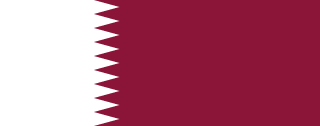
Qatar
State of Qatar
Population: UN WPP 2024, revision 1, projection for 1 July 2026. Sources and methodology.
Geography and territory
Qatar is a small peninsula jutting northward from the eastern flank of the Arabian Peninsula into the waters of the Persian Gulf. Covering just 11,586 square kilometers, it is one of the smallest countries in Asia. Its only land border runs south to Saudi Arabia, while Bahrain lies a short distance away across the Gulf to the northwest. The peninsula stretches roughly 160 kilometers from north to south and about 80 kilometers across at its widest point.
The Qatari landscape is overwhelmingly flat and desert-covered, with a maximum elevation of just 103 meters at Tuwayyir al Hamir, making it one of the flattest countries on Earth. The coastline runs for about 560 kilometers, alternating sandy beaches with coastal salt flats known as sabkhas and pockets of mangrove. The interior is defined by gravel plains and sand dunes, with occasional depressions where groundwater surfaces have historically supported small oases.
The climate is desert-hot and extreme, with summer temperatures regularly exceeding 45 degrees Celsius (113 degrees Fahrenheit), compounded along the coast by heavy humidity that can make conditions feel nearly unbearable. Winters, by contrast, are mild and pleasant, with average temperatures around 18 degrees Celsius, making the months between November and March the most comfortable time to visit. Rainfall is extremely scarce, averaging under 80 millimeters a year, and the country has no permanent rivers or lakes, leaving groundwater and, increasingly, desalinated seawater as the main sources of fresh water for a fast-growing population. Despite these harsh conditions, migratory birds pass through the coastal wetlands each year, and the surrounding Gulf waters, though warm and saline, sustain fish stocks, coral patches, and populations of dugong that have long supported local fishing.
History
The Qatari peninsula has been inhabited since prehistoric times, with stone tools and archaeological sites pointing to human activity stretching back thousands of years. The region was woven into the trading networks of the ancient Dilmun civilization and later fell within the orbit of the Persian, Seleucid, and Sassanid empires. For centuries, coastal communities depended on pearl diving, an industry that sustained the local economy well into the 20th century.
The Al Thani family established its authority over the peninsula in the mid-19th century, and in 1868 signed an agreement with Britain that formally recognized Qatar’s separation from Bahrain. The country became a British protectorate in 1916 and remained one until independence was declared on September 3, 1971. The discovery of oil in 1939, and above all the development of the North Field natural gas reserve beginning in the 1990s, transformed the country’s fortunes beyond recognition.
Emir Sheikh Hamad bin Khalifa Al Thani, who came to power in 1995, drove a rapid modernization campaign that included founding Al Jazeera, the television network that reshaped Arab media, establishing Education City, and pursuing an assertive diplomacy that put Qatar firmly on the world stage. In 2013 he abdicated in favor of his son, Sheikh Tamim, who has continued that trajectory, a path that culminated in Qatar hosting the 2022 FIFA World Cup.
Culture and society
Qatari culture rests on Bedouin and maritime traditions shared across the Gulf, though the country has undergone an unprecedented social transformation in recent decades. Qatari citizens make up only a small fraction of the total population, while the great majority of residents are expatriate workers from India, Nepal, the Philippines, Egypt, and dozens of other countries. This demographic structure creates a dual society, one built around the national community and another around the vast expatriate workforce that keeps the country running.
The ruling Al Thani family has invested heavily in culture as a tool of international influence. Qatar Museums, chaired by Sheikha Al-Mayassa bint Hamad Al Thani, has turned Doha into a first-rank cultural destination, filled with museums designed by internationally renowned architects. Traditional practices such as falconry, camel racing, ardah folk music, and Nabati poetry are actively preserved and promoted alongside these global cultural ventures.
Education has been another major priority: Education City hosts branch campuses of prestigious American and European universities, including Georgetown, Northwestern, and Carnegie Mellon. Al Jazeera, founded in Doha in 1996, reshaped the Arab media landscape by introducing independent journalism and open debate to a region long dominated by state broadcasting. Qatari society today balances social conservatism rooted in local custom with a cosmopolitan openness driven by the country’s international ambitions.
Economy
Qatar holds the third-largest natural gas reserves in the world, centered on the offshore North Field, which has made it one of the leading global exporters of liquefied natural gas. This energy wealth has produced one of the highest per capita incomes anywhere on Earth, with figures well above $80,000 per person. The Qatari economy remains heavily dependent on hydrocarbons, which account for the majority of export revenue and a large share of government income, underpinning a total gross domestic product of about $215.56 billion.
The Qatar National Vision 2030 charts a course toward diversification, with growing emphasis on education, research, tourism, finance, and industry. The Qatar Investment Authority, the country’s sovereign wealth fund with hundreds of billions of dollars in assets, has made strategic investments in global companies and landmarks, including stakes in Volkswagen, Barclays, Harrods, Paris Saint-Germain, and prime real estate in London, New York, and other world capitals.
Hosting the 2022 FIFA World Cup drove an enormous wave of infrastructure investment, including air-conditioned stadiums, a new metro system, roads, hotels, and the entirely new city of Lusail. Qatar has also built up substantial petrochemical, fertilizer, and aluminum industries, while its national carrier, Qatar Airways, has established itself as one of the world’s leading airlines, operating through the state-of-the-art Hamad International Airport.
Food and cuisine
Qatari cuisine shares its roots with the broader cooking traditions of the Gulf, but carries its own distinct character shaped by Bedouin heritage and historic trade links with India and East Africa. Machboos, spiced rice cooked with lamb, chicken, or fish and seasoned with a fragrant blend of baharat, dried lime, and saffron, is the country’s signature dish. Thareed, a stew of meat and vegetables served over thin bread, is another classic, traditionally associated with dishes favored by the Prophet Muhammad.
Seafood is central to the Qatari diet: hamour (grouper), Gulf shrimp, and zubaidi are grilled, curried, or served over rice. Balaleet, sweet vermicelli noodles flavored with cardamom and served alongside a savory omelet, is a distinctive traditional breakfast that blends sweet and savory flavors. Madrouba, a comforting porridge of rice and shredded chicken seasoned with spices, is especially popular during Ramadan.
Arabic coffee, gahwa, brewed with cardamom and saffron and served alongside dates, remains the essential ritual of Qatari hospitality. Karak chai, milky tea boiled with cardamom and saffron and reflecting strong Indian influence, has become the most popular everyday beverage. Traditional sweets include lugaimat, fried dough balls drizzled with honey, esh asaraya, a creamy cake with a crisp base, and dates stuffed with almonds or walnuts. Doha’s dining scene today is remarkably cosmopolitan, pairing international fine dining with authentic local establishments.
Tourism and landmarks
Doha has transformed into a top-tier travel destination through massive investment in cultural and leisure infrastructure. The Museum of Islamic Art, designed by I. M. Pei on an artificial island in Doha Bay, holds one of the finest collections of Islamic art anywhere in the world. The National Museum of Qatar, designed by Jean Nouvel in the shape of a desert rose, tells the country’s story through an immersive and visually striking design.
Souq Waqif, restored to recreate the atmosphere of a traditional Qatari marketplace, functions as the social heart of Doha, with its spice and textile stalls, open-air restaurants, falcon shops, and lively evening crowds. The Pearl-Qatar, a luxury artificial island, and Lusail, the new city built for the World Cup, offer waterfront promenades, shopping, and entertainment. The stadiums built for the 2022 World Cup have themselves become architectural attractions in their own right.
Beyond Doha, the Qatari desert offers dune safaris, overnight camping under the stars, and the striking Inland Sea at Khor Al Adaid, where desert dunes meet the sea directly, a rare geological formation recognized by UNESCO. The mangroves of Al Thakira offer kayaking through a surprising coastal ecosystem, and the beaches of the northern peninsula provide clear waters for swimming and water sports.
Fun facts about Qatar
- Qatar was the first Arab nation to host the FIFA World Cup, in 2022, with stadiums fitted with advanced cooling technology to counter the desert heat.
- Qatar’s per capita GDP is among the highest in the world, exceeding $80,000 per person.
- Al Jazeera, the television network that transformed Arab-language media, was founded in Doha in 1996.
- Qatar has one of the most lopsided citizen-to-expatriate ratios on Earth, with native Qataris making up a small minority of the population.
- The North Field, Qatar’s giant offshore gas reserve, is shared with Iran, which calls its portion South Pars.
- Khor Al Adaid, the Inland Sea, is one of the few places in the world where desert dunes meet open sea without a river in between.
Qatar in numbers
Latest World Bank and UNDP observations, each with its own year. “World median” is the middle value among the countries that report the same indicator; “#” ranks from the highest value.
Population since 1960
Qatar had 36,010 people in 1960 and 3.0 million in 2025 — 82.5 times as many.
People
99.4% of people live in towns and cities (world median 63.4%). 15.0% are under 15 and 1.7% are 65 or older — a middle-aged population. Women have 1.72 children on average, below the replacement level of about 2.1 needed to keep a population stable in the long run without migration.
Economy
The economy grew by 2.9% in real terms in 2025. Consumer prices rose by 1.3% in 2024. Industry makes up the largest share of output (57.0% of GDP); agriculture contributes 0.3%.
Development and environment
UNDP rates human development in Qatar as very high, with an index of 0.886 in 2023 (rank 43 of 193). 98.1% of people use the internet and 100.0% have access to electricity. Forest covers 0.1% of the land (world median 32.8%).
Sources: World Bank, World Development Indicators (CC BY 4.0), most recent observation from 2015 onward; UNDP Human Development Report 2025. Retrieved 2026-10-10. Sector shares need not add up to 100% because taxes and subsidies on products are excluded. Missing values are left blank rather than estimated. Sources and methodology.
Climate of Qatar
Averaged across Qatar, the warmest month is July (36.4 °C) and the coolest is January (17.5 °C), a seasonal swing of 18.9 °C. The annual mean is 27.9 °C.
About 69 mm of precipitation falls in a typical year. March is the wettest month (16 mm) and June the driest (0 mm). What little rain there is falls mostly from January to March (65% of the total).
Less than 250 mm a year is typical of desert climates.
Show monthly values as a table
| Month | Mean °C | Low °C | High °C | Precipitation, mm |
|---|---|---|---|---|
| January | 17.5 | 13.5 | 21.5 | 15 |
| February | 19.1 | 14.9 | 23.4 | 14 |
| March | 22.4 | 17.7 | 27.2 | 16 |
| April | 27.4 | 22.2 | 32.6 | 7 |
| May | 32.7 | 26.7 | 38.7 | 1 |
| June | 35.3 | 29.4 | 41.3 | 0 |
| July | 36.4 | 31.0 | 41.8 | 0 |
| August | 36.1 | 30.8 | 41.3 | 0 |
| September | 33.8 | 28.4 | 39.2 | 0 |
| October | 30.2 | 25.1 | 35.4 | 0 |
| November | 24.6 | 20.2 | 29.1 | 4 |
| December | 19.9 | 15.7 | 24.0 | 12 |
Figures are 1991–2020 averages across the whole land area of Qatar, from the World Bank Climate Change Knowledge Portal, CRU TS 4.08 (CC BY 4.0). They are not readings from one weather station: the capital, the coast and high ground can be much warmer, cooler, wetter or drier.
Travel essentials for Qatar
The practical details visitors ask about first. Traffic in Qatar drives on the right, like most of the world. Mains electricity is 240 V at 50 Hz, so devices made only for 110–120 V (common in North America) need a converter unless they are dual-voltage — most phone and laptop chargers are.
- Emergency number
- 999
- Driving side
- Right
- Plug types
- Type D, Type GD: three large round pins in a triangle; G: three rectangular pins (British)
- Voltage
- 240 V50 Hz
- Dialling code
- +974From abroad: your exit code, then 974 and the number
- Currency
- Qatari Riyal (QAR)
- Time zone
- AST (UTC+3)Current local time in Qatar
Compiled from IEC plug and voltage standards, national emergency-service listings and the UN road-traffic conventions. Emergency numbers and local coverage can change — confirm them locally on arrival. Qatar's internet domain is .qa.
Where Qatar ranks in the world
Each position counts only the countries with data in that ranking guide. First place is the highest value — for price levels, the most expensive. Select a card to see the full table.
- Population134th of 1963.2 millionUN projection, July 2026
- Land area157th of 19511,490 km²World Bank, 2023
- Population density45th of 194231 per km²World Bank, 2023
- GDP (nominal)55th of 187$216.3BWorld Bank, 2024, current US$
- GDP per capita10th of 187$75,685World Bank, 2024, current US$
- Life expectancy22nd of 19482.5 yearsWorld Bank, 2024
- Price level24th of 16580 (US = 100)ICP 2021, household consumption
Bordering countries of Qatar

Compare Qatar with another country
Frequently asked questions about Qatar
What is the capital of Qatar?
The capital of Qatar is Doha.
What is the population of Qatar?
The UN World Population Prospects projection for Qatar is 3,173,559 people (3.2 million) on 1 July 2026. National statistical offices may publish different estimates.
What language is spoken in Qatar?
The official language of Qatar is Arabic.
What currency is used in Qatar?
The currency of Qatar is the Qatari Riyal (QAR).
How big is Qatar?
Qatar covers an area of 11,586 km².
What type of government does Qatar have?
Qatar is a absolute monarchy (emirate).
Which countries border Qatar?
Qatar shares land borders with Saudi Arabia.
What is the highest point in Qatar?
The highest point in Qatar is Tuwayyir al Hamir (103 m).


