Nepal
Federal Democratic Republic of Nepal
Population: UN WPP 2024, revision 1, projection for 1 July 2026. Sources and methodology.
Geography and territory
Nepal occupies 147,516 square kilometers at the heart of the Himalayas, wedged between the world’s two most populous nations: China to the north and India along its southern, eastern, and western borders. Few countries pack such extreme elevation change into so narrow a strip of territory, ranging from the subtropical Terai plains, barely 60 meters above sea level, to the summit of Mount Everest at 8,849 meters, the highest point on the planet. Eight of the world’s fourteen peaks above 8,000 meters lie wholly or partly within Nepal’s borders.
The country divides into three roughly parallel bands. In the south, the Terai extends the flat Indo-Gangetic plain into Nepal, covered in dense subtropical forest, fed by wide rivers, and home to protected populations of one-horned rhinoceros, Bengal tigers, and Asian elephants in parks such as Chitwan and Bardia. The central hill region, rising between roughly 1,000 and 4,000 meters, holds the fertile valleys of Kathmandu and Pokhara and is home to the bulk of the national population.
The northern band belongs entirely to the Himalayas, an unbroken wall of ice and rock running the length of the border with Chinese-administered Tibet. Alongside Everest, Nepal claims Kangchenjunga (8,586 m), Lhotse (8,516 m), Makalu (8,485 m), and Annapurna (8,091 m), among other giants that draw mountaineers from around the world. Glacier-fed rivers such as the Koshi, Gandaki, and Karnali cascade south from these peaks, sustaining agriculture and daily life for tens of millions of people across both Nepal and northern India.
History
Nepal’s history has long been shaped by its position between the Indian and Tibetan civilizational spheres. The Kathmandu Valley gave rise to sophisticated dynasties that left behind an extraordinary architectural and artistic legacy. The Licchavi dynasty, from roughly the fourth to ninth centuries, and the Malla kingdoms that followed from the twelfth through eighteenth centuries transformed the valley’s three city-states, Kathmandu, Patan, and Bhaktapur, into rival centers of art and culture, their temples, palaces, and Durbar squares reaching a level of refinement that astonished the earliest European visitors.
In 1768, Prithvi Narayan Shah, ruler of the small hill principality of Gorkha, conquered and unified the valley’s fragmented kingdoms, founding modern Nepal. Uniquely in South Asia, Nepal was never colonized, preserving its sovereignty against British imperial ambition through a mix of diplomacy and military resistance; Nepalese Gurkha soldiers subsequently earned a lasting reputation serving in the British Army, a legacy that continues today. The Shah dynasty ruled for more than two centuries, first as an absolute monarchy and later under the effective control of the powerful Rana family, who held real political power for roughly a hundred years.
The twentieth century brought sweeping change: a democratic opening in 1951, a brief period of parliamentary government, the restoration of royal power, and finally a Maoist insurgency between 1996 and 2006 that ultimately led to the monarchy’s abolition. In 2008, Nepal became a federal democratic republic, closing 240 years of royal rule. A devastating 2015 earthquake, which killed more than 8,000 people and badly damaged the historic monuments of the Kathmandu Valley, marked another pivotal chapter, one that has since showcased the country’s remarkable capacity for recovery.
Culture and society
Nepal is a cultural mosaic of extraordinary depth, home to more than 125 ethnic groups speaking well over 120 languages. Hinduism and Buddhism, the country’s two major faiths, coexist in a genuinely unique symbiosis: temples of both traditions often share sacred ground, and many Nepalis venerate deities from each without any sense of contradiction. Lumbini, the birthplace of the Buddha, and Pashupatinath, the country’s holiest Hindu temple, both draw pilgrims from around the world.
The Durbar squares of Kathmandu, Patan, and Bhaktapur, collectively a UNESCO World Heritage Site, concentrate a density of temples, palaces, and carved-wood sculpture unmatched anywhere else. Newar architecture, developed by the Kathmandu Valley’s indigenous ethnic group, reached extraordinary heights of craftsmanship in its woodcarving, tiered pagoda roofs, and courtyard palaces. The stupas of Boudhanath and Swayambhunath, their painted Buddha eyes gazing out in all four directions, are among the country’s most recognizable visual symbols.
Festivals run through the Nepali calendar almost without pause. Dashain, the country’s largest Hindu festival, celebrates the triumph of good over evil across fifteen days of ritual, family gatherings, and ceremonial offerings. Tihar, the festival of lights, fills cities with oil lamps and flower garlands. Masked dances, processions of sacred chariots, and shamanic rituals among mountain communities add further layers of ceremony to a cultural calendar that makes Nepal one of the most captivating countries on Earth.
Economy
Nepal’s economy, valued at roughly $45.5 billion in GDP, remains among the least developed in Asia, constrained by rugged terrain, landlocked geography, and recurring natural disasters. Agriculture employs nearly two-thirds of the workforce, with rice, corn, wheat, and lentils grown on terraced hillsides and in fertile valleys as staple subsistence crops. Nepali tea, grown in the eastern hills, has become a respected export product internationally.
Tourism is the most dynamic sector of the economy and a vital source of foreign currency. Hundreds of thousands of visitors travel to Nepal each year for Himalayan trekking, mountaineering, wildlife safaris in the Terai jungle, and the cultural riches of the Kathmandu Valley. The Annapurna Circuit, the Everest Base Camp trek, and the Langtang trail rank among the most celebrated hiking routes in the world, and climbing permits, particularly for Everest, generate substantial revenue for the government.
Remittances sent home by Nepali migrant workers, employed largely in India, the Gulf states, Malaysia, and South Korea, account for more than a quarter of GDP and provide the primary economic lifeline for millions of families. The country’s hydropower potential, estimated at around 83,000 megawatts, remains largely untapped, representing a development opportunity that could transform the Nepali economy if matched by adequate investment. Handicrafts, including pashmina textiles, thangka paintings, and singing bowls, add further income from the tourism trade.
Food and cuisine
Nepali cuisine mirrors the country’s geographic and ethnic diversity, spanning Indian-influenced flavors in the south to Tibetan traditions in the north. Dal bhat, the undisputed national dish, pairs steamed rice with lentil soup, vegetable curry known as tarkari, pickled relishes called achar, and sometimes meat or fish. Eaten twice daily by most Nepalis, the dish is so central to national life that “dal bhat power, 24 hour” has become a popular saying celebrating its staying power on the trail.
Momos, dumplings filled with meat or vegetables and either steamed or fried, are perhaps Nepal’s best-known culinary export, adapted from Tibetan tradition into the country’s most popular snack, typically served with a spicy tomato-sesame dipping sauce that varies by region. Thukpa, a warming noodle soup with vegetables and meat, is the comfort food of choice in mountain regions, while chatamari, a Newari rice crepe topped with minced meat and egg, represents the more refined cooking of the Kathmandu Valley.
Nepali sweets include sel roti, a ring-shaped fried rice-flour doughnut prepared especially during the Tihar festival, and juju dhau, the celebrated yogurt of Bhaktapur, prized for its creamy texture and delicate flavor. Traditional drinks range from chiya, spiced milk tea in the Indian style, to tongba, hot millet beer served in a bamboo vessel and sipped through a thin straw, and raksi, a distilled rice or millet spirit that accompanies community celebrations.
Tourism and landmarks
Nepal is a legendary destination for mountain lovers and spiritual travelers alike. The Kathmandu Valley alone holds seven UNESCO World Heritage sites within a remarkably compact area: the three Durbar squares with their medieval temples and palaces, the Buddhist stupas of Boudhanath and Swayambhunath (the “Monkey Temple”), the Hindu temple complex of Pashupatinath beside the cremation ghats of the Bagmati River, and the temple complex at Changu Narayan. Patan, known as the city of fine arts, holds more than 600 temples and the country’s finest collection of bronze sculpture.
Himalayan trekking is Nepal’s signature travel experience. The Annapurna Circuit, widely regarded as one of the finest treks in the world, winds over two to three weeks through landscapes ranging from tropical rice paddies to glaciers above 5,000 meters, passing through Gurung and Thakali villages with sweeping views of the Annapurna massif. Everest Base Camp, reached after roughly two weeks of trekking through Sherpa territory, offers the unmatched thrill of standing close beneath the world’s highest mountain.
Chitwan National Park, in the Terai lowlands, offers elephant-back or canoe safaris to spot one-horned rhinos, Bengal tigers, crocodiles, and an extraordinary variety of birdlife. Pokhara, set beside Phewa Lake with the Machhapuchhre peak reflected in its waters, serves as the gateway to Annapurna trekking and a hub for adventure sports, including paragliding with Himalayan views. Lumbini, the Buddha’s birthplace in the western Terai, draws Buddhist pilgrims from around the world to the preserved sacred garden where Prince Siddhartha was born.
Fun facts about Nepal
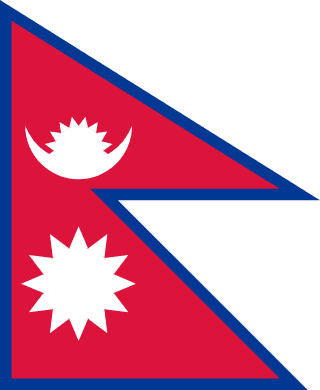
- Nepal is the only country in the world with a national flag that is neither square nor rectangular, formed from two stacked triangles representing the Himalayas and the country’s major faiths.
- Nepal’s time zone, UTC+5:45, is one of the most unusual in the world, offset from neighboring India by just 15 minutes.
- Eight of the world’s fourteen mountains above 8,000 meters lie wholly or partly within Nepal.
- Nepal was never colonized by any European power, a rare distinction in South Asia.
- The legend of the Yeti, the mysterious “abominable snowman,” originates in the folklore of Nepal’s Himalayan communities.
Nepal in numbers
Latest World Bank and UNDP observations, each with its own year. “World median” is the middle value among the countries that report the same indicator; “#” ranks from the highest value.
Population since 1960
Nepal had 10.1 million people in 1960 and 29.6 million in 2025 — 2.9 times as many.
People
67.0% of people live in towns and cities (world median 63.4%). 28.1% are under 15 and 6.6% are 65 or older — a middle-aged population. Women have 1.96 children on average, below the replacement level of about 2.1 needed to keep a population stable in the long run without migration.
Economy
The economy grew by 4.4% in real terms in 2025. Consumer prices rose by 2.7% in 2025. Services make up the largest share of output (54.4% of GDP); agriculture contributes 21.6%, a large share that points to a farming-based economy.
Development and environment
UNDP rates human development in Nepal as medium, with an index of 0.622 in 2023 (rank 145 of 193). 46.3% of people use the internet and 97.9% have access to electricity. Forest covers 43.6% of the land (world median 32.8%).
Sources: World Bank, World Development Indicators (CC BY 4.0), most recent observation from 2015 onward; UNDP Human Development Report 2025. Retrieved 2026-10-10. Sector shares need not add up to 100% because taxes and subsidies on products are excluded. Missing values are left blank rather than estimated. Sources and methodology.
Climate of Nepal
Averaged across Nepal, the warmest month is July (20.2 °C) and the coolest is January (5.0 °C), a seasonal swing of 15.2 °C. The annual mean is 14.1 °C.
About 1,283 mm of precipitation falls in a typical year. July is the wettest month (327 mm) and November the driest (9 mm). The three wettest consecutive months, July to September, bring 61% of the year's total — a pronounced rainy season.
Show monthly values as a table
| Month | Mean °C | Low °C | High °C | Precipitation, mm |
|---|---|---|---|---|
| January | 5.0 | −2.1 | 12.2 | 20 |
| February | 7.0 | −0.3 | 14.3 | 31 |
| March | 11.3 | 3.7 | 18.9 | 35 |
| April | 15.4 | 8.1 | 22.6 | 50 |
| May | 18.2 | 11.8 | 24.6 | 110 |
| June | 20.0 | 14.8 | 25.3 | 186 |
| July | 20.2 | 16.0 | 24.5 | 327 |
| August | 20.1 | 16.0 | 24.2 | 266 |
| September | 18.7 | 14.0 | 23.5 | 194 |
| October | 15.2 | 9.1 | 21.4 | 45 |
| November | 10.9 | 3.6 | 18.2 | 9 |
| December | 6.9 | −0.5 | 14.3 | 12 |
Figures are 1991–2020 averages across the whole land area of Nepal, from the World Bank Climate Change Knowledge Portal, CRU TS 4.08 (CC BY 4.0). They are not readings from one weather station: the capital, the coast and high ground can be much warmer, cooler, wetter or drier.
Travel essentials for Nepal
The practical details visitors ask about first. Traffic in Nepal drives on the left, one of 54 of the 196 countries profiled here that do — see the full list. Mains electricity is 230 V at 50 Hz, so devices made only for 110–120 V (common in North America) need a converter unless they are dual-voltage — most phone and laptop chargers are.
- Emergency number
- 100Ambulance 102 · Fire 101
- Driving side
- Left
- Plug types
- Type C, Type D, Type MC: two round pins (Europlug); D: three large round pins in a triangle; M: three large round pins (South African)
- Voltage
- 230 V50 Hz
- Dialling code
- +977From abroad: your exit code, then 977 and the number
- Currency
- Nepalese Rupee (NPR)
- Time zone
- UTC+5:45Current local time in Nepal
Compiled from IEC plug and voltage standards, national emergency-service listings and the UN road-traffic conventions. Emergency numbers and local coverage can change — confirm them locally on arrival. Nepal's internet domain is .np.
Where Nepal ranks in the world
Each position counts only the countries with data in that ranking guide. First place is the highest value — for price levels, the most expensive. Select a card to see the full table.
- Population52nd of 19629.6 millionUN projection, July 2026
- Land area92nd of 195143,350 km²World Bank, 2023
- Population density51st of 194207 per km²World Bank, 2023
- GDP (nominal)98th of 187$43.3BWorld Bank, 2024, current US$
- GDP per capita159th of 187$1,460World Bank, 2024, current US$
- Life expectancy128th of 19470.6 yearsWorld Bank, 2024
- Price level156th of 16529 (US = 100)ICP 2021, household consumption
Bordering countries of Nepal


Compare Nepal with another country
Frequently asked questions about Nepal
What is the capital of Nepal?
The capital of Nepal is Kathmandu.
What is the population of Nepal?
The UN World Population Prospects projection for Nepal is 29,629,410 people (29.6 million) on 1 July 2026. National statistical offices may publish different estimates.
What language is spoken in Nepal?
The official language of Nepal is Nepali.
What currency is used in Nepal?
The currency of Nepal is the Nepalese Rupee (NPR).
How big is Nepal?
Nepal covers an area of 147,516 km².
What type of government does Nepal have?
Nepal is a federal parliamentary republic.
Which countries border Nepal?
Nepal shares land borders with China, India.
What is the highest point in Nepal?
The highest point in Nepal is Mount Everest (8,849 m).


