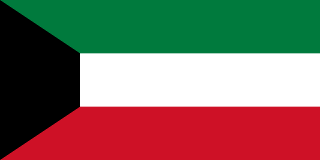
Kuwait
State of Kuwait
Population: UN WPP 2024, revision 1, projection for 1 July 2026. Sources and methodology.
Geography and territory
Kuwait is one of the smallest countries in the Middle East, covering just 17,818 square kilometers at the northwestern tip of the Persian Gulf. Its largely flat, desert territory borders Iraq to the north and west, Saudi Arabia to the south, and the waters of the Persian Gulf to the east. A coastline of roughly 500 kilometers includes Kuwait Bay, a natural inlet that has anchored the country’s maritime life for centuries.
Kuwait’s terrain is predominantly flat, with a maximum elevation of just 306 meters at Mutla Ridge in the northwest. The land is mostly rocky and sandy desert, with scattered dunes and depressions that flood seasonally. Nine coastal islands extend the country’s territory, including Bubiyan, the largest, and Failaka, notable for its archaeological significance. There are no permanent rivers or lakes, and annual rainfall rarely exceeds 120 millimeters.
Kuwait’s climate is among the most extreme on Earth: summers are scorching, with temperatures frequently topping 50°C, accompanied by sandstorms that can cut visibility to just a few meters. Winters are short and relatively mild, with pleasant temperatures between November and February offering the best window for outdoor life. Coastal humidity in summer makes the heat feel even more oppressive.
History
Kuwait Bay has been a hub of human activity since antiquity. Failaka Island held settlements of the Dilmun civilization and served as a Greek trading post known as Ikaros during the era of Alexander the Great. The founding of modern Kuwait, however, traces back to the 18th century, when the Al-Sabah family, originating from central Arabia, settled at the bay and was chosen to govern by local merchant families.
Through the 18th and 19th centuries, Kuwait thrived as a center of shipbuilding, pearl trading, and commercial transit between India, East Africa, and inland Arabian markets. A protectorate treaty with the British Empire, formalized in 1899, shielded the emirate from Ottoman and Iraqi ambitions. The 1938 discovery of oil, with commercial extraction beginning after the Second World War, transformed the economy and society at breakneck speed.
Independence arrived in 1961, and Kuwait became one of the wealthiest countries in the world on a per-capita basis. The Iraqi invasion of August 1990, ordered by Saddam Hussein, and the subsequent 1991 Gulf War that liberated the country stand as the most traumatic episode of modern Kuwaiti history. Oil-well fires set by retreating Iraqi troops caused an unprecedented environmental catastrophe. Reconstruction was swift, but the psychological impact endures in the national memory.
Culture and society
Kuwaiti culture blends Arab and Bedouin traditions with an openness to the outside world that distinguishes it within the Gulf region. Kuwait was historically the most liberal country in the Gulf, with an elected parliament dating to 1963, a relatively free press, and a vibrant cultural scene. Its literary tradition is notable, with poets and novelists who have made significant contributions to contemporary Arabic literature.
Kuwaiti society maintains a strong cultural identity expressed through the diwaniya, a unique social institution where men gather regularly to discuss politics, business, and social matters. These gatherings, held in special reception rooms attached to homes, form the heart of the country’s social and political life. Traditional Kuwaiti music, shaped by seafaring and pearl-diving traditions, includes sea songs (fann al-bahri) once sung during pearl-diving expeditions.
Kuwaiti citizens make up roughly 30 percent of the total population, alongside a large expatriate community from India, Egypt, the Philippines, Bangladesh, and elsewhere that sustains the economy. The government provides generous benefits to citizens, including free education and healthcare, housing subsidies, and guaranteed public-sector employment, a structure that has produced one of the highest standards of living in the world.
Economy
Kuwait holds the world’s sixth-largest proven oil reserves, and the Burgan field ranks as the second-largest oil field on the planet. Oil accounts for roughly 90 percent of government revenue and 95 percent of exports, making Kuwait an economy extraordinarily dependent on a single resource. Kuwait’s per-capita GDP ranks among the highest in the world.
The Kuwaiti dinar is the world’s highest-valued currency by unit, with an exchange rate exceeding 3 US dollars. The Kuwait Investment Authority (KIA), established in 1953, is one of the oldest and largest sovereign wealth funds in the world, with estimated assets exceeding $700 billion. The fund was created with the explicit vision of securing the country’s financial future beyond the oil era.
Diversification efforts have materialized in the Kuwait Vision 2035 (“New Kuwait”) plan, which aims to develop the country as a regional financial and commercial hub. Megaprojects such as Silk City, a planned urban development on the northern coast, and Failaka Island as a tourism destination, are on the drawing board. Even so, dependence on oil remains the economy’s central structural challenge.
Food and cuisine
Kuwaiti cuisine reflects the country’s dual maritime and desert heritage, enriched by Persian, Indian, and South Asian influences. Machboos, spiced rice with lamb, chicken, or fish, prepared with a spice blend that includes dried lime, cinnamon, and cardamom, is the national dish and the centerpiece of every family gathering. Zubaidi (silver pomfret), an emblematic fish of the Persian Gulf, is a delicacy served grilled or with rice.
Seafood takes center stage in coastal cooking: Gulf shrimp, hamour (grouper), and safi are prepared in countless ways. Gabout, a lamb stew with legumes, is a comforting winter dish. Kuwaiti harees, a wheat porridge with shredded meat, is especially popular during Ramadan. Tashreeb, bread soaked in meat and vegetable broth, elevates resourceful cooking into culinary art.
Kuwaiti sweets are generous and fragrant: lugaimat, fried dough balls drenched in date syrup or honey, are the most popular dessert, sold in homes and street stalls alike. Rahash, a pressed tahini sweet, and girs ogaily, a semolina cake with cardamom and saffron, round out the pastry offerings. Chai haleeb, tea with milk and cardamom, accompanies every social exchange, while jallab, a date drink with rosewater, offers relief during the scorching summers.
Tourism and landmarks
Kuwait offers a blend of urban modernity, maritime heritage, and authentic cultural experiences. The Kuwait Towers, three iconic structures on the coast inaugurated in 1979, are the country’s most recognizable symbol. The Grand Mosque of Kuwait, with room for 10,000 worshippers, impresses with its architecture and Islamic garden. The Kuwait National Museum houses collections tracing the country’s history from antiquity through the oil era.
The Mubarakiya district, with its traditional souk, is the historic heart of the city, where spices, perfumes, fabrics, and crafts are sold in an atmosphere evoking pre-oil Kuwait. The Sheikh Jaber Al-Ahmad Cultural Centre, one of the largest cultural complexes in the Middle East, houses theaters, concert halls, and exhibition spaces. Historic merchant houses in the old Hawalli district offer a window into the past.
Failaka Island, a half-hour ferry ride from the city, preserves remains of the Dilmun civilization and a Greek temple, along with traces of the Iraqi invasion that have been preserved as a memorial. The Kuwaiti desert offers winter camping, camel racing, and nights under the stars. The country’s southern beaches and the mangroves of the northern coast offer nature outings, while modern malls and entertainment parks cater to family tourism.
Fun facts about Kuwait
- The Kuwaiti dinar is the world’s highest-valued currency by unit, exceeding 3 US dollars per dinar.
- Kuwait holds the world’s second-largest oil field, Burgan, which was set ablaze by retreating Iraqi troops in 1991, sending smoke plumes visible from space.
- The Kuwait Investment Authority, founded in 1953, is the world’s oldest sovereign wealth fund.
- Kuwait was the first Gulf country to have a democratically elected parliament, established in 1963.
- Summer temperatures in Kuwait can exceed 54°C, placing it among the hottest places on Earth.
Kuwait in numbers
Latest World Bank and UNDP observations, each with its own year. “World median” is the middle value among the countries that report the same indicator; “#” ranks from the highest value.
Population since 1960
Kuwait had 311,060 people in 1960 and 4.9 million in 2025 — 15.6 times as many.
People
100.0% of people live in towns and cities (world median 63.4%). 18.0% are under 15 and 3.2% are 65 or older — a middle-aged population. Women have 1.56 children on average, below the replacement level of about 2.1 needed to keep a population stable in the long run without migration.
Economy
The economy grew by 2.7% in real terms in 2025. Consumer prices rose by 2.4% in 2025. Services make up the largest share of output (59.6% of GDP); agriculture contributes 0.5%.
Development and environment
UNDP rates human development in Kuwait as very high, with an index of 0.852 in 2023 (rank 52 of 193). 100.0% of people use the internet and 100.0% have access to electricity. Forest covers 0.4% of the land (world median 32.8%).
Sources: World Bank, World Development Indicators (CC BY 4.0), most recent observation from 2015 onward; UNDP Human Development Report 2025. Retrieved 2026-10-10. Sector shares need not add up to 100% because taxes and subsidies on products are excluded. Missing values are left blank rather than estimated. Sources and methodology.
Climate of Kuwait
Averaged across Kuwait, the warmest month is July (37.9 °C) and the coolest is January (13.2 °C), a seasonal swing of 24.7 °C. The annual mean is 26.3 °C.
About 119 mm of precipitation falls in a typical year. December is the wettest month (25 mm) and June the driest (0 mm). What little rain there is falls mostly from November to January (55% of the total).
Less than 250 mm a year is typical of desert climates.
Show monthly values as a table
| Month | Mean °C | Low °C | High °C | Precipitation, mm |
|---|---|---|---|---|
| January | 13.2 | 7.8 | 18.6 | 21 |
| February | 15.6 | 9.9 | 21.4 | 13 |
| March | 20.1 | 13.7 | 26.6 | 20 |
| April | 25.8 | 19.2 | 32.4 | 17 |
| May | 32.3 | 25.0 | 39.7 | 3 |
| June | 36.4 | 28.5 | 44.3 | 0 |
| July | 37.9 | 30.4 | 45.5 | 0 |
| August | 37.3 | 29.2 | 45.4 | 0 |
| September | 34.1 | 25.9 | 42.3 | 0 |
| October | 28.4 | 20.8 | 36.1 | 2 |
| November | 20.2 | 14.3 | 26.2 | 19 |
| December | 14.8 | 9.2 | 20.4 | 25 |
Figures are 1991–2020 averages across the whole land area of Kuwait, from the World Bank Climate Change Knowledge Portal, CRU TS 4.08 (CC BY 4.0). They are not readings from one weather station: the capital, the coast and high ground can be much warmer, cooler, wetter or drier.
Travel essentials for Kuwait
The practical details visitors ask about first. Traffic in Kuwait drives on the right, like most of the world. Mains electricity is 240 V at 50 Hz, so devices made only for 110–120 V (common in North America) need a converter unless they are dual-voltage — most phone and laptop chargers are.
- Emergency number
- 112
- Driving side
- Right
- Plug types
- Type C, Type GC: two round pins (Europlug); G: three rectangular pins (British)
- Voltage
- 240 V50 Hz
- Dialling code
- +965From abroad: your exit code, then 965 and the number
- Currency
- Kuwaiti Dinar (KWD)
- Time zone
- AST (UTC+3)Current local time in Kuwait
Compiled from IEC plug and voltage standards, national emergency-service listings and the UN road-traffic conventions. Emergency numbers and local coverage can change — confirm them locally on arrival. Kuwait's internet domain is .kw.
Where Kuwait ranks in the world
Each position counts only the countries with data in that ranking guide. First place is the highest value — for price levels, the most expensive. Select a card to see the full table.
- Population127th of 1965.1 millionUN projection, July 2026
- Land area152nd of 19517,820 km²World Bank, 2023
- Population density32nd of 194272 per km²World Bank, 2023
- GDP (nominal)57th of 187$160.9BWorld Bank, 2024, current US$
- GDP per capita36th of 187$32,856World Bank, 2024, current US$
- Life expectancy3rd of 19484.6 yearsWorld Bank, 2024
- Price level42nd of 16564 (US = 100)ICP 2021, household consumption
Bordering countries of Kuwait


Compare Kuwait with another country
Frequently asked questions about Kuwait
What is the capital of Kuwait?
The capital of Kuwait is Kuwait City.
What is the population of Kuwait?
The UN World Population Prospects projection for Kuwait is 5,102,773 people (5.1 million) on 1 July 2026. National statistical offices may publish different estimates.
What language is spoken in Kuwait?
The official language of Kuwait is Arabic.
What currency is used in Kuwait?
The currency of Kuwait is the Kuwaiti Dinar (KWD).
How big is Kuwait?
Kuwait covers an area of 17,818 km².
What type of government does Kuwait have?
Kuwait is a constitutional monarchy (emirate).
Which countries border Kuwait?
Kuwait shares land borders with Iraq, Saudi Arabia.
What is the highest point in Kuwait?
The highest point in Kuwait is Mutla Ridge (306 m).


