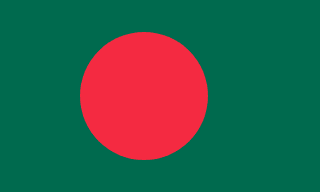
Bangladesh
People's Republic of Bangladesh
Population: UN WPP 2024, revision 1, projection for 1 July 2026. Sources and methodology.
Geography and territory
Bangladesh, officially the People’s Republic of Bangladesh, is one of the most densely populated countries on Earth, packing a population of about 177.8 million into just 148,460 square kilometers. Located in South Asia, the country occupies most of the Ganges-Brahmaputra delta, the largest river delta on the planet. It is almost entirely enclosed by India, which borders it to the west, north, and east, shares a shorter frontier with Myanmar to the southeast, and opens onto the Bay of Bengal along a coastline of roughly 580 kilometers to the south.
Water defines the Bangladeshi landscape more than any other feature. The Ganges, known locally as the Padma, the Brahmaputra, called the Jamuna within the country, and the Meghna converge across the territory, feeding an intricate network of hundreds of rivers, channels, and tributaries that irrigate some of the most fertile alluvial plains in the world. The terrain is overwhelmingly flat, with elevations rarely exceeding 10 meters above sea level, a fact that makes the country exceptionally vulnerable to climate change and rising seas. The Chittagong Hill Tracts in the southeast provide the principal exception to this lowland flatness, culminating in Keokradong, the country’s highest point at 1,230 meters.
Bangladesh has a tropical monsoon climate with three distinct seasons: a hot, dry period from March to May; a monsoon season from June to October that brings torrential rains capable of flooding up to a third of the country; and a cooler, dry season from November to February. Tropical cyclones sweeping in from the Bay of Bengal pose a recurring and often devastating threat. Despite intense population pressure, Bangladesh retains remarkable ecosystems, chief among them the Sundarbans, the largest mangrove forest in the world, shared with India, home to the Bengal tiger and recognized as a UNESCO World Heritage Site.
History
The history of Bangladesh is inseparable from that of the wider Indian subcontinent and the Bengali cultural identity that binds the region together. Bengal was among the most prosperous provinces of the Mughal Empire, celebrated for its muslin, silk, and spices. This wealth drew Portuguese, Dutch, and British traders, and the British East India Company established dominance following the Battle of Plassey in 1757, making Bengal the first part of the subcontinent to fall under direct colonial control.
The 1947 partition of British India split Bengal in two: the predominantly Hindu west remained part of India, while the predominantly Muslim east became East Pakistan, a geographic anomaly separated from West Pakistan by more than 1,600 kilometers of Indian territory. Discriminatory policies from the Pakistani government, especially the attempt to impose Urdu over Bengali as the state language, fueled deepening resentment. The 1952 Language Movement, during which students were killed defending their right to speak Bengali, is commemorated every February 21 by UNESCO as International Mother Language Day.
The 1971 Liberation War, led by Sheikh Mujibur Rahman, culminated in Bangladesh’s independence on March 26, 1971, following a brutal conflict that produced millions of casualties and refugees, with Indian military intervention proving decisive to the eventual victory over Pakistan. The decades since independence have brought political instability, military coups, recurrent natural disasters, and a persistent struggle against poverty. Even so, Bangladesh has achieved striking gains in social development, including sharp reductions in child mortality, expanded schooling for girls, and the rise of microfinance, a model pioneered by the Grameen Bank of Muhammad Yunus, winner of the 2006 Nobel Peace Prize.
Culture and society
Bangladeshi culture is, above all, Bengali culture: a literary, artistic, and musical tradition of extraordinary richness shared with the Indian state of West Bengal. Rabindranath Tagore, the first non-European to win the Nobel Prize in Literature, in 1913, was born in Calcutta but his legacy belongs to both Bengals; he composed the national anthem of Bangladesh, Amar Shonar Bangla, just as he did India’s. The rebellious verse of Kazi Nazrul Islam and the poetic prose of Jibanananda Das add further depth to a Bengali literary tradition of remarkable range.
Baul music, a mystical tradition of wandering singers who blend Sufi and Hindu devotional themes, has been recognized by UNESCO as an Intangible Cultural Heritage. Baul minstrels travel from village to village accompanied by the ektara, a single-stringed instrument, singing of divine love and spiritual searching. Textile artistry forms another cultural pillar: jamdani, a hand-woven cotton muslin prized for its intricate patterns, ranks among the finest fabrics in the world and is likewise inscribed on UNESCO’s intangible heritage list. The sari remains the traditional garment for women, woven in regional styles of striking beauty.
The major festivals of the Bangladeshi calendar include Pohela Boishakh, the Bengali New Year on April 14, celebrated with colorful processions, music, and fairs; Eid al-Fitr and Eid al-Adha, the principal Islamic holidays in a country where roughly nine in ten people are Muslim; and Durga Puja, the largest Hindu celebration. Cricket is a genuine national passion that unites Bangladeshis across regional and religious lines, and the national team has achieved notable milestones on the international stage. Despite ongoing economic hardship, Bangladeshi society is known for its resilience, creativity, and strong communal solidarity, forged over centuries of adapting to the demands of a challenging natural environment.
Economy
Bangladesh has undergone a remarkable economic transformation, moving from one of the poorest countries in the world at independence in 1971 to a lower-middle-income economy with sustained annual growth that has often exceeded 6 percent, and a gross domestic product now estimated at $456.32 billion. The ready-made garment industry drives this growth, accounting for the large majority of the country’s exports. Bangladesh ranks as the world’s second-largest apparel exporter after China, with thousands of factories employing millions of workers, most of them women.
Remittances sent home by Bangladeshis working abroad, particularly in the Persian Gulf states, Malaysia, and Europe, provide another vital source of national income, running into the tens of billions of dollars each year. Agriculture, though its share of GDP has declined, still employs a large portion of the workforce, with rice, jute, tea, and aquaculture as the leading products. The country’s pioneering microfinance sector, built by institutions such as the Grameen Bank and BRAC, has shown that small loans to the poorest borrowers can be both financially sustainable and socially transformative.
Significant economic challenges remain, but they are being addressed with determination. Infrastructure improvements, symbolized by the Padma Bridge, opened in 2022 as the country’s largest engineering project financed entirely with domestic resources, together with rapid digitalization and diversification into sectors such as pharmaceuticals and information technology, point to ambitious development goals. Climate vulnerability stands as the greatest existential challenge the country faces, with flooding, cyclones, and rising sea levels threatening to displace millions of people in the decades ahead, a risk reflected in a Human Development Index still classified as medium, at 0.685.
Food and cuisine
Bangladeshi cuisine is a celebration of rice, fish, and spices, three elements that define the culinary identity of a people bound inseparably to their rivers and fertile lands. Rice is so central to daily life that the Bengali phrase for eating a meal, bhat khaowa, literally means “eating rice.” Every meal revolves around a plate of steaming rice accompanied by curries of fish, vegetables, and lentils, known as dal, along with condiments that vary by region, season, and occasion.
Hilsa, called ilish in Bengali and often referred to as the king of Bangladeshi fish, is the most prized ingredient in the national kitchen. It is prepared in countless ways: steamed in banana leaves, cooked in a mustard-seed curry known as shorshe ilish, fried until crisp, or simply grilled. Dhaka-style biryani, a legacy of Mughal cooking, layers basmati rice with tender goat meat, saffron, nuts, and a slow cooking process that builds extraordinary depth of flavor. Kacchi biryani, in which raw marinated meat is cooked together with the rice in a sealed pot, is the most celebrated version of the dish.
Bangladeshi sweets enjoy a legendary reputation across the subcontinent. Mishti doi, a sweetened yogurt traditionally set in clay pots, rasgulla, spongy cheese balls soaked in syrup, sandesh, and chomchom represent a refined confectionery tradition in which fresh milk, sugar, and flavorings such as cardamom and rosewater produce delicate textures and flavors. Tea, known as cha and typically drunk with milk and sugar, is the everyday social beverage of choice, while street vendors selling fuchka, the Bangladeshi take on pani puri, along with chotpoti and jhalmuri, offer spicy, savory snacks throughout the day.
Tourism and landmarks
The Sundarbans, the largest mangrove forest on Earth, spanning roughly 10,000 square kilometers shared between Bangladesh and India, form the country’s most spectacular natural attraction. Designated a UNESCO World Heritage Site, this dense and often impenetrable mangrove wilderness shelters the royal Bengal tiger, the estuarine crocodile, the Ganges river dolphin, and hundreds of bird species. Boat excursions through the Sundarbans’ quiet waterways, where the silence is broken only by birdsong and the ripple of water, offer an immersive encounter with wilderness that is hard to match anywhere else in the region.
Cox’s Bazar, with an unbroken 120-kilometer stretch of sandy beach, ranks among the longest beaches in the world and is the country’s leading domestic vacation destination. Saint Martin’s Island, the only coral island in Bangladesh, offers clear waters and coral reefs. Inland, the ruins of Paharpur, an eighth-century Buddhist monastery, form a UNESCO World Heritage Site and stand as a testament to the region’s rich Buddhist heritage. The historic mosque city of Bagerhat, built in the fifteenth century and once home to 360 mosques, is another UNESCO-listed site that showcases the sophistication of Islamic architecture in Bengal.
Dhaka, the capital, ranks among the most densely populated and chaotic cities on Earth, yet it is also one of the most captivating. Old Dhaka bustles with colorful rickshaws, labyrinthine markets, Mughal-era mosques such as Lalbagh Fort, and the lively Sadarghat river terminal, where hundreds of ferries connect the capital to the interior in an overwhelming visual spectacle. The Chittagong Hill Tracts and the Bandarban region, with indigenous hill communities, hidden waterfalls, and lush vegetation, provide a striking contrast to the flat deltaic plains that dominate most of the country.
Fun facts about Bangladesh
- February 21 is observed worldwide as International Mother Language Day, in memory of the Bangladeshi students who died in 1952 defending their right to speak Bengali.
- The Sundarbans hold the largest single population of Bengal tigers in the world, with the animals uniquely adapted to life in a mangrove ecosystem.
- Cox’s Bazar boasts one of the longest unbroken sandy beaches on the planet, stretching for 120 uninterrupted kilometers.
- Bangladesh is the world’s second-largest garment exporter, and its textile industry employs millions of workers, the majority of them women.
- The Grameen Bank, founded by Nobel laureate Muhammad Yunus, pioneered microcredit lending and has extended loans to millions of borrowers, most of them women, inspiring similar programs in over a hundred countries.
- The hand-painted rickshaws of Dhaka are considered a rolling folk art form, each one decorated with colorful scenes from films, landscapes, and floral motifs, with hundreds of thousands plying the capital’s streets.
Bangladesh in numbers
Latest World Bank and UNDP observations, each with its own year. “World median” is the middle value among the countries that report the same indicator; “#” ranks from the highest value.
Population since 1960
Bangladesh had 51.8 million people in 1960 and 175.7 million in 2025 — 3.4 times as many.
People
33.2% of people live in towns and cities (world median 63.4%). 27.6% are under 15 and 6.7% are 65 or older — a middle-aged population. Women have 2.14 children on average, close to the replacement level of about 2.1.
Economy
The economy grew by 3.5% in real terms in 2025. Consumer prices rose by 8.8% in 2025. Services make up the largest share of output (52.1% of GDP); agriculture contributes 11.4%.
Development and environment
UNDP rates human development in Bangladesh as medium, with an index of 0.685 in 2023 (rank 130 of 193). 53.4% of people use the internet and 99.5% have access to electricity. Forest covers 14.4% of the land (world median 32.8%).
Sources: World Bank, World Development Indicators (CC BY 4.0), most recent observation from 2015 onward; UNDP Human Development Report 2025. Retrieved 2026-10-10. Sector shares need not add up to 100% because taxes and subsidies on products are excluded. Missing values are left blank rather than estimated. Sources and methodology.
Climate of Bangladesh
Averaged across Bangladesh, the warmest month is June (28.7 °C) and the coolest is January (18.7 °C), a seasonal swing of 10.0 °C. The annual mean is 25.7 °C.
About 2,213 mm of precipitation falls in a typical year. July is the wettest month (493 mm) and December the driest (6 mm). The three wettest consecutive months, June to August, bring 57% of the year's total — a pronounced rainy season.
Show monthly values as a table
| Month | Mean °C | Low °C | High °C | Precipitation, mm |
|---|---|---|---|---|
| January | 18.7 | 12.3 | 25.2 | 10 |
| February | 21.4 | 14.8 | 28.1 | 20 |
| March | 25.7 | 19.3 | 32.1 | 43 |
| April | 28.1 | 22.8 | 33.4 | 121 |
| May | 28.6 | 24.4 | 32.9 | 236 |
| June | 28.7 | 25.4 | 32.0 | 377 |
| July | 28.5 | 25.6 | 31.3 | 493 |
| August | 28.6 | 25.7 | 31.5 | 392 |
| September | 28.5 | 25.4 | 31.7 | 299 |
| October | 27.4 | 23.5 | 31.3 | 187 |
| November | 23.9 | 18.5 | 29.3 | 30 |
| December | 20.0 | 13.9 | 26.1 | 6 |
Figures are 1991–2020 averages across the whole land area of Bangladesh, from the World Bank Climate Change Knowledge Portal, CRU TS 4.08 (CC BY 4.0). They are not readings from one weather station: the capital, the coast and high ground can be much warmer, cooler, wetter or drier.
Travel essentials for Bangladesh
The practical details visitors ask about first. Traffic in Bangladesh drives on the left, one of 54 of the 196 countries profiled here that do — see the full list. Mains electricity is 220 V at 50 Hz, so devices made only for 110–120 V (common in North America) need a converter unless they are dual-voltage — most phone and laptop chargers are.
- Emergency number
- 999
- Driving side
- Left
- Plug types
- Type A, Type C, Type D, Type G, Type KA: two flat parallel pins; C: two round pins (Europlug); D: three large round pins in a triangle; G: three rectangular pins (British); K: three round pins (Danish)
- Voltage
- 220 V50 Hz
- Dialling code
- +880From abroad: your exit code, then 880 and the number
- Currency
- Taka (BDT)
- Time zone
- BST (UTC+6)Current local time in Bangladesh
Compiled from IEC plug and voltage standards, national emergency-service listings and the UN road-traffic conventions. Emergency numbers and local coverage can change — confirm them locally on arrival. Bangladesh's internet domain is .bd.
Where Bangladesh ranks in the world
Each position counts only the countries with data in that ranking guide. First place is the highest value — for price levels, the most expensive. Select a card to see the full table.
- Population8th of 196177.8 millionUN projection, July 2026
- Land area94th of 195129,980 km²World Bank, 2023
- Population density6th of 1941,319 per km²World Bank, 2023
- GDP (nominal)35th of 187$450.1BWorld Bank, 2024, current US$
- GDP per capita141st of 187$2,593World Bank, 2024, current US$
- Life expectancy86th of 19474.9 yearsWorld Bank, 2024
- Price level130th of 16534 (US = 100)ICP 2021, household consumption
Bordering countries of Bangladesh


Compare Bangladesh with another country
Frequently asked questions about Bangladesh
What is the capital of Bangladesh?
The capital of Bangladesh is Dhaka.
What is the population of Bangladesh?
The UN World Population Prospects projection for Bangladesh is 177,818,044 people (177.8 million) on 1 July 2026. National statistical offices may publish different estimates.
What language is spoken in Bangladesh?
The official language of Bangladesh is Bengali (Bangla).
What currency is used in Bangladesh?
The currency of Bangladesh is the Taka (BDT).
How big is Bangladesh?
Bangladesh covers an area of 148,460 km².
What type of government does Bangladesh have?
Bangladesh is a parliamentary republic.
Which countries border Bangladesh?
Bangladesh shares land borders with India, Myanmar.
What is the highest point in Bangladesh?
The highest point in Bangladesh is Keokradong (1,230 m).


