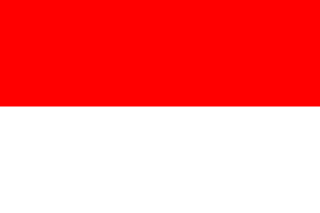
Indonesia
Republic of Indonesia
Population: UN WPP 2024, revision 1, projection for 1 July 2026. Sources and methodology.
Geography and territory
Indonesia is the largest archipelago on Earth, made up of more than 17,000 islands stretching across roughly 5,100 kilometers between the Indian and Pacific oceans. Covering 1,904,569 square kilometers, it ranks as the world’s 14th-largest country and straddles the boundary between Asia and Oceania. Its five main islands are Sumatra, Java, Borneo (Kalimantan), Sulawesi, and New Guinea (Papua), though only around 6,000 of its islands are inhabited. Indonesia shares land borders with Malaysia, Papua New Guinea, and Timor-Leste.
The country sits on the Pacific Ring of Fire, making it one of the most geologically active regions on the planet. Indonesia is home to more than 130 active volcanoes, including Krakatoa, whose 1883 eruption ranks among the most devastating in recorded history. Lake Toba in Sumatra, formed by a supervolcanic eruption roughly 75,000 years ago, is the largest volcanic lake in the world. This tectonic activity also leaves the country vulnerable to earthquakes and tsunamis, most notably the catastrophic 2004 tsunami that struck Aceh.
Straddling the equator, Indonesia has a tropical climate marked by warm temperatures and abundant rainfall year-round, with distinct wet and dry seasons shaped by monsoon winds that shift direction across the archipelago. It harbors the second-largest expanse of rainforest on Earth, surpassed only by the Amazon, and extraordinary biodiversity that includes orangutans in Sumatra and Borneo, the uniquely Indonesian Komodo dragon, critically endangered Javan rhinos, and thousands of endemic species of birds, reptiles, and plants. The coral reefs of Indonesia’s Coral Triangle make up the most biodiverse marine ecosystem on the planet, sustaining fishing communities and a growing dive tourism industry alike.
History
Indonesian history stretches back more than a million years to early hominids who inhabited Java, most famously Java Man, an early specimen of Homo erectus. Maritime trade routes turned the archipelago into a crossroads of civilizations: the Hindu-Buddhist kingdoms of Srivijaya (7th–13th centuries) and Majapahit (13th–15th centuries) extended their influence across Southeast Asia. The magnificent Borobudur temple, the largest Buddhist monument in the world, and the striking Hindu temple complex of Prambanan stand as testaments to that era’s splendor.
The spread of Islam, carried by Arab and Indian traders from the 13th century onward, gradually reshaped the archipelago’s religious identity. Europeans arrived in the 16th century in search of the prized spices of the Moluccas. After competition among the Portuguese, Spanish, and British, the Netherlands established colonial dominance that lasted more than three centuries, administered through the Dutch East India Company, which exploited the archipelago’s resources.
The nationalist movement, led by Sukarno, proclaimed independence on August 17, 1945, following the Japanese occupation during the Second World War. Sukarno governed as the country’s first president until 1967, when General Suharto seized power in a coup and established the so-called New Order, an authoritarian regime that lasted three decades while driving strong economic growth. The Asian financial crisis of 1997 triggered Suharto’s downfall and ushered in the reformasi era, which transformed Indonesia into the world’s third-largest democracy.
Culture and society
Indonesia is a remarkable cultural mosaic, home to more than 300 ethnic groups and over 700 living languages. Its national motto, Bhinneka Tunggal Ika (“Unity in Diversity”), reflects both the challenge and the richness of holding together a nation of such pluralism. Indonesian (Bahasa Indonesia), a lingua franca derived from Malay, serves as a unifying national language, though most Indonesians also speak a regional ethnic language.
Indonesia’s traditional arts are remarkably rich. Batik, a wax-resist textile dyeing technique, has been recognized by UNESCO as a masterpiece of intangible cultural heritage and stands as a national symbol. Gamelan, the metallic percussion orchestra of Java and Bali, produces hypnotic sounds that accompany ceremonial dances and performances of wayang kulit, shadow puppet theater that narrates episodes from the Ramayana and the Mahabharata.
With well over 200 million Muslims, Indonesia has the largest Muslim population of any country on Earth, though the faith is generally practiced in a moderate, syncretic form that incorporates Hindu, Buddhist, and animist elements. Bali stands out as a uniquely Hindu enclave, its temples, ceremonies, and dances renowned worldwide. The funerary traditions of the Toraja people in Sulawesi, the communal longhouses of the Batak in Sumatra, and the ritual ceremonies of Western Papua all reflect the archipelago’s deep cultural diversity.
Economy
Indonesia is the largest economy in Southeast Asia and a prominent member of the G20, with an output of roughly $1.45 trillion. Its economic model rests on a mix of agriculture, mining, manufacturing, and services. The country is one of the world’s leading producers of palm oil, rubber, cocoa, coffee, tea, and spices, a direct legacy of its historical role as the legendary Spice Islands. Mining contributes coal, nickel, tin, and copper, with Indonesia counting among the world’s top nickel exporters.
The manufacturing sector has grown substantially, with textile, footwear, electronics, and automotive industries drawing on an abundant and competitive labor force. Indonesia’s digital economy is booming, with tech unicorns such as GoTo (formed by the merger of Gojek and Tokopedia) and Traveloka transforming e-commerce, transportation, and digital payments across the archipelago.
Indonesia faces the challenge of balancing economic development with environmental sustainability. Deforestation linked to palm oil plantations and mining has drawn international criticism, while the country works to diversify its economy and reduce its dependence on raw commodities. The ambitious project to relocate the capital from Jakarta to Nusantara, on the island of Borneo, reflects the need to relieve congestion on Java, ease pressure on an already overcrowded capital, and spread development more evenly across the vast archipelago in the years ahead.
Food and cuisine
Indonesian cuisine mirrors the country’s extraordinary cultural and geographic diversity, with culinary traditions as varied as its hundreds of ethnic groups. Nasi goreng, or fried rice, is considered the national dish and appears in countless regional variations. Rendang, a slow-cooked beef stew simmered in coconut milk and spices that originated in West Sumatra, has repeatedly been ranked among the most delicious dishes in the world in international polls.
Javanese cooking is known for its sweeter flavors and generous use of peanut sauce in dishes such as gado-gado (vegetable salad) and satay (skewered grilled meat). Padang cuisine, from West Sumatra, is famous for its abundance and heat, served in the distinctive nasi Padang style where numerous dishes are laid out on the table at once. Balinese cooking incorporates spice blends such as base gede and dishes like babi guling (roast pork) that reflect the island’s unique Hindu heritage.
Street markets and warungs, small family-run eateries, form the heart of Indonesia’s food culture. Mie goreng (fried noodles), bakso (meatball soup), soto (spiced broth), and martabak (a sweet or savory stuffed pancake) are everyday delights within everyone’s reach. Indonesian coffee, from Sumatra Mandheling to the famed kopi luwak — one of the world’s most expensive coffees, processed through the digestive system of the civet — has earned international acclaim among specialty coffee enthusiasts.
Tourism and landmarks
Bali, the Island of the Gods, is Indonesia’s most famous destination and one of the most visited islands in the world. Temples such as Tanah Lot, perched on a rock battered by ocean waves, and Besakih, Bali’s mother temple, create scenes of mystical beauty. The rice terraces of Tegallalang, the beaches of Seminyak and Uluwatu, and the vibrant arts scene of Ubud round out an island that draws millions of visitors annually.
Borobudur temple in Central Java, with its 2,672 relief panels and 504 Buddha statues, is the largest Buddhist monument in the world and offers an awe-inspiring spiritual experience at sunrise. Nearby stands Prambanan, a spectacular complex of Hindu temples with towers reaching 47 meters. Komodo National Park allows visitors to observe the Komodo dragon, the largest lizard on Earth, in its natural habitat, surrounded by crystal-clear waters ideal for diving.
Indonesia’s natural diversity seems boundless. Raja Ampat, in West Papua, offers the most biodiverse diving on the planet, with more than 1,500 fish species recorded. The forests of Sumatra and Borneo offer close encounters with orangutans at rehabilitation centers such as Bukit Lawang. Lake Toba, with Samosir Island at its center, pairs volcanic scenery with the fascinating Batak culture. Active volcanoes such as Bromo and Ijen in Java offer spectacular climbs past smoking craters and turquoise acid lakes.
Fun facts about Indonesia
- Indonesia has more than 17,000 islands, of which only about 6,000 are inhabited, making it the largest archipelago in the world.
- Lake Toba in Sumatra, formed by a volcanic supereruption around 75,000 years ago, is the largest volcanic lake on the planet.
- The Komodo dragon, which can grow up to three meters long, exists in the wild only on a handful of Indonesian islands.
- Indonesia spans three time zones to cover its vast east-west extent.
- Indonesia has the largest Muslim population of any nation, yet its constitution officially recognizes six different religions.
- Krakatoa’s 1883 eruption produced what is believed to be the loudest sound ever recorded, reportedly heard some 4,800 kilometers away, and later gave rise to a new active volcano nicknamed Anak Krakatoa, or “Child of Krakatoa.”
Indonesia in numbers
Latest World Bank and UNDP observations, each with its own year. “World median” is the middle value among the countries that report the same indicator; “#” ranks from the highest value.
Population since 1960
Indonesia had 88.3 million people in 1960 and 285.7 million in 2025 — 3.2 times as many.
People
59.4% of people live in towns and cities (world median 63.4%). 24.2% are under 15 and 7.5% are 65 or older — a middle-aged population. Women have 2.12 children on average, close to the replacement level of about 2.1.
Economy
The economy grew by 5.1% in real terms in 2025. Consumer prices rose by 1.9% in 2025. Services make up the largest share of output (43.9% of GDP); agriculture contributes 13.1%.
Development and environment
UNDP rates human development in Indonesia as high, with an index of 0.728 in 2023 (rank 113 of 193). 72.8% of people use the internet and 99.9% have access to electricity. Forest covers 50.7% of the land (world median 32.8%).
Sources: World Bank, World Development Indicators (CC BY 4.0), most recent observation from 2015 onward; UNDP Human Development Report 2025. Retrieved 2026-10-10. Sector shares need not add up to 100% because taxes and subsidies on products are excluded. Missing values are left blank rather than estimated. Sources and methodology.
Climate of Indonesia
Averaged across Indonesia, the mean temperature stays between 25.6 °C (July) and 26.3 °C (April) — a swing of only 0.7 °C, so seasons are marked by rainfall rather than by heat.
About 2,767 mm of precipitation falls in a typical year. December is the wettest month (295 mm) and August the driest (162 mm). Rain is spread fairly evenly through the year.
Show monthly values as a table
| Month | Mean °C | Low °C | High °C | Precipitation, mm |
|---|---|---|---|---|
| January | 25.8 | 21.5 | 30.2 | 281 |
| February | 25.9 | 21.5 | 30.4 | 255 |
| March | 26.1 | 21.6 | 30.6 | 288 |
| April | 26.3 | 21.8 | 30.8 | 276 |
| May | 26.2 | 21.7 | 30.8 | 227 |
| June | 25.9 | 21.4 | 30.4 | 186 |
| July | 25.6 | 21.0 | 30.2 | 168 |
| August | 25.6 | 20.9 | 30.4 | 162 |
| September | 25.8 | 21.0 | 30.6 | 166 |
| October | 26.1 | 21.3 | 31.0 | 210 |
| November | 26.2 | 21.5 | 30.9 | 254 |
| December | 26.0 | 21.6 | 30.5 | 295 |
Figures are 1991–2020 averages across the whole land area of Indonesia, from the World Bank Climate Change Knowledge Portal, CRU TS 4.08 (CC BY 4.0). They are not readings from one weather station: the capital, the coast and high ground can be much warmer, cooler, wetter or drier.
Travel essentials for Indonesia
The practical details visitors ask about first. Traffic in Indonesia drives on the left, one of 54 of the 196 countries profiled here that do — see the full list. Mains electricity is 230 V at 50 Hz, so devices made only for 110–120 V (common in North America) need a converter unless they are dual-voltage — most phone and laptop chargers are.
- Emergency number
- 112Police 110 · Ambulance 118 · Fire 113
- Driving side
- Left
- Plug types
- Type C, Type FC: two round pins (Europlug); F: two round pins with side earth clips (Schuko)
- Voltage
- 230 V50 Hz
- Dialling code
- +62From abroad: your exit code, then 62 and the number
- Currency
- Indonesian Rupiah (IDR)
- Time zone
- WIB/WITA/WIT (UTC+7 to UTC+9)Current local time in Indonesia
Compiled from IEC plug and voltage standards, national emergency-service listings and the UN road-traffic conventions. Emergency numbers and local coverage can change — confirm them locally on arrival. Indonesia's internet domain is .id.
Where Indonesia ranks in the world
Each position counts only the countries with data in that ranking guide. First place is the highest value — for price levels, the most expensive. Select a card to see the full table.
- Population4th of 196287.9 millionUN projection, July 2026
- Land area14th of 1951,892,555 km²World Bank, 2023
- Population density61st of 194149 per km²World Bank, 2023
- GDP (nominal)16th of 187$1.40TWorld Bank, 2024, current US$
- GDP per capita116th of 187$4,925World Bank, 2024, current US$
- Life expectancy124th of 19471.3 yearsWorld Bank, 2024
- Price level119th of 16537 (US = 100)ICP 2021, household consumption
Bordering countries of Indonesia


Compare Indonesia with another country
Frequently asked questions about Indonesia
What is the capital of Indonesia?
The capital of Indonesia is Jakarta.
What is the population of Indonesia?
The UN World Population Prospects projection for Indonesia is 287,886,782 people (287.9 million) on 1 July 2026. National statistical offices may publish different estimates.
What language is spoken in Indonesia?
The official language of Indonesia is Indonesian (Bahasa Indonesia).
What currency is used in Indonesia?
The currency of Indonesia is the Indonesian Rupiah (IDR).
How big is Indonesia?
Indonesia covers an area of 1,904,569 km².
What type of government does Indonesia have?
Indonesia is a presidential republic.
Which countries border Indonesia?
Indonesia shares land borders with Malaysia, Papua New Guinea, Timor-Leste.
What is the highest point in Indonesia?
The highest point in Indonesia is Puncak Jaya (4,884 m).


