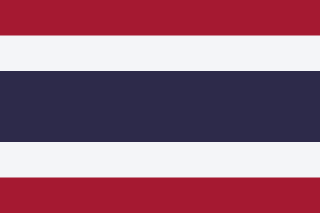
Thailand
Kingdom of Thailand
Population: UN WPP 2024, revision 1, projection for 1 July 2026. Sources and methodology.
Geography and territory
Thailand sits at the heart of Southeast Asia, covering 513,120 square kilometers that stretch from the forested mountains of the north to the tropical beaches of the south. It shares borders with Myanmar to the north and west, Laos to the northeast and east, Cambodia to the southeast, and Malaysia to the south. Viewed on a map, the country’s outline is often likened to the head of an elephant, the nation’s symbolic animal, with the Malay Peninsula forming its trunk trailing southward.
The Thai landscape divides into five distinct natural regions. The mountainous north, an extension of the eastern Himalayan foothills, holds the country’s highest point, Doi Inthanon at 2,565 meters, along with dense tropical forest. The Khorat Plateau in the northeast, known as Isan, forms a dry, elevated plain drained by the Mekong River. The central plain, fed by the Chao Phraya River, serves as the nation’s rice basket and one of the most productive agricultural zones in all of Asia.
Thailand’s coastline runs for more than 3,200 kilometers, bordered by the Gulf of Thailand to the east and the Andaman Sea to the west. The Andaman coast is famous for dramatic karst formations that rise straight out of the sea, their vertical cliffs draped in tropical greenery. The climate is tropical monsoon, cycling through a hot season, a rainy season, and a cooler season, though lowland temperatures rarely dip below 20 degrees Celsius. Biodiversity is considerable, with rainforests sheltering Asian elephants, tigers, gibbons, and an extraordinary range of tropical birdlife.
History
Thailand holds a distinction unique in Southeast Asia: it is the only country in the region never colonized by a European power, a fact that remains a deep source of national pride. Its name, meaning “Land of the Free,” reflects this singular history. The earliest Thai kingdoms emerged in the 13th century with Sukhothai, regarded as the cradle of Thai civilization, where the Thai script was developed and Theravada Buddhism was established as the foundation of the state.
The kingdom of Ayutthaya, which flourished from 1351 to 1767, turned Thailand into a regional power and a cosmopolitan trading center that maintained diplomatic ties with China, Japan, Persia, and several European nations. After Burmese forces destroyed Ayutthaya in 1767, King Taksin oversaw a rapid rebuilding effort, and in 1782 the Chakri dynasty founded Bangkok as the new capital, a dynasty that still occupies the throne today.
In the 19th century, Kings Mongkut (Rama IV) and Chulalongkorn (Rama V) modernized the country through shrewd diplomacy that preserved Thai independence even as France and Britain carved up the surrounding territories into colonies. The 1932 revolution converted the absolute monarchy into a constitutional one, though modern Thai political history has since alternated repeatedly between civilian governments and military coups. The monarchy remains a central and deeply revered institution in Thai society.
Culture and society
Theravada Buddhism runs through nearly every aspect of Thai culture, practiced by more than 90 percent of the population. The country’s more than 40,000 Buddhist temples, or wat, serve not only as places of worship but as centers of education, art, and community life. Thai men traditionally ordain as monks for a period, a rite of passage believed to generate spiritual merit for the entire family. The monarchy occupies a similarly sacred place in Thai life, and respect for the king is enforced through strict lèse-majesté laws.
The concept of sanuk, or finding enjoyment in daily activities, pervades Thai life alongside kreng jai, a deep consideration for others, and the easygoing philosophy of mai pen rai, or “never mind.” The famous Thai smile, which has earned the country its nickname “Land of Smiles,” conveys a far broader range of emotion than simple happiness. Festivals such as Songkran, the Thai New Year celebrated with citywide water fights in April, and Loi Krathong, when thousands of lanterns float on rivers and canals in November, produce some of the most striking public spectacles anywhere in Asia.
Traditional Thai arts include Khon, an elaborately masked classical dance drama based on the Ramakien, the Thai retelling of the Ramayana; muay thai, elevated to the status of a national martial art; and fine craftsmanship in silk, carved wood, and metalwork. Traditional Thai massage, with a history stretching back more than 2,500 years, combines pressure applied to energy points with assisted stretching and is recognized worldwide as a therapeutic practice.
Economy
Thailand is the second-largest economy in Southeast Asia and a solidly upper-middle-income emerging market. The country industrialized rapidly beginning in the 1960s and has since become a major manufacturing hub for automobiles, electronics, and processed food. It ranks among Asia’s largest producers and exporters of automobiles, with factories run by Toyota, Honda, Mitsubishi, and other major manufacturers earning it the nickname “Detroit of Asia.”
Tourism forms a central pillar of the economy, generating more than 10 percent of GDP and drawing over 35 million international visitors annually before the pandemic. Agriculture also remains significant, with Thailand ranking among the world’s top exporters of rice, natural rubber, cane sugar, and fishery products. The country’s food processing industry has reached global scale, making Thailand a leading exporter of canned tuna, shrimp, and tropical fruit.
The Thai economic model faces persistent challenges, including a stark divide between metropolitan Bangkok and rural regions, particularly the northeastern Isan area. Recurring political instability has periodically shaken investor confidence, though the economy has shown considerable resilience overall. The Eastern Economic Corridor, modeled loosely on China’s special economic zones, aims to attract investment in high-tech industries, robotics, aviation, and biotechnology to drive the country’s next phase of development.
Food and cuisine
Thai cuisine enjoys near-universal acclaim as one of the most balanced and flavorful in the world, built on the interplay of five core tastes: sweet, salty, sour, bitter, and spicy. Pad thai, stir-fried rice noodles with shrimp, tofu, peanuts, and lime, is perhaps the most internationally recognized Thai dish. Yet the true depth of Thai cooking reveals itself in preparations such as tom yum goong, a hot-and-sour shrimp soup with lemongrass and galangal, and green curry, a creamy, fragrant dish built on coconut milk and Thai basil.
Thai food breaks down into four major regional traditions. The north offers dishes like khao soi, a curried noodle soup with Burmese influence, and sai oua, a herb-packed sausage. The northeast, or Isan, is known for som tam (green papaya salad), laab (a minced meat salad), and sticky rice. The central region, centered on Bangkok, produced a more refined royal cuisine. The south leans into bolder Malay-influenced flavors, generous use of turmeric, and rich fish curries such as massaman, celebrated for the sheer complexity of its spice blend.
Thailand’s street food culture is legendary, praised repeatedly by chefs and food critics around the world. Bangkok’s night markets, such as Yaowarat in Chinatown and the stalls along Khao San Road, serve everything from satay skewers with peanut sauce to mango sticky rice, the country’s signature dessert. Singha and Chang beer commonly accompany meals, while a growing cocktail scene built around local ingredients like lemongrass, ginger, and chili has taken hold in the country’s major cities.
Tourism and landmarks
Bangkok, the country’s vibrant capital, dazzles visitors with the Grand Palace and the Temple of the Emerald Buddha, Wat Phra Kaew, whose gilded spires and multicolored roofs form one of the most iconic images of the country. Wat Arun, the Temple of Dawn, rises majestically beside the Chao Phraya River, its central spire encrusted with porcelain. The floating markets of Damnoen Saduak, the canals of Thonburi, and the frenetic energy of Khao San Road round out a city that never fails to leave an impression.
The islands and beaches of southern Thailand rank among the world’s premier tropical destinations. Phuket, the country’s largest island, offers everything from luxury resorts to the lively nightlife of Patong. The Phi Phi Islands, home to the famed Maya Bay, and Phang Nga Bay, with its dramatic limestone karsts rising from turquoise water, deliver postcard scenery at every turn. Koh Samui, Koh Phangan (famous for its full moon parties), and Koh Tao, a mecca for accessible diving, draw travelers from around the globe.
Northern Thailand offers a slower, more culturally immersive experience. Chiang Mai, known as the Rose of the North, boasts more than 300 Buddhist temples within its charming walled old city. Sukhothai Historical Park preserves the ruins of the kingdom’s first capital, with serene Buddha statues set among ancient pillars and lotus ponds. Chiang Rai captivates visitors with the White Temple, Wat Rong Khun, a dazzlingly original work of contemporary art, while nearby hill-tribe villages offer encounters with communities such as the Karen, Hmong, and Akha.
Fun facts about Thailand
- Thailand is the only country in Southeast Asia never colonized by a European power, giving rise to its name, which means “Land of the Free.”
- Bangkok’s full ceremonial name in Thai runs to 168 letters and is recorded as the longest city name in the world.
- The elephant is Thailand’s national animal, and more than 3,000 domesticated elephants live at festivals and conservation centers around the country.
- Chiang Mai’s Yi Peng festival, when thousands of paper lanterns rise into the night sky, is one of the most photographed sights in Southeast Asia.
- Thailand is the world’s largest exporter of rice and one of the top producers of natural rubber globally.
- Every muay thai match opens with the wai kru, a ritual dance paying respect to teachers before the fighting begins.
Thailand in numbers
Latest World Bank and UNDP observations, each with its own year. “World median” is the middle value among the countries that report the same indicator; “#” ranks from the highest value.
Population since 1960
Thailand had 26.9 million people in 1960 and 71.6 million in 2025 — 2.7 times as many.
People
62.8% of people live in towns and cities (world median 63.4%). 14.4% are under 15 and 16.0% are 65 or older — an ageing population. Women have 1.20 children on average, below the replacement level of about 2.1 needed to keep a population stable in the long run without migration.
Economy
The economy grew by 2.4% in real terms in 2025. Consumer prices fell by 0.1% in 2025. Services make up the largest share of output (60.2% of GDP); agriculture contributes 8.7%.
Development and environment
UNDP rates human development in Thailand as high, with an index of 0.798 in 2023 (rank 76 of 193). 90.9% of people use the internet and 100.0% have access to electricity. Forest covers 38.7% of the land (world median 32.8%).
Sources: World Bank, World Development Indicators (CC BY 4.0), most recent observation from 2015 onward; UNDP Human Development Report 2025. Retrieved 2026-10-10. Sector shares need not add up to 100% because taxes and subsidies on products are excluded. Missing values are left blank rather than estimated. Sources and methodology.
Climate of Thailand
Averaged across Thailand, the warmest month is April (29.3 °C) and the coolest is December (23.9 °C), a seasonal swing of 5.4 °C. The annual mean is 26.9 °C.
About 1,610 mm of precipitation falls in a typical year. August is the wettest month (273 mm) and February the driest (17 mm). The wettest stretch is July to September, with 47% of the year's total.
Show monthly values as a table
| Month | Mean °C | Low °C | High °C | Precipitation, mm |
|---|---|---|---|---|
| January | 24.1 | 17.7 | 30.6 | 22 |
| February | 25.8 | 19.0 | 32.6 | 17 |
| March | 28.0 | 21.5 | 34.5 | 47 |
| April | 29.3 | 23.5 | 35.3 | 92 |
| May | 28.8 | 23.9 | 33.7 | 191 |
| June | 28.1 | 23.9 | 32.4 | 213 |
| July | 27.6 | 23.7 | 31.6 | 223 |
| August | 27.4 | 23.5 | 31.3 | 273 |
| September | 27.1 | 23.1 | 31.3 | 263 |
| October | 26.7 | 22.3 | 31.1 | 158 |
| November | 25.6 | 20.4 | 30.8 | 73 |
| December | 23.9 | 18.1 | 29.8 | 38 |
Figures are 1991–2020 averages across the whole land area of Thailand, from the World Bank Climate Change Knowledge Portal, CRU TS 4.08 (CC BY 4.0). They are not readings from one weather station: the capital, the coast and high ground can be much warmer, cooler, wetter or drier.
Travel essentials for Thailand
The practical details visitors ask about first. Traffic in Thailand drives on the left, one of 54 of the 196 countries profiled here that do — see the full list. Mains electricity is 230 V at 50 Hz, so devices made only for 110–120 V (common in North America) need a converter unless they are dual-voltage — most phone and laptop chargers are.
- Emergency number
- 191Ambulance 1669 · Fire 199
- Driving side
- Left
- Plug types
- Type A, Type B, Type C, Type OA: two flat parallel pins; B: two flat pins plus a round earth pin; C: two round pins (Europlug); O: three round pins (Thai)
- Voltage
- 230 V50 Hz
- Dialling code
- +66From abroad: your exit code, then 66 and the number
- Currency
- Thai Baht (THB)
- Time zone
- ICT (UTC+7)Current local time in Thailand
Compiled from IEC plug and voltage standards, national emergency-service listings and the UN road-traffic conventions. Emergency numbers and local coverage can change — confirm them locally on arrival. Thailand's internet domain is .th.
Where Thailand ranks in the world
Each position counts only the countries with data in that ranking guide. First place is the highest value — for price levels, the most expensive. Select a card to see the full table.
- Population21st of 19671.6 millionUN projection, July 2026
- Land area50th of 195510,890 km²World Bank, 2023
- Population density67th of 194140 per km²World Bank, 2023
- GDP (nominal)30th of 187$529.4BWorld Bank, 2024, current US$
- GDP per capita94th of 187$7,387World Bank, 2024, current US$
- Life expectancy71st of 19476.6 yearsWorld Bank, 2024
- Price level121st of 16537 (US = 100)ICP 2021, household consumption
Bordering countries of Thailand


Compare Thailand with another country
Frequently asked questions about Thailand
What is the capital of Thailand?
The capital of Thailand is Bangkok.
What is the population of Thailand?
The UN World Population Prospects projection for Thailand is 71,559,614 people (71.6 million) on 1 July 2026. National statistical offices may publish different estimates.
What language is spoken in Thailand?
The official language of Thailand is Thai.
What currency is used in Thailand?
The currency of Thailand is the Thai Baht (THB).
How big is Thailand?
Thailand covers an area of 513,120 km².
What type of government does Thailand have?
Thailand is a constitutional monarchy.
Which countries border Thailand?
Thailand shares land borders with Myanmar, Laos, Cambodia, Malaysia.
What is the highest point in Thailand?
The highest point in Thailand is Doi Inthanon (2,565 m).


