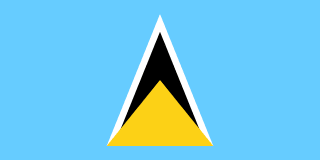
Saint Lucia
Saint Lucia
Population: UN WPP 2024, revision 1, projection for 1 July 2026. Sources and methodology.
Geography and territory
Saint Lucia is a volcanic island of 616 square kilometers rising from the eastern Caribbean’s Lesser Antilles chain, positioned between Martinique to the north and Saint Vincent and the Grenadines to the southwest. Stretching roughly 43 kilometers long and 22 kilometers wide, it ranks among the most rugged and mountainous islands in the region, its interior draped in dense tropical rainforest that spills down toward beaches of golden and volcanic black sand.
The island’s most recognizable feature is the Pitons, twin volcanic spires known as Gros Piton, at 771 meters, and Petit Piton, at 743 meters, that shoot straight up from the sea near the town of Soufriere on the southwestern coast. Named a UNESCO World Heritage Site in 2004, they form one of the most photographed landscapes anywhere in the Caribbean. The island’s true high point, however, lies inland at Mount Gimie, which reaches 950 meters.
Saint Lucia’s volcanic origins remain vividly visible near Soufriere, where the Sulphur Springs geothermal field bubbles with fumaroles, boiling mud pools, and sulfurous waters. The climate is tropical, tempered by steady northeasterly trade winds, with a dry season running from December to May and a wetter season from June through November, during which the island can be affected by tropical storms and hurricanes. Home to 180,149 people, Saint Lucia pairs a small population with an outsized natural and cultural profile.
Beyond the Pitons, the island’s interior is laced with rainforest reserves, freshwater streams, and steep ridgelines that make road travel between towns slower and more scenic than the map suggests. The Central Forest Reserve, straddling the mountainous spine of the island, is home to the rare Saint Lucia parrot, a vividly colored bird found nowhere else on Earth and now a national symbol of conservation success after decades of recovery efforts. Along the coasts, fishing villages, marinas, and resort towns are strung between headlands, giving the island a layered geography where mountain, forest, and sea are rarely more than a few kilometers apart.
History
The island’s earliest inhabitants were Arawak peoples who arrived from South America around the third or fourth century, later displaced by the Kalinago, or Carib people, who called the island Iouanalao and Hewanorra, meaning “land of the iguanas,” a name still carried today by the island’s international airport. Unlike many neighboring islands, the Kalinago successfully resisted European settlement for much of the seventeenth century.
Few colonies changed hands as often as Saint Lucia, which passed between France and Britain fourteen times over the seventeenth, eighteenth, and nineteenth centuries, earning it the nickname “the Helen of the West Indies,” a nod to Helen of Troy. French settlers founded Soufriere in 1746 and established sugar plantations worked by enslaved Africans; Britain secured lasting control in 1814 under the Treaty of Paris.
Slavery was abolished in 1834. For more than a century afterward, the island functioned as a British sugar and, later, banana colony, before gaining internal self-government as an Associated State in 1967. Full independence arrived on February 22, 1979, within the Commonwealth of Nations. Since then, Saint Lucia has remained a stable parliamentary democracy, with power alternating peacefully between its two main political parties.
The scars and legacies of this turbulent colonial past are still visible in the island’s place names, architecture, and legal traditions, which mix French civil law influences with a British-style parliamentary system and judiciary. Soufriere, the old French colonial town near the Pitons, retains much of its historic charm, while forts built to defend against rival naval powers still crown several of the island’s headlands. As a member of the Commonwealth, Saint Lucia recognizes the British monarch as ceremonial head of state, represented locally by a governor-general, while day-to-day governance rests with an elected prime minister and parliament.
Culture and society
Saint Lucian culture blends African, French, British, and indigenous influences into something distinctly its own. English is the official language, but most Saint Lucians also speak Kwéyòl, a French-based Creole that remains vibrant in music, radio broadcasting, and everyday conversation. Every October, the island celebrates Jounen Kwéyòl, a day dedicated to Creole language and traditions.
For its size, Saint Lucia holds an extraordinary intellectual distinction: it has produced more Nobel laureates per capita than any other country in the world, thanks to economist W. Arthur Lewis, who won the Nobel Prize in Economics in 1979, and poet and playwright Derek Walcott, awarded the Nobel Prize in Literature in 1992 for a body of work that includes his epic Caribbean poem “Omeros.”
Saint Lucian society is predominantly of African descent, with smaller mixed-race, Indian, and European communities, and reflects a largely Catholic tradition inherited from French colonization alongside a strong Protestant presence. The island’s rival flower societies, La Rose and La Marguerite, which stage competing songs and processions, represent a cultural tradition found nowhere else. Musically, calypso, soca, and zouk thrive alongside the internationally acclaimed Saint Lucia Jazz Festival, while cricket, as across much of the former British Caribbean, remains the national sport.
Storytelling, proverbs, and oral history passed down in Kwéyòl remain a living part of village life, particularly in rural communities along the east coast, where French Creole influence runs deepest. Traditional dress for festivals and cultural performances often features madras plaid fabric, a legacy of French colonial trade with India that has become a recognizable symbol of Saint Lucian identity. Family and community ties remain strong, and religious holidays, harvest festivals, and fishing-village patronal feasts continue to structure the social calendar across the island.
Economy
Tourism now forms the backbone of Saint Lucia’s economy, generating roughly half of the island’s output and employment. Cruise ships docking at Castries, luxury resorts along the northwestern coast, and nature-based tourism centered on Soufriere together drive the services sector that dominates the modern economy.
For much of the twentieth century, the island’s economy was primarily agricultural, with bananas as the star export crop shipped to the United Kingdom. The erosion of preferential European trade access in the late 1990s dealt the sector a serious blow, and while bananas, cocoa, coconuts, and tropical fruit remain relevant, they now trail far behind tourism in economic importance. The island also produces well-regarded rum and maintains a small light-manufacturing sector alongside offshore financial services.
Like other small island economies, Saint Lucia remains vulnerable to hurricanes and swings in international tourism demand. It shares its currency, the Eastern Caribbean dollar, with seven other members of the Organisation of Eastern Caribbean States, all served by a common regional central bank.
Efforts to diversify beyond hospitality have focused on renewable energy, information and communications technology, and niche agriculture such as cacao for the artisanal chocolate trade. Small farms and family-run guesthouses still play an important role alongside larger resort chains, giving the tourism sector a mix of scales that helps spread income across different communities. Infrastructure investment in ports, roads, and the international airport at Hewanorra continues to be a policy priority as the government looks to accommodate steady growth in visitor numbers.
Food and cuisine
Saint Lucian cooking merges French technique, African pantry staples, and Creole ingredients. The national dish, green fig and saltfish, pairs boiled green bananas with salted, flaked fish, a direct legacy of the colonial era. Hearty, well-spiced stews are common, including bouyon, a filling pot of meat, root vegetables, and dumplings, alongside grilled fish and seafood and lambi, or conch.
The markets of Castries overflow with mangoes, guavas, papayas, coconuts, and the root vegetables locally known as “ground provisions,” including yam, dasheen, and sweet potato. Friday nights are something of an institution, with the Anse La Raye fish fry and the Gros Islet street party drawing crowds for grilled fish and chicken served up to a soundtrack of soca. Meals are typically washed down with local rum, Piton beer, or hot cocoa made from the island’s own cacao, whose cultivation is enjoying a revival tied to a growing artisanal chocolate industry.
Street food culture is strong across the island, with vendors selling accra, deep-fried saltfish fritters, alongside roasted corn, bakes, and johnnycakes at roadside stands. Sunday lunch remains an important family ritual in many households, often centered on stewed chicken or fish, rice and peas, and a selection of ground provisions simmered together. Restaurants in Rodney Bay and Castries increasingly blend these traditional flavors with international techniques, reflecting the island’s growing reputation as a culinary destination in its own right.
Tourism and landmarks
Saint Lucia ranks among the most sought-after destinations in the Caribbean, particularly popular with honeymooners. Its signature attraction is the Pitons and the surrounding Soufriere area, home to the “drive-in” volcano at Sulphur Springs, often promoted as the only volcano in the world accessible by car, along with therapeutic mud baths, the Diamond Falls waterfall and botanical gardens, and some of the island’s finest panoramic views.
In the north, the capital, Castries, offers a lively central market and the Cathedral of the Immaculate Conception, while Rodney Bay is the hub for beaches, marinas, and nightlife. Pigeon Island National Park preserves eighteenth-century forts with sweeping views across the Saint Lucia Channel. Hikers can climb Gros Piton on a guided trail or explore rainforest paths through the interior, while the west coast offers excellent diving and snorkeling. The island’s calendar highlights include a renowned jazz festival each May and a colorful carnival in July.
Beyond the headline sights, smaller attractions reward travelers willing to venture off the main routes. The fishing village of Anse La Raye and the historic town of Dennery offer a quieter, more local view of island life, while the botanical gardens scattered around Soufriere showcase the island’s extraordinary plant diversity, from heliconias to towering rainforest trees. Boat tours along the west coast combine snorkeling stops with views of the Pitons from the water, often spotting sea turtles and, seasonally, migrating whales offshore.
Fun facts about Saint Lucia
- Saint Lucia is the only country in the world named after a historical woman, Saint Lucy of Syracuse, a fourth-century Christian martyr.
- With two Nobel laureates, economist W. Arthur Lewis and writer Derek Walcott, and fewer than 200,000 people, it has more Nobel Prize winners per capita than any nation on Earth; remarkably, both were born on January 23.
- The island changed hands between France and Britain fourteen times, more often than any other island in the Caribbean.
- The twin Pitons lend their name to Piton, the national beer, and are featured prominently on the country’s flag alongside the blue of sea and sky.
- Hewanorra International Airport still carries the Kalinago name for the island, meaning “land of the iguanas.”
- Sulphur Springs near Soufriere markets itself as “the world’s only drive-in volcano.”
Saint Lucia in numbers
Latest World Bank and UNDP observations, each with its own year. “World median” is the middle value among the countries that report the same indicator; “#” ranks from the highest value.
Population since 1960
Saint Lucia had 92,585 people in 1960 and 180,149 in 2025 — 95% more.
People
29.1% of people live in towns and cities (world median 63.4%). 17.2% are under 15 and 10.0% are 65 or older — a middle-aged population. Women have 1.39 children on average, below the replacement level of about 2.1 needed to keep a population stable in the long run without migration.
Economy
The economy shrank by 0.6% in real terms in 2025. Consumer prices rose by 2.0% in 2025. Services make up the largest share of output (73.8% of GDP); agriculture contributes 1.7%.
Development and environment
UNDP rates human development in Saint Lucia as high, with an index of 0.748 in 2023 (rank 103 of 193). 68.2% of people use the internet and 100.0% have access to electricity. Forest covers 53.8% of the land (world median 32.8%).
Sources: World Bank, World Development Indicators (CC BY 4.0), most recent observation from 2015 onward; UNDP Human Development Report 2025. Retrieved 2026-10-10. Sector shares need not add up to 100% because taxes and subsidies on products are excluded. Missing values are left blank rather than estimated. Sources and methodology.
Climate of Saint Lucia
Averaged across Saint Lucia, the mean temperature stays between 25.7 °C (January) and 28.0 °C (June) — a swing of only 2.3 °C, so seasons are marked by rainfall rather than by heat.
About 2,082 mm of precipitation falls in a typical year. November is the wettest month (292 mm) and March the driest (73 mm). The wettest stretch is September to November, with 38% of the year's total.
Show monthly values as a table
| Month | Mean °C | Low °C | High °C | Precipitation, mm |
|---|---|---|---|---|
| January | 25.7 | 22.6 | 28.8 | 114 |
| February | 25.7 | 22.7 | 28.7 | 80 |
| March | 26.1 | 22.9 | 29.4 | 73 |
| April | 26.9 | 23.8 | 30.1 | 117 |
| May | 27.7 | 24.7 | 30.7 | 145 |
| June | 28.0 | 25.2 | 30.7 | 187 |
| July | 28.0 | 25.2 | 30.8 | 208 |
| August | 28.0 | 25.1 | 31.0 | 207 |
| September | 27.9 | 24.8 | 31.1 | 239 |
| October | 27.5 | 24.3 | 30.8 | 269 |
| November | 27.1 | 24.0 | 30.2 | 292 |
| December | 26.3 | 23.4 | 29.4 | 152 |
Figures are 1991–2020 averages across the whole land area of Saint Lucia, from the World Bank Climate Change Knowledge Portal, CRU TS 4.08 (CC BY 4.0). They are not readings from one weather station: the capital, the coast and high ground can be much warmer, cooler, wetter or drier.
Travel essentials for Saint Lucia
The practical details visitors ask about first. Traffic in Saint Lucia drives on the left, one of 54 of the 196 countries profiled here that do — see the full list. Mains electricity is 230 V at 50 Hz, so devices made only for 110–120 V (common in North America) need a converter unless they are dual-voltage — most phone and laptop chargers are.
- Emergency number
- 911
- Driving side
- Left
- Plug types
- Type GG: three rectangular pins (British)
- Voltage
- 230 V50 Hz
- Dialling code
- +1-758From abroad: your exit code, then 1-758 and the number
- Currency
- Eastern Caribbean Dollar (XCD)
- Time zone
- AST (UTC-4)Current local time in Saint Lucia
Compiled from IEC plug and voltage standards, national emergency-service listings and the UN road-traffic conventions. Emergency numbers and local coverage can change — confirm them locally on arrival. Saint Lucia's internet domain is .lc.
Where Saint Lucia ranks in the world
Each position counts only the countries with data in that ranking guide. First place is the highest value — for price levels, the most expensive. Select a card to see the full table.
- Population178th of 196180,488UN projection, July 2026
- Land area178th of 195610 km²World Bank, 2023
- Population density30th of 194294 per km²World Bank, 2023
- GDP (nominal)165th of 187$2.6BWorld Bank, 2024, current US$
- GDP per capita64th of 187$14,494World Bank, 2024, current US$
- Life expectancy105th of 19472.8 yearsWorld Bank, 2024
- Price level47th of 16561 (US = 100)ICP 2021, household consumption
Compare Saint Lucia with another country
Frequently asked questions about Saint Lucia
What is the capital of Saint Lucia?
The capital of Saint Lucia is Castries.
What is the population of Saint Lucia?
The UN World Population Prospects projection for Saint Lucia is 180,488 people (180,488) on 1 July 2026. National statistical offices may publish different estimates.
What language is spoken in Saint Lucia?
The official language of Saint Lucia is English.
What currency is used in Saint Lucia?
The currency of Saint Lucia is the Eastern Caribbean Dollar (XCD).
How big is Saint Lucia?
Saint Lucia covers an area of 616 km².
What type of government does Saint Lucia have?
Saint Lucia is a parliamentary monarchy.
What is the highest point in Saint Lucia?
The highest point in Saint Lucia is Mount Gimie (950 m).


