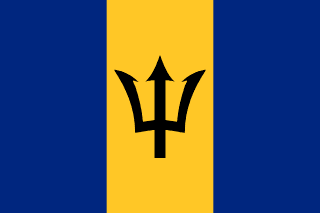
Barbados
Barbados
Population: UN WPP 2024, revision 1, projection for 1 July 2026. Sources and methodology.
Geography and territory
Barbados is the easternmost island in the Caribbean, standing apart from the arc of the Lesser Antilles in the open Atlantic Ocean, roughly 100 miles east of Saint Vincent and the Grenadines. Covering just 430 square kilometers and measuring about 21 miles long by 14 miles wide, it ranks among the smallest sovereign nations in the Western Hemisphere. Unlike most of its volcanic Caribbean neighbors, Barbados was built by coral: millions of years of accumulated coral deposits atop a sedimentary shelf gave the island its distinctive limestone foundation.
The terrain is comparatively flat and gently terraced, rising in coral shelves from the coastline toward the interior highlands. Mount Hillaby, at 336 meters, is the island’s highest point, tucked into the parish of Saint Andrew. The west coast, shielded from the trade winds and washed by the calm Caribbean Sea, is lined with golden sand and glassy water, while the east coast faces the open Atlantic directly, producing a rougher, more dramatic shoreline of cliffs, dark sand, and powerful surf that draws wave riders from around the world.
Trade winds out of the northeast keep the tropical climate comfortable year-round, with temperatures typically ranging between 24 and 30 degrees Celsius. Because its porous limestone soil absorbs rainfall so readily, Barbados has no major rivers, but it does hold an extensive network of underground caverns, the most spectacular of which is Harrison’s Cave. Offshore, coral reefs ring the island and shelter a rich marine world of sea turtles, tropical fish, and seahorses.
The island is politically divided into eleven parishes, each with its own distinct character, from the bustling capital parish of Saint Michael to the quiet, agricultural interior of Saint John and Saint Philip. Gully systems, formed by collapsed cave networks, thread through the countryside and support pockets of dense tropical vegetation that survived the plantation era. Despite its small footprint, Barbados packs in a remarkable variety of landscapes within a short drive, from rugged Atlantic cliffs to sheltered coves and gently rolling cane fields.
History
Long before Europeans arrived, Barbados was home to Arawak and later Carib peoples. Portuguese sailors sighted the island in the early sixteenth century and gave it the name “Os Barbados,” or “the bearded ones,” inspired by the hanging aerial roots of the bearded fig trees they found along the shore. The English established the first permanent settlement in 1627, and Barbados went on to become one of Britain’s oldest Caribbean colonies, remaining under uninterrupted British rule for 339 years until independence.
Sugarcane, introduced in the 1640s, transformed the island almost overnight. Barbados quickly became the leading sugar producer in the British world, generating enormous wealth for plantation owners while relying on the forced labor of thousands of enslaved Africans. Plantations covered nearly every acre of arable land, wiping out most of the island’s original vegetation in the process. Bussa’s Rebellion of 1816, the largest uprising by enslaved people in Barbadian history, stands as a landmark moment on the long road to the abolition of slavery in 1834.
Barbados won its independence from the United Kingdom on 30 November 1966 under the leadership of Errol Barrow, who became the island’s first prime minister and remains widely honored as the father of the nation. Independence came peacefully, through negotiation rather than conflict, and Barbados went on to build one of the Caribbean’s most stable parliamentary democracies, with regular elections and an uninterrupted constitutional tradition. In November 2021, the nation took a further historic step by becoming a republic, replacing the British monarch as head of state with an elected president, Dame Sandra Mason. That transition marked the culmination of a long process of cultural and political decolonization, cementing a fully sovereign Barbadian identity.
Culture and society
Barbadian culture, affectionately known as “Bajan,” blends African and British traditions into something distinctly Caribbean. Crop Over, a festival marking the end of the sugarcane harvest, is the most important celebration on the island’s calendar, building to Grand Kadooment Day, a riotous parade of costumed troupes, soca and calypso music, and an infectious energy that rivals the Caribbean’s biggest carnivals.
Barbadian music has reached a truly global audience through Rihanna, born in Bridgetown and one of the best-selling recording artists in history, now honored as a National Hero and cultural ambassador for the island. Calypso and soca remain the island’s signature musical genres, with annual Crop Over competitions that continue to launch new talent. Tuk music, a homegrown Barbadian style played with flute, bass drum, and snare, traces its roots to British military bands reshaped by African rhythmic influence.
Barbadian society boasts one of the highest standards of living in the Caribbean, with universal access to education and health care. Cricket functions almost as a national religion, uniting the island and producing legends such as Sir Garfield Sobers and Sir Frank Worrell. The University of the West Indies maintains a campus on the island that serves as a regional academic hub. Bajan dialect, an English-based creole full of local color, remains a proud marker of the island’s cultural identity.
Economy
Barbados has shifted dramatically from a sugar-dependent economy to a diversified, services-driven one. Tourism is now the chief economic engine, drawing more than a million visitors annually to its beaches, its warm hospitality, and its well-developed resort infrastructure. The west coast, nicknamed the “Platinum Coast,” is home to luxury resorts and villas catering to affluent travelers.
International financial services form the second pillar of the economy, with Barbados established as a respected offshore business center backed by numerous double-taxation treaties. Light manufacturing, including food and beverage processing and electronic components, adds further diversification. Rum production carries both economic and cultural weight, led by Mount Gay, the oldest continuously operating rum distillery in the world, founded in 1703.
The island faces real challenges, including vulnerability to hurricanes, coastal erosion, the high cost of imported energy, and a significant public debt burden. The government has pursued reforms to sharpen competitiveness, including a remote-work visa program aimed at attracting digital nomads, and has invested in renewable energy projects, particularly solar power, in an effort to reduce reliance on imported fuel. Agriculture, though much reduced from its plantation-era scale, still yields sugarcane, vegetables, and ornamental plants, while small-scale flying fish fishing endures as both an economic activity and a cultural touchstone. Barbados also maintains close economic ties with its Caribbean Community partners and continues to position itself as a hub for regional trade and business services.
Food and cuisine
Barbadian cuisine fuses African, British, Indian, and Caribbean influences into vivid, comforting flavors. The national dish is cou-cou and flying fish: cou-cou is a slow-cooked cornmeal and okra preparation with a creamy yet firm texture, served alongside flying fish stewed in a spiced tomato sauce. Flying fish are so central to island identity that Barbados is often called “the land of the flying fish.”
Pudding and souse, a beloved Saturday tradition, pairs a spiced sweet-potato pudding with pickled pork marinated in lime, cucumber, onion, and pepper. Fish cakes, cutters (salt-bread sandwiches stuffed with various fillings), and macaroni pie, a baked and cheesy macaroni casserole, are everyday staples across the island. Pea soup with salted pork is another comforting Saturday classic.
Barbadian rum enjoys worldwide renown, and the island is widely regarded as the birthplace of Caribbean rum, with Mount Gay distilling since 1703. The classic Bajan rum punch follows the old rhyme “one of sour, two of sweet, three of strong, four of weak,” combining lime, sugar, rum, and water. Popular desserts include coconut bread, conkies (sweet cornmeal parcels with coconut and spices, steamed in banana leaves and traditionally eaten on Independence Day), and guava cheese, a firm, sweet guava confection.
Tourism and landmarks
Bridgetown, the capital, and its historic garrison were named a UNESCO World Heritage Site in 2011. The historic center showcases British colonial architecture, including the Barbados Parliament Buildings, one of the oldest legislatures in the Western Hemisphere, established in 1639, alongside St. Michael’s Cathedral and the Cheapside public market. A statue of Lord Nelson stands in National Heroes Square, predating London’s more famous Trafalgar Square column.
The west coast, with beaches such as Mullins Beach, Paynes Bay, and Sandy Lane, offers calm, clear water ideal for swimming, snorkeling, and sea turtle encounters. Harrison’s Cave, a limestone cavern system with stalactites, stalagmites, underground streams, and waterfalls, is a geological showpiece explored by electric tram. Hunte’s Gardens, planted inside a collapsed cave gully, hold an extraordinary tropical botanical collection.
The east coast, anchored by Bathsheba and its Atlantic-carved rock formations, offers a wilder, more dramatic landscape and hosts international surfing competitions. St. Nicholas Abbey, a Jacobean plantation house dating to 1658, complete with a working artisanal rum distillery and a historic steam railway, offers a vivid window into the island’s sugar-era past. Animal Flower Cave, at the island’s northern tip, is Barbados’s only accessible sea cave, with natural pools and sweeping ocean views.
Fun facts about Barbados
- Barbados is often called the birthplace of Caribbean rum: Mount Gay has been distilling on the island since 1703, making it the world’s oldest rum brand still in production.
- Rihanna, born Robyn Rihanna Fenty in Bridgetown, is a National Hero of Barbados and one of the best-selling music artists of all time.
- Barbados became a republic in November 2021, replacing the British monarch with an elected head of state after roughly four centuries of ties to the crown.
- The Barbados Parliament, established in 1639, is one of the oldest legislative bodies in the Western Hemisphere.
- The flying fish is so central to Barbadian identity that it appears on coins and coats of arms, and the island is nicknamed “the land of the flying fish.”
- With more than 600 people per square kilometer, Barbados has one of the highest population densities in the Americas.
Barbados in numbers
Latest World Bank and UNDP observations, each with its own year. “World median” is the middle value among the countries that report the same indicator; “#” ranks from the highest value.
Population since 1960
Barbados had 230,893 people in 1960 and 282,623 in 2025 — 22% more.
People
59.7% of people live in towns and cities (world median 63.4%). 17.1% are under 15 and 17.1% are 65 or older — an ageing population. Women have 1.71 children on average, below the replacement level of about 2.1 needed to keep a population stable in the long run without migration.
Economy
The economy grew by 2.7% in real terms in 2025. Consumer prices rose by 0.8% in 2025. Services make up the largest share of output (75.8% of GDP); agriculture contributes 1.6%.
Development and environment
UNDP rates human development in Barbados as very high, with an index of 0.811 in 2023 (rank 69 of 193). 70.4% of people use the internet and 100.0% have access to electricity. Forest covers 14.6% of the land (world median 32.8%).
Sources: World Bank, World Development Indicators (CC BY 4.0), most recent observation from 2015 onward; UNDP Human Development Report 2025. Retrieved 2026-10-10. Sector shares need not add up to 100% because taxes and subsidies on products are excluded. Missing values are left blank rather than estimated. Sources and methodology.
Climate of Barbados
Averaged across Barbados, the mean temperature stays between 25.4 °C (January) and 27.5 °C (June) — a swing of only 2.1 °C, so seasons are marked by rainfall rather than by heat.
About 1,536 mm of precipitation falls in a typical year. November is the wettest month (218 mm) and March the driest (53 mm). The wettest stretch is September to November, with 39% of the year's total.
Show monthly values as a table
| Month | Mean °C | Low °C | High °C | Precipitation, mm |
|---|---|---|---|---|
| January | 25.4 | 21.9 | 29.0 | 86 |
| February | 25.4 | 21.7 | 29.1 | 54 |
| March | 25.9 | 21.9 | 29.9 | 53 |
| April | 26.6 | 22.7 | 30.5 | 77 |
| May | 27.3 | 23.6 | 31.2 | 91 |
| June | 27.5 | 24.0 | 31.0 | 134 |
| July | 27.2 | 23.9 | 30.7 | 144 |
| August | 27.4 | 23.9 | 31.0 | 169 |
| September | 27.3 | 23.8 | 31.0 | 194 |
| October | 27.0 | 23.4 | 30.6 | 194 |
| November | 26.6 | 23.3 | 30.0 | 218 |
| December | 26.0 | 22.6 | 29.3 | 122 |
Figures are 1991–2020 averages across the whole land area of Barbados, from the World Bank Climate Change Knowledge Portal, CRU TS 4.08 (CC BY 4.0). They are not readings from one weather station: the capital, the coast and high ground can be much warmer, cooler, wetter or drier.
Travel essentials for Barbados
The practical details visitors ask about first. Traffic in Barbados drives on the left, one of 54 of the 196 countries profiled here that do — see the full list. Mains electricity is 115 V at 50 Hz, so appliances built only for 220–240 V need a voltage converter.
- Emergency number
- 211Ambulance 511 · Fire 311
- Driving side
- Left
- Plug types
- Type A, Type BA: two flat parallel pins; B: two flat pins plus a round earth pin
- Voltage
- 115 V50 Hz
- Dialling code
- +1-246From abroad: your exit code, then 1-246 and the number
- Currency
- Barbadian Dollar (BBD)
- Time zone
- AST (UTC-4)Current local time in Barbados
Compiled from IEC plug and voltage standards, national emergency-service listings and the UN road-traffic conventions. Emergency numbers and local coverage can change — confirm them locally on arrival. Barbados's internet domain is .bb.
Where Barbados ranks in the world
Each position counts only the countries with data in that ranking guide. First place is the highest value — for price levels, the most expensive. Select a card to see the full table.
- Population175th of 196282,724UN projection, July 2026
- Land area183rd of 195430 km²World Bank, 2023
- Population density8th of 194657 per km²World Bank, 2023
- GDP (nominal)151st of 187$7.6BWorld Bank, 2024, current US$
- GDP per capita43rd of 187$26,897World Bank, 2024, current US$
- Life expectancy75th of 19476.3 yearsWorld Bank, 2024
Compare Barbados with another country
Frequently asked questions about Barbados
What is the capital of Barbados?
The capital of Barbados is Bridgetown.
What is the population of Barbados?
The UN World Population Prospects projection for Barbados is 282,724 people (282,724) on 1 July 2026. National statistical offices may publish different estimates.
What language is spoken in Barbados?
The official language of Barbados is English.
What currency is used in Barbados?
The currency of Barbados is the Barbadian Dollar (BBD).
How big is Barbados?
Barbados covers an area of 430 km².
What type of government does Barbados have?
Barbados is a parliamentary republic.
What is the highest point in Barbados?
The highest point in Barbados is Mount Hillaby (336 m).


