
Flag of Saint Lucia
Saint Lucia
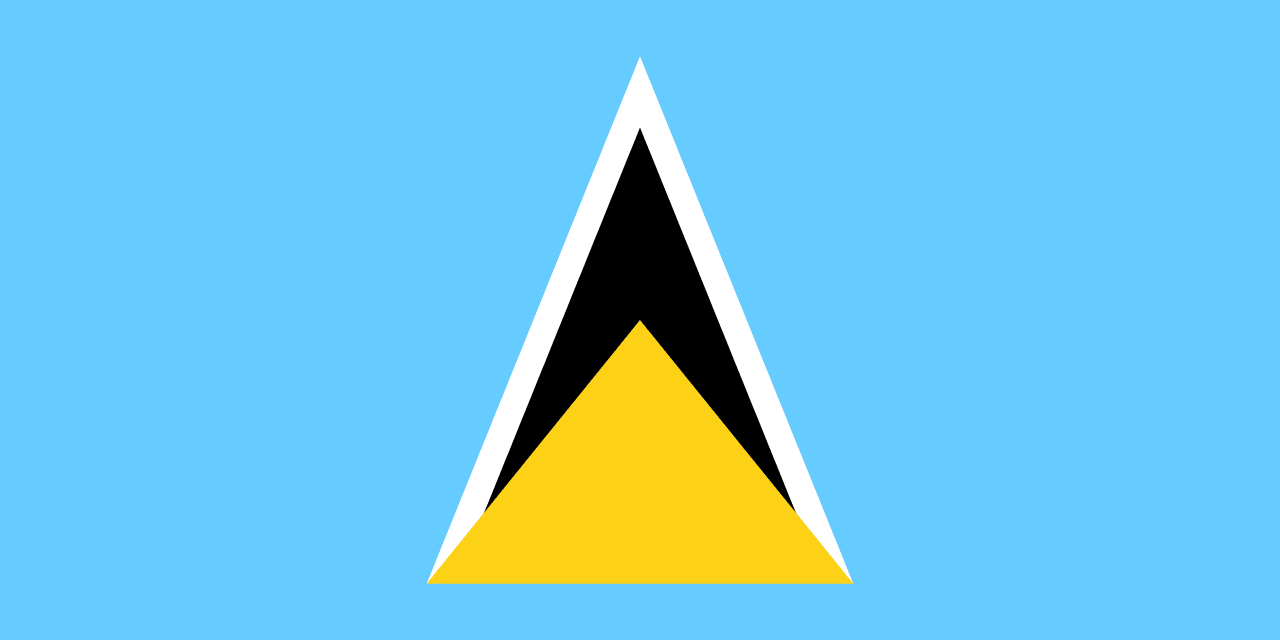
Flag details
- Country
- Saint Lucia
- Official name
- Saint Lucia
- Capital
- Castries
- ISO code
- LC / LCA
- Region
- Caribbean
Flag colors
- #66ccff86%
- #fcd1167%
Share of the flag's surface, measured from the image.
Download the flag
Meaning and history of the flag of Saint Lucia
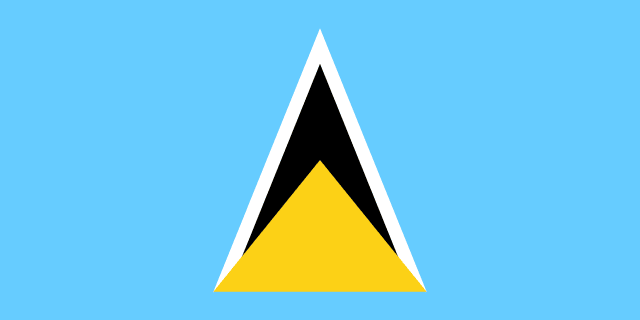
The flag of Saint Lucia has a sky-blue field bearing, at its center, three overlapping triangles: a black triangle edged in white with a shorter yellow triangle in front of it. Together they evoke the silhouette of the Pitons, the twin volcanic peaks of Gros Piton and Petit Piton that rise from the sea near Soufrière and stand as the island's most iconic natural landmark.
It was adopted on March 1, 1967, when Saint Lucia became an associated state of the United Kingdom, and its design is credited to local artist Dunstan St Omer. Blue represents the tropical sky and the Atlantic and Caribbean waters surrounding the island; yellow symbolizes sunlight and prosperity; and the black and white of the triangles reflect the harmonious coexistence of the African and European heritages that shape the country's culture. The flag's triangle proportions have been slightly adjusted since independence in 1979, while its symbolism has remained unchanged.
The design is one of the most distinctive in the Caribbean, forgoing the stripes and stars common to the region in favor of a geometric image drawn directly from the island's geography. The Pitons, a UNESCO World Heritage Site, are thus enshrined as a national emblem, uniting identity, nature, and pride in an instantly recognizable symbol.
You can view the flag of Saint Lucia in high resolution above and download it in several sizes for personal, educational or reference use. To explore more, visit the full Saint Lucia profile, its map, or the current local time in Castries.