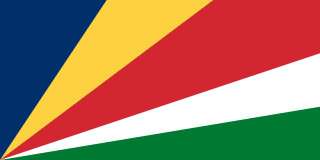
Seychelles
Republic of Seychelles
Population: UN WPP 2024, revision 1, projection for 1 July 2026. Sources and methodology.
Geography and territory
Seychelles is an archipelago scattered across the Indian Ocean, roughly 1,600 kilometers east of the African mainland and northeast of Madagascar. It comprises 115 islands spread over a maritime area exceeding one million square kilometers, though the total land area amounts to just 459 square kilometers. The islands fall into two distinct groups: the granitic inner islands, which include Mahé, Praslin, and La Digue, and the flatter, more scattered coral outer islands.
The granitic islands are a geological rarity, representing the only mid-ocean fragments of continental granite found anywhere on Earth. Mahé, the largest and most populous island, is home to the capital city of Victoria and to Morne Seychellois, the archipelago’s highest point at 905 meters. Across these islands, forested mountain peaks draped in lush tropical vegetation give way to white-sand beaches framed by massive, sculpted granite boulders, a combination that gives Seychelles its instantly recognizable look.
Seychelles enjoys a tropical maritime climate, with temperatures ranging between roughly 24 and 32 degrees Celsius throughout the year. A wetter season runs from November to March, driven by northwest monsoon winds, while a drier season prevails from May to September under southeast trade winds. The surrounding waters teem with life: extensive coral reefs shelter hundreds of species of tropical fish, along with sea turtles and whale sharks, making the archipelago one of the richest marine environments in the Indian Ocean.
Beyond its beaches and reefs, Seychelles harbors pockets of ancient palm forest found nowhere else on the planet, remnants of vegetation that predates the separation of the continents. Because the islands were never connected to any mainland by a land bridge, many native plants and animals evolved in near-total isolation, producing a level of endemism that conservationists consider extraordinary for such a small landmass. This isolation is also why the government has made habitat protection such a central part of national policy.
History
Human history in Seychelles is remarkably short compared to most of Africa. Arab and Portuguese sailors are believed to have sighted the islands centuries earlier, but it was not until 1756 that France formally claimed the archipelago, naming it after Jean Moreau de Séchelles, finance minister to King Louis XV. The first French settlers arrived in 1770, establishing spice plantations and bringing enslaved Africans and Malagasy people to work the land.
During the Napoleonic Wars, Britain seized control of the islands in 1811, a takeover formalized by the 1814 Treaty of Paris. Under British rule, Seychelles was administered as a dependency of Mauritius until 1903, when it became a separate Crown colony in its own right. The abolition of slavery in 1835 reshaped island society profoundly, giving rise to the Creole culture that defines the nation’s identity today.
Seychelles achieved independence on June 29, 1976, with James Mancham as its first president. A coup in 1977 brought France-Albert René to power, and he presided over a one-party system that lasted until 1993, when multiparty democracy was restored. In the decades since, the country has built a reputation for notable political stability and has positioned itself among Africa’s most prosperous nations, betting its future on sustainable tourism and environmental conservation.
Culture and society
Seychellois culture is a striking blend of African, European, and Asian influences, layered together over centuries of colonial history. Seychellois Creole, the mother tongue of the vast majority of the population, emerged from the fusion of French with African and Malagasy languages and has become a powerful symbol of national identity. Alongside Creole, English and French hold official status, making Seychelles a genuinely trilingual nation.
Music and dance are central to island life. Sega and moutya stand out as the most iconic musical traditions: sega is upbeat and festive, played on guitars and percussion, while moutya, rooted in African heritage, follows the hypnotic rhythm of drums and traces back to the songs of enslaved communities. The annual Festival Kreol, held each October, is the country’s most important cultural event, bringing together music, dance, food, and craft for a week-long celebration of Creole heritage.
Seychellois society stands out for its high level of human development within the African context. The country provides free education and healthcare, and its small population fosters a tightly knit community where personal relationships carry real weight. Harmonious coexistence among people of different ethnic and religious backgrounds is a defining feature of island life, with Hindu, Muslim, and Christian communities living side by side without significant friction. Family ties remain strong across generations, and many islanders maintain close connections to fishing, farming, or small-scale trade even as the broader economy has shifted toward services and hospitality.
Economy
The Seychellois economy rests on two principal pillars: tourism and fishing. Tourism alone accounts for a substantial share of national output and supports, directly and indirectly, a large portion of the workforce. Each year the islands welcome visitors from around the world drawn by their pristine beaches, exceptional biodiversity, and upscale resort offerings, and Seychelles has firmly established itself as an exclusive, high-end destination in the global travel market.
Fishing forms the second major economic engine, with tuna as the dominant catch. The port of Victoria hosts one of the largest tuna canning and processing operations in the entire Indian Ocean. Seychelles’ exclusive economic zone spans roughly 1.3 million square kilometers, an extraordinarily large maritime territory relative to the country’s tiny land area, generating meaningful revenue through fishing licenses granted to international fleets.
Seychelles boasts the highest per capita income in Africa, a reflection of genuinely strong economic development for such a small island nation. Even so, the economy faces real structural challenges, including heavy reliance on tourism, vulnerability to climate change, and dependence on imports for most consumer goods, since the islands’ limited farmland cannot support large-scale agriculture. The government has pushed forward a “blue economy” agenda, seeking to diversify income through marine biotechnology, renewable energy, and financial services alongside its traditional pillars, while also pioneering conservation financing tools that other small island nations have since studied as a model.
Food and cuisine
Seychellois cuisine is a delicious fusion of African, French, Indian, and Chinese culinary traditions, a direct result of the archipelago’s multicultural past. Fish and seafood form the backbone of the island diet: octopus curry, grilled fish served with a tangy Creole sauce, and shark chutney are signature dishes that reflect the deep bond between islanders and the surrounding ocean. Rice accompanies nearly every main meal.
Coconut appears in nearly every corner of Seychellois cooking. Coconut milk enriches curries and stews, grated coconut turns up in desserts and salads, and coconut oil is a common cooking fat. Banana ladob, a sweet dish of ripe bananas simmered in coconut milk and vanilla, ranks among the most beloved desserts. Tropical fruit is abundant as well, with mango, papaya, passion fruit, and star fruit sold fresh in local markets or blended into juices.
Among traditional drinks, fresh coconut water served straight from the fruit is a staple, alongside toddy, or calou, a mildly alcoholic beverage made from fermented palm sap. The local SeyBrew lager and tea flavored with cinnamon and lemon are also popular. Victoria’s markets, especially the Sir Selwyn Selwyn-Clarke Market, offer visitors an authentic taste of Creole cooking prepared fresh on the spot.
Tourism and landmarks
Seychelles is celebrated worldwide as one of the most exclusive tropical destinations on the planet. Anse Source d’Argent on La Digue is considered one of the most photographed beaches anywhere, its dramatic granite boulders rising from shallow turquoise water. On Praslin, the Vallée de Mai, a UNESCO World Heritage site, protects a primeval forest where the legendary coco de mar grows—the largest seed in the entire plant kingdom, capable of weighing up to 25 kilograms.
The Sainte Anne Marine National Park, the first marine park established anywhere in the Indian Ocean, offers exceptional diving and snorkeling among pristine coral reefs. Aldabra Atoll, also a UNESCO World Heritage site, is the world’s largest raised coral atoll and shelters roughly 100,000 giant Aldabra tortoises, the largest population of the species anywhere on Earth. Tightly restricted access has kept its ecosystem almost entirely untouched by human activity.
On Mahé, Morne Seychellois National Park covers about a fifth of the island and offers hiking trails through tropical forest leading to the archipelago’s highest peak. The compact capital, Victoria, charms visitors with its clock tower modeled on Big Ben and its colorful market, retaining an unmistakable colonial character despite its small size. Curieuse Island, reachable by boat from Praslin, pairs deserted beaches with a free-roaming giant tortoise colony and mangrove forests where seabirds nest. Beyond the well-known granitic islands, adventurous travelers can charter boats to the remote outer coral islands, where uninhabited beaches and untouched reefs offer a far quieter alternative to the more visited resorts of Mahé and Praslin.
Fun facts about Seychelles
- The coco de mar, Seychelles’ national symbol, produces the largest seed in the plant kingdom and grows naturally only on the islands of Praslin and Curieuse.
- With a population of 122,730, Seychelles is the smallest nation in Africa by population.
- The archipelago is home to more than half of the world’s giant tortoises, thanks largely to the enormous population on Aldabra Atoll.
- Victoria, the capital, is among the smallest capital cities in the world, with only around 25,000 residents.
- Seychelles was the first country in the world to enshrine environmental protection directly in its constitution.
- The archipelago holds two UNESCO World Heritage sites, the Vallée de Mai and Aldabra Atoll, an unusually high number for such a small country.
The Seychelles in numbers
Latest World Bank and UNDP observations, each with its own year. “World median” is the middle value among the countries that report the same indicator; “#” ranks from the highest value.
Population since 1960
The Seychelles had 41,700 people in 1960 and 122,730 in 2025 — 2.9 times as many.
People
45.5% of people live in towns and cities (world median 63.4%). 19.8% are under 15 and 8.7% are 65 or older — a middle-aged population. Women have 1.85 children on average, below the replacement level of about 2.1 needed to keep a population stable in the long run without migration.
Economy
The economy grew by 5.8% in real terms in 2025. Consumer prices rose by 0.3% in 2025. Services make up the largest share of output (67.9% of GDP); agriculture contributes 2.6%.
Development and environment
UNDP rates human development in the Seychelles as very high, with an index of 0.848 in 2023 (rank 54 of 193). 87.8% of people use the internet and 100.0% have access to electricity. Forest covers 58.5% of the land (world median 32.8%).
Sources: World Bank, World Development Indicators (CC BY 4.0), most recent observation from 2015 onward; UNDP Human Development Report 2025. Retrieved 2026-10-10. Sector shares need not add up to 100% because taxes and subsidies on products are excluded. Missing values are left blank rather than estimated. Sources and methodology.
Climate of the Seychelles
Averaged across the Seychelles, the mean temperature stays between 25.6 °C (July) and 28.3 °C (April) — a swing of only 2.7 °C, so seasons are marked by rainfall rather than by heat.
About 1,652 mm of precipitation falls in a typical year. January is the wettest month (276 mm) and July the driest (58 mm). The wettest stretch is December to February, with 40% of the year's total.
Show monthly values as a table
| Month | Mean °C | Low °C | High °C | Precipitation, mm |
|---|---|---|---|---|
| January | 27.4 | 24.6 | 30.3 | 276 |
| February | 27.8 | 25.0 | 30.5 | 180 |
| March | 28.2 | 25.1 | 31.2 | 170 |
| April | 28.3 | 25.2 | 31.3 | 163 |
| May | 27.8 | 25.2 | 30.4 | 114 |
| June | 26.5 | 24.1 | 28.9 | 68 |
| July | 25.6 | 23.3 | 27.9 | 58 |
| August | 25.7 | 23.2 | 28.3 | 66 |
| September | 26.3 | 23.7 | 28.9 | 103 |
| October | 26.8 | 24.1 | 29.7 | 110 |
| November | 27.4 | 24.4 | 30.5 | 135 |
| December | 27.4 | 24.4 | 30.5 | 209 |
Figures are 1991–2020 averages across the whole land area of the Seychelles, from the World Bank Climate Change Knowledge Portal, CRU TS 4.08 (CC BY 4.0). They are not readings from one weather station: the capital, the coast and high ground can be much warmer, cooler, wetter or drier.
Travel essentials for the Seychelles
The practical details visitors ask about first. Traffic in the Seychelles drives on the left, one of 54 of the 196 countries profiled here that do — see the full list. Mains electricity is 240 V at 50 Hz, so devices made only for 110–120 V (common in North America) need a converter unless they are dual-voltage — most phone and laptop chargers are.
- Emergency number
- 999Ambulance 151
- Driving side
- Left
- Plug types
- Type GG: three rectangular pins (British)
- Voltage
- 240 V50 Hz
- Dialling code
- +248From abroad: your exit code, then 248 and the number
- Currency
- Seychellois Rupee (SCR)
- Time zone
- SCT (UTC+4)Current local time in the Seychelles
Compiled from IEC plug and voltage standards, national emergency-service listings and the UN road-traffic conventions. Emergency numbers and local coverage can change — confirm them locally on arrival. The Seychelles's internet domain is .sc.
Where the Seychelles ranks in the world
Each position counts only the countries with data in that ranking guide. First place is the highest value — for price levels, the most expensive. Select a card to see the full table.
- Population180th of 196134,959UN projection, July 2026
- Land area180th of 195460 km²World Bank, 2023
- Population density36th of 194260 per km²World Bank, 2023
- GDP (nominal)168th of 187$2.2BWorld Bank, 2024, current US$
- GDP per capita58th of 187$18,365World Bank, 2024, current US$
- Life expectancy76th of 19476.3 yearsWorld Bank, 2024
- Price level53rd of 16558 (US = 100)ICP 2021, household consumption
Compare the Seychelles with another country
Frequently asked questions about the Seychelles
What is the capital of the Seychelles?
The capital of the Seychelles is Victoria.
What is the population of the Seychelles?
The UN World Population Prospects projection for the Seychelles is 134,959 people (134,959) on 1 July 2026. National statistical offices may publish different estimates.
What language is spoken in the Seychelles?
The official language of the Seychelles is Seychellois Creole, English, French.
What currency is used in the Seychelles?
The currency of the Seychelles is the Seychellois Rupee (SCR).
How big is the Seychelles?
The Seychelles covers an area of 459 km².
What type of government does the Seychelles have?
The Seychelles is a presidential republic.
What is the highest point in the Seychelles?
The highest point in the Seychelles is Morne Seychellois (905 m).


