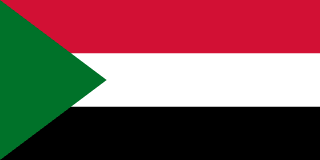
Sudan
Republic of Sudan
Population: UN WPP 2024, revision 1, projection for 1 July 2026. Sources and methodology.
Geography and territory
Sudan is the third-largest country in Africa after Algeria and the Democratic Republic of the Congo, covering 1,861,484 square kilometers across the northeastern part of the continent. The country borders seven nations and has an outlet to the Red Sea along roughly 850 kilometers of coastline in its northeast. Its geographic position makes it a natural bridge between sub-Saharan Africa and the Arab world of North Africa.
The Nile River is the backbone of Sudan’s geography. The White Nile, flowing from Uganda, and the Blue Nile, rising in Ethiopia, meet at Khartoum, the capital, in a striking confluence that ranks among the continent’s most remarkable geographic features. From this meeting point, the unified Nile flows north through the desert into Egypt. The north of the country is dominated by the Nubian Desert and the Libyan Desert, vast stretches of sand and rock covering more than a third of national territory.
Sudan’s terrain ranges from the desert plains of the north to the volcanic mountains of Darfur in the west, where Jebel Marra reaches 3,042 meters as the country’s highest point. The center and south feature savanna and grassland that grow progressively wetter moving southward. The climate is predominantly tropical in the south and desert in the north, with temperatures that can exceed 50 degrees Celsius during the hottest months. Rainfall is concentrated between June and October in the south, while the north remains extremely arid.
History
Sudan holds one of humanity’s oldest civilizations. The Kingdom of Kush, which flourished in the Nubia region from the eighth century BCE to the fourth century CE, rivaled ancient Egypt in power and cultural sophistication. The Kushites even conquered Egypt, ruling it as its Twenty-Fifth Dynasty. The pyramids of Meroe, more than 200 royal funerary structures dating from this period, form the largest collection of pyramids in the world, outnumbering those of Egypt itself.
The arrival of Islam in the seventh century profoundly reshaped Sudanese society, blending with Nubian and African traditions to forge a distinct cultural identity. For centuries, sultanates such as Sennar and Darfur governed different regions. In the nineteenth century, Turco-Egyptian rule sparked the Mahdist Revolution of 1885, a religious-nationalist movement that established an independent Islamic state until the Anglo-Egyptian reconquest of 1898, which ushered in the period of British-Egyptian condominium rule.
Sudan gained independence on January 1, 1956, but its subsequent history has been marked by internal conflict. Two prolonged civil wars between the Arabized, Islamic north and the Christian and animist south, from 1955 to 1972 and from 1983 to 2005, devastated the country, culminating in South Sudan’s independence in 2011. The Darfur conflict, which began in 2003, triggered a humanitarian crisis of enormous scale. In 2019, a popular uprising toppled President Omar al-Bashir after three decades in power, but the transition to democracy was derailed by a military power struggle that, since 2023, has plunged the country into a devastating new crisis.
Culture and society
Sudanese culture forms a fascinating crossroads between the Arab traditions of North Africa and the sub-Saharan cultures to the south. This duality shows in every aspect of daily life: music, dress, architecture, and social customs all reflect a unique synthesis of influences found nowhere else in Africa. The country is home to more than 500 ethnic groups speaking over 100 languages, with Sudanese Arabic serving as the common tongue.
Sudanese hospitality is legendary throughout the region. The tea and coffee ceremony holds a central place in social life: jabana, coffee brewed the traditional way with ginger and spices in a clay pot, is served in multiple rounds to guests and visitors alike. Sudanese weddings are multi-day celebrations that draw in entire communities with music, dance, elaborate henna, and generous banquets. Henna, applied in intricate designs on the hands and feet of the bride, is an artistic tradition shared with the cultures of North Africa and the Middle East.
Sudanese music carries its own distinct identity, blending Arab melodies with African rhythms. Artists such as Mohammed Wardi and Mohammed el Amin are revered as national icons whose songs have accompanied the country’s historic moments. Arabic-Sudanese poetry, recited in local dialect, is a highly cherished form of artistic expression. Traditional men’s dress, the white jalabiya with turban, and women’s dress, the toub, a long cloth wrapped elegantly around the body, remain everyday attire and continue to mark the visual identity of Sudanese society.
Economy
Sudan’s economy rests on agriculture, livestock, and the extraction of natural resources. Agriculture employs most of the working population and is concentrated in the Nile valleys and the savanna belt of the country’s center, where sorghum, millet, sesame, groundnut, and cotton are cultivated. Sudan has historically been one of the world’s largest producers of gum arabic, a product derived from acacia trees used in the food, pharmaceutical, and cosmetics industries, supplying around 80 percent of world production.
Oil was for years the main driver of Sudanese exports, but South Sudan’s independence in 2011 stripped the country of roughly three-quarters of its oil reserves. That loss forced a difficult economic restructuring that remains incomplete. Gold mining has emerged as an alternative, making Sudan one of Africa’s leading gold producers, with deposits concentrated in the Red Sea region and the north of the country.
Sudan’s economic challenges are immense. Chronic inflation, external debt, decades of international sanctions, and armed conflict have kept much of the population in poverty. Agriculture, despite its potential, suffers from insufficient infrastructure and the effects of climate change, with increasingly frequent droughts. The armed conflict that began in 2023 has dramatically worsened the humanitarian situation, causing mass displacement and the destruction of essential infrastructure.
Food and cuisine
Sudanese cuisine is a tangible expression of the cultural fusion that defines the country, blending Arab, Nubian, and African influences into nutritious and flavorful cooking. Ful medames, fava beans slow-cooked with sesame oil, tomato, onion, and spices, is the country’s most widespread breakfast dish and is considered the national dish. It is served with flatbread and eaten in homes and street stalls alike, representing a culinary link with Egypt and the Horn of Africa.
Kisra, a thin, spongy flatbread made from fermented sorghum dough, is the basic accompaniment to most Sudanese meals. It is rolled up or used to scoop meat and vegetable stews. Mulah, a thick stew that can be made with lamb, chicken, or vegetables in a peanut or tomato sauce, is the usual complement to kisra. Agashe, a sesame paste served alongside many dishes, and dakwa, a ground peanut sauce, are near-universal condiments on the Sudanese table.
The tea and coffee ceremony is an inseparable social ritual of Sudanese life. Jabana, coffee flavored with ginger, cinnamon, and cardamom, is prepared ceremonially and served in three consecutive rounds, each carrying symbolic meaning. Strong, heavily sweetened red tea is drunk throughout the day and is the country’s most popular beverage. Sudanese sweets include sesame candies, stuffed dates, and basbousa, a semolina cake soaked in rosewater-scented syrup that reflects the country’s culinary connection to the wider Arab world.
Tourism and landmarks
Sudan holds archaeological heritage of incalculable value that remains largely unknown to international tourism. The pyramids of Meroe, a UNESCO World Heritage site, are the crown jewel of Sudan’s cultural legacy. More than 200 Nubian-style pyramids, slimmer and steeper than their Egyptian counterparts, rise from the desert as testimony to the splendor of the Kingdom of Kush. Unlike the pyramids of Egypt, here visitors can contemplate these ancient monuments in complete solitude.
The island of Meroe, the sacred city of Naqa with its temples showing Greco-Roman and Egyptian influence, and the temple of Musawwarat es-Sufra form an archaeological triangle of extraordinary richness. Farther north, the ruins of the ancient kingdom of Kerma and the temples of Soleb and Jebel Barkal, the latter also a UNESCO World Heritage site, complete an itinerary spanning more than three millennia of civilization. The National Museum of Sudan in Khartoum holds an outstanding collection, including Nubian temples rescued before the construction of the Aswan Dam.
The confluence of the White Nile and Blue Nile at Khartoum offers one of Africa’s most striking natural spectacles, especially visible from the Tuti Bridge. The Red Sea coast, with the port city of Port Sudan, conceals pristine coral reefs and dive sites that rival the best in the world. Dinder National Park, on the border with Ethiopia, protects a savanna rich in wildlife. Political instability and armed conflict, however, have severely constrained tourism development in the country.
Fun facts about Sudan
- Sudan has more pyramids than Egypt: more than 200 Nubian pyramids survive in the Meroe region
- Khartoum sits exactly at the confluence of the White Nile and Blue Nile, a geographic phenomenon visible to the naked eye through the contrasting color of the waters
- Sudan produces around 80 percent of the world’s gum arabic, an essential ingredient in the food and pharmaceutical industries
- The Sudanese Nubian Desert contains some of the hottest regions on the planet, with temperatures exceeding 50 degrees Celsius
- The ancient Kushite civilization of Sudan conquered and ruled Egypt as its Twenty-Fifth Dynasty
- The country is home to more than 500 ethnic groups speaking over 100 different languages
Sudan in numbers
Latest World Bank and UNDP observations, each with its own year. “World median” is the middle value among the countries that report the same indicator; “#” ranks from the highest value.
Population since 1960
Sudan had 8.4 million people in 1960 and 51.7 million in 2025 — 6.2 times as many.
People
34.9% of people live in towns and cities (world median 63.4%). 40.2% are under 15 and 3.4% are 65 or older — a very young population. Women have 4.26 children on average, above the replacement level of about 2.1.
Economy
The economy grew by 3.1% in real terms in 2025. Consumer prices rose by 138.8% in 2022 — very high inflation. Services make up the largest share of output (37.0% of GDP); agriculture contributes 29.4%, a large share that points to a farming-based economy.
Development and environment
UNDP rates human development in Sudan as low, with an index of 0.511 in 2023 (rank 176 of 193). 18.6% of people use the internet and 66.0% have access to electricity. Forest covers 11.9% of the land (world median 32.8%).
Sources: World Bank, World Development Indicators (CC BY 4.0), most recent observation from 2015 onward; UNDP Human Development Report 2025. Retrieved 2026-10-10. Sector shares need not add up to 100% because taxes and subsidies on products are excluded. Missing values are left blank rather than estimated. Sources and methodology.
Climate of Sudan
Averaged across Sudan, the warmest month is June (32.3 °C) and the coolest is January (21.4 °C), a seasonal swing of 10.9 °C. The annual mean is 28.0 °C.
About 253 mm of precipitation falls in a typical year. August is the wettest month (88 mm) and February the driest (0 mm). The three wettest consecutive months, July to September, bring 76% of the year's total — a pronounced rainy season.
Show monthly values as a table
| Month | Mean °C | Low °C | High °C | Precipitation, mm |
|---|---|---|---|---|
| January | 21.4 | 13.0 | 29.9 | 0 |
| February | 23.6 | 15.0 | 32.3 | 0 |
| March | 26.8 | 18.1 | 35.6 | 1 |
| April | 30.2 | 21.5 | 38.9 | 3 |
| May | 32.2 | 24.3 | 40.1 | 14 |
| June | 32.3 | 24.9 | 39.7 | 28 |
| July | 31.0 | 24.5 | 37.5 | 65 |
| August | 30.3 | 24.2 | 36.5 | 88 |
| September | 30.3 | 23.7 | 37.0 | 40 |
| October | 29.4 | 22.0 | 37.0 | 14 |
| November | 25.7 | 17.8 | 33.7 | 1 |
| December | 22.3 | 14.2 | 30.4 | 0 |
Figures are 1991–2020 averages across the whole land area of Sudan, from the World Bank Climate Change Knowledge Portal, CRU TS 4.08 (CC BY 4.0). They are not readings from one weather station: the capital, the coast and high ground can be much warmer, cooler, wetter or drier.
Travel essentials for Sudan
The practical details visitors ask about first. Traffic in Sudan drives on the right, like most of the world. Mains electricity is 230 V at 50 Hz, so devices made only for 110–120 V (common in North America) need a converter unless they are dual-voltage — most phone and laptop chargers are.
- Emergency number
- 999Ambulance 333 · Fire 998
- Driving side
- Right
- Plug types
- Type C, Type DC: two round pins (Europlug); D: three large round pins in a triangle
- Voltage
- 230 V50 Hz
- Dialling code
- +249From abroad: your exit code, then 249 and the number
- Currency
- Sudanese Pound (SDG)
- Time zone
- CAT (UTC+2)Current local time in Sudan
Compiled from IEC plug and voltage standards, national emergency-service listings and the UN road-traffic conventions. Emergency numbers and local coverage can change — confirm them locally on arrival. Sudan's internet domain is .sd.
Where Sudan ranks in the world
Each position counts only the countries with data in that ranking guide. First place is the highest value — for price levels, the most expensive. Select a card to see the full table.
- Population29th of 19653.3 millionUN projection, July 2026
- Land area15th of 1951,868,000 km²World Bank, 2023
- Population density156th of 19427 per km²World Bank, 2023
- GDP (nominal)91st of 187$49.7BWorld Bank, 2024, current US$
- GDP per capita173rd of 187$985World Bank, 2024, current US$
- Life expectancy159th of 19466.5 yearsWorld Bank, 2024
- Price level161st of 16527 (US = 100)ICP 2021, household consumption
Bordering countries of Sudan


Compare Sudan with another country
Frequently asked questions about Sudan
What is the capital of Sudan?
The capital of Sudan is Khartoum.
What is the population of Sudan?
The UN World Population Prospects projection for Sudan is 53,282,719 people (53.3 million) on 1 July 2026. National statistical offices may publish different estimates.
What language is spoken in Sudan?
The official language of Sudan is Arabic, English.
What currency is used in Sudan?
The currency of Sudan is the Sudanese Pound (SDG).
How big is Sudan?
Sudan covers an area of 1,861,484 km².
What type of government does Sudan have?
Sudan is a transitional government.
Which countries border Sudan?
Sudan shares land borders with Egypt, Libya, Chad, Central African Republic, South Sudan, Ethiopia, Eritrea.
What is the highest point in Sudan?
The highest point in Sudan is Jebel Marra (3,042 m).


