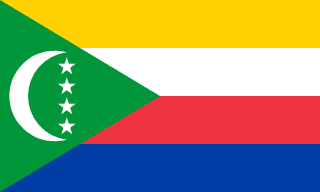
Comoros
Union of the Comoros
Population: UN WPP 2024, revision 1, projection for 1 July 2026. Sources and methodology.
Geography and territory
The Comoros archipelago lies in the Mozambique Channel of the Indian Ocean, between the eastern coast of Africa and the island of Madagascar. With a total land area of just 2,235 square kilometers, it is one of the smallest nations in Africa. The country consists of three main islands: Grande Comore, known locally as Ngazidja, the largest and most populous; Anjouan, or Ndzuani, mountainous and fertile; and Moheli, or Mwali, the smallest and least developed of the three. A fourth island in the chain, Mayotte, remains under French administration despite longstanding Comorian claims to sovereignty over it.
All three islands are volcanic in origin, which has left them with rugged terrain and remarkably fertile soil. Grande Comore is dominated by Mount Karthala, one of the most active volcanoes on Earth, rising to 2,361 meters and crowned by a crater roughly three kilometers across. Karthala’s eruptions, the most recent occurring in 2005, have repeatedly reshaped the island’s landscape, blanketing large stretches of ground in hardened black lava that contrasts sharply with the lush tropical vegetation covering its slopes. Because its volcanic soils are so porous, Grande Comore has no permanent rivers, and access to fresh water remains a persistent challenge for its residents.
Anjouan and Moheli present greener, wetter landscapes, with tropical forest covering their mountains and fertile valleys given over to spices, vanilla, and ylang-ylang cultivation. All three islands are ringed by beaches of both white and black sand and by coral reefs that support an extraordinary variety of marine life. Comorian waters are also home to the coelacanth, an ancient fish once believed to have gone extinct alongside the dinosaurs some 65 million years ago until it was rediscovered alive off the Comorian coast in 1938 — one of the most sensational zoological finds of the twentieth century.
History
For centuries, the Comoros served as a crossroads of civilizations in the Indian Ocean. The first settlers arrived from the East African coast and from Indonesia more than a thousand years ago, followed by Arab and Persian traders who introduced Islam to the islands around the twelfth century. The sultanates that took shape across the archipelago played an active role in Indian Ocean trade networks, exporting spices, enslaved people, and ambergris while absorbing cultural influences from Africa, Arabia, Persia, India, and Southeast Asia.
French involvement began in 1841, when the local sultan ceded Mayotte to France. Over the following decades, French control gradually extended across the rest of the archipelago, which was formally declared a colony in 1912. Colonial administrators developed plantations of aromatic crops, particularly ylang-ylang and vanilla, which became the backbone of the island economy — though the benefits flowed mainly to French landowners and a small local elite, while most of the population remained impoverished.
Independence was declared unilaterally on 6 July 1975, after a referendum produced overwhelming support in three of the four islands. Mayotte alone voted to remain under French sovereignty, a split that continues to generate diplomatic friction to this day. The decades following independence proved exceptionally turbulent, with more than twenty coups or attempted coups recorded in the country’s first thirty years, a period in which the French mercenary Bob Denard repeatedly intervened and became an almost permanent fixture of Comorian politics.
Culture and society
Comorian culture blends African, Arab, Persian, Malagasy, and French influences into an identity found nowhere else in the Indian Ocean. Sunni Islam of the Shafi’i school, practiced by nearly the entire population, anchors social and cultural life, yet it coexists comfortably with older African and Malagasy traditions. Ceremonies involving djinn spirits, possession rituals, and consultations with traditional healers are practiced alongside orthodox Islamic worship without any sense of contradiction.
The Grand Mariage, known locally as anda or harusi, is the single most important social institution in Comorian life. Far more than a wedding, this traditional ceremony — which can stretch on for weeks and cost the equivalent of tens of thousands of euros — serves as a rite of passage that grants a man the standing of a notable within his community, along with the right to take part in collective decisions and to hold a place of honor at public gatherings. Families often save for years, sometimes decades, to afford these celebrations, which sit at the very center of Comorian social life.
Music and dance occupy a central place in everyday culture. Twarab, a musical style with roots in Zanzibar that pairs sung poetry with Arab melodies and Western instruments, provides the soundtrack for evenings and celebrations alike. Chigoma, a rhythmic dance of African origin performed to the beat of large drums, appears at weddings and festivals throughout the islands. The Comorian language, related to Swahili but enriched with borrowings from Arabic, French, and Malagasy, carries a rich oral tradition of storytelling, proverbs, and poetry.
Economy
The Comorian economy is among the most fragile in the world, heavily reliant on export agriculture that leaves it exposed to swings in international markets. Ylang-ylang, whose fragrant blossoms yield an essential oil prized in the perfume industry, is the archipelago’s signature crop: the Comoros are the world’s leading producer of ylang-ylang essence, distilled by hand in small stills scattered across the islands’ plantations. Vanilla and cloves round out the trio of aromatic exports that underpin the country’s trade.
Remittances from the Comorian diaspora, especially the sizable community living in France, provide a vital source of national income, accounting for a significant share of gross domestic product. Artisanal fishing remains the primary livelihood for coastal communities, even though the country’s substantial maritime territory remains largely untapped for lack of technical and financial resources. Tourism, while still in its early stages, holds considerable promise thanks to pristine beaches, coral reefs, and an unusually authentic cultural landscape.
The country faces steep economic challenges, including weak infrastructure, scarce drinking water, dependence on imported energy, and high vulnerability to climate change. Because the country is spread across separate islands, importing goods is costly and inter-island connectivity remains difficult. The government has sought to diversify an economy overly dependent on agricultural exports and remittances by developing ecotourism, industrial fishing, and renewable energy, including the geothermal potential of Mount Karthala — an economy whose overall size, at roughly $1.82 billion in gross domestic product, remains one of the smallest in the world.
Food and cuisine
Comorian cuisine mirrors the archipelago’s role as an Indian Ocean crossroads, blending African, Arab, Indian, and French flavors into fragrant, comforting dishes. Rice, the essential staple, is prepared in countless ways — perfumed with cardamom and cinnamon in the Arab style, cooked in coconut milk in the manner of the Swahili coast, or served alongside spiced fish and vegetable sauces. Coconut, present in every form from milk and cream to grated flesh and oil, is the ingredient that gives Comorian food its unmistakable character.
Langouste au coco, spiny lobster simmered in spiced coconut milk, is perhaps the archipelago’s most celebrated dish. Mataba, made from pounded cassava leaves slow-cooked in coconut milk and spices, is a deeply flavored, creamy everyday stew. Pilaou, a spiced rice pilaf made with meat, mkatra foutra, a coconut bread baked over hot coals, and sambusa, triangular pastries filled with meat or fish, round out the essential dishes of the Comorian table.
Spices form the soul of Comorian cooking: cinnamon, cardamom, cumin, ginger, turmeric, and cloves combine in aromatic blends that perfume stews and rice dishes alike. Traditional sweets include halua, a semolina halva made with honey and nuts, and mkatra siniya, coconut rice cakes. Green tea flavored with lemongrass and sugar is the everyday social drink, served in small cups during gatherings and after meals, while juices made from tropical fruits such as guava, mango, and pineapple accompany daily meals.
Tourism and landmarks
Moheli, the smallest of the three islands, is a sanctuary of untouched nature and the country’s leading ecotourism destination. Moheli Marine National Park, the country’s first protected marine area, shelters pristine coral reefs, green turtles that nest on its beaches between November and March, dolphins, and, occasionally, humpback whales passing through the Mozambique Channel. The small fishing villages scattered along Moheli’s coast offer an authentic, low-key form of community tourism.
Mount Karthala, on Grande Comore, offers a demanding but unforgettable trek. The roughly six-hour climb through tropical forest and volcanic terrain ends at the rim of one of the largest active craters in the world, with sweeping views across the Mozambique Channel and, on clear days, as far as the coast of Madagascar. Moroni, the capital, charms visitors with its medina of narrow lanes, its old dhow harbor, and the Friday Mosque, whose white minaret has become the archipelago’s most photographed landmark.
Anjouan, often called the pearl of the Comoros, appeals to lovers of tropical scenery with its forest-covered mountains, hidden waterfalls, and ylang-ylang plantations that scent the air for miles. The citadel of Mutsamudu, anchored by a seventeenth-century fortress and a maze of Arab-influenced streets, testifies to the islands’ long history as trading centers. Diving and snorkeling along Comorian reefs bring encounters with turtles, rays, reef sharks, and dense schools of colorful tropical fish in remarkably clear water.
Fun facts about Comoros
- The Comoros produce more ylang-ylang essence than any other country, supplying the flower oil behind some of the world’s most famous perfumes.
- The coelacanth, a fish once thought to have died out with the dinosaurs, was found alive off the Comorian coast in 1938, one of the most stunning zoological discoveries in history.
- The archipelago recorded more than twenty coups or coup attempts in its first three decades of independence, one of the highest totals per capita of any nation.
- A traditional Grand Mariage wedding can cost the equivalent of tens of thousands of euros and is considered essential for a man to achieve full social standing in his community.
- Mount Karthala, at 2,361 meters, is one of the most active volcanoes in the world and last erupted in 2005.
- Mayotte, part of the same island chain and claimed by the Comoros, remains a French overseas department and is therefore part of the European Union.
The Comoros in numbers
Latest World Bank and UNDP observations, each with its own year. “World median” is the middle value among the countries that report the same indicator; “#” ranks from the highest value.
Population since 1960
The Comoros had 197,700 people in 1960 and 882,847 in 2025 — 4.5 times as many.
People
33.9% of people live in towns and cities (world median 63.4%). 36.9% are under 15 and 4.5% are 65 or older — a young population. Women have 3.82 children on average, above the replacement level of about 2.1.
Economy
The economy grew by 3.8% in real terms in 2025. Consumer prices rose by 3.2% in 2025. Services make up the largest share of output (48.8% of GDP); agriculture contributes 36.6%, a large share that points to a farming-based economy.
Development and environment
UNDP rates human development in the Comoros as medium, with an index of 0.603 in 2023 (rank 152 of 193). 32.5% of people use the internet and 91.7% have access to electricity. Forest covers 17.8% of the land (world median 32.8%).
Sources: World Bank, World Development Indicators (CC BY 4.0), most recent observation from 2015 onward; UNDP Human Development Report 2025. Retrieved 2026-10-10. Sector shares need not add up to 100% because taxes and subsidies on products are excluded. Missing values are left blank rather than estimated. Sources and methodology.
Climate of the Comoros
Averaged across the Comoros, the mean temperature stays between 21.6 °C (July) and 25.3 °C (January) — a swing of only 3.7 °C, so seasons are marked by rainfall rather than by heat.
About 2,098 mm of precipitation falls in a typical year. January is the wettest month (313 mm) and September the driest (64 mm). The wettest stretch is January to March, with 40% of the year's total.
Show monthly values as a table
| Month | Mean °C | Low °C | High °C | Precipitation, mm |
|---|---|---|---|---|
| January | 25.3 | 22.2 | 28.4 | 313 |
| February | 25.2 | 22.0 | 28.4 | 270 |
| March | 25.2 | 21.8 | 28.5 | 265 |
| April | 24.6 | 21.3 | 28.1 | 232 |
| May | 24.1 | 20.7 | 27.5 | 159 |
| June | 22.6 | 19.4 | 25.8 | 157 |
| July | 21.6 | 18.3 | 25.0 | 154 |
| August | 21.6 | 17.8 | 25.5 | 102 |
| September | 22.0 | 18.2 | 25.9 | 64 |
| October | 23.2 | 19.4 | 27.0 | 90 |
| November | 24.4 | 20.9 | 27.9 | 98 |
| December | 25.0 | 21.7 | 28.4 | 196 |
Figures are 1991–2020 averages across the whole land area of the Comoros, from the World Bank Climate Change Knowledge Portal, CRU TS 4.08 (CC BY 4.0). They are not readings from one weather station: the capital, the coast and high ground can be much warmer, cooler, wetter or drier.
Travel essentials for the Comoros
The practical details visitors ask about first. Traffic in the Comoros drives on the right, like most of the world. Mains electricity is 220 V at 50 Hz, so devices made only for 110–120 V (common in North America) need a converter unless they are dual-voltage — most phone and laptop chargers are.
- Emergency number
- 17
- Driving side
- Right
- Plug types
- Type C, Type EC: two round pins (Europlug); E: two round pins, earth pin in the socket
- Voltage
- 220 V50 Hz
- Dialling code
- +269From abroad: your exit code, then 269 and the number
- Currency
- Comorian Franc (KMF)
- Time zone
- EAT (UTC+3)Current local time in the Comoros
Compiled from IEC plug and voltage standards, national emergency-service listings and the UN road-traffic conventions. Emergency numbers and local coverage can change — confirm them locally on arrival. The Comoros's internet domain is .km.
Where the Comoros ranks in the world
Each position counts only the countries with data in that ranking guide. First place is the highest value — for price levels, the most expensive. Select a card to see the full table.
- Population160th of 196899,010UN projection, July 2026
- Land area170th of 1951,861 km²World Bank, 2023
- Population density18th of 194457 per km²World Bank, 2023
- GDP (nominal)172nd of 187$1.6BWorld Bank, 2024, current US$
- GDP per capita153rd of 187$1,858World Bank, 2024, current US$
- Life expectancy156th of 19467.0 yearsWorld Bank, 2024
- Price level60th of 16555 (US = 100)ICP 2021, household consumption
Compare the Comoros with another country
Frequently asked questions about the Comoros
What is the capital of the Comoros?
The capital of the Comoros is Moroni.
What is the population of the Comoros?
The UN World Population Prospects projection for the Comoros is 899,010 people (899,010) on 1 July 2026. National statistical offices may publish different estimates.
What language is spoken in the Comoros?
The official language of the Comoros is Comorian, French and Arabic.
What currency is used in the Comoros?
The currency of the Comoros is the Comorian Franc (KMF).
How big is the Comoros?
The Comoros covers an area of 2,235 km².
What type of government does the Comoros have?
The Comoros is a federal presidential republic.
What is the highest point in the Comoros?
The highest point in the Comoros is Mount Karthala (2,361 m).


