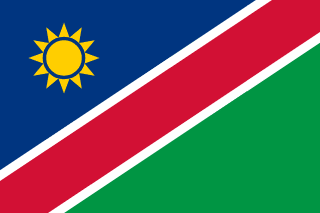
Namibia
Republic of Namibia
Population: UN WPP 2024, revision 1, projection for 1 July 2026. Sources and methodology.
Geography and territory
Namibia stretches across 825,615 square kilometers of southwestern Africa, bordered by Angola and a short strip of Zambia to the north, Botswana to the east, South Africa to the south, and the cold Atlantic Ocean along its entire western edge. Few countries on Earth pack such a range of extreme landscapes into one territory: the Namib Desert, believed to be the oldest desert in the world at somewhere between 55 and 80 million years old, runs the length of the coast, while the Kalahari basin spreads across the east, savanna woodland covers the north, and the eerie Skeleton Coast lines the northwest.
The Namib’s towering red dunes, some exceeding 300 meters, rank among the tallest on the planet and dominate the coastal belt. Sossusvlei, where sculpted dune formations shift color with the changing light, is one of the most photographed landscapes in Africa. Far to the northeast, the Zambezi Region, formerly known as the Caprivi Strip, presents an altogether different, almost tropical Namibia, with perennial rivers, wetlands, and woodland that support abundant wildlife rarely associated with the rest of the country.
Namibia’s climate is overwhelmingly arid to semi-arid, with annual rainfall ranging from under 50 millimeters along the coastal Namib to roughly 600 millimeters in the far northeast. The cold Benguela Current, flowing north along the Atlantic seaboard, produces the thick morning fog that sustains many desert-adapted species, including the Welwitschia mirabilis, an extraordinary endemic plant that can live for more than two thousand years while producing only two leaves in its entire lifetime. The country’s highest point, the Brandberg massif, tops out at 2,573 meters.
History
Namibia’s human story begins with the San people, widely regarded as among the oldest continuous inhabitants of southern Africa, whose presence in the region stretches back more than 25,000 years. The rock engravings at Twyfelfontein, a UNESCO World Heritage Site, preserve a remarkable record of their artistic and spiritual life. Bantu-speaking peoples, including the Ovambo, Herero, and Nama, later settled across different parts of the territory, developing pastoral and agricultural societies that shaped the country’s ethnic landscape.
European contact began in earnest with German missionaries and traders in the mid-nineteenth century, and in 1884 the territory was declared the colony of German South West Africa. That colonial period produced one of the darkest chapters in African history: the genocide of the Herero and Nama peoples between 1904 and 1908, widely regarded as the first genocide of the twentieth century, in which tens of thousands died in concentration camps and forced marches into the desert.
After World War I, the League of Nations handed administration of the territory to South Africa, which extended its apartheid system across the region. The independence struggle, led by the South West Africa People’s Organization (SWAPO) under Sam Nujoma, spanned decades of guerrilla warfare and international diplomacy before Namibia finally achieved sovereignty on March 21, 1990, making it the last African country to shed colonial rule. Its constitution, adopted that same year, broke new ground by enshrining environmental protection as a founding principle of the state.
Culture and society
Namibian society encompasses more than a dozen ethnic groups, each with distinct traditions, languages, and ways of life. The Ovambo, who make up roughly half the population, are concentrated mainly in the north. The Herero are instantly recognizable by the elaborate Victorian-style dresses and horned headwear worn by their women, a look adapted during the colonial era into a lasting symbol of cultural resilience. In the remote northwest, the Himba maintain one of the most traditional lifestyles anywhere on the continent.
The San, the region’s earliest inhabitants, carry an invaluable cultural legacy that includes ancestral knowledge of desert survival, an animist worldview, and a rock-art tradition spanning millennia. Their language, marked by distinctive click consonants, has drawn linguists from around the world, and San trance dances, healing ceremonies that can last through the night, are recognized as part of the country’s intangible cultural heritage.
Contemporary Namibia has cultivated a lively arts scene, with visual artists, musicians, and writers exploring the tensions between tradition and modernity, colonialism and independence. The National Art Gallery in Windhoek and a calendar of cultural festivals across the country give this creativity a public stage. English, the official language since independence, coexists with Afrikaans, German, and numerous indigenous languages, a linguistic mosaic that reflects the country’s layered history.
Economy
With a GDP of about $15.1 billion, Namibia’s economy rests heavily on its considerable mineral wealth, which accounts for roughly a quarter of national output. The country ranks among the world’s top uranium producers, home to the Rössing Mine, one of the largest open-pit uranium operations anywhere, and it is also a significant diamond producer, extracting gems both from land-based mines and through offshore dredging along the Atlantic coast. Zinc, gold, and copper round out a diversified extractive sector.
Livestock farming, particularly cattle and sheep, forms another pillar of the economy, practiced on both large commercial ranches and by traditional pastoralist communities. Fishing in the nutrient-rich waters of the South Atlantic, fed by the productive Benguela Current, contributes meaningfully to national income, with hake, sardines, and tuna among the principal catches.
Tourism has become one of Namibia’s fastest-growing sectors, drawing travelers captivated by dramatic scenery, abundant wildlife, and a strong national commitment to conservation. Namibia pioneered community-based conservation in Africa, with more than 80 registered conservancies that manage natural resources while channeling direct benefits to local residents. Despite these strengths, Namibia also contends with one of the highest levels of income inequality in the world, with a wide gap separating a prosperous minority from large segments of the population still living in poverty.
Food and cuisine
Namibian cuisine blends African tradition with strong German and South African influences, a legacy of the country’s colonial history. Meat dominates the Namibian table, with biltong, air-dried spiced meat, and droëwors, dried sausage, serving as ever-present snacks. The braai, the South African open-fire barbecue, has been enthusiastically embraced as a Namibian institution, a social occasion built around grilling beef, lamb, and game over open coals.
Game meat is something of a national specialty, with kudu, oryx, springbok, and ostrich prepared on the grill, stewed, or turned into biltong. Potjiekos, a slow-cooked stew simmered in a three-legged cast-iron pot over hot coals, combines meat, vegetables, and spices into a dish inherited from Afrikaner tradition. Mopane worms, the protein-rich caterpillars harvested from mopane trees, remain a traditional delicacy eaten dried or fried.
German influence is especially visible in Namibia’s craft breweries, which produce beer according to the German purity law, with Windhoek Lager the best known and most widely exported. German-style bakeries selling rye bread, pretzels, and apple strudel can still be found in Windhoek, Swakopmund, and Lüderitz. Oshifima, a stiff porridge made from pearl millet flour, is the staple food of the Ovambo people and is typically served with meat or vegetable stew, representing the most authentic culinary tradition of the north.
Tourism and landmarks
Etosha National Park stands as Namibia’s premier safari destination and one of the finest wildlife-viewing areas anywhere in Africa. Its vast white salt pan, visible from space, draws enormous concentrations of animals to its waterholes during the dry season, offering exceptional opportunities to photograph lions, elephants, rhinos, giraffes, zebras, and more than 340 recorded bird species. Because visitors can self-drive through the park and stay at camps within its boundaries, Etosha remains one of Africa’s most accessible safari experiences.
Sossusvlei and the surrounding Namib Desert form one of the continent’s most iconic landscapes. Towering red dunes, including the famous Dune 45 and Big Daddy, rise above a parched clay pan where the skeletal, centuries-old camel thorn trees of Deadvlei, some more than 900 years dead yet still standing, create a scene that looks almost extraterrestrial. Farther north, the aptly named Skeleton Coast offers a haunting stretch of shipwreck remains, seal colonies, and dunes tumbling directly into the Atlantic surf.
Swakopmund, a coastal town built around striking German colonial architecture, serves as the country’s adventure-sports hub, offering dune sandboarding, kayaking among seals and dolphins, and skydiving over the desert. Fish River Canyon, the second-largest canyon in the world after the Grand Canyon, offers dramatic vistas and one of Africa’s most demanding multi-day hiking trails. The Twyfelfontein rock engravings, a UNESCO World Heritage Site, and the traditional Himba villages of the Kaokoland round out an exceptionally diverse tourism offering.
Fun facts about Namibia
- Namibia was the first country in the world to enshrine environmental protection in its constitution, adopted in 1990.
- The Namib Desert, estimated at 55 to 80 million years old, is considered the oldest desert on Earth.
- The Welwitschia mirabilis, a plant found only in the Namib Desert, can live more than two thousand years while growing just two leaves during its entire lifespan.
- Namibia is home to the world’s largest cheetah population, holding roughly a third of all wild cheetahs on the planet.
- With only around three people per square kilometer, Namibia is one of the most sparsely populated countries on Earth.
- The dunes of Sossusvlei rise more than 300 meters, among the tallest in the world, their deep red color the result of oxidized iron in the sand.
Namibia in numbers
Latest World Bank and UNDP observations, each with its own year. “World median” is the middle value among the countries that report the same indicator; “#” ranks from the highest value.
Population since 1960
Namibia had 591,465 people in 1960 and 3.1 million in 2025 — 5.2 times as many.
People
50.9% of people live in towns and cities (world median 63.4%). 36.7% are under 15 and 3.8% are 65 or older — a young population. Women have 3.21 children on average, above the replacement level of about 2.1.
Economy
The economy grew by 1.7% in real terms in 2025. Consumer prices rose by 3.5% in 2025. Services make up the largest share of output (55.0% of GDP); agriculture contributes 7.0%.
Development and environment
UNDP rates human development in Namibia as medium, with an index of 0.665 in 2023 (rank 136 of 193). 64.9% of people use the internet and 59.3% have access to electricity. Forest covers 9.8% of the land (world median 32.8%).
Sources: World Bank, World Development Indicators (CC BY 4.0), most recent observation from 2015 onward; UNDP Human Development Report 2025. Retrieved 2026-10-10. Sector shares need not add up to 100% because taxes and subsidies on products are excluded. Missing values are left blank rather than estimated. Sources and methodology.
Climate of Namibia
Averaged across Namibia, the warmest month is January (24.5 °C) and the coolest is July (14.6 °C), a seasonal swing of 9.9 °C. The annual mean is 20.4 °C.
About 277 mm of precipitation falls in a typical year. February is the wettest month (66 mm) and July the driest (1 mm). The three wettest consecutive months, January to March, bring 67% of the year's total — a pronounced rainy season.
Show monthly values as a table
| Month | Mean °C | Low °C | High °C | Precipitation, mm |
|---|---|---|---|---|
| January | 24.5 | 17.9 | 31.1 | 64 |
| February | 24.0 | 17.8 | 30.2 | 66 |
| March | 23.0 | 16.7 | 29.3 | 54 |
| April | 20.8 | 13.9 | 27.8 | 19 |
| May | 17.7 | 9.8 | 25.5 | 3 |
| June | 14.9 | 6.9 | 23.1 | 1 |
| July | 14.6 | 6.3 | 23.0 | 1 |
| August | 16.4 | 7.8 | 25.0 | 1 |
| September | 19.6 | 11.1 | 28.1 | 2 |
| October | 22.2 | 14.3 | 30.2 | 9 |
| November | 23.3 | 15.9 | 30.7 | 22 |
| December | 24.2 | 17.1 | 31.4 | 35 |
Figures are 1991–2020 averages across the whole land area of Namibia, from the World Bank Climate Change Knowledge Portal, CRU TS 4.08 (CC BY 4.0). They are not readings from one weather station: the capital, the coast and high ground can be much warmer, cooler, wetter or drier.
Travel essentials for Namibia
The practical details visitors ask about first. Traffic in Namibia drives on the left, one of 54 of the 196 countries profiled here that do — see the full list. Mains electricity is 220 V at 50 Hz, so devices made only for 110–120 V (common in North America) need a converter unless they are dual-voltage — most phone and laptop chargers are.
- Emergency number
- 10111Ambulance 211111 · Fire 211111
- Driving side
- Left
- Plug types
- Type D, Type MD: three large round pins in a triangle; M: three large round pins (South African)
- Voltage
- 220 V50 Hz
- Dialling code
- +264From abroad: your exit code, then 264 and the number
- Currency
- Namibian Dollar (NAD)
- Time zone
- CAT (UTC+2)Current local time in Namibia
Compiled from IEC plug and voltage standards, national emergency-service listings and the UN road-traffic conventions. Emergency numbers and local coverage can change — confirm them locally on arrival. Namibia's internet domain is .na.
Where Namibia ranks in the world
Each position counts only the countries with data in that ranking guide. First place is the highest value — for price levels, the most expensive. Select a card to see the full table.
- Population135th of 1963.2 millionUN projection, July 2026
- Land area33rd of 195823,290 km²World Bank, 2023
- Population density192nd of 1943.6 per km²World Bank, 2023
- GDP (nominal)142nd of 187$13.6BWorld Bank, 2024, current US$
- GDP per capita119th of 187$4,502World Bank, 2024, current US$
- Life expectancy149th of 19467.5 yearsWorld Bank, 2024
- Price level74th of 16549 (US = 100)ICP 2021, household consumption
Bordering countries of Namibia


Compare Namibia with another country
Frequently asked questions about Namibia
What is the capital of Namibia?
The capital of Namibia is Windhoek.
What is the population of Namibia?
The UN World Population Prospects projection for Namibia is 3,153,246 people (3.2 million) on 1 July 2026. National statistical offices may publish different estimates.
What language is spoken in Namibia?
The official language of Namibia is English.
What currency is used in Namibia?
The currency of Namibia is the Namibian Dollar (NAD).
How big is Namibia?
Namibia covers an area of 825,615 km².
What type of government does Namibia have?
Namibia is a presidential republic.
Which countries border Namibia?
Namibia shares land borders with Angola, Zambia, Botswana, South Africa.
What is the highest point in Namibia?
The highest point in Namibia is Brandberg (2,573 m).


