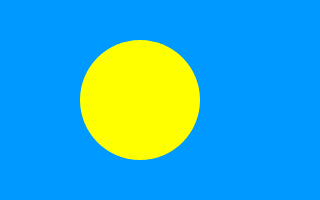
Palau
Republic of Palau
Population: UN WPP 2024, revision 1, projection for 1 July 2026. Sources and methodology.
Geography and territory
Palau is a scattered archipelago of roughly 340 islands in the western Pacific Ocean, lying east of the Philippines and north of Indonesia. Despite a land area of just 459 square kilometers, the nation stretches across some 650 kilometers of ocean from north to south. Babeldaob, at 331 square kilometers, is by far the largest island and hosts the capital, Ngerulmud, one of the smallest and least populated national capitals anywhere in the world, purpose-built in 2006 to replace the former capital, Koror.
The country’s most spectacular feature is the Rock Islands, a UNESCO World Heritage site inscribed in 2012. More than 400 limestone islets, mushroom-shaped and blanketed in tropical greenery, rise out of a turquoise lagoon in a landscape sculpted by millions of years of erosion. These karst formations enclose isolated marine lakes, hidden caves, and ecosystems found nowhere else on Earth. Palau’s climate is tropical and humid year-round, tempered by ocean breezes, with a wetter season from roughly May through November and an ever-present risk of typhoons passing through the wider region.
Palau’s marine environment is extraordinary even by the standards of the Pacific. Its waters shelter more than 1,500 species of fish, roughly 700 species of coral, and 350 kinds of anemone, placing the country at the heart of the Coral Triangle, one of the planet’s richest reservoirs of marine biodiversity. Nutrient-rich currents sweeping past the islands sustain a food web that includes manta rays, sharks, sea turtles, and vast schools of pelagic fish. In 2015, Palau established the Palau National Marine Sanctuary, a fully protected zone covering about 80 percent of its exclusive economic zone.
History
Palau’s first settlers arrived roughly 3,000 years ago, most likely from the Philippines or Indonesia. These early communities carved elaborate agricultural terraces into the hillsides of Babeldaob, still visible today, and built a complex matrilineal society organized around ranked clans. Central to village life were the bai, communal meetinghouses whose beams and gables were carved and painted with narrative scenes, serving as centers of governance and social gathering.
Spain claimed Palau in the seventeenth century as part of the Caroline Islands, though its presence remained light until Catholic missionaries arrived in the nineteenth century. After Spain’s defeat in 1898, the islands were sold to Germany, which in turn lost control to Japan during the First World War. Japan developed the islands intensively, establishing plantations, phosphate mines, and infrastructure. The Battle of Peleliu in 1944 ranks among the bloodiest engagements of the Pacific War, producing more than 12,000 combined casualties in a little over two months of fighting.
Following the war, the United States administered Palau as part of the Trust Territory of the Pacific Islands. After decades of negotiation and several rounds of referenda, Palauans approved the Compact of Free Association that would govern relations with Washington, and independence formally arrived on October 1, 1994. The compact continues to provide economic assistance and defense guarantees while allowing Palau to conduct its own foreign policy as a fully sovereign state and member of the United Nations. Palau distinguished itself early as an environmental leader, becoming the first nation to establish a national shark sanctuary in 2009 and later creating one of the largest fully protected marine areas on the planet.
Culture and society
Palauan culture blends ancestral Micronesian traditions with layers of Spanish, German, Japanese, and American influence absorbed across centuries of colonial contact. Society remains organized along matrilineal lines, with land, titles, and inheritance passed through the maternal line. Senior women within each clan wield considerable authority over decisions concerning land distribution and the selection of chiefs.
The bai, traditional men’s meetinghouses, stand among the finest achievements of Palauan art and architecture. Their beams and gables are carved and painted with legends, historical events, and moral lessons rendered in vivid narrative detail. The Palauan storyboard, a wood-carved art form recounting traditional tales, has become one of the country’s most recognizable cultural symbols and a prized souvenir. Traditional dances, accompanied by chants that preserve oral history, are performed at ceremonies marking events such as a first childbirth or the dedication of a new bai.
Palau’s traditional currency system, made up of glass and ceramic beads of mysterious origin known as udoud, possibly brought by Asian traders centuries ago, remains culturally significant. These beads carry different values depending on type, size, and color, and continue to circulate in ceremonial exchanges tied to marriage and funerals. The relationship with the sea runs deep in Palauan identity, expressed through a sophisticated fishing tradition and the bul, a customary system of fishing moratoriums that stands among the oldest known forms of sustainable marine resource management. English and Palauan are both official languages nationwide, though several states also recognize Japanese, Sonsorolese, or Tobian, a reflection of the linguistic diversity packed into this small population.
Economy
Palau’s economy, with a gross domestic product of roughly $345 million, rests heavily on tourism and financial assistance from the United States. Tourism alone accounts for more than half of GDP, drawing visitors with world-class diving, the Rock Islands, and the archipelago’s pristine natural beauty. Japan, Taiwan, South Korea, and the United States supply the majority of visiting tourists.
The Compact of Free Association with the United States provides significant annual funding that underwrites much of the government budget and public services. Fishing, particularly for tuna, generates revenue through licenses sold to foreign fleets. Agriculture remains limited and largely subsistence-based, centered on taro, cassava, sweet potato, and coconut, with copra and handicrafts contributing modest commercial output.
Palau has deliberately pursued a high-value, low-volume model of tourism, capping visitor numbers to protect its fragile ecosystems. The Palau Pledge, an environmental commitment stamped into every visitor’s passport, was a pioneering initiative requiring tourists to promise responsible conduct toward the environment. The National Marine Sanctuary, safeguarding 80 percent of the country’s exclusive economic zone, reflects a long-term national strategy that treats conservation itself as an economic asset. Because the country imports the majority of its manufactured goods and fuel, the government also works to diversify revenue through international development partnerships and modest investment in renewable energy, aiming to reduce dependence on imported diesel for electricity generation.
Food and cuisine
Palauan cuisine pairs fresh tropical ingredients with traditional Micronesian cooking methods and clear Japanese and American influences. Fresh fish dominates the table: tuna, parrotfish, grouper, and Napoleon wrasse are grilled, served raw in sashimi style, simmered in coconut milk soups, or wrapped in taro leaves and cooked over hot coals. Mangrove crab and rock lobster are especially prized delicacies.
Taro is the most esteemed staple of Palauan cooking, painstakingly cultivated in irrigated patches. It is typically boiled, mashed with coconut milk, or added to soups. Breadfruit, yam, sweet potato, and cassava round out the starchy backbone of the diet. Japanese influence surfaces clearly in the popularity of sashimi, rice as a side dish, and refined techniques for preparing raw fish.
Fresh coconut juice is the most important social drink, appearing at nearly every gathering and celebration, while locally brewed Red Rooster beer is the leading commercial beverage. Ceremonial feasts typically feature roast pork alongside an assortment of fish, shellfish, taro, and tropical fruit, all served on banana leaves. Desserts often center on sweet tapioca preparations made with coconut milk and tropical fruits such as papaya, mango, pineapple, and passion fruit.
Tourism and landmarks
Palau enjoys a worldwide reputation as one of the finest diving destinations on Earth. Blue Corner, a legendary dive site where powerful currents draw in sharks, manta rays, sea turtles, and immense schools of fish, is routinely ranked among the ten best dive spots in the world. German Channel offers reliable encounters with giant manta rays visiting cleaning stations, while Japanese shipwrecks from the Second World War, resting in the lagoon near Koror, provide fascinating historical dives.
Jellyfish Lake on the island of Eil Malk offers a genuinely one-of-a-kind experience. This isolated marine lake teems with millions of golden jellyfish that, after thousands of years without predators, have lost their ability to sting, allowing visitors to swim among them in a surreal encounter. The Rock Islands themselves, jungle-topped limestone formations rising from emerald water, are best explored by kayak or small boat, revealing hidden beaches, sea caves, and secluded lakes along the way.
On land, the Badrulchau monoliths in northern Babeldaob form a mysterious arrangement of 52 basalt stones of unknown origin, sometimes compared to European megaliths. Ancient terraces carved into the hills of Babeldaob attest to a sophisticated tradition of agricultural engineering. The Belau National Museum in Koror offers an excellent introduction to the country’s history and customs, while the Peleliu battlefields, with their bunkers, abandoned tanks, and fortified caves, stand as a sobering memorial to the Second World War. The Ngardmau Waterfall, reached by a boardwalk through rainforest on Babeldaob, and the KB Bridge connecting Koror to Babeldaob round out a compact but remarkably varied roster of natural and cultural sights.
Fun facts about Palau
- Palau became the first country in the world to establish a national shark sanctuary in 2009, banning all shark fishing across roughly 600,000 square kilometers of territorial waters.
- Jellyfish Lake is home to millions of golden jellyfish that evolved without a functional sting after thousands of years of isolation from predators.
- The Palau Pledge is the first environmental conservation pledge ever stamped into a national passport, requiring every visitor to commit to protecting the environment upon entry.
- The Palauan language includes roughly 17 distinct dialects among a population of under 18,000 people, a legacy of the historical isolation between island communities.
- Traditional glass beads used as ceremonial currency in Palau have mysterious origins, with some pieces dated to centuries old and their true source still undetermined.
Palau in numbers
Latest World Bank and UNDP observations, each with its own year. “World median” is the middle value among the countries that report the same indicator; “#” ranks from the highest value.
Population since 1960
Palau had 9,328 people in 1960 and 17,663 in 2025 — 89% more.
The population peaked at 19,820 in 2004 and has since declined.
People
79.3% of people live in towns and cities (world median 63.4%). 17.9% are under 15 and 11.8% are 65 or older — a middle-aged population. Women have 1.88 children on average, below the replacement level of about 2.1 needed to keep a population stable in the long run without migration.
Economy
The economy grew by 6.3% in real terms in 2025. Consumer prices fell by 0.4% in 2025. Services make up the largest share of output (73.1% of GDP); agriculture contributes 2.7%.
Development and environment
UNDP rates human development in Palau as high, with an index of 0.786 in 2023 (rank 84 of 193). 83.9% of people use the internet and 100.0% have access to electricity. Forest covers 90.8% of the land (world median 32.8%).
Sources: World Bank, World Development Indicators (CC BY 4.0), most recent observation from 2015 onward; UNDP Human Development Report 2025. Retrieved 2026-10-10. Sector shares need not add up to 100% because taxes and subsidies on products are excluded. Missing values are left blank rather than estimated. Sources and methodology.
Climate of Palau
Averaged across Palau, the mean temperature stays between 27.5 °C (January) and 28.2 °C (May) — a swing of only 0.7 °C, so seasons are marked by rainfall rather than by heat.
About 3,411 mm of precipitation falls in a typical year. July is the wettest month (362 mm) and March the driest (187 mm). Rain is spread fairly evenly through the year.
Show monthly values as a table
| Month | Mean °C | Low °C | High °C | Precipitation, mm |
|---|---|---|---|---|
| January | 27.5 | 24.4 | 30.8 | 274 |
| February | 27.6 | 24.4 | 30.9 | 207 |
| March | 27.7 | 24.4 | 31.1 | 187 |
| April | 28.1 | 24.8 | 31.5 | 220 |
| May | 28.2 | 24.9 | 31.5 | 318 |
| June | 27.8 | 24.6 | 31.1 | 347 |
| July | 27.6 | 24.5 | 30.8 | 362 |
| August | 27.7 | 24.7 | 30.7 | 322 |
| September | 27.7 | 24.7 | 30.7 | 329 |
| October | 28.0 | 24.8 | 31.1 | 281 |
| November | 28.0 | 24.7 | 31.3 | 265 |
| December | 27.9 | 24.7 | 31.1 | 299 |
Figures are 1991–2020 averages across the whole land area of Palau, from the World Bank Climate Change Knowledge Portal, CRU TS 4.08 (CC BY 4.0). They are not readings from one weather station: the capital, the coast and high ground can be much warmer, cooler, wetter or drier.
Travel essentials for Palau
The practical details visitors ask about first. Traffic in Palau drives on the right, like most of the world. Mains electricity is 120 V at 60 Hz, so appliances built only for 220–240 V need a voltage converter.
- Emergency number
- 911
- Driving side
- Right
- Plug types
- Type A, Type BA: two flat parallel pins; B: two flat pins plus a round earth pin
- Voltage
- 120 V60 Hz
- Dialling code
- +680From abroad: your exit code, then 680 and the number
- Currency
- United States Dollar (USD)
- Time zone
- PWT (UTC+9)Current local time in Palau
Compiled from IEC plug and voltage standards, national emergency-service listings and the UN road-traffic conventions. Emergency numbers and local coverage can change — confirm them locally on arrival. Palau's internet domain is .pw.
Where Palau ranks in the world
Each position counts only the countries with data in that ranking guide. First place is the highest value — for price levels, the most expensive. Select a card to see the full table.
- Population193rd of 19617,614UN projection, July 2026
- Land area181st of 195460 km²World Bank, 2023
- Population density144th of 19439 per km²World Bank, 2023
- GDP (nominal)184th of 187$322MWorld Bank, 2024, current US$
- GDP per capita59th of 187$18,169World Bank, 2024, current US$
- Life expectancy134th of 19469.4 yearsWorld Bank, 2024
Compare Palau with another country
Frequently asked questions about Palau
What is the capital of Palau?
The capital of Palau is Ngerulmud.
What is the population of Palau?
The UN World Population Prospects projection for Palau is 17,614 people (17,614) on 1 July 2026. National statistical offices may publish different estimates.
What language is spoken in Palau?
The official language of Palau is Palauan, English.
What currency is used in Palau?
The currency of Palau is the United States Dollar (USD).
How big is Palau?
Palau covers an area of 459 km².
What type of government does Palau have?
Palau is a presidential republic.
What is the highest point in Palau?
The highest point in Palau is Mount Ngerchelchuus (242 m).


