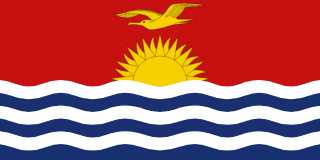
Kiribati
Republic of Kiribati
Population: UN WPP 2024, revision 1, projection for 1 July 2026. Sources and methodology.
Geography and territory
Kiribati is a singular island nation made up of 33 coral atolls and one raised island scattered across a vast stretch of the central Pacific Ocean. Although its total land area is barely 811 square kilometers, its exclusive economic zone covers more than 3.5 million square kilometers of ocean, one of the largest in the world. The islands are grouped into three main archipelagos: the Gilbert Islands, the Phoenix Islands, and the Line Islands.
Kiribati’s most extraordinary geographic trait is that it is the only country on Earth spanning all four hemispheres, straddling both the equator and the 180th meridian. Kiritimati Island, formerly known as Christmas Island, is the largest coral atoll in the world by land area, covering 388 square kilometers, and was the first place on the planet to welcome the new millennium on January 1, 2000.
Kiribati’s atolls rise just a few meters above sea level, with a maximum elevation of only 81 meters on Banaba, the country’s sole raised island. This extreme low elevation makes Kiribati one of the most vulnerable nations in the world to climate change and rising seas. Scientific projections suggest much of the territory could be submerged within decades, posing an existential dilemma for the nation and its people.
History
Human history on the islands that make up Kiribati stretches back roughly 3,000 years, when Micronesian and Polynesian voyagers settled the atolls. Islanders developed a sophisticated maritime culture, with astronomical and navigational knowledge that allowed them to cross vast ocean distances. Traditional society was organized around unimane, or councils of elders, who governed each island.
The first European contact occurred in the late 16th century with Spanish explorers, but it was not until the 19th century that whalers, traders, and missionaries began arriving regularly. The British Phosphate Company began mining the rich phosphate deposits of Banaba Island in 1900, an operation that radically transformed the island but also led to the forced deportation of its population. Britain established the Gilbert and Ellice Islands as a colony in 1916.
During the Second World War, Japanese forces occupied the Gilbert Islands, and the Battle of Tarawa in November 1943 was one of the bloodiest amphibious assaults of the Pacific war, claiming more than 6,000 casualties in just three days. After the Ellice Islands separated to become Tuvalu in 1978, Kiribati achieved independence on July 12, 1979. In recent decades, the government has led international campaigns on climate change, even purchasing land in Fiji as a possible future refuge for its population.
Culture and society
The culture of Kiribati, known as te katei ni Kiribati, is an ocean-shaped culture reflecting centuries of adaptation to life on coral atolls. The I-Kiribati, as the people are known, maintain a strong cultural identity built on community, respect for elders, and connection to the sea. Communal land ownership and networks of family obligation are foundational pillars of social life.
The traditional dances of Kiribati are celebrated across Oceania for their energy, precision, and beauty. Te buki, a seated dance performed by women with rapid, precise arm movements, and te bino, a standing dance with vigorous motion, are performed to choral singing and percussion. Dancers wear elaborate costumes of pandanus fiber, shells, and feathers. Narrative songs carry ancestral stories, genealogies, and navigational knowledge.
I-Kiribati craftsmanship includes the making of combat armor from coconut fiber and pufferfish skin, unique in Oceania, as well as the weaving of pandanus mats, hats, and fans. Traditional canoes, with their distinctive triangular sails, are still built and used for fishing and inter-island races. The maneaba, a high-roofed, open-sided communal meeting house, is the center of village social life, hosting gatherings, festivities, and ceremonies.
Economy
The economy of Kiribati is one of the smallest in the world, with a GDP of roughly $349 million. Fishing is the country’s most valuable economic resource, with the sale of tuna fishing licenses to foreign fleets operating within its vast exclusive economic zone generating a significant share of government revenue. The Revenue Equalization Reserve Fund, created from the proceeds of Banaba’s phosphate mining, provides a financial safety net.
Subsistence agriculture on the atolls is limited by poor coral soils. Coconut, breadfruit, pandanus, and banana are the main crops, while artisanal fishing supplies the primary source of protein. Copra, dried coconut used to produce oil, is the only significant agricultural export. Seaweed farming in lagoon waters is an emerging sector.
Kiribati relies heavily on foreign aid, particularly from Australia, New Zealand, Japan, and Taiwan. Remittances from I-Kiribati seafarers employed on international merchant ships are another vital income source. The government has explored innovative options to diversify the economy, including establishing one of the world’s largest marine protected areas in the Phoenix Islands and developing sport-fishing tourism on Christmas Island.
Food and cuisine
Kiribati’s cuisine is simple and deeply tied to the ocean and the limited resources of the coral atolls. Fresh fish is the staple food, prepared in various ways: grilled over coconut-husk coals, boiled in coconut milk, sun-dried, or eaten raw marinated in lime juice. Tuna, swordfish, mahi-mahi, and a variety of reef fish form the backbone of the I-Kiribati protein diet.
Coconut products are everywhere in Kiribati cooking. Coconut milk serves as the base for cooking fish and vegetables, coconut water is the most refreshing drink available, coconut meat is eaten fresh or dried, and toddy, fermented sap from the coconut palm, is a traditional drink that can be sweet or alcoholic depending on how long it ferments. Pandanus, whose fruit is processed into a sweet paste that keeps for months, is another essential food.
Breadfruit is prepared boiled, roasted, or mashed, providing an important source of carbohydrates. Pork and chicken are reserved for special occasions and community celebrations. Ceremonial cooking uses the um, an earth oven similar to those found across the Pacific islands. The agricultural limitations of the atolls have forced I-Kiribati to import growing quantities of rice, flour, and canned goods, gradually reshaping traditional eating habits.
Tourism and landmarks
Kiribati offers a remote, authentic travel experience for those seeking destinations well off the beaten path. Christmas Island (Kiritimati), the world’s largest atoll, is a legendary destination for fly-fishing, drawing anglers from around the globe hoping to land the prized bonefish in its expansive, crystal-clear lagoons. The island’s seabird colonies, numbering in the millions, offer an impressive natural spectacle.
Tarawa Atoll, the country’s capital, preserves significant remnants of the 1943 battle, including Japanese bunkers, artillery positions, and memorials. The Tarawa Peace Memorial honors the thousands of soldiers who perished in one of the fiercest engagements of the Pacific war. Sunken wrecks of military vehicles and vessels offer fascinating historical diving opportunities.
The lagoons of Kiribati’s atolls offer turquoise waters of extraordinary clarity, ideal for snorkeling and kayaking. Marine life abounds in the coral reefs surrounding the islands, with turtles, manta rays, reef sharks, and a wide diversity of tropical fish. The cultural experience of visiting traditional villages, taking part in maneaba ceremonies, and watching I-Kiribati dance is every bit as memorable as the natural surroundings.
Fun facts about Kiribati
- Kiribati is the only country in the world that spans all four hemispheres, crossing both the equator and the 180th meridian.
- Christmas Island (Kiritimati) was the first place on Earth to greet the year 2000, drawing worldwide media attention during the millennium celebrations.
- The name Kiribati is pronounced “Kiribas,” since the “ti” in Gilbertese is pronounced as “s” — the word is a phonetic adaptation of “Gilberts.”
- Facing the threat of climate change, the government of Kiribati purchased 20 square kilometers of land in Fiji as a possible future refuge for its population.
- Kiribati’s traditional combat armor, woven from coconut fiber and covered in pufferfish skin, is unique in the world and displayed in museums across several continents.
Kiribati in numbers
Latest World Bank and UNDP observations, each with its own year. “World median” is the middle value among the countries that report the same indicator; “#” ranks from the highest value.
Population since 1960
Kiribati had 47,157 people in 1960 and 136,488 in 2025 — 2.9 times as many.
People
63.4% of people live in towns and cities (world median 63.4%). 34.4% are under 15 and 4.4% are 65 or older — a young population. Women have 3.12 children on average, above the replacement level of about 2.1.
Economy
The economy grew by 4.2% in real terms in 2025. Consumer prices rose by 6.5% in 2025. Services make up the largest share of output (70.3% of GDP); agriculture contributes 23.2%, a large share that points to a farming-based economy.
Development and environment
UNDP rates human development in Kiribati as medium, with an index of 0.644 in 2023 (rank 140 of 193). 89.4% of people use the internet and 97.7% have access to electricity. Forest covers 1.3% of the land (world median 32.8%).
Sources: World Bank, World Development Indicators (CC BY 4.0), most recent observation from 2015 onward; UNDP Human Development Report 2025. Retrieved 2026-10-10. Sector shares need not add up to 100% because taxes and subsidies on products are excluded. Missing values are left blank rather than estimated. Sources and methodology.
Climate of Kiribati
Averaged across Kiribati, the mean temperature stays between 27.6 °C (July) and 28.0 °C (April) — a swing of only 0.4 °C, so seasons are marked by rainfall rather than by heat.
About 1,421 mm of precipitation falls in a typical year. April is the wettest month (175 mm) and October the driest (74 mm).
Show monthly values as a table
| Month | Mean °C | Low °C | High °C | Precipitation, mm |
|---|---|---|---|---|
| January | 27.7 | 24.9 | 30.6 | 161 |
| February | 27.8 | 25.0 | 30.6 | 121 |
| March | 27.9 | 25.0 | 30.9 | 150 |
| April | 28.0 | 24.9 | 31.0 | 175 |
| May | 28.0 | 24.9 | 31.1 | 128 |
| June | 27.8 | 24.6 | 30.9 | 128 |
| July | 27.6 | 24.3 | 30.9 | 120 |
| August | 27.6 | 24.2 | 31.0 | 93 |
| September | 27.6 | 24.2 | 31.0 | 81 |
| October | 27.6 | 24.2 | 31.1 | 74 |
| November | 27.8 | 24.5 | 31.2 | 79 |
| December | 27.8 | 24.8 | 30.8 | 113 |
Figures are 1991–2020 averages across the whole land area of Kiribati, from the World Bank Climate Change Knowledge Portal, CRU TS 4.08 (CC BY 4.0). They are not readings from one weather station: the capital, the coast and high ground can be much warmer, cooler, wetter or drier.
Travel essentials for Kiribati
The practical details visitors ask about first. Traffic in Kiribati drives on the left, one of 54 of the 196 countries profiled here that do — see the full list. Mains electricity is 240 V at 50 Hz, so devices made only for 110–120 V (common in North America) need a converter unless they are dual-voltage — most phone and laptop chargers are.
- Emergency number
- 992Ambulance 994 · Fire 993
- Driving side
- Left
- Plug types
- Type II: two angled flat pins plus earth
- Voltage
- 240 V50 Hz
- Dialling code
- +686From abroad: your exit code, then 686 and the number
- Currency
- Australian Dollar (AUD)
- Time zone
- UTC+12 to UTC+14Current local time in Kiribati
Compiled from IEC plug and voltage standards, national emergency-service listings and the UN road-traffic conventions. Emergency numbers and local coverage can change — confirm them locally on arrival. Kiribati's internet domain is .ki.
Where Kiribati ranks in the world
Each position counts only the countries with data in that ranking guide. First place is the highest value — for price levels, the most expensive. Select a card to see the full table.
- Population179th of 196138,445UN projection, July 2026
- Land area172nd of 195810 km²World Bank, 2023
- Population density56th of 194164 per km²World Bank, 2023
- GDP (nominal)183rd of 187$343MWorld Bank, 2024, current US$
- GDP per capita143rd of 187$2,551World Bank, 2024, current US$
- Life expectancy157th of 19466.6 yearsWorld Bank, 2024
Compare Kiribati with another country
Frequently asked questions about Kiribati
What is the capital of Kiribati?
The capital of Kiribati is Tarawa.
What is the population of Kiribati?
The UN World Population Prospects projection for Kiribati is 138,445 people (138,445) on 1 July 2026. National statistical offices may publish different estimates.
What language is spoken in Kiribati?
The official language of Kiribati is Gilbertese, English.
What currency is used in Kiribati?
The currency of Kiribati is the Australian Dollar (AUD).
How big is Kiribati?
Kiribati covers an area of 811 km².
What type of government does Kiribati have?
Kiribati is a presidential republic.
What is the highest point in Kiribati?
The highest point in Kiribati is Unnamed point on Banaba (81 m).


