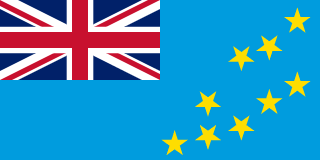
Tuvalu
Tuvalu
Population: UN WPP 2024, revision 1, projection for 1 July 2026. Sources and methodology.
Geography and territory
Tuvalu is a scattering of four coral islands and five atolls in the central Pacific Ocean, roughly midway between Australia and Hawaii. With a total land area of just 26 square kilometers, it ranks as one of the smallest countries on Earth by territory and, with a population of only 9,492, among the smallest by population of any United Nations member state. The nine islands that make up the country are spread across some 676 kilometers of open ocean, leaving no land borders to speak of.
The name Tuvalu translates to “eight standing together,” a reference to the eight islands traditionally inhabited before the ninth, Niulakita, was settled in 1949. Funafuti, the atoll that serves as capital, is home to roughly half the national population, packed onto a strip of land that in places narrows to barely 20 meters wide. The nation’s highest point, an unnamed spot on Niulakita, reaches only about 4.6 meters above sea level, making Tuvalu the second-lowest country in the world after the Maldives.
That extreme low elevation places Tuvalu among the countries most acutely threatened by climate change and sea-level rise. High tides already bring recurring flooding, saltwater intrusion is contaminating freshwater supplies and food crops, and tropical cyclones pose an existential danger to a nation with almost nowhere to retreat. Scientists have repeatedly warned that Tuvalu could become one of the first countries to be rendered uninhabitable by rising seas, a prospect that has forced unprecedented international conversations about statehood, citizenship, and climate displacement. The government has responded by pursuing land reclamation projects on Funafuti and by digitally documenting the nation’s territory, culture, and government functions so that Tuvalu’s identity could, in theory, persist even if its physical land eventually disappears.
History
Polynesian voyagers, likely arriving from Samoa and Tonga, settled the islands of Tuvalu around 2,000 years ago. They developed a sophisticated maritime culture built on celestial navigation, canoe construction, and fishing techniques finely tuned to life on coral atolls. Each island retained its own distinct identity and social order, governed by traditional chiefs known as aliki who presided over closely knit communities.
Spanish explorer Alvaro de Mendana sighted the islands in 1568, though sustained European contact did not begin until the nineteenth century, when whalers, traders, and missionaries arrived in greater numbers. The practice of “blackbirding,” the forced recruitment of laborers for plantations in Fiji, Samoa, and Queensland, inflicted severe harm on several island populations during this period. Britain declared a protectorate in 1892 and administered Tuvalu jointly with the Gilbert Islands as a single colony.
In 1974, Tuvaluans voted in a referendum to separate from the Gilbert Islands, whose Micronesian culture differed sharply from Tuvalu’s Polynesian heritage. Independence followed on October 1, 1978, with Tuvalu emerging as a constitutional monarchy under the British Crown. In the decades since, the country has become an unlikely global symbol in the fight against climate change, with its leaders delivering impassioned speeches at international forums, sometimes speaking from atolls that are visibly sinking beneath the waves.
Culture and society
Tuvaluan culture is deeply Polynesian, organized around community, extended family, and an enduring relationship with the sea. Traditional governance centers on the fale kaupule, a council of elders on each island responsible for local administration and dispute resolution. The concept of kaitasi, an ethic of communal labor and shared resources, remains central to social life on islands where survival has long depended on cooperation.
Music and dance form the most vibrant thread of Tuvaluan cultural expression. The fatele, a collective performance blending percussion, harmonized voices, and synchronized movement, stands as the country’s signature art form. Fatele are composed for celebrations, visiting dignitaries, and inter-island competitions, with lyrics ranging from history and mythology to current events and pointed satire; each island maintains its own distinctive style of performance.
Traditional craftsmanship includes the weaving of pandanus mats, fans, hats, and bags, along with the carving of fishhooks from mother-of-pearl. The Congregational church, introduced by missionaries in the nineteenth century, remains central to social life, with Sundays reserved for worship and rest. Tuvaluan society is notably egalitarian and peaceful, with one of the lowest crime rates anywhere in the world; the country maintains no military, and its police force numbers fewer than 50 officers nationwide. Tuvaluan and English serve as the country’s official languages, with Tuvaluan, a Polynesian tongue closely related to Samoan, spoken in daily life across the islands while English is used in government, education, and international affairs.
Economy
Tuvalu has one of the smallest economies on Earth, with an annual GDP of roughly $60 million, yet the country has found remarkably creative ways to offset its scarcity of natural resources. The best known is the licensing of its internet domain, .tv, which generates several million dollars a year from television networks and digital media companies worldwide eager to use the suffix.
Sales of tuna fishing licenses within Tuvalu’s exclusive economic zone, which spans roughly 900,000 square kilometers of ocean, provide another significant source of revenue. International aid from Australia, New Zealand, Japan, the European Union, and Taiwan covers a substantial share of the government budget, while remittances from Tuvaluans working as merchant seamen or living abroad, particularly in New Zealand, help sustain many households.
Subsistence activity remains essential for most residents. Artisanal fishing supplies the bulk of dietary protein, while coconut, pit-grown taro, pandanus, and banana form the core staple crops. Copra stands as the only agricultural export of any real significance. The government has also pursued unconventional revenue streams, from issuing collectible postage stamps to leasing its international telephone code for pay-per-use services, underscoring the resourcefulness required to sustain such a small and geographically constrained economy. Tuvalu uses the Australian dollar as its currency, a practical arrangement given the country’s close economic and diplomatic ties to Australia and the impracticality of maintaining an independent monetary system at such a small scale.
Food and cuisine
Tuvaluan cuisine is shaped by an atoll environment where land resources are scarce and the ocean provides abundantly. Fresh fish sits at the center of the diet, prepared over coconut-husk charcoal, simmered in coconut milk, marinated raw in citrus juice, or smoked and sun-dried for preservation. Pulaka, a variety of taro grown in pits dug down to the freshwater lens beneath the atoll, is the most prestigious crop and the food most closely tied to ceremonial occasions.
Coconut appears in nearly every dish. Its milk flavors savory and sweet preparations alike, fresh meat is eaten as a snack, grated flesh garnishes fish dishes, and toddy tapped from the palm’s flower stalks is drunk fresh as a sweet beverage or fermented into an alcoholic drink. Pandanus fruit, processed into a dense, nutrient-rich paste, and breadfruit round out the islands’ carbohydrate staples.
Communal feasts, held for religious holidays, weddings, funerals, and important visits, carry deep social significance, with food shared generously according to long-established customs of distribution. Pork, raised on the islands, is typically reserved for these special occasions. Imported staples such as rice, flour, sugar, canned meat, and instant noodles have increasingly entered the modern diet, a shift that mirrors health concerns seen across other small Pacific island nations.
Tourism and landmarks
Tuvalu ranks among the least-visited countries in the world, welcoming only around one to two thousand tourists annually, a scarcity that makes it an extraordinarily exclusive destination. Funafuti, the capital atoll, serves as the sole point of entry and the only location with visitor accommodations. Funafuti Lagoon, one of the largest in the Pacific at roughly 275 square kilometers, offers crystal-clear waters ideal for snorkeling, swimming, and sailing amid colorful coral and abundant marine life.
The Funafuti Conservation Area, established in 1996, protects six uninhabited islets and their surrounding waters at the atoll’s western edge. Visitors can arrange boat excursions to these pristine islets, where white sand beaches, seabird colonies, and intact reefs offer a glimpse of untouched nature. Green turtles nest on these shores, and the surrounding reefs shelter blacktip reef sharks, manta rays, and hundreds of tropical fish species.
The most distinctive part of any visit to Tuvalu is simply experiencing daily life in one of the smallest, most isolated communities on the planet. Funafuti’s airport runway, also the largest open recreational space on the island, doubles as a soccer field, playground, and social gathering spot whenever no flights are scheduled. Watching the sunset from the runway, surrounded by local families, has become an iconic image of the country. Fatele performances, colonial-era churches, and small local markets complete an intimate, unrepeatable cultural experience.
Fun facts about Tuvalu
- Tuvalu’s .tv internet domain is leased to television and streaming companies worldwide, generating millions of dollars a year and becoming one of the country’s largest income sources.
- With a highest point of just 4.6 meters above sea level, Tuvalu is the second-lowest country on Earth after the Maldives and faces genuine risk from rising seas.
- The runway at Funafuti’s airport doubles as the island’s main public park, soccer field, and social gathering space whenever no aircraft are scheduled to land.
- Tuvalu’s name means “eight standing together,” referring to its eight originally settled islands, even though a ninth, Niulakita, was added in 1949.
- The country has no standing military, and its entire national police force numbers fewer than 50 officers.
- Tuvalu welcomes only about one to two thousand visitors a year, making it one of the least-touristed nations on the planet.
Tuvalu in numbers
Latest World Bank and UNDP observations, each with its own year. “World median” is the middle value among the countries that report the same indicator; “#” ranks from the highest value.
Population since 1960
Tuvalu had 5,598 people in 1960 and 9,492 in 2025 — 70% more.
The population peaked at 11,001 in 2013 and has since declined.
People
65.4% of people live in towns and cities (world median 63.4%). 33.0% are under 15 and 7.0% are 65 or older — a young population. Women have 3.17 children on average, above the replacement level of about 2.1.
Economy
The economy grew by 1.6% in real terms in 2025.
Development and environment
UNDP rates human development in Tuvalu as medium, with an index of 0.689 in 2023 (rank 129 of 193). 35.2% of people use the internet and 100.0% have access to electricity. Forest covers 39.6% of the land (world median 32.8%).
Sources: World Bank, World Development Indicators (CC BY 4.0), most recent observation from 2015 onward; UNDP Human Development Report 2025. Retrieved 2026-10-10. Sector shares need not add up to 100% because taxes and subsidies on products are excluded. Missing values are left blank rather than estimated. Sources and methodology.
Climate of Tuvalu
Averaged across Tuvalu, the mean temperature stays between 28.4 °C (July) and 28.9 °C (May) — a swing of only 0.5 °C, so seasons are marked by rainfall rather than by heat.
About 2,820 mm of precipitation falls in a typical year. January is the wettest month (340 mm) and September the driest (183 mm).
Show monthly values as a table
| Month | Mean °C | Low °C | High °C | Precipitation, mm |
|---|---|---|---|---|
| January | 28.6 | 25.4 | 31.8 | 340 |
| February | 28.6 | 25.5 | 31.8 | 284 |
| March | 28.6 | 25.4 | 31.8 | 286 |
| April | 28.7 | 25.4 | 32.0 | 229 |
| May | 28.9 | 25.9 | 32.0 | 210 |
| June | 28.6 | 25.7 | 31.4 | 187 |
| July | 28.4 | 25.5 | 31.4 | 210 |
| August | 28.4 | 25.4 | 31.5 | 197 |
| September | 28.5 | 25.5 | 31.5 | 183 |
| October | 28.5 | 25.4 | 31.6 | 194 |
| November | 28.6 | 25.4 | 31.9 | 210 |
| December | 28.6 | 25.5 | 31.7 | 291 |
Figures are 1991–2020 averages across the whole land area of Tuvalu, from the World Bank Climate Change Knowledge Portal, CRU TS 4.08 (CC BY 4.0). They are not readings from one weather station: the capital, the coast and high ground can be much warmer, cooler, wetter or drier.
Travel essentials for Tuvalu
The practical details visitors ask about first. Traffic in Tuvalu drives on the left, one of 54 of the 196 countries profiled here that do — see the full list. Mains electricity is 220 V at 50 Hz, so devices made only for 110–120 V (common in North America) need a converter unless they are dual-voltage — most phone and laptop chargers are.
- Emergency number
- 911
- Driving side
- Left
- Plug types
- Type II: two angled flat pins plus earth
- Voltage
- 220 V50 Hz
- Dialling code
- +688From abroad: your exit code, then 688 and the number
- Currency
- Australian Dollar (AUD)
- Time zone
- TVT (UTC+12)Current local time in Tuvalu
Compiled from IEC plug and voltage standards, national emergency-service listings and the UN road-traffic conventions. Emergency numbers and local coverage can change — confirm them locally on arrival. Tuvalu's internet domain is .tv.
Where Tuvalu ranks in the world
Each position counts only the countries with data in that ranking guide. First place is the highest value — for price levels, the most expensive. Select a card to see the full table.
- Population195th of 1969,362UN projection, July 2026
- Land area192nd of 19530 km²World Bank, 2023
- Population density26th of 194327 per km²World Bank, 2023
- GDP (nominal)187th of 187$57MWorld Bank, 2024, current US$
- GDP per capita108th of 187$5,884World Bank, 2024, current US$
- Life expectancy152nd of 19467.3 yearsWorld Bank, 2024
Compare Tuvalu with another country
Frequently asked questions about Tuvalu
What is the capital of Tuvalu?
The capital of Tuvalu is Funafuti.
What is the population of Tuvalu?
The UN World Population Prospects projection for Tuvalu is 9,362 people (9,362) on 1 July 2026. National statistical offices may publish different estimates.
What language is spoken in Tuvalu?
The official language of Tuvalu is Tuvaluan, English.
What currency is used in Tuvalu?
The currency of Tuvalu is the Australian Dollar (AUD).
How big is Tuvalu?
Tuvalu covers an area of 26 km².
What type of government does Tuvalu have?
Tuvalu is a parliamentary constitutional monarchy.
What is the highest point in Tuvalu?
The highest point in Tuvalu is Unnamed point on Niulakita (4.6 m).

