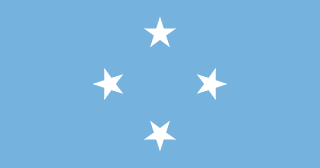
Micronesia
Federated States of Micronesia
Population: UN WPP 2024, revision 1, projection for 1 July 2026. Sources and methodology.
Geography and territory
The Federated States of Micronesia is a sovereign island nation in the western Pacific Ocean, not to be confused with the wider Micronesia region of which it forms only a part alongside neighbors such as Palau, Guam, and the Marshall Islands. The country itself is a federation of more than 600 islands and islets scattered across roughly 2,600 kilometers of open ocean, yet all of that dispersion adds up to a modest total land area of just 702 km². Four states, arranged from west to east, give the federation its structure: Yap, Chuuk, Pohnpei, and Kosrae, each built around a principal island or island cluster with its own distinct culture and history.
Geologically, the four states could hardly be more different from one another. Pohnpei and Kosrae are high volcanic islands, their interiors rising into jungle-cloaked peaks; Mount Nanlaud on Pohnpei, at 782 meters, is the highest point in the entire country. Chuuk is built around a cluster of volcanic islands enclosed within one of the largest atoll lagoons on Earth, a natural harbor so vast it once sheltered an entire imperial fleet. Yap is geologically unusual for the region, combining high islands of continental origin with low coral atolls, a mix rarely found elsewhere in Micronesia.
The climate across the federation is tropical and consistently warm, with heavy year-round rainfall that is especially intense on Pohnpei, which receives more than 7,600 millimeters of rain annually and ranks among the wettest places on the planet. The coral reefs ringing the islands sit within the Coral Triangle, the world’s richest zone of marine biodiversity, and Micronesian waters are home to more than 1,000 fish species, some 350 coral species, and abundant marine megafauna, from reef sharks to manta rays.
History
Human history in this part of the Pacific stretches back more than 4,000 years, to Austronesian voyagers who settled the islands and developed sophisticated societies alongside extraordinary skills in open-ocean navigation, reading stars, swells, and the flight patterns of seabirds to find their way across vast distances. The most striking legacy of this early period is Nan Madol, a ceremonial city built between the eighth and sixteenth centuries on 92 artificial islets of stacked basalt off the coast of Pohnpei, often described as the Venice of the Pacific.
European contact began in the sixteenth century with Spanish and Portuguese explorers, and Spain formally claimed the Caroline Islands in the following century, though its actual presence on the ground remained minimal. After Spain’s defeat in the Spanish-American War of 1898, the islands were sold to Germany in 1899. Japan seized control during the First World War and later fortified the islands extensively, turning Chuuk in particular into a major naval base. That buildup came to a violent end in 1944, when the Battle of Chuuk Lagoon destroyed the anchored Japanese fleet, leaving dozens of sunken warships that today form one of the most celebrated wreck-diving destinations on Earth.
Following the Second World War, the United States administered the islands as part of the United Nations Trust Territory of the Pacific Islands. Full independence arrived on November 3, 1986, under a Compact of Free Association with the United States, an arrangement that continues to shape the country’s economy and security today. In exchange for strategic access and defense responsibilities, the compact provides substantial financial assistance, and it has been renewed and refined over the decades as the cornerstone of the bilateral relationship.
Culture and society
Cultural life across the Federated States of Micronesia is remarkably varied, since each of the four states preserves its own language, customs, and social structures. What unites them are shared values: deep respect for elders, the centrality of the extended family, generous ceremonial exchange, and an abiding connection to the sea. Social organization ranges from the matrilineal systems found in Chuuk and Pohnpei to the distinctive caste-like hierarchy that structures village life in Yap.
Yap is famous well beyond Micronesia for its stone money, known as rai: enormous calcite discs with a hole through the center, some reaching four meters across and weighing several tons. Ordinary cash now handles everyday transactions, but rai remain essential for major ceremonial exchanges such as marriages, land transfers, and formal compensation. A stone’s value has less to do with its size than with its history, particularly the dangers its carriers faced transporting it by canoe from quarries in distant Palau.
Traditional navigation is one of the country’s most sophisticated cultural inheritances. Navigators from Yap’s outer islands and other atoll communities still carry ancestral knowledge that allows them to sail thousands of kilometers in traditional canoes without any instruments, relying solely on stars, wave patterns, currents, and the behavior of seabirds and marine life. On Pohnpei, an elaborate system of sakau (kava) titles and nahnmwarki chiefly ceremonies preserves a traditional social hierarchy that coexists comfortably alongside modern democratic institutions.
Economy
With a gross domestic product of about $502 million, the Micronesian economy leans heavily on financial assistance from the United States under the Compact of Free Association. These funds make up a substantial share of the national budget and underwrite infrastructure, education, health care, and public services. Reducing that dependence and building greater economic self-sufficiency remains one of the country’s central long-term challenges.
Fishing is the nation’s single most valuable natural resource. The country’s expansive exclusive economic zone hosts significant tuna stocks, and licensing fees paid by foreign fishing fleets, chiefly from Japan, South Korea, Taiwan, and other Asian nations, generate meaningful government revenue. Artisanal fishing remains vital to local food security, while subsistence agriculture supplies taro, yam, sweet potato, banana, coconut, and breadfruit for household consumption.
Tourism holds real growth potential, particularly wreck diving in Chuuk Lagoon, the archaeological wonder of Nan Madol on Pohnpei, and cultural experiences in Yap. Limited air connectivity, distance from major source markets, and modest tourism infrastructure, however, continue to constrain the sector’s expansion. Remittances sent home by Micronesians living in the United States, Guam, and Hawaii provide an important supplement to family incomes across the islands.
Food and cuisine
Micronesian cooking reflects millennia of dependence on both the ocean and tropical agriculture. Fresh fish sits at the center of nearly every meal and is prepared in strikingly different ways from island to island: grilled over coconut-husk coals, wrapped in banana leaf with coconut milk, marinated and eaten raw, or smoked for preservation. Tuna, parrotfish, grouper, and a range of reef species are the most commonly consumed catches.
Taro holds a place of particular prestige on Pohnpei, where farmers cultivate more than 100 local varieties in carefully tended plots. It is boiled, mashed, or fermented in pits to produce mar, a preserved food with a strong, distinctive flavor. Breadfruit, yam, and sweet potato round out the starch-heavy diet, while coconut appears in nearly every dish: its milk enriches stews, its meat is eaten fresh or grated, and its oil is used for cooking.
Sakau, Pohnpei’s version of kava, occupies a central place in social and ceremonial life. Prepared by pounding the roots of the Piper methysticum plant over hibiscus fibers, it produces an earthy, relaxing drink consumed at communal gatherings and chiefly ceremonies. In Yap, betel nut chewing serves a similarly social function. Major celebrations across the federation are marked by communal feasts in which whole pigs, chickens, and fish are cooked in earth ovens and shared according to long-established traditions of distribution.
Tourism and landmarks
Micronesia offers experiences that appeal strongly to adventurous travelers drawn to history, living culture, and the underwater world. Chuuk Lagoon, often called Truk Lagoon, is widely regarded as the finest wreck-diving site on the planet. More than 60 Japanese warships, aircraft, and submarines rest on its clear seafloor, encrusted with coral and teeming with marine life, forming an unmatched underwater museum of the Second World War.
Nan Madol, off the coast of Pohnpei, ranks among the most enigmatic archaeological sites in the Pacific. Built on artificial islets from columns of basalt weighing up to 50 tons apiece, this ancient ceremonial city was designated a UNESCO World Heritage Site. Its megalithic ruins of temples, royal tombs, and canals speak to a sophisticated civilization that flourished between the eighth and sixteenth centuries, and exactly how its builders moved and stacked such massive stones remains only partly understood.
Yap draws travelers fascinated by living traditional culture and its famous stone money. Village life there still centers on traditional men’s houses and community structures, and residents wear pandanus-fiber clothing on ceremonial occasions. The giant manta rays that gather in Yap’s Mi’l Channel are a major draw for divers worldwide. Kosrae, the easternmost state, offers pristine mangroves, ancient ruins at Lelu, and some of the least explored coral reefs anywhere in the Pacific.
Fun facts about Micronesia
- Yap’s stone money, with calcite discs up to four meters across, is one of the most unusual currencies ever devised, and a stone’s worth depends on its history and the risks taken to transport it rather than on its size
- Nan Madol, the “Venice of the Pacific,” was built on 92 artificial islets from an estimated 750,000 tons of basalt columns, and researchers still debate exactly how the ancient Pohnpeians achieved this engineering feat
- Chuuk Lagoon holds more than 60 Japanese warships sunk during the 1944 Operation Hailstone air raids, making it the largest accessible naval graveyard for divers anywhere in the world
- Micronesia’s “.fm” internet domain has become popular among radio stations and music-streaming companies worldwide because it echoes the abbreviation for “frequency modulation”
- Traditional navigators from Yap’s outer islands can still sail hundreds of kilometers across open ocean in sailing canoes without any instruments, guided only by the stars, swells, and currents
- Despite its enormous oceanic spread of some 2,600 kilometers, the country’s total land area is only 702 km², making it one of the smallest nations on Earth by land mass
Micronesia in numbers
Latest World Bank and UNDP observations, each with its own year. “World median” is the middle value among the countries that report the same indicator; “#” ranks from the highest value.
Population since 1960
Micronesia had 43,061 people in 1960 and 113,683 in 2025 — 2.6 times as many.
People
22.5% of people live in towns and cities (world median 63.4%). 31.5% are under 15 and 6.2% are 65 or older — a young population. Women have 2.74 children on average, above the replacement level of about 2.1.
Economy
The economy grew by 1.1% in real terms in 2025. Consumer prices rose by 5.4% in 2022. Services make up the largest share of output (65.3% of GDP); agriculture contributes 24.2%, a large share that points to a farming-based economy.
Development and environment
UNDP rates human development in Micronesia as medium, with an index of 0.615 in 2023 (rank 149 of 193). 39.5% of people use the internet and 88.9% have access to electricity. Forest covers 92.1% of the land (world median 32.8%).
Sources: World Bank, World Development Indicators (CC BY 4.0), most recent observation from 2015 onward; UNDP Human Development Report 2025. Retrieved 2026-10-10. Sector shares need not add up to 100% because taxes and subsidies on products are excluded. Missing values are left blank rather than estimated. Sources and methodology.
Climate of Micronesia
Averaged across Micronesia, the mean temperature stays between 27.1 °C (August) and 27.5 °C (April) — a swing of only 0.4 °C, so seasons are marked by rainfall rather than by heat.
About 3,930 mm of precipitation falls in a typical year. May is the wettest month (380 mm) and February the driest (225 mm). Rain is spread fairly evenly through the year.
Show monthly values as a table
| Month | Mean °C | Low °C | High °C | Precipitation, mm |
|---|---|---|---|---|
| January | 27.2 | 24.5 | 29.9 | 283 |
| February | 27.2 | 24.4 | 30.1 | 225 |
| March | 27.4 | 24.4 | 30.4 | 277 |
| April | 27.5 | 24.5 | 30.5 | 348 |
| May | 27.5 | 24.5 | 30.6 | 380 |
| June | 27.3 | 24.2 | 30.6 | 348 |
| July | 27.2 | 23.7 | 30.7 | 356 |
| August | 27.1 | 23.5 | 30.8 | 344 |
| September | 27.2 | 23.5 | 31.0 | 353 |
| October | 27.2 | 23.5 | 31.0 | 334 |
| November | 27.3 | 23.8 | 30.9 | 331 |
| December | 27.3 | 24.4 | 30.3 | 351 |
Figures are 1991–2020 averages across the whole land area of Micronesia, from the World Bank Climate Change Knowledge Portal, CRU TS 4.08 (CC BY 4.0). They are not readings from one weather station: the capital, the coast and high ground can be much warmer, cooler, wetter or drier.
Travel essentials for Micronesia
The practical details visitors ask about first. Traffic in Micronesia drives on the right, like most of the world. Mains electricity is 120 V at 60 Hz, so appliances built only for 220–240 V need a voltage converter.
- Emergency number
- 911
- Driving side
- Right
- Plug types
- Type A, Type BA: two flat parallel pins; B: two flat pins plus a round earth pin
- Voltage
- 120 V60 Hz
- Dialling code
- +691From abroad: your exit code, then 691 and the number
- Currency
- United States Dollar (USD)
- Time zone
- PONT (UTC+11)Current local time in Micronesia
Compiled from IEC plug and voltage standards, national emergency-service listings and the UN road-traffic conventions. Emergency numbers and local coverage can change — confirm them locally on arrival. Micronesia's internet domain is .fm.
Where Micronesia ranks in the world
Each position counts only the countries with data in that ranking guide. First place is the highest value — for price levels, the most expensive. Select a card to see the full table.
- Population182nd of 196114,183UN projection, July 2026
- Land area177th of 195700 km²World Bank, 2023
- Population density57th of 194161 per km²World Bank, 2023
- GDP (nominal)182nd of 187$481MWorld Bank, 2024, current US$
- GDP per capita122nd of 187$4,252World Bank, 2024, current US$
- Life expectancy151st of 19467.4 yearsWorld Bank, 2024
Compare Micronesia with another country
Frequently asked questions about Micronesia
What is the capital of Micronesia?
The capital of Micronesia is Palikir.
What is the population of Micronesia?
The UN World Population Prospects projection for Micronesia is 114,183 people (114,183) on 1 July 2026. National statistical offices may publish different estimates.
What language is spoken in Micronesia?
The official language of Micronesia is English, Chuukese, Pohnpeian, Kosraean, Yapese.
What currency is used in Micronesia?
The currency of Micronesia is the United States Dollar (USD).
How big is Micronesia?
Micronesia covers an area of 702 km².
What type of government does Micronesia have?
Micronesia is a federal presidential republic.
What is the highest point in Micronesia?
The highest point in Micronesia is Mount Nanlaud (782 m).


