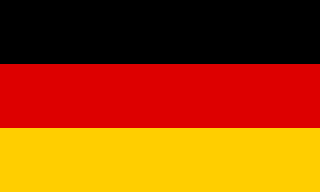
Germany
Federal Republic of Germany
Population: UN WPP 2024, revision 1, projection for 1 July 2026. Sources and methodology.
Geography and territory
Germany sits at the heart of Central Europe, covering 357,590 square kilometers that make it the seventh-largest country on the continent by area, with a population of about 83.6 million that makes it the most populous member state of the European Union. It borders Denmark and the North and Baltic Seas to the north, Poland and the Czech Republic to the east, Austria and Switzerland to the south, and France, Luxembourg, Belgium, and the Netherlands to the west, giving it more neighboring countries than almost any other nation in Europe. This central position has made Germany a historical crossroads between the cultures of northern and southern Europe.
The country’s terrain unfolds in three broad bands running north to south. The North European Plain covers the northern third of the country, a region of low-lying land and coastline along the North and Baltic Seas. A central belt of ancient uplands, rolling hills, and river basins follows, including the well-known Black Forest. To the south, the land rises into the foothills of the Alps and the Bavarian Alps themselves, where Germany’s highest point, the Zugspitze, tops out at 2,962 meters.
An extensive network of rivers has long underpinned Germany’s economic development. The Rhine, Elbe, Danube, and Weser serve as major arteries of trade and transport across the country, linking inland industrial centers to major seaports. Lake Constance, shared with Switzerland and Austria, is Germany’s largest lake. The climate is temperate oceanic in the north, shifting to a more continental pattern inland and to the south, with cold winters and mild-to-warm summers, and rainfall is spread fairly evenly across the year rather than concentrated in a single season.
History
German history is deeply interwoven with the broader history of Europe. Germanic peoples inhabited the region for centuries before the Holy Roman Empire consolidated in the 10th century, becoming the dominant political structure in Central Europe for more than eight hundred years. The Protestant Reformation, launched by Martin Luther in 1517 from Wittenberg, reshaped not only Germany but all of Western civilization.
Before that unification, the German-speaking lands had existed for centuries as a patchwork of kingdoms, duchies, and free cities loosely bound together, and Bismarck’s achievement in welding them into a single state under Prussian leadership reshaped the balance of power across Europe almost overnight. The new empire quickly grew into a major industrial and military power. The 20th century brought profound upheaval: World War I, the Weimar Republic, the rise of Nazism, and the devastation of World War II left tragic marks on both the country and the world at large. The Holocaust, carried out under the Nazi regime, remains one of the darkest chapters in human history.
Following defeat in 1945, Germany was split into two states — the Federal Republic of Germany in the west and the German Democratic Republic in the east — divided from 1961 onward by the Berlin Wall and the heavily fortified inner-German border. The Wall’s fall on November 9, 1989, symbolized the end of the Cold War and led to German reunification on October 3, 1990, though integrating the formerly communist east economically and socially remained a challenge for years afterward. Since then, Germany has established itself as Europe’s leading economic power and a cornerstone of the European Union, playing a central role in the bloc’s major political and monetary decisions.
Culture and society
Germany’s contributions to world culture are extraordinary. In music, figures such as Johann Sebastian Bach, Ludwig van Beethoven, Johannes Brahms, Richard Wagner, and Robert Schumann shaped centuries of classical tradition. In philosophy, thinkers including Immanuel Kant, Georg Wilhelm Friedrich Hegel, Friedrich Nietzsche, and Karl Marx left a lasting imprint on modern thought.
German literature counts giants such as Johann Wolfgang von Goethe, Friedrich Schiller, Thomas Mann, and Hermann Hesse among its ranks. In science, Albert Einstein, Max Planck, Werner Heisenberg, and Robert Koch transformed physics and medicine. Germany has produced more Nobel laureates than almost any other country. Its university system, anchored by institutions such as Heidelberg University and Berlin’s Humboldt University, carries considerable international prestige.
Modern German society is known for a high standard of living, a robust social welfare system, and a strong cultural emphasis on punctuality and efficiency. It is also a genuinely multicultural society shaped by substantial immigration, particularly from Turkey, the Balkans, and, more recently, Syria and Ukraine, adding new layers to an already diverse cultural landscape. Traditional festivals such as Munich’s Oktoberfest, the country’s Christmas markets, and Cologne’s Carnival draw millions of visitors each year, and soccer stands as the clear national passion, with the Bundesliga among the most closely followed leagues in the world and the national team among the most successful in World Cup history.
Economy
Germany is Europe’s largest economy and the world’s fourth-largest by nominal GDP, built around an economic model known as the social market economy, which pairs free enterprise with strong social protections. Industry remains the backbone of the system, and Germany ranks as one of the world’s top exporters of manufactured goods.
The automotive industry is emblematic of German industrial strength. Brands such as Volkswagen, BMW, Mercedes-Benz, Audi, and Porsche are synonymous with precision engineering and quality. Beyond automobiles, Germany excels in mechanical engineering and the chemical and pharmaceutical industries, with companies like BASF, Bayer, and Siemens leading their respective fields globally.
The Mittelstand — the vast network of highly specialized, often family-owned small and medium-sized businesses — forms the true backbone of the German economy. Many of these firms are world leaders in narrow market niches, sometimes called “hidden champions,” and together they account for the bulk of the country’s employment and exports. Germany has also positioned itself as a pioneer of the energy transition, known as the Energiewende, investing heavily in wind and solar power while progressively phasing out nuclear power and coal in favor of cleaner sources.
Food and cuisine
German cuisine is far richer and more varied than the stereotypes suggest, with each region maintaining its own culinary traditions shaped by local history and geography. Bavarian cooking offers dishes like Schweinshaxe (roasted pork knuckle), Knödel (dumplings), and Weisswurst (white sausage), while northern German cuisine leans toward fish and seafood, with the Fischbrötchen (fish sandwich) as its emblem.
German bread deserves special mention: with more than 3,000 registered varieties, the country’s baking culture has been recognized by UNESCO as intangible cultural heritage. Sausages, or Wurst, are another culinary hallmark, with hundreds of regional variations ranging from Thuringian bratwurst to Berlin’s beloved currywurst. Pretzels, artisanal mustard, and sauerkraut round out the traditional German table.
Germany is also a major beer nation. With more than 1,500 breweries and a brewing tradition still shaped by the 1516 Reinheitsgebot, or purity law, German beer culture is among the oldest and most respected in the world, and regional styles range from the dark, malty bocks of Bavaria to the tart, refreshing Berliner Weisse. The Rhine and Mosel wine regions produce excellent white wines, particularly Riesling, grown on steep terraced vineyards along the riverbanks. In recent decades, fine dining in Germany has flourished as well, with a growing number of restaurants earning Michelin stars.
Tourism and landmarks
Germany ranks among Europe’s most popular travel destinations, offering vibrant cities, fairy-tale castles, striking natural landscapes, and a deep cultural heritage that draws tens of millions of international visitors every year. Berlin, the capital, captivates visitors with its blend of history and modernity: remnants of the Wall, the Brandenburg Gate, the Museum Island — a UNESCO World Heritage Site — and a cutting-edge arts and nightlife scene make it a genuinely singular city.
Munich, the capital of Bavaria, offers the grandeur of Marienplatz and the Residenz palace, along with easy access to the Alps and Neuschwanstein Castle, likely the most photographed castle in the world and an inspiration for Disney’s Sleeping Beauty castle. The Romantic Road, winding through medieval towns like Rothenburg ob der Tauber and Füssen, remains one of Europe’s most celebrated travel routes.
Other essential stops include Hamburg, with its harbor and UNESCO-listed warehouse district; Cologne, home to its towering Gothic cathedral; Dresden, with its baroque palaces; and Heidelberg, with its romantic castle overlooking the Neckar River. The Black Forest, the castle- and vineyard-lined Rhine Valley, and the Baltic coastline all offer striking natural scenery, from dense pine forest and cuckoo-clock villages to chalk cliffs and quiet fishing harbors. In all, Germany is home to more than 40 UNESCO World Heritage Sites.
Fun facts about Germany
- Germany has more than 1,500 breweries producing over 1,500 types of beer, one of the highest concentrations found anywhere in the world.
- The Autobahn, Germany’s famed highway network, is known for stretches with no speed limit, though roughly a third of the system does carry posted restrictions.
- The Christmas tree, or Tannenbaum, originated as a German decorating tradition in the 16th century before spreading around the world.
- Heidelberg University, founded in 1386, is Germany’s oldest university and one of the oldest in Europe.
- Germany is home to more than 25,000 castles and palaces, more than any other country in Europe.
Germany in numbers
Latest World Bank and UNDP observations, each with its own year. “World median” is the middle value among the countries that report the same indicator; “#” ranks from the highest value.
Population since 1960
Germany had 72.8 million people in 1960 and 83.5 million in 2025 — 15% more.
People
82.1% of people live in towns and cities (world median 63.4%). 13.9% are under 15 and 23.7% are 65 or older — one of the oldest age structures in the world. Women have 1.36 children on average, below the replacement level of about 2.1 needed to keep a population stable in the long run without migration.
Economy
The economy grew by 0.2% in real terms in 2025. Consumer prices rose by 2.2% in 2025. Services make up the largest share of output (64.5% of GDP); agriculture contributes 0.9%.
Development and environment
UNDP rates human development in Germany as very high, with an index of 0.959 in 2023 (rank 5 of 193). 93.5% of people use the internet and 100.0% have access to electricity. Forest covers 32.8% of the land (world median 32.8%).
Sources: World Bank, World Development Indicators (CC BY 4.0), most recent observation from 2015 onward; UNDP Human Development Report 2025. Retrieved 2026-10-10. Sector shares need not add up to 100% because taxes and subsidies on products are excluded. Missing values are left blank rather than estimated. Sources and methodology.
Climate of Germany
Averaged across Germany, the warmest month is July (18.6 °C) and the coolest is January (0.9 °C), a seasonal swing of 17.7 °C. The annual mean is 9.5 °C.
About 727 mm of precipitation falls in a typical year. July is the wettest month (89 mm) and April the driest (42 mm).
Show monthly values as a table
| Month | Mean °C | Low °C | High °C | Precipitation, mm |
|---|---|---|---|---|
| January | 0.9 | −1.7 | 3.5 | 53 |
| February | 1.7 | −1.4 | 4.9 | 45 |
| March | 4.9 | 0.8 | 9.0 | 48 |
| April | 9.3 | 4.2 | 14.5 | 42 |
| May | 13.3 | 8.1 | 18.5 | 66 |
| June | 16.6 | 11.5 | 21.7 | 75 |
| July | 18.6 | 13.4 | 23.9 | 89 |
| August | 18.4 | 13.2 | 23.7 | 78 |
| September | 14.4 | 9.7 | 19.1 | 59 |
| October | 9.7 | 5.9 | 13.6 | 59 |
| November | 5.0 | 2.4 | 7.8 | 55 |
| December | 1.7 | −0.6 | 4.1 | 59 |
Figures are 1991–2020 averages across the whole land area of Germany, from the World Bank Climate Change Knowledge Portal, CRU TS 4.08 (CC BY 4.0). They are not readings from one weather station: the capital, the coast and high ground can be much warmer, cooler, wetter or drier.
Travel essentials for Germany
The practical details visitors ask about first. Traffic in Germany drives on the right, like most of the world. Mains electricity is 230 V at 50 Hz, so devices made only for 110–120 V (common in North America) need a converter unless they are dual-voltage — most phone and laptop chargers are.
- Emergency number
- 112Police 110
- Driving side
- Right
- Plug types
- Type C, Type FC: two round pins (Europlug); F: two round pins with side earth clips (Schuko)
- Voltage
- 230 V50 Hz
- Dialling code
- +49From abroad: your exit code, then 49 and the number
- Currency
- Euro (EUR)
- Time zone
- CET (UTC+1)Current local time in Germany
Compiled from IEC plug and voltage standards, national emergency-service listings and the UN road-traffic conventions. Emergency numbers and local coverage can change — confirm them locally on arrival. Germany's internet domain is .de.
Where Germany ranks in the world
Each position counts only the countries with data in that ranking guide. First place is the highest value — for price levels, the most expensive. Select a card to see the full table.
- Population19th of 19683.6 millionUN projection, July 2026
- Land area63rd of 195349,430 km²World Bank, 2023
- Population density43rd of 194238 per km²World Bank, 2023
- GDP (nominal)3rd of 187$4.69TWorld Bank, 2024, current US$
- GDP per capita17th of 187$56,104World Bank, 2024, current US$
- Life expectancy39th of 19480.8 yearsWorld Bank, 2024
- Price level20th of 16588 (US = 100)ICP 2021, household consumption
Bordering countries of Germany


Compare Germany with another country
Frequently asked questions about Germany
What is the capital of Germany?
The capital of Germany is Berlin.
What is the population of Germany?
The UN World Population Prospects projection for Germany is 83,644,258 people (83.6 million) on 1 July 2026. National statistical offices may publish different estimates.
What language is spoken in Germany?
The official language of Germany is German.
What currency is used in Germany?
The currency of Germany is the Euro (EUR).
How big is Germany?
Germany covers an area of 357,590 km².
What type of government does Germany have?
Germany is a federal parliamentary republic.
Which countries border Germany?
Germany shares land borders with Denmark, Poland, Czech Republic, Austria, Switzerland, France, Luxembourg, Belgium, Netherlands.
What is the highest point in Germany?
The highest point in Germany is Zugspitze (2,962 m).
